



EUDR Compliance for Palm Oil Supply Chains
Palm oil production has more than doubled since 2005, and now exceeds 78 million metric tons in 2024, making palm oil one of the most widely traded forest-risk commodities globally. This rapid expansion raises environmental red flags, as palm oil plantations claimed about 30,000 hectares of Indonesian forest in 2023 alone, contributing directly to tropical deforestation and biodiversity loss.
Companies must meet strict EUDR rules for palm oil products entering the European Union by December 30, 2025. These rules demand detailed requirements for deforestation-free supply chains and need exact location tracking back to where the palm oil grows. The stakes are high – businesses that don’t comply could face fines up to 4% of their EU earnings.
Making this work gets tricky when you look at the numbers. Small farmers produce around 41% of Indonesia’s palm oil, 27% of Malaysia’s, and roughly 35-40% of the world’s supply. The EUDR rules don’t stop at raw palm oil but cover many products in food, fuel, cosmetics, and industry applications.
Experts predict global palm oil production will grow four to six times by 2050. Setting up supply chains that follow these rules isn’t just about meeting regulations, it’s crucial for business survival. This piece breaks down what palm oil operators and traders should know to navigate EUDR requirements for palm oil supply chains.
Understanding the EUDR and Its Impact on Palm Oil
The European Union Deforestation Regulation (EUDR) marks a transformation from optional sustainability initiatives to mandatory legal requirements for products linked to deforestation and forest degradation. The EU introduced this regulation in 2023 to keep products connected to deforestation, including palm oil, out of the EU market.
Why Palm Oil Is a Focus Commodity
Palm oil is a key target under the EUDR because farmers keep clearing forests to grow more of it. It leads the world in vegetable oil production and consumption, playing a vital role in the global food sector.
The EU knows it’s responsible as a major consumer of palm oil and similar forest-risk products. The EU’s palm oil consumption has dropped in the last decade, but palm oil remains vital because of its many uses. You’ll find palm oil in food products, cosmetics, biofuels, and industrial products, which makes complete regulation vital to reduce global deforestation.
On top of that, palm oil farming disproportionately impacts biodiversity-rich areas hard, mainly in Indonesia and Malaysia. These two countries make up over 80% of global palm oil production. They also handle about 90% of worldwide palm oil exports, reaching 38 million metric tons in 2021/22.
Key Dates and Deforestation Cut-Off
The EUDR sets December 31, 2020, as the official deforestation cutoff date. Palm oil producers can’t legally sell palm oil in EU markets if it comes from land cleared after this date. This date creates a clear line for checking compliance.
Implementation timeline for EUDR compliance:
- Large and medium operators: December 30, 2026
- Micro and small operators: June 30, 2027
- Micro and small operators already under EU Timber Regulation: December 30, 2026
The EU first planned implementation for December 2024, the EUDR implementation timeline was later extended to December 2025, and ended up pushing it to December 2026. Companies now have more time to adjust their supply chains. All the same, environmental organizations criticize this delay, worried about ongoing deforestation during this transition period.
Operators vs. Traders: Who Must Comply
The EUDR splits businesses into two main groups based on their role in the palm oil supply chain:
- Operators bring palm oil products into the EU market first or export them. This group has importers who bring palm products to the EU and companies that turn one listed product into another from the regulation’s Annex I. So, any business that converts palm oil into products like glycerol must follow these rules when selling in the EU for the first time.
- Traders buy or sell palm oil products already in the EU market. Their EUDR duties change based on company size:
- Large traders must meet similar requirements as operators
- Small and medium traders have simpler rules to follow
Both groups must ensure their palm oil products are deforestation-free, legally produced, and traceable to their origin. Operators also need to submit detailed EUDR due diligence reports through the EU’s information system before selling products.
Palm oil faces unique challenges with traceability because of its complex supply chains that have many small farmers. The rules ask for exact coordinates of every plot where palm oil grows. This creates big hurdles for scattered supply networks.
Products and Derivatives Covered Under EUDR
The EUDR’s scope for palm oil goes way beyond crude oil to cover numerous palm oil derivatives and processed products. Unlike voluntary certification schemes, companies must comply with specific products defined through harmonized system (HS) codes—the international standard that classifies traded goods and determining EUDR applicability.
List of Affected HS Codes
The regulation clearly identifies palm oil products that need compliance through designated HS codes. These codes help determine if a product falls under EUDR obligations.
Key palm oil HS codes covered by the EUDR include:
- 1207 10: Palm nuts and kernels
- 1511: Palm oil and its fractions (refined or unrefined)
- 1513 21: Crude palm kernel and babassu oil
- 1513 29: Refined palm kernel and babassu oil
- 2306 60: Oilcake and residues from palm nuts or kernels
- 2905 45: Glycerol (95% purity or higher)
- 2915 70: Palmitic acid, stearic acid, their salts and esters
- 2915 90: Other saturated acyclic monocarboxylic acids
- 3823 11: Industrial stearic acid
- 3823 12: Industrial oleic acid
- 3823 19: Industrial monocarboxylic fatty acids
- 3823 70: Industrial fatty alcohols
Products containing palm oil derivatives require EUDR compliance only when listed in Annex I of the regulation. To name just one example, soaps or shampoos with palm oil derivatives usually stay outside EUDR obligations, depending on their HS classification.
Palm Oil Derivatives and Hidden Risks
Companies face unique EUDR compliance challenges with palm oil derivatives, even those with proven traceability systems. These processed ingredients move through complex supply chains that make origin verification difficult.
The biggest problem with palm oil derivatives comes from limited sourcing transparency information: traders usually get mill lists without knowing farm-level origins or fresh fruit bunch (FFB) sources. This lack of transparency creates major blind spots in compliance efforts.
Palm oil derivatives also frequently move through mass-balance systems where sustainable and conventional materials mix, making traceability harder. Companies must try different approaches when exact data isn’t available:
- Probabilistic sourcing models to estimate likely origins
- Risk assessments based on geographic regions
- More supplier involvement for better transparency
Companies that don’t deal very well with derivative sourcing face major EUDR compliance risks. Deforestation-linked materials could enter supposedly compliant supply chains without detection, threatening EU market access.
Implications for Food, Cosmetics, and Industrial Sectors
EUDR’s palm oil requirements affect different industries based on how they use palm oil and their existing traceability systems.
The food industry uses palm oil in many processed products, from chocolate and bakery products to snacks and ready meals. Major food brands face increasing consumer pressure about palm oil sustainability. Many brands now work to ensure EUDR compliant sourcing or remove palm oil completely.
The cosmetics sector makes products containing palm derivatives that may not need regulation based on their HS classification. Despite that, market pressure and consumer expectations push cosmetic companies toward enhanced palm oil traceability and responsible sourcing.
The industrial applications segment faces special challenges with derivatives like glycerol, fatty acids, and alcohol, all covered by EUDR. These ingredients often enter manufacturing processes with minimal origin information.
These sectors face both challenges and opportunities from the regulations. Companies need to invest heavily in traceability systems and supplier engagement. Early adopters gain competitive advantages as markets prefer deforestation-free products more.
Cosmetic companies toward enhanced palm oil traceability and responsible sourcing must really examine their palm oil supply chains. Hidden derivatives can undermine EUDR compliance efforts even when primary ingredients meet all requirements.
Challenges in Achieving EUDR Compliance
Palm oil companies must overcome several substantial challenges to meet EUDR compliance standards and keep their access to EU markets, despite their experience with sustainability requirements.
Fragmented Supply Chains
Supply chains in the palm oil industry involve complex networks of intermediaries before products reach processors or exporters, which makes complete traceability hard to achieve. Fresh Fruit Bunches (FFBs) movement through supply chains illustrates this complexity. In Indonesia, for example, mills rely on large traders working with multiple sub-agents. Most mills cannot track where their FFB suppliers get their fruit. Smallholders and agents conduct mostly informal transactions with simple receipts as the only documentation. The chain of custody needed for EUDR compliance breaks down when FFBs from different sources mix at collection centers.
Smallholder Mapping and Data Gaps
Much of global palm oil comes from smallholders – they manage 41% of planted palm oil areas in Indonesia, 27% in Malaysia, and produce about 35-40% of global palm oil output. Yet these smallholders struggle with compliance systems. Research shows that only 0.2% of smallholder participants sold directly to mills or through cooperatives. Only 12.8% kept records of their sales transactions. Independent smallholders find it hard to provide EUDR-mandated geolocation data because they lack digital tools, formal land titles, and polygon maps of their plots.
Limitations of Certification Schemes
Certifications like RSPO, ISPO, and MSPO are the foundations of sustainability, but they fall short of EUDR compliance obligations. NVWA’s recent EUDR dry run showed that certifications support due diligence but cannot replace operators’ legal duties. Sustainability schemes have their shortcomings, smallholders produce less than 10% of RSPO-Certified Sustainable palm oil, with independent smallholders making up under 2% of total RSPO-certified volume. Critics also point out that companies can keep their certification despite evidence of non-compliance, creating regulatory risk.
Cost and Availability of Segregated Material
Companies pursuing EUDR compliance face practical barriers due to limited segregated certified, deforestation-free palm oil supply. This oil costs substantially more than conventional or mass-balance certified options.
Businesses competing in price-sensitive markets struggle with this price premium. Industry experts say complete supply chain segregation is “technically possible but cost wise unaffordable”. Mass balance models that mix certified and non-certified materials could work under EUDR only if all components meet deforestation-free standards.
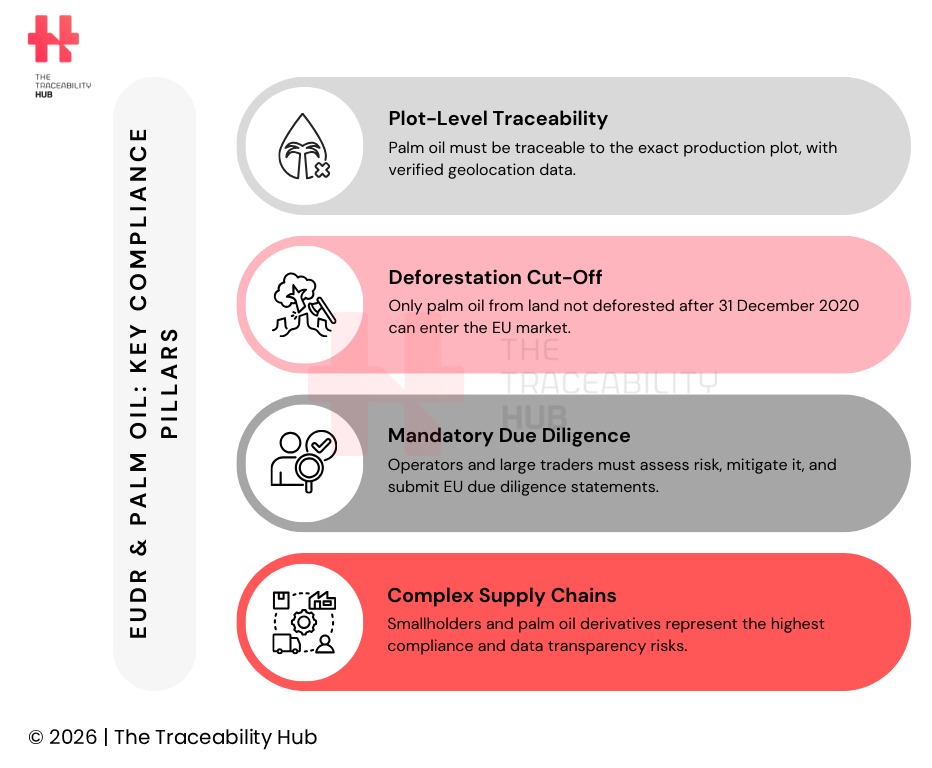
EUDR & Palm Oil Key Compliance Pillars
Step-by-Step Guide to Build EUDR Compliance for Palm Oil Supply Chains
A compliant palm oil supply chain under EUDR needs six key steps. Companies need strong procedures that link field-level data with regulatory requirements to show compliance.
Map Your Supply Chain with Plot-Level Traceability
Your supply chain mapping should identify every player in your palm oil supply network. The first step is to collect precise geolocation data using polygon boundaries for plots larger than four hectares instead of point coordinates. Operators must provide latitude and longitude points with six decimal digits to describe each plot perimeter when plots are larger than four hectares. A single coordinate point works for smaller plots under four hectares. This detailed mapping should cover all suppliers, from large estates to individual smallholders.
Verify Legality and Land Rights
After mapping, collect documents that prove legal compliance in the production country. This includes land tenure evidence, environmental permits, and proof that local labor laws are followed. The EUDR requires both legal compliance and deforestation-free status, you need both. Make sure production areas don’t overlap with protected territories or indigenous lands.
Conduct Deforestation Risk Assessments
The next step is to review risks by analyzing satellite imagery and historical land-use data. This verifies that no deforestation happened after December 31, 2020. Group suppliers based on their location near protected areas, past land changes, and their commitments. Your risk assessment should look at farm plot data quality, the sourcing region’s deforestation history, land tenure clarity, and how complex the supply chain is.
Reduce Risks and Document Actions
When you spot risks, put appropriate measures in place until the risk becomes negligible. You might need to remap problem areas, gather more documents, or work with farmers on fixes. All mitigation measures must be documented and retained for at least five years.
Submit EU Due Diligence Statements
After proper risk reduction, prepare and submit your due diligence statement through the EU’s Information System (TRACES NT). Each statement needs operator information, product information, geolocation data, and compliance declarations. Starting December 30, 2025, operators must submit these statements before selling products in the EU market.
Maintain ongoing monitoring and updates
Set up continuous monitoring through satellite data, field audits, and regular supplier reports. Look over your due diligence statements at least once a year. This ongoing verification will give sustainable compliance and help build trust throughout your supply chain.
Supporting Smallholders and Indigenous Land Rights
Smallholders are the foundations of the palm oil industry. They produce between 35-40% of global palm oil output. Their integration into EUDR-compliant supply chains is vital yet challenging.
Why Inclusion Matters for EUDR Compliance
Smallholders own approximately 41% of palm planted areas in Indonesia and 27% in Malaysia. Companies cannot achieve complete traceability or maintain sufficient supply volumes without their integration. Yes, it is clear that excluding smallholders would harm rural livelihoods and could push production toward markets with weaker environmental standards.
Tools and Training for Smallholders
Several joint initiatives now tackle smallholder inclusion challenges. Projects by companies such as Unilever and Meridia have mapped 28,000 smallholders across Aceh, North Sumatera and Riau. Their field data collection aids RSPO Certification. This detailed mapping gives smallholders the baseline documentation they need for EUDR compliance.
Recognizing and Mapping IPLC Territories
Indigenous Peoples and Local Communities (IPLCs) face legal and documentation barriers. Sarawak’s state laws don’t support indigenous rights to ancestral territories. They impose arbitrary 1,000-hectare limits on legally recognized areas. Indonesian indigenous communities within state forest zones also struggle to prove their legal land use rights.
The solutions include faster identification and marking of customary lands. Recognition of multiple IPLC categories (indigenous peoples, traditional communities, family farmers) helps too. Social Forestry and Agrarian Reform programs address landlessness. These initiatives pave the way for legally compliant palm oil production.
A Guide to EUDR Compliance for Palm Oil Supply Chains
EUDR compliance marks a turning point for the palm oil industry that changes how companies manage their supply chains. Companies must adapt to these strict requirements or face heavy penalties and market exclusion. Plot-level traceability, legal production verification, and post-2020 deforestation assessment creates new levels of accountability across palm oil supply chains.
These EUDR requirements pose major challenges for businesses, especially when you have smallholder inclusion and derivative traceability. Notwithstanding that, companies with foresight see these challenges as chances to build stronger supply networks while protecting the environment. Of course, the six-step compliance process offers a practical framework to build reliable systems that meet regulatory needs.
Smallholder palm farmers need special focus during this transition period. Their role remains vital not just for supply volumes but also for fair economic growth. Mapping, training, and support programs for smallholders should be priorities among other technical compliance measures.
Time moves quickly toward the December 2026 EUDR implementation deadline. Palm oil operators need decisive action to map supply chains, verify legal production, get a full picture of risks, and put effective mitigation strategies in place. It also helps operators prepare systems that submit accurate due diligence statements through the EU information system.
EUDR compliance ended up surpassing simple regulatory adherence. It sets new standards for responsible palm oil production that balance environmental protection with economic growth. Companies that proactively invest in compliance will likely become industry innovators and build resilient supply chains ready to meet growing global demand for deforestation-free palm oil products.
Read more: RFID vs. Barcode: Choosing the Right Tracking for Your Operations