


EU PPWR Explained: 2025–2040 Packaging Rules, Recyclability & Compliance
The PPWR requirement marks the biggest change in EU packaging laws ever. This new regulation impacts 40% of the EU packaging market. Companies might need to spend a lot to follow these rules. The shift from directives to direct regulation means packaging companies in Europe need to make big operational changes.
The new EU PPWR rules bring tough requirements that packaging businesses need to understand well. Companies working under PPWR Europe must meet specific recyclability targets, follow substance restrictions, and fulfill reuse obligations. The EU PPWR sets clear timelines and metrics that are a big deal as it means that previous packaging directives are changing. So packaging producers, importers, and distributors need to know these new standards inside out to keep selling in the market.
This piece breaks down everything about PPWR, from timelines to what companies need to do to stay compliant. On top of that, it helps you find the main differences between the new regulation and old directives and shows you how to meet the upcoming requirements.
EU PPWR Explained
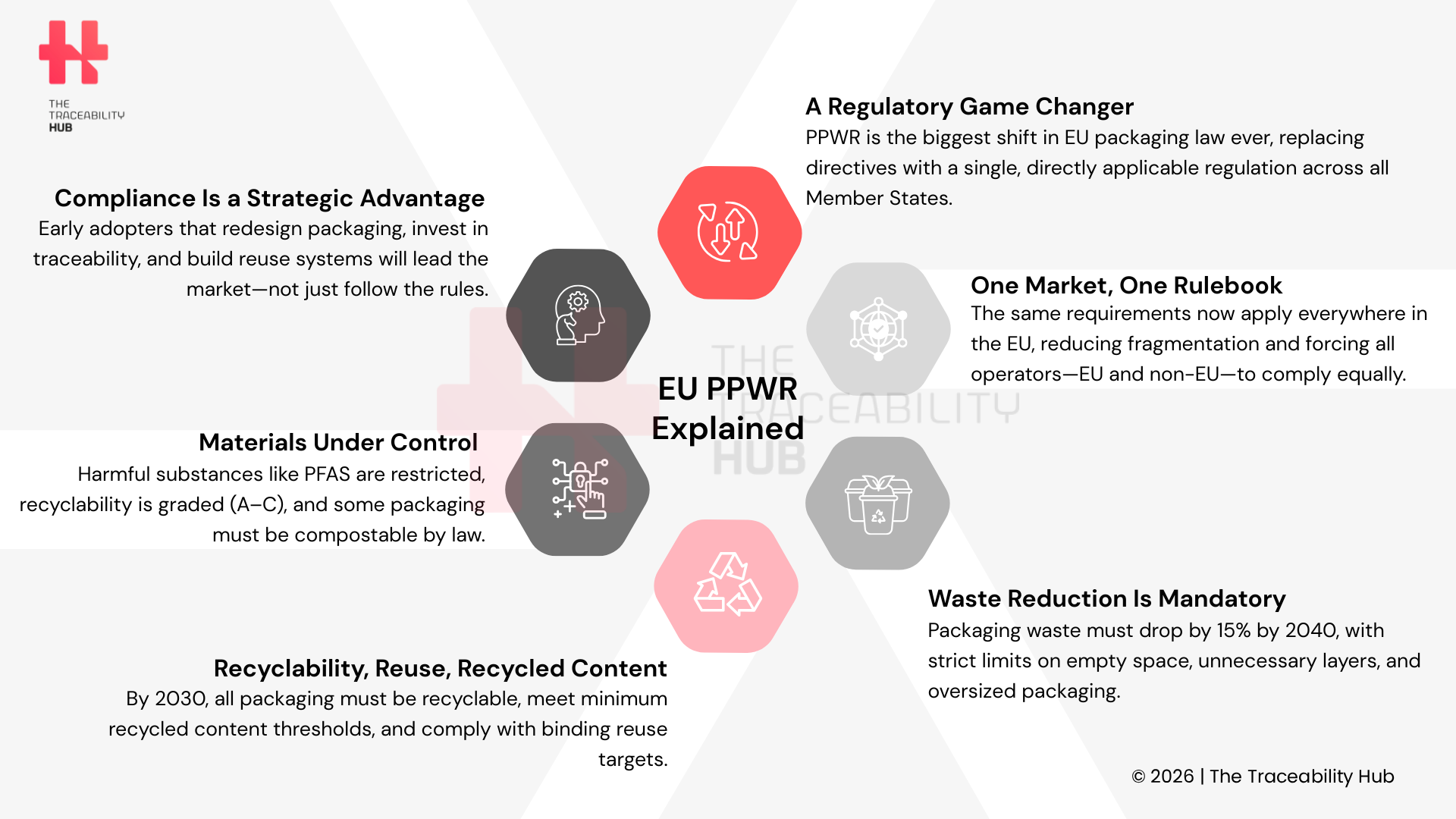
Overview of the EU PPWR Regulation
The EU has revolutionized EU packaging legislation with Regulation (EU) 2025/40, which changes how packaging requirements work in Europe. These detailed rules apply to all packaging placed on the EU market to set bold environmental targets for decades ahead.
What is Regulation (EU) 2025/40 (EU PPWR)?
On January 22, 2025 the EU’s Official Journal published Regulation (EU) 2025/40, also known as the Packaging and Packaging Waste Regulation (PPWR). The rules came into effect on February 11-12, 2025 with some variation in coverage dates and will apply broadly from August 12, 2026. PPWR creates a complete framework for packaging that puts sustainability first throughout the entire packaging lifecycle.
PPWR’s main goals are to:
- Stop and prevent unnecessary packaging waste
- Push for reuse, refill, and recycling systems
- Align EU packaging rules among Member States
- Help achieve EU circular economy and climate neutrality by 2050
The rules cover packaging and packaging waste of any material or source: industrial, retail, household, and others. EU PPWR sets binding standards for the complete packaging lifecycle, from design to waste management. The regulation will roll out gradually, with requirements taking effect between 2026 and 2040.
How EU PPWR is different from the previous Packaging Directive
EU PPWR takes over from the Packaging and Packaging Waste Directive 94/62/EC (PPWD) that existed since the 1990s. This switch from directive to regulation marks one of the most important changes in EU packaging laws.
Key differences include:
- Legal structure: PPWR applies the same rules across all 27 EU countries, unlike the old directive where Member States could interpret rules in their own way. Countries can no longer make adjustments that fragment the market.
- Scope and enforcement: A unified EU packaging compliance framework now applies to everyone in the packaging supply chain: manufacturers, importers, distributors, and waste managers. Companies outside the EU sending packaged goods to European markets must also comply with them.
- Ambition level: PPWR regulation sets tougher requirements than the previous directive. Though some bold targets were reduced after industry feedback, the final rules still emphasize recyclability and minimal packaging.
Direct applicability of PPWR Across All EU Member States
Switching from directive to PPWR regulation changes how packaging rules work in Europe. Similar requirements now apply at the same time across EU Member States without needing national measures.
This direct application brings several benefits. The regulation creates one unified market for packaging and packaged goods. Companies following these rules can sell their products anywhere in the EU. Market fragmentation caused by different EPR and environmental labeling rules no longer exist.
Businesses operating in multiple European countries now have better legal clarity. They follow one set of rules instead of dealing with 27 different national versions.
The PPWR regulation keeps its internal market legal basis (Article 114 TFEU), which restricts Member States from adding extra packaging rules. Any new measures must be fair, non-discriminatory, and allow free movement of packaged goods.
Key Goals of the EU PPWR for the Circular Economy
The EU PPWR regulation’s eco-friendly targets are the foundations of a framework that addresses packaging waste and promotes sustainable material use. This regulation will revolutionize how Europe designs, uses, and processes product packaging through its all-encompassing approach.
EU Packaging Waste Reduction by 15% by 2040
PPWR’s progressive waste reduction targets require EU Member States to reduce per capita packaging waste compared to 2018 levels. These reduction targets follow a stepped approach:
- 5% waste reduction by 2030
- 10% waste reduction by 2035
- 15% waste reduction by 2040
These targets tackle an urgent environmental challenge because packaging waste grows faster than economic output and population in the EU. In fact, the total mass of packaging waste in the EU has increased by about 20% in the last decade. The EU PPWR regulation wants to separate packaging waste generation from economic growth.
The EU regulation addresses excessive packaging by requiring minimal materials and dimensions for all EU market packaging to function properly. This prohibits packaging structures like double walls, false bottoms, and unnecessary layers that artificially increase volume. Empty space ratios must not exceed 50% by 2030 for e-commerce, transport, and grouped packaging.
Mandatory Recyclability and Reuse Targets Under the EU PPWR
PPWR’s most revolutionary aspect requires all EU market packaging to be recyclable by 2030. Product packaging design must allow all components to be recycled effectively instead of being discarded or incinerated.
A performance-based assessment system will review packaging recyclability and grade it as A, B, or C based on design criteria. The EU market will only allow packaging that is at least 70% recyclable threshold by weight (grade C) by 2030. These requirements create clear, measurable standards for “recyclable” packaging.
PPWR also sets mandatory recycled content targets for plastic packaging. Each plastic part that makes up more than 5% of total packaging weight needs minimum recycled content percentages. Contact-sensitive PET packaging must have 30% recycled content by 2030 and 50% by 2040.
The EU PPWR regulation establishes specific reuse targets for packaging types:
- 10% of beverage packaging must be reusable by 2030 (with a non-mandatory target of 40% by 2040)
- 40% of packaging for transporting products within the EU must be reusable by 2030
- Economic operators must use at least 70% of transport packaging in reusable formats by 2040
- Grouped packaging in box form must be 10% reusable by 2030, increasing to 25% by 2040
Alignment of the EU PPWR with the European Green Deal
PPWR plays a vital role in the European Green Deal’s environmental agenda. It supports Europe’s transformation into a resource-efficient, competitive, and climate-neutral economy by 2050. The regulation of emphasis on minimizing waste and promoting circularity matches the European Green Deal‘s principle of separating economic growth from resource consumption.
The EU PPWR regulation helps achieve carbon neutrality by reducing greenhouse gas emissions from packaging production and waste management. The regulation supports climate targets and addresses resource depletion by minimizing raw material extraction, promoting recycled content, and reducing waste incineration.
This PPWR regulation advances the European Green Deal’s circular economy goals through concrete measures that ensure packaging sustainability throughout its lifecycle. These measures include recyclable packaging design, mandatory recycled content, and reuse systems, key elements of the EU’s Circular Economy Action Plan.
The EU PPWR creates a level playing field for businesses by standardizing sustainability requirements across Member States. This drives innovation and competitiveness throughout Europe’s packaging sector.
EU PPWR Timeline and Enforcement Milestones
The EU PPWR implementation takes a step-by-step approach. Companies need to understand their compliance deadlines that stretch into the 2030s. This timeline helps packaging companies create strategies and stay compliant as new rules take effect.
EU PPWR Entry into Force: February 12, 2025
The EU published the PPWR regulation in its Official Journal on January 22, 2025. Standard EU rules made the regulation official 20 days later, on February 11-12, 2025. This date marks the start of legal effect and begins the transition period for businesses to prepare.
The official start date doesn’t mean companies must comply right away. The PPWR regulation uses several transition periods that create a gradual rollout. The previous Packaging Directive 94/65/EC and its national versions stay valid until specific PPWR rules become active.
General Application Date: August 12, 2026
Most EU PPWR rules start 18 months after the official date. August 12, 2026 marks the first big compliance deadline. The regulation’s basic requirements for product packaging design and composition become active then.
This phase activates several legal requirements:
- A ban on packaging with certain levels of per- and polyfluoroalkyl substances (PFAS)
- Rules for EU declarations of conformity and technical documentation
- EU Producer and importer labeling rules under Articles 15 and 18
Despite that, some PPWR rules have longer transition periods. To name just one example, standard labeling requirements start 24 months after the implementing act, possibly extending to August 2028.
2030 and 2035 Recyclability and Reuse Deadlines
The biggest changes come in 2030 and 2035. These years bring strict standards for packaging recyclability and reuse.
2030 PPWR milestones:
- Packaging design must be recyclable. The EU will ban any packaging below 70% recyclability by weight (Grade C)
- New recycled content targets apply: 30% for contact-sensitive PET packaging, 10% for other contact-sensitive plastic packaging, and 30% for single-use plastic beverage bottles
- Reuse targets become mandatory: 10% of HORECA sector take-away packaging, 10% of beverage packaging, 40% of transport packaging, and 10% of non-cardboard grouped packaging must be reusable
- Food retailers with sales areas over 400m² must use 10% of their space for food and non-food refill systems
- E-commerce packaging empty space cannot exceed 50%
- Companies start reporting their progress toward reuse and refill targets
- EU Member States must cut packaging waste by 5% per person compared to 2018
2035 PPWR Milestones:
- All packaging must be “recyclable at scale” – collected, sorted, and recycled through modern infrastructure covering at least 75% of EU citizens
- EU Member States must cut packaging waste by 10% per person compared to 2018
The framework sets a final product waste reduction goal of 15% by 2040 compared to 2018. These deadlines show a step-by-step approach that starts with packaging design and moves toward bigger changes in waste management.
The European Commission will release various implementing acts and minimum recyclability standards to explain specific requirements. Companies get time to adjust before stricter rules apply. Early preparation makes sense given the scale of changes ahead.
Packaging Design and Material Requirements Under the EU PPWR
The EU PPWR regulation puts material composition at its core. The rules affect how companies design their product packaging. These rules target harmful substances, recyclability, recycled content, and compostable materials.
Substance Restrictions under Article 5 PFAS Packaging (e.g., PFAS, Heavy Metals)
Article 5 of the EU PPWR sets strict limits on harmful chemicals. Food-contact packaging faces new rules about per- and polyfluoroalkyl substances (PFAS). Starting August 12, 2026, food-contact packaging must meet these PFAS limits:
- 25 ppb for any individual PFAS detected through targeted analysis
- 250 ppb for the sum of targeted PFAS
- 50 ppm for all PFAS, including polymeric PFAS
These PFAS restrictions line up with broader EU chemical strategies but kick in earlier than other proposed PFAS rules. Companies must keep technical documents that show them these limits.
The EU PPWR keeps existing heavy metal restrictions from the previous directive. Lead, cadmium, mercury, and hexavalent chromium combined must stay under 100 mg/kg by weight. Human health and environmental protection remain non-negotiable in packaging design, even with the push for recyclability.
Recyclability Performance Grades A–C (Article 6 Recyclability Grades)
The European Commission will create detailed design-for-recycling criteria and grading system by January 1, 2028. From 2030, all product packaging needs at least a Grade C recyclability rating to sell in the EU market. Article 6 recyclability grades depend on how much of the packaging weight can be recycled:
- Grade A: ≥ 95% recyclable
- Grade B: ≥ 80% recyclable
- Grade C: ≥ 70% recyclable
Rules get tougher after 2030. By 2038, companies can’t sell packaging below Grade B. Extended Producer Responsibility (EPR) fees change based on these grades, which encourages better recyclability.
The assessment reviews how easily components separate, sorting efficiency, recycling process fit, and recycled quality. It also checks if any harmful substances might affect recycling.
Minimum Recycled Content Thresholds by Material Type (Article 7)
Plastic packaging must include specific amounts of post-consumer recycled content. By 2030, Article 7 recycled content requirements:
- 30% for contact-sensitive PET packaging (excluding beverage bottles)
- 10% for other contact-sensitive plastic packaging
- 30% for single-use plastic beverage bottles
- 35% for all other plastic packaging
These targets grow by 2040: 50% for contact-sensitive PET, 25% for other contact-sensitive packaging, 65% for beverage bottles, and 65% for all other plastic packaging.
Some product packaging types don’t need to meet these rules. This includes pharmaceutical packaging, medical devices, infant formula packaging, dangerous goods containers, compostable packaging, and plastic parts under 5% of total packaging weight.
Compostable Packaging Requirements Under Article 9
Some packaging must be compostable under the EU PPWR. This includes permeable tea and coffee bags, single-serve units, fruit and vegetable sticky labels, and very lightweight plastic carrier bags.
Each EU country can add more items to their compostable list. They might include non-permeable tea and coffee bags, other lightweight carrier bags, and packaging already marked as compostable before August 12, 2026.
All Article 9 compostable packaging must meet EN 13432 industrial composting standards. European organizations will create new standards for home composability since none exist yet. These compostable packaging rules start from February 12, 2028.
These material and design requirements create a detailed framework that will change how Europe makes packaging. Manufacturers must shift toward safer, eco-friendly, and fully recyclable or compostable options.
Reuse, Refill, and Packaging Minimization Obligations
The EU PPWR regulation brings sweeping changes to packaging operations through reuse and minimization rules. These changes affect supply chains with binding targets and strict timelines that businesses must follow.
Mandatory Reuse Systems for Transport and Takeaway Packaging
The EU PPWR sets strict reuse requirements for transport packaging. Companies must ensure 100% reusable packaging between their sites or businesses in the same EU Member State by January 1, 2030. Cross-border transport within the EU needs 40% reusable packaging by 2030, aiming for 70% by 2040. The PPWR Europe rules don’t apply to dangerous goods packaging and direct food-contact materials.
HORECA businesses face new takeaway packaging rules. Starting February 12, 2028, hotels, restaurants, and cafes must give customers a reusable option for takeaway items. These businesses should reach a 10% reuse rate by 2030. Customers won’t pay extra for choosing reusable containers.
Void Space Limits and Packaging Size Reduction Rules (Article 10 & 24)
PPWR Europe New rules target excessive packaging with strict space limits. Empty space in grouped, transport, and e-commerce packaging must stay under 50% by January 1, 2030. This limit counts space taken by bubble wrap, air cushions, foam chips, polystyrene, and other fillers.
The PPWR compliance pushes for smaller packaging overall. Packages must shrink to their smallest working size by January 1, 2030. Double walls, false bottoms, and extra layers won’t be allowed. Packages are still needed to protect products and meet safety standards.
Refill Obligations for Food and Beverage Packaging (Article 32 & 33)
Food service businesses must let customers bring their own containers starting February 12, 2027. They can’t charge extra or make it harder for customers who do this. Each EU country decides how to handle food safety liability.
Beverage packaging faces its own targets. The rules want 10% reusable packaging by 2030, hoping to reach 40% by 2040. Larger retailers with over 400 square meters should use 10% of their space for refill options by 2030.
Breaking this EU packaging legislation could mean legal trouble and fines, though exact penalties aren’t set yet. The 2030 deadline might seem far, but businesses need to start planning now. They must work out container details, change their supply chains, and build better digital systems.
Labeling, EPR, and Market Restrictions
The key to the EU PPWR lies in standardization among Member States. The regulation pays close attention to unified labeling, producer accountability, and market access restrictions.
Harmonized EU Packaging Labeling Requirements (Article 12 & 13)
PPWR Europe requires coordinated packaging labels that show material composition to help consumers sort better starting August 12, 2028. Reusable packaging needs a label with QR code details about collection points and reuse instructions by February 2029.
Labels on compostable packaging must show it works in industrial facilities but not in home settings. This coordination resolves the current problem where many countries use their own labeling systems.
Extended Producer Responsibility (Article 44)
Articles 44-47 lay out complete Extended Producer Responsibility (EPR) rules that make packaging producers pay their share in collecting, sorting, and recycling packaging waste. Companies need to sign up with national schemes, track packaging volumes, and cover waste management costs. Producer Responsibility Organizations (PROs) can handle these duties on behalf of producers. National registers will start working within 18 months after implementing acts to take effect.
Ban on Single-Use Packaging Formats (Annex V Packaging Bans)
The PPWR bans these single-use packaging formats starting January 1, 2030:
- Plastic grouped packaging (e.g., collation films, shrink wrap)
- Single-use plastic packaging for fresh produce under 1.5kg
- On-premises HORECA food and beverage containers
- Individual portions of condiments, preservatives, and seasonings
- Hotel toiletry packaging (material-neutral ban)
- Very lightweight plastic carrier bags under 15 microns
These Annex V packaging bans don’t apply to composite packaging that contains less than 5% plastic.
What the EU PPWR Means for Packaging Companies
The EU Packaging and Packaging Waste Regulation (PPWR) marks a major change in European packaging laws that will reshape the packaging industry completely. During this change, packaging companies must adapt their business plans, product designs, and daily operations to meet strict new rules.
Companies in the EU market have a clear EU packaging compliance schedule to follow. The regulation starts in August 2026, and complete recycling requirements must be met by 2030. Companies should start preparing early, especially when they use restricted materials or packaging types that will be banned.
This new EU PPWR regulation sets much tougher standards than before. Packaging companies must review their materials, redesign products for recycling, add recycled content, and set up reuse systems in their supply chains. The EU PPWR rules now apply equally to all Member States, which creates one clear framework for packaging.
Smart companies see these requirements as chances to grow rather than roadblocks. Those who welcome eco-friendly product packaging design and investing in green solutions will lead to market changes. The burden of following these rules hits small businesses harder since they have limited resources to make big changes.
The regulation aims to cut waste by 15% by 2040 and enforce strict recycling rules. These changes match the EU’s climate goals and consumer priorities for eco-friendly packaging. Companies that go beyond the basic requirements will likely become market leaders.
EU Packaging companies must work on many fronts at once. They just need to handle substance limits, design changes, recycled materials, reuse systems, and label standards. These changes protect our environment and create fair competition for everyone. The move toward sustainable packaging has started, and companies that adapt quickly will succeed in this new EU market.
Read more: Walmart RFID Implementation: Real Results from Early Adopter Suppliers