



RFID-Enabled Inventory Management in Modern Food Logistics Environment
RFID food tracking technology for food supply chain visibility is changing how the food industry curbs a staggering problem: one-third of all food produced globally goes to waste, with major losses during storage and transportation across complex food supply chains. This invisible drain on resources creates an environmental challenge and a business chance for food manufacturers, distributors, and retailers. RFID technology provides a powerful solution through immediate visibility across the supply chain that eliminates blind spots causing waste and inefficiency.
Smart packaging with RFID tags for perishable food monitoring manages perishable food by detecting changes in freshness biomarkers at the item level, so food waste decreases. The Leveche tag showed it could cut food waste by 50% through RFID-based freshness detection. This technology enables smooth tracking from production to consumption across the end-to-end food supply chain and builds greater transparency and trust between brands, regulators, and consumers. Food companies need RFID implementation more urgently now, especially with FDA’s Food Traceability Rule. Though delayed until July 2028, this rule will require detailed record-keeping for high-risk foods. RFID systems generate sortable digital records for food traceability compliance needed during outbreaks or recalls and provide vital documentation within FDA’s 24-hour request window.
Understanding RFID’s Role in Food Supply Chain Visibility
RFID technology acts as both the brain and nervous system of smart logistics and digital supply chain infrastructure in the food industry. It creates an invisible digital connection that tracks food products from farm to shelf with continuous RFID data capture. This technology builds a continuous digital record for food traceability and inventory accuracy that follows each product throughout its life cycle. It has changed how companies track food safety, freshness, and location in real time.
How Does RFID Tracking Work in Food Logistics?
Radio Frequency Identification (RFID) tracking uses wireless communication within food logistics systems to send data between RFID tags and readers. Each tag has a sensor connected to an antenna that sends stored information like unique identifiers or product data for serialized food items. Food supply chains use RFID tags directly in packaging and smart food labels. This creates a digital identity for item-level food tracking that stays with each product from start to finish.
Modern RFID systems do much more than just identify products in warehouses or retail environments. Advanced solutions create a live digital record of each product by tracking temperature, humidity, and location throughout cold chain logistics. Companies can connect traceability lot codes (TLCs) with shipment data inside RFID traceability platforms. This allows uninterrupted tracking from start to delivery across multi-node food distribution networks.
RFID becomes even more powerful when integrated with cloud platforms and supply chain management software that combines tag data from facilities, warehouses, and transport networks. These systems remove communication barriers between separate systems and partners within fragmented food supply ecosystems. Supply chains can now see everything at once and adapt quickly to changes.
Key Differences between RFID and Barcode Systems
Barcodes have helped the food industry for decades in basic inventory tracking. RFID technology offers major improvements in supply chain visibility and food traceability accuracy:
- Reading capabilities: RFID readers can detect tags without seeing them directly in warehouse, cold storage, or transport settings. They read data through packaging and scan multiple items at once, while barcodes need direct sight and individual scanning.
- Scanning efficiency: RFID lets you scan items in bulk quickly during receiving, shipping, or inventory audits. One RFID reader can scan more than 100 tags at the same time, which reduces manual work compared to scanning barcodes one by one.
- Data capacity: RFID tags hold more data than barcodes but mainly focus on serialization for cost-effective item-level tracking. This keeps tag costs down while still providing detailed item information for food safety and traceability.
- Security features: RFID provides better data security through encryption that needs authorized readers. This makes information harder to access or tamper with compared to regular barcodes.
- Environmental monitoring: Advanced RFID tags can track conditions like temperature and humidity. This helps food logistics ensure proper storage for freshness and safety throughout distribution.
Why Blind Spots Exist in Traditional Food Supply Chains
Food supply chains face visibility gaps and data silos that create business risks. A recent survey shows that only 30% of global supply chain executives say their leaders can see supply chain problems clearly, down from 50% in 2023. These blind spots come from separate systems, old data, and isolated partners across food production, processing, and distribution.
Poor tracking often results from old systems or paper records instead of digital food traceability solutions and manual checks that cause errors and slow information sharing. Food manufacturers can’t work ahead without knowing how to track inventory, watch production, or get early supplier warnings in real time.
Small problems like late shipments or missing ingredients can quickly become missed deliveries, quality issues, or recalls that impact food safety and brand trust. These problems also quietly reduce profits and damage trust between partners.
Food industry timing matters and perishables won’t wait. RFID technology for food supply chain visibility helps solve these visibility problems that pose real risks to business success.
Solving Food Supply Chain Blind Spots with RFID
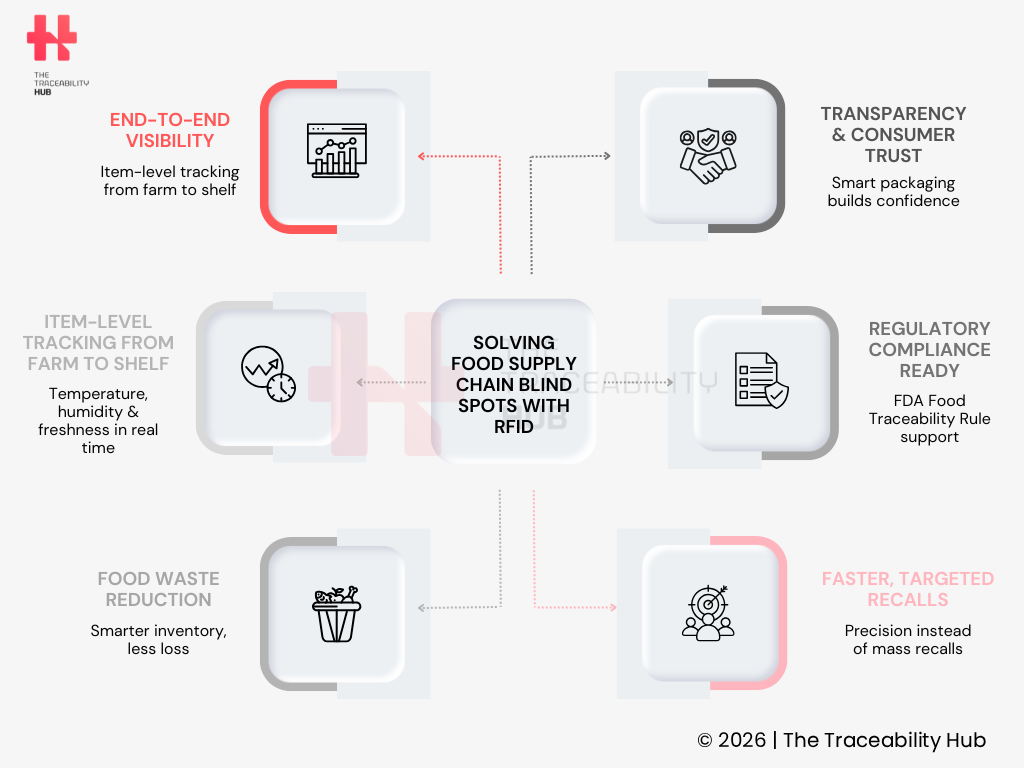
Addressing Supply Chain Complexity with RFID
Food supply chains today involve many handoffs and complex logistics networks. Traditional monitoring methods don’t work well in these situations at a scale. RFID food tracking and digital traceability systems cut through this complexity and give clear visibility at every distribution stage.
Real-Time Location Tracking of Perishable Goods
RFID technology tracks food products continuously throughout their trip across cold chain logistics. RFID tags with temperature sensors provide up-to-the-minute data about environmental conditions inside refrigerated transport and storage. This helps maintain perishable items at the right temperature to preserve freshness and shelf life. The system lets operators spot problems before products get damaged beyond repair.
RFID systems quickly alert staff when refrigerated transport conditions go wrong during food distribution. The system immediately notifies logistics teams if a refrigerated truck temperature goes outside safe limits. Teams can then fix refrigeration systems or change routes to prevent spoilage. Products arrive in perfect condition instead of discovering quality issues at delivery.
RFID food traceability from farm to shelf
Product traceability marks a radical alteration in supply chain management for the food industry. RFID creates an unbroken digital thread from start to final delivery using item-level food traceability. Companies can now track individual items. The technology links traceability of lot codes with shipment data to create a complete digital record of each product’s trip across the supply chain.
RFID food traceability becomes even better when connected to cloud platforms and food traceability software that combine tag data from facilities, warehouses, and transport networks. These systems break down communication barriers between separate systems and partners. They provide:
- Full visibility of product locations in real time across food logistics operations
- Detailed handling information throughout the supply chain for compliance and quality control
- Complete origin-to-shelf documentation for each item to support recalls and audits
This smooth tracking helps businesses prepare for the FDA’s Food Traceability Rule. The rule requires detailed records for high-risk foods with compliance extended to 2028.
Reducing Delays and Spoilage through Automated Checkpoints
Strategic RFID checkpoints throughout the supply chain capture data as products move through critical points in food distribution workflows. These include receiving docks, storage coolers, and sales floors. The automation cuts labor costs for inventory checks by up to 78% while improving accuracy.
RFID’s stock rotation and expiration tracking for perishable inventory management prevents food waste. Managers quickly spot items near expiration dates and move older stock first. This feature is great for perishable items like meat, dairy, and produce in grocery and food service environments. It keeps products fresh all the way to consumers.
Companies maintain exact inventory levels with this technology using real-time inventory visibility. It prevents having too much or too little stock. The system improves logistics efficiency with data that optimizes routes and cuts transportation costs. Timely deliveries happen more often, key factors in keeping food fresh and reducing waste.
RFID technology makes food logistics proactive instead of reactive through automation and data-driven decision-making. It creates strong networks that protect product quality and reduce operational costs by handling supply chain complexity with automated, accurate monitoring.
Improving Food Safety and Regulatory Compliance
Food businesses face tougher safety standards every day. RFID food tracking technology provides expandable solutions that automate and verify documentation systems to meet complex food safety, traceability, and regulatory compliance requirements.
Meeting FDA Food Traceability Rule with RFID
The FDA’s Food Traceability Final Rule demands extra recordkeeping beyond standard regulations for foods on the Food Traceability List (FTL). Companies must maintain records with Key Data Elements (KDEs) linked to specific Critical Tracking Events (CTEs) throughout the food supply chain network. The FDA requires these detailed food traceability records within 24 hours during investigations or recalls.
RFID technology for food traceability delivers exact tracking capabilities needed for regulatory compliance. RFID tags attached to products create visibility from farm to fork by tracking everything from origin through ingredients, processing, distribution, and retail sale. This complete supply chain visibility helps companies meet regulations and build consumer trust.
RFID Smart Labels for Temperature and Humidity Monitoring
Modern RFID smart labels for food now come with temperature and humidity sensors that monitor environmental conditions constantly. These specialized RFID temperature monitoring tags show visual warnings when products go beyond safe temperature limits. They work with various temperature ranges from -3°F (-16°C) to 86°F (30°C) and time settings from 15 minutes to 12 hours.
These tags instantly verify proper handling in cold chain monitoring and food logistics. Temperature sensors log data continuously to ensure products stay within safe temperature ranges during storage and transportation. This helps companies predict and manage product shelf life accurately, which reduces waste and maintains quality.
Preventing Cross-Contamination with Item-Level Tracking
Cross-contamination is a systemic problem throughout the food supply chain ecosystem. RFID tracking stops contamination by ensuring clean equipment usage in production and keeping products away from restricted areas. This feature proves valuable during transport and handling where product integrity depends on regular vehicle sanitizing, accurate tracking, and proper monitoring.
Automated Audit Trails for FSMA and HACCP Compliance
RFID technology creates automated documentation that helps manufacturers follow Food Safety Modernization Act (FSMA) regulations by recording product movement and handling details. Companies can quickly access origin information, manufacturing details, and logistical timestamps, vital food safety data for tracking movement and addressing safety concerns.
This automated system strengthens quality assurance through HACCP compliance programs, internal audits, supplier verification programs, food traceability systems, and environmental monitoring programs.
Reducing Food Waste and Inventory Errors
Food waste poses a global challenge across modern food supply chains. UN data reveals that people waste at least a quarter of all food worldwide. The United States wastes most food in three categories: meat, poultry, and fish (41%); vegetables (17%); and dairy products (14%). For example, fruits and vegetables are among the most wasted categories because of cosmetic standards, short shelf life and overstocking. RFID food tracking solutions provide tools that help track and manage and reduce these problems.
Tracking Expiration Dates with RFID Food Tags
RFID systems excel at managing product shelf life by tracking expiration dates automatically at the item level. These RFID food tag systems track stock levels immediately and spot items close to expiry. RFID tags with integrated temperature, humidity, and ammonia sensors help determine meat products’ freshness. The system categorizes quality into four stages: high, medium, low, and spoilage.
Similarly, vegetable freshness monitoring uses RFID tags with oxygen and carbon dioxide sensors. These sensors assess quality based on the respiration quotient (RQ) supporting more accurate fresh food inventory management.
RFID tags measure temperature and calculate product lifespan. This information reaches readers with RFID readers throughout the supply chain and feeds centralized inventory systems. Management systems can then alert businesses about products nearing expiration, so they can take action early.
Minimizing Overstocking and Understocking Risks
RFID technology helps food businesses keep optimal stock levels through immediate high-accuracy inventory tracking. This precision prevents overstocking that creates food waste and understocking that loses sales. RFID inventory management systems monitor inventory with up to 98% accuracy. Businesses can spot fast-moving products and seasonal trends easily.
RFID readers capture information from multiple items at once from a distance, even though packaging. This eliminates manual barcode scanning. Bulk RFID scanning speeds up inventory checks and cuts labor costs by automating counting tasks.
RFID-Enabled FIFO (First In, First Out) Inventory Systems
RFID technology implements FIFO inventory principles with precision by tracking when food products enter inventory. Digital use-by dates help staff prioritize older stock accurately. They can identify items to mark down for quick sale instead of throwing them away. RFID automation replaces manual processes with FIFO protocols that reduce waste through accurate rotation of perishables goods.
Grocery stores using RFID food tracking in pilot projects have cut food waste by up to 20%. The results look even better for dairy products. Simulation models show RFID technology can reduce dairy waste by 29.41% in supermarkets and 38.52% at production sites. These results show how real-time data sharing across the food supply chain makes a big difference.
Enhancing Recall Accuracy and Consumer Trust
Quick action during food contamination can prevent isolated cases from becoming public health crises. RFID food tracking systems play a vital role in managing these high-stakes situations.
RFID for Food Recalls: Batch-Level Traceability
RFID technology makes targeted recalls possible and reduces the need for large-scale product removal. Companies can save time, money, and brand reputation by tracking and removing only the affected products’ lines. Food items can be traced completely from raw materials, ingredients and production through distribution by linking traceability of lot codes with detailed shipment and location data.
Speeding Up Product Removal During Contamination Events
RFID systems create sortable, searchable digital records that make quick responses possible during contamination events. Companies must provide detailed traceability records within 24 hours when FDA requests them. The RFID-powered system helps teams identify affected products and track their distribution paths quickly to protect consumers. Quick removal of contaminated products from shelves becomes possible during emergencies.
Building Transparency with Smart Packaging Food Solutions
Smart packaging with RFID technology turns each product package into its own quality control monitor. Brands can connect directly with consumers through the product itself. RFID-enabled packaging stores data about storage conditions through RFID-enabled packaging that stores data about origin, handling, and storage conditions. This transparency builds public trust in food security and gives businesses valuable consumer data.
RFID Food Tracking: Improving Food Supply Chain Visibility & Traceability
RFID technology has become a gamechanger in dealing with food supply chain management’s biggest problems in food supply chain management. Our analysis shows how this technology removes blind spots that used to cause much waste and inefficiency. Knowing how to track products from farm to shelf with precision has brought a fundamental change in food businesses’ operations.
RFID’s benefits go beyond simple inventory management. Up-to-the-minute location tracking lets companies monitor perishable goods non-stop and ensures optimal conditions during transport and storage. On top of that, automated checkpoints optimize labor costs and improve accuracy, with some implementations reducing operational expenses by up to 78%.
RFID systems give food safety a major boost by preventing cross-contamination and maintaining detailed audit trails. These features help businesses meet strict FDA Food Traceability Rule requirements. They also create automated documentation systems that comply with FSMA and HACCP standards.
Technology directly tackles the massive global food waste problem head-on. Smart labels and RFID track expiration dates, monitor environmental conditions, and enable precise FIFO inventory management with remarkable results. Grocers have seen waste reduction of up to 20% in pilot projects. Simulation models show even better potential 29.41% waste reduction in supermarkets and 38.52% at dairy production sites.
When contamination occurs, RFID systems are a great way to get swift, targeted recalls instead of broad product removals. This precision protects public health and brand reputation through faster response times and accurate product identification.
Smart packaging with RFID technology ended up building transparency between brands and consumers. Each package works as an independent quality control agent that stores data about product origin, handling, and storage conditions. This visibility creates trust and gives businesses valuable insights into their products’ path.
RFID technology isn’t just an operational improvement: it’s a complete solution to long-standing food supply chain challenges. Companies that adopt RFID systems are leading in efficiency, safety, and sustainability: three foundations to succeed in today’s food industry.
Read more: Traceability in Industry 4.0 and Smart Manufacturing