



How the EU Empowering Consumers Directive Targets Greenwashing
The EU’s Empowering Consumers for the Green Transition Directive (Directive (EU) 2024/825) marks a shift from largely voluntary sustainability messaging toward stricter consumer-protection rules on environmental claims.
The directive introduces new restrictions on generic environmental claims (often associated with greenwashing) and on sustainability labels that are not based on approved certification schemes or established by public authorities.
Member States had to adopt and publish national transposition measures by 27 March 2026, with the new EU environmental claims and greenwashing rules applying from 27 September 2026. The reform is designed to curb greenwashing in marketing and product communication, strengthen consumer trust, and support fairer competition across the EU market.
Businesses should now review how they substantiate green claims, use environmental sustainability labels, and prepare internal EU regulatory compliance processes before the rules begin to apply.
Understanding the Empowering Consumers Directive (EmpCo)
What the Directive Covers
The Directive (EU) 2024/825 strengthens EU consumer protection law by amending two existing laws: the Unfair Commercial Practices Directive and the Consumer Rights Directive. Rather than creating a standalone regulatory framework, the directive integrates new sustainability-related consumer protection rules and environmental claims regulation directly into the EU’s established consumer protection regime.
These updates address issues that have become increasingly common in modern markets, particularly misleading environmental claims, green marketing practices, and product-related claims.
The directive applies to business-to-consumer (B2C) commercial practices, covering any action, omission, representation, or communication directly linked to the advertising, promotion, or sale of products to consumers in the European Union. It introduces specific rules targeting:
- Misleading environmental claims and greenwashing practices.
- Sustainability labels are not based on recognized certification schemes or established by public authorities.
- Misleading statements about product durability or repairability.
- Marketing practices encourage premature product replacement.
Several of these practices are now included in Annex I of the Unfair Commercial Practices Directive, the EU’s list of commercial practices that are considered unfair in all circumstances across the internal market.
Branding and trademarks may also be relevant where they communicate environmental claims or sustainability messaging in commercial contexts. While the directive does not regulate intellectual property rights directly, the marketing use of brand names or trademarks containing terms such as “green”, “eco”, “natural”, “sustainable”, or “climate neutral” could fall within the scope of the EU environmental marketing regulation if they create misleading environmental impressions for consumers.
Timeline and Enforcement Dates
The Empowering Consumers for the Green Transition Directive (Directive EU) 2024/825 entered into force on 26 March 2024, twenty days after its publication in the Official Journal of the European Union on 6 March 2024.
EU Member States must transpose the directive into national consumers protection law by 27 March 2026.
The new consumer protection rules must then apply from 27 September 2026.
From that date onward, commercial practices falling within the directive’s scope must comply with the updated requirements on environmental claims regulation, sustainability labels of transparency, and product-related information.
Businesses are therefore expected to review marketing materials, environmental advertising claims, and consumer communications ahead of the application date to ensure EU regulatory compliance once the new rules begin to apply.
Who Needs to Comply
The provisions apply to traders engaging in business-to-consumer (B2C) commercial practices directed at consumers in the European Union, regardless of the company’s size or place of establishment.
Companies based outside the EU must also comply if their products or marketing target EU consumers or the EU internal market.
Under Directive (EU) 2024/825, which amends the Unfair Commercial Practices Directive, responsibility generally falls on the trader responsible for the commercial communication or environmental claim. This may include manufacturers, brand owners, importers, retailers, and online sellers, depending on who makes or presents the environmental claim to consumers.
The rules apply to a wide range of commercial communications, including claims displayed on:
- Product packaging
- Shelf labels or in-store marketing materials
- Online product pages in e-commerce environments
- Digital marketing and advertising channels.
Enforcement is carried out by national consumer protection authorities under EU consumer law. For widespread infringements, penalties may reach up to 4% of a company’s annual turnover in the relevant Member States, in line with the enforcement framework introduced by the Omnibus Directive.
Before vs After Directive (EU) 2024825
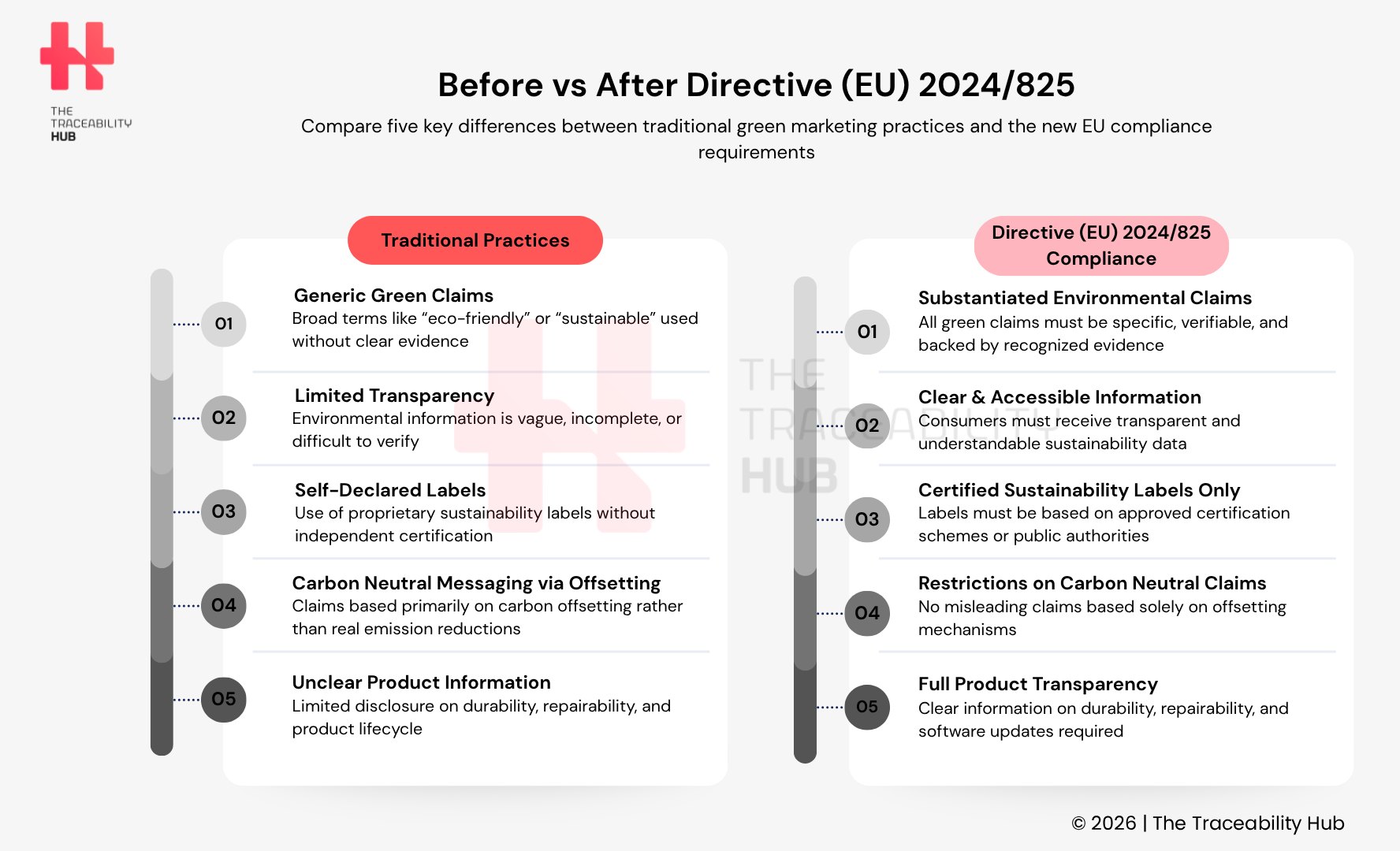
Key Prohibitions and Requirements Under EmpCo
The Directive (EU) 2024/825 strengthens EU consumer protection rules on environmental marketing and sustainability claims by expanding the list of commercial practices that are considered unfair in all circumstances under Annex I of the Unfair Commercial Practices Directive.
These additions target:
- Misleading environmental claims
- Unreliable sustainability labels
- Marketing practices related to product durability and repairability.
Practices included in Annex I are automatically prohibited across the EU internal market without the need for case-by-case assessment.
Ban on Generic Green Claims
The directive introduces stricter rules on generic environmental claims.
Broad terms such as “environmentally friendly,” “eco-friendly”, “green” or “sustainable” may be considered misleading if they are not supported by clear, verifiable evidence of environmental performance.
A generic environmental claim generally refers to a statement suggesting environmental benefits without specifying the relevant environmental characteristics or providing adequate scientific or technical substantiation. Under the directive, such claims are prohibited unless the trader can demonstrate recognized excellent environmental performance relevant to the claim.
In practice, this may involve certification under recognized environmental labelling schemes such as the EU Ecolabel or other verified third-party certification systems that demonstrate high environmental performance.
Businesses making environmental third-party claims must ensure that supporting information is clear, specific, and accessible to consumers through the relevant marketing, labelling or product information channels.
Restrictions on Carbon Neutral Statements
The directive introduces stricter rules on environmental claims related to greenhouse gas emissions and climate neutrality marketing. Under Directive (EU) 2024/825, it is considered an unfair commercial practice to make environmental claims about a product based on greenhouse gas emissions offsetting.
This restriction targets claims suggesting that a product has a neutral, reduced, or positive climate impact when this claim relies primarily on offsetting mechanisms. Marketing terms such as “carbon neutral”, “CO₂ neutral”, or “climate positive” may therefore be considered misleading if they are based on offsetting rather than measurable emission reductions associated with the product or the company’s operations.
Companies may still communicate information about corporate climate strategies, emission reduction efforts, or investments in environmental initiatives.
However, such communications must be presented clearly and must not create the impression that a product itself has achieved climate neutrality through offsetting mechanisms.
Rules on Sustainability Labels for brands
The directive also introduces new requirements for sustainability labels displayed to consumers. Environmental or sustainability labels may only be used if they are established by public authorities or based on a recognized certification scheme, in line with the EU sustainability labels regulation introduced under Directive (EU) 2024/825.
Certification schemes must include transparent criteria, independent monitoring, and publicly accessible compliance requirements. The objective is to reduce the proliferation of self-declared environmental labels or green marketing symbols that may confuse consumers or lack credible verification.
Trademarks and labels registered with authorities such as the European Union Intellectual Property Office (EUIPO) do not automatically fall outside the scope of these EU environmental claims rules.
Even if a mark is legally registered, its use in marketing may still be considered misleading under EU consumer protection law if it conveys unsupported or unsubstantiated environmental claims.
Transparency on Product Durability
The directive introduces stronger protections against misleading practices related to product durability and product lifespan claims. Under Directive (EU) 2024/825, traders must not provide misleading information about a product’s expected lifespan, durability performance, or its repairability under normal conditions of use.
Businesses are also prohibited from withholding material information about product features that may affect durability, repairability, or long-term functionality.
These EU consumer transparency rules are designed to ensure that consumers receive accurate information about how long products are expected to last and whether they can be repaired when necessary.
Disclosure Requirements on Software Updates
The directive also addresses transparency requirements regarding software updates for products with digital elements, an area increasingly relevant for smart devices and connected products. Traders must not omit material information about software updates that could affect the functioning or performance of a product.
Consumers must receive clear, accessible, and relevant information about updates where they are necessary for the product’s continued functioning or performance. These obligations complement existing requirements under the Sale of Goods Directive, which requires sellers to provide updates needed to maintain product conformity for goods with digital elements under EU law.
Practical Steps to Ensure Compliance
Businesses should begin EU regulatory compliance preparations well before the new rules apply on 27 September 2026, the official application date of the EU Empowering Consumers Directive (Directive (EU) 2024/825).
This is especially important for companies with complex product portfolios, long packaging update cycles, or sustainability claims used across multiple marketing channels. Early preparation can help businesses review existing claims, identify substantiation gaps, and adjust marketing and product communications before the EU environmental claims regulation begins to apply.
Audit Your Current Marketing Materials
Companies should review sustainability-related communications across all relevant consumer-facing channels, including:
- Product packaging
- Company websites
- Advertising campaign
- Social media, and sales materials.
Particular attention should be paid to broad environmental marketing terms such as “environmentally friendly”, “eco-friendly”, and “green”, since the EU Empowering Consumers Directive specifically targets generic environmental claims that are not supported by recognized excellent environmental performance or clear substantiation.
Businesses should also catalogue their sustainability claims, identify the technical evidence supporting each claim, and review any proprietary labels or visual elements that could convey an environmental message to consumers under EU green marketing rules.
Establish Verification Processes for Environmental Claims
Companies should create internal substantiation records for each environmental or sustainability claim used in marketing or product communication. Depending on the claim, these records may include:
- Technical documentation
- Laboratory test results
- Independent certifications
- Product specifications, or other supporting evidence.
Under Directive (EU) 2024/825, sustainability labels may only be used if they are established by public authorities or based on a recognized certification scheme.
Such schemes must involve third-party verification and transparent, publicly available certification criteria. Businesses should therefore review any proprietary labels, eco-icons, and ensure that environmental claims are supported before they are presented to consumers.
Update Product Information and Labeling
Businesses should review product information, labelling practices, point-of-sale materials, and online listings ahead of the new rules’ application from 27 September 2026, when the EU Empowering Consumers Directive becomes fully applicable.
The European Commission has adopted a harmonized EU notice on consumers’ legal guarantee rights, which must be displayed in shops both online and offline, and harmonized EU label labels for producers that voluntarily offer a commercial guarantee of durability of more than two years for the entire product at no extra cost.
Companies should also review how they communicate durability, reparability, and software-update information so that consumers receive clear, accurate and non-misleading product information in line with EU consumer protection and environmental transparency rules.
Train Your Marketing and Legal Teams
Businesses should establish internal approval processes for environmental claims and sustainability messaging, involving marketing, sustainability, and legal teams before publishing environmental claims.
It is advisable to define who is responsible for technical validation of environmental supporting data and who provides legal review of claim wording and marketing language.
Internal guidelines can help teams distinguish between acceptable sustainability messaging and high-risk environmental claims, while cross-functional training can improve understanding of substantiation requirements and reduce the risk of misleading claims under EU consumer law.
Building A Sustainable Compliance Strategy
Long-term compliance under the EU Empowering Consumers for the Green Transition Directive will usually require more than one-time claim reviews.
Businesses should develop internal governance systems that support consistent substantiation, monitoring, review, and approval of environmental communications over time, especially where sustainability claims appear across multiple products, markets, or marketing channels.
Implementing Third-Party Certification
Independent certification can strengthen the credibility of environmental claims and sustainability communications, particularly where a business uses sustainability labels.
Under Directive (EU) 2024/825, sustainability labels may be used only if they are established by public authorities or based on a certification scheme with transparent, fair, and publicly accessible criteria and independent third-party verification.
Businesses should therefore review whether any environmental certification schemes or sustainability labels they use meet those conditions.
Standards such as ISO/IEC 17065 and ISO 19011 may be relevant as certification and auditing benchmarks in some schemes, but they are not stated in the directive itself as universal legal requirements.
Creating Internal Documentation Systems
Businesses should consider structured documentation and compliance management systems to support compliance with the new EU environmental rules on environmental claims and consumer information. In practice, internal systems can help:
- Centralize claim policies
- Track internal approvals
- Maintain version control of marketing communications
- Retain substantiation records for claims.
While EmpCo does not require a specific document-management tool, strong documentation can make it easier to demonstrate compliance and respond to regulatory scrutiny.
Developing Consumer-Friendly Communication
Clear, specific, and well-substantiated sustainability communication can become a competitive advantage under stricter EU transparency and green marketing rules.
Businesses that present verified sustainability information in a transparent and non-misleading way may be better positioned to build consumer trust and brand credibility. Companies should review claims whenever new evidence, product changes, or regulatory developments could affect their accuracy.
Monitoring Regulatory Updates
Businesses should monitor national transposition measures, enforcement guidance, and case law as Member States implement EmpCo. Germany, for example, has already published draft legislation to transpose parts of Directive (EU) 2024/825 into national law. Ongoing enforcement by national consumer authorities and interpretation by courts will likely shape how these EU greenwashing rules and environmental claims regulations are applied in practice across the EU.
Getting Ready for the EU’s New Consumer Transparency Rules
With the new EU consumer transparency and environmental claims rules set to apply from 27 September 2026, businesses have a limited window to review environmental claims, product information, and consumer-facing communications.
Companies that begin preparing early can reduce EU regulatory compliance risk by auditing existing environmental claims, strengthening substantiation and verification processes, and aligning internal approval systems with the updated EU consumer protection framework. Businesses that treat these changes as an opportunity to improve transparency and responsible sustainability communication may be better placed to build consumer trust and differentiate themselves in a stricter EU regulatory environment.
Read more: RFID Inventory Tracking for Gas Cylinder Manufacturing: Improve Inventory Visibility