



A Strategic Plan for Europe’s DOP and IGP Assets
Europe is entering a new phase in the protection of its Geographical Indications (GI). Faced with rising global counterfeiting, global trade tensions and increasing pressure on rural economies, the European Union is strengthening its guard around DOP (Protected Designation of Origin) and IGP (Protected Geographical Indication) products, one of its most distinctive economic and cultural assets.
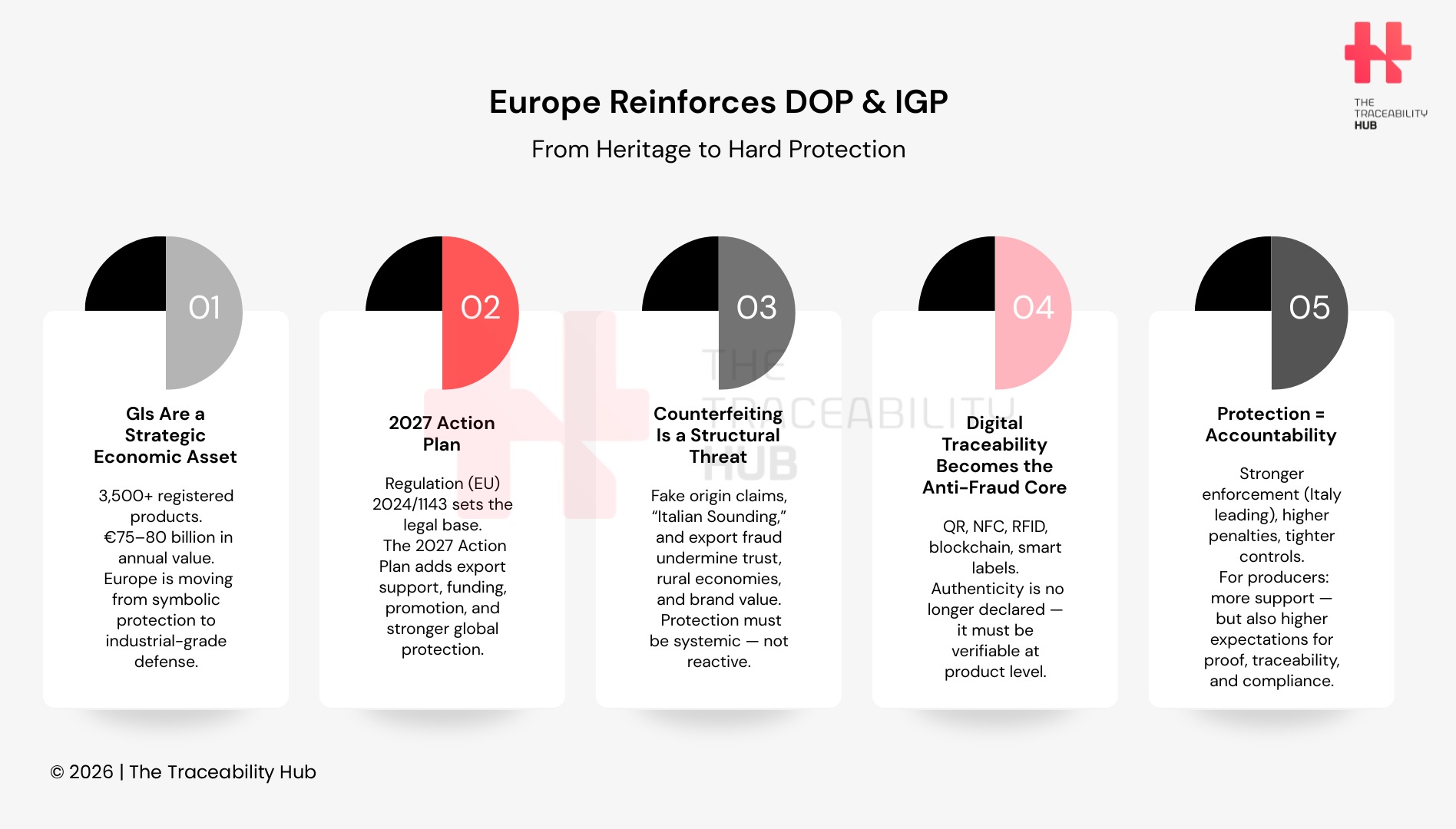
With more than 3,500 registered Geographical Indications, evenly split between food and wine, the EU GI system generates €75–80 billion annually and represents around 16% of total agri-food exports. These products consistently deliver double the market value of comparable non-certified goods, making them a cornerstone of Europe’s competitive advantage in global high-value agri-food markets.
Yet this value comes with vulnerability. Product counterfeiting, misuse of names (including the widespread “Italian Sounding” phenomenon), fragmented enforcement and uneven consumer awareness are eroding trust and undermining producers, especially those active in export markets. Against this backdrop, the European Commission has announced the development of a dedicated EU Action Plan for DOP and IGP products by 2027, designed to move beyond symbolic protection and toward systemic, enforceable and technology-enabled safeguards.
Why a European Action Plan Now?
The timing is not accidental. The Action Plan builds directly on Regulation (EU) 2024/1143, which modernized the legal framework for Geographical Indications but now requires concrete instruments to deliver real-world impact. At the same time, the Commission has opened discussions on strengthening the Common Agricultural Policy (CAP) budget, starting from the current €297 billion allocation for the next seven years, with GI products explicitly recognized as strategic drivers of rural resilience and value creation.
According to Christophe Hansen, European Commissioner for Agriculture and Food, the GI system is “the distinctive wealth of European agriculture” and must be both protected and actively valorized. The upcoming Action Plan is expected to focus on export support, stronger legal protection in international markets, coordinated promotion campaigns, and new investments in research, innovation and digital traceability.
The urgency is also geopolitical. In the context of weakening multilateral trade frameworks and growing tariff and non-tariff barriers, Geographical Indications have become both an economic shield and a diplomatic lever, requiring Europe to act with greater unity and strategic intent.
A Foundation for Rural Europe
Italy stands at the center of this vision. With 897 registered DOP and IGP products generating €20 billion in value, it represents the most advanced GI ecosystem in Europe, and, increasingly, a reference model. Speaking in Siena during the European Quality Food Forum hosted by Fondazione Qualivita, Commissioner Hansen explicitly described Italy as a benchmark for the future of Europe’s GI strategy.
“Geographical Indications are the backbone of rural Europe”, Hansen stated, announcing that the IG Action Plan 2027 will be one of the EU’s core tools to strengthen territorial economies, protect authenticity and enhance consumer recognition. The plan is expected to combine policy, promotion, enforcement and digital tools (and digital anti-fraud tools), reinforcing the role of producer consortia while improving visibility across retail and international markets.
It is a strategic choice aimed at safeguarding identity, ensuring fair competition and building long-term resilience across Europe’s agri-food supply chains.
European Voices: A Unified Call for Protection and Investment
What makes the EUs upcoming 2027 Geographical Indications Action Plan more than a policy headline is the rare alignment it has already generated across Europe’s GI powerhouses. At the VII European Forum on Food Quality in Siena, hosted by the Qualivita Foundation with oriGIn and national GI organizations, EU institutions, Member States, and producer consortia converged around the same message: Europe’s DOP and IGP system needs stronger protection, bigger investment, and smarter tools to scale globally and resist agri-food counterfeiting.
Commissioner Christophe Hansen has emphasized the strategic importance of Geographical Indications (GIs), describing them as both a symbol of European heritage and a major economic asset. According to European Commission data, GI products generate approximately €75 billion in annual sales and account for around 15–16% of total EU agri-food exports. On average, GI products command a price premium of roughly double that of comparable non-certified goods.
In this context, the Commission has signalled its intention to further strengthen support for GI products in the coming years, including enhanced export promotion, reinforced legal protection, and continued investment in innovation and rural development policies.
Italy: “Defending GIs Is Not Protectionism—It’s the Future”
Italy’s position is both ideological and operational: GI protection is framed as a forward-looking competitiveness strategy, not a defensive trade stance. Italian Agriculture Minister Francesco Lollobrigida captured this clearly: defending GIs “is not protectionism, it is the future,” tying the GI system to food supply chain value, rural jobs, and Europe’s food sovereignty narrative.
Just as importantly, Italy is moving on enforcement at home: in late 2025, the Senate approved (first reading) a bill strengthening checks along the food supply chain, upgrading penalties for food fraud and deceptive origin claims, and reinforcing GI protection with tougher sanctions and confiscation measures, an internal policy signal that mirrors Europe’s broader direction.
France: A Precious but Fragile Treasure
France added a crucial nuance: GIs are valuable precisely because they are vulnerable. French Agriculture Minister Annie Genevard described Geographical Indications as “a precious but fragile treasure”, stressing that Europe’s GI credibility is exposed not only to usurpations and food counterfeiting, but also to systemic pressures like health risks, climate change impacts, and the “proliferation of labels” that can confuse consumers and dilute meaning. Her prescription is strategic and long-term: stronger protection, greater support for producer consortia, investment in training and research, and more powerful promotion, especially toward younger generations.
Spain: An Economic Engine for Rural Areas
Spain has positioned Geographical Indications (GIs) at the centre of its rural economic strategy. According to data from Spain’s Ministry of Agriculture, Fisheries and Food, GI products generate approximately €8–9 billion annually, supporting over 330,000 registered farmers and livestock producers and linking close to 8,000 agri-food companies across the country.
These figures underscore the scale of Spain’s GI ecosystem and its importance for rural employment, value creation, and export competitiveness.
The Consortia Perspective: “A Success Story—Still Underutilized”
Producer organizations reinforced that Europe’s GI system is a success story, but its potential is still underexploited. oriGIn EU’s leadership emphasized the need to expand recognition, support food producers more effectively, and intensify promotion so consumers clearly associate GIs with authentic origin and quality, while Origin Italia pushed for stronger international protection and more support to consortia facing sustainability and export challenges.
Together, these voices point to a single strategic conclusion: Europe is repositioning GIs from “heritage policy” to “industrial-grade value protection”. The 2027 plan is set up to be the instrument that turns that consensus into budgets, enforcement mechanisms, and, crucially for traceability, digital tools that make authenticity verifiable in real markets.
Europe Reinforces DOP & IGP
The Growing Threat of Counterfeiting
As Europe prepares to strengthen protection for DOP and IGP products through the 2027 Action Plan, one risk is driving urgency more than any other: counterfeiting is escalating in scale, sophistication, and global reach. What was once perceived as a marginal or low-tech problem has evolved into a structural threat to Europe’s agri-food value chains, especially for high-value, export-oriented products.
The Counterfeiting Crisis
Recent cases make the scale of the issue impossible to ignore. From false Prosecco bottles circulating in international markets to counterfeit wine versions of well-known brands such as Yellow Tail appearing in the UK, foo fraud is no longer confined to obscure channels or low-end products. It increasingly targets recognized labels, premium positioning, and trusted origins.
Industry investigations show that counterfeit wine and food products directly threaten:
- Consumer trust, by breaking the link between label and products origin
- Brand credibility, undermining years of investment in quality and brand reputation
- Export markets, where legal protection is often weaker and enforcement fragmented
- Public health, due to the absence of controls on ingredients, storage, and production
- Fair competition, penalizing compliant producers while rewarding illicit actors
For Geographical Indications (GI), whose value is built precisely on authenticity, origin, and verifiable production methods, counterfeiting is not just an economic loss. It is an attack on the credibility of the entire GI system.
This is why the European Commission, supported by Member States and producer consortia, is shifting from a reactive model to a preventive, technology-enabled approach to protection.
Technology as an Anti-Fraud Shield
Modern traceability technologies are now a central pillar of Europe’s anti-counterfeiting response. No longer limited to back-office compliance, these tools are increasingly designed to operate across the entire supply chain, and all the way to the consumer.
Key anti-fraud technologies include:
- Dynamic QR codes, updated in real time and resistant to cloning
- Holographic seals, acting as visible and tamper-evident identifiers
- NFC chips, enabling contactless verification via smartphones
- RFID and chip less RFID solutions, including graphene-based laser-induced graphene (LIG) tags that are low-cost and non-replicable
- Blockchain-based traceability systems, providing immutable records of production and distribution events
- Smart Labels or digitally enabled labels that allow authentication, tracking, and consumer interaction as they can incorporate dynamic QR codes, NFC chips, RFID / chipless RFID, encrypted serial numbers, tamper‑evident features or cloud‑connected verification logic.
EU-backed initiatives such as TRACEWINDU exemplify this shift. The project aims to create complete digital lifecycle archives for wines, covering production, bottling, logistics, and distribution. By scanning smart packaging, users can access certified data directly, bridging the gap between physical products and trusted digital records.
For producers, these anti-fraud systems deliver tangible advantages:
- Proof of authenticity in domestic and export markets
- Compliance with EU traceability and transparency requirements
- Reduced exposure to fraud and brand misuse
- Stronger engagement with consumers through verified storytelling
For consumers, the benefits are equally concrete:
- Instant access to verified product origin and production information
- Practical tools to identify suspicious or non-authentic products
- Greater confidence in purchasing decisions, especially in premium segments
In this context, traceability evolves from a regulatory obligation into a strategic trust infrastructure.
Design as a Legal Defense
Alongside digital systems, Europe is rediscovering the defensive power of product design and packaging as legal assets. Brand protection is no longer limited to registering names or logos. Increasingly, through a combination of design protection, material innovation and security printing technologies. producers are protecting:
- bottle shapes (custom molds and proprietary geometries that are difficult to replicate)
- capsules and closures (unique capsule designs, embossing, and tamperevident features that prevent substitution or refilling)
- color schemes (such as precise color matching, proprietary inks, and controlled palettes that counterfeiters struggle to reproduce)
- label materials and textures (such as exclusive papers, tactile finishes, embossing, hot foils, and specialty varnishes that create a signature brand feel)
- distinctive graphic or tactile elements (such as micro‑details, embossing, debossing, metallic effects, and layered printing techniques that add complexity and authenticity)
These features can be legally registered and enforced, making imitation significantly harder and riskier for food counterfeiters. Design thus becomes a functional layer of anti-fraud strategy, reinforcing both legal protection and consumer recognition.
Combined with customs notifications and border surveillance, these measures help create a multi-layered defense, where law, technology, and design converge to protect authenticity.
National Legislation: Italy Tightens Controls and Penalties
While the EU prepares its 2027 Action Plan for Geographical Indications (GI), Italy has already moved from strategy to enforcement. With broad parliamentary support and no opposing votes, the Italian Senate has approved a sweeping reform that strengthens the country’s anti-fraud, traceability, and GI protection framework across the entire national agri-food supply chain.
The message is explicit: in a global market increasingly exposed to food counterfeiting, Italian sounding, and technologically enabled fraud, protecting DOP and IGP products requires hard law, tougher penalties, and coordinated controls.
New Criminal Offences Introduced
At the core of the reform is a major update to Italy’s criminal framework for food fraud. The law formally defines and penalizes a range of illicit practices that had previously been fragmented or inadequately covered, including:
- food fraud, across all stages of the food supply chain
- misleading indications on origin, quality, or quantity
- organized fraudulent activities, with aggravating circumstances
- “false organic” claims, responding to growing abuse of sustainability labels
- large-scale illicit batches, targeting industrial-scale fraud
Penalties are aggravated in severe cases, particularly when fraud is systematic or involves significant volumes. Authorities are also granted expanded powers to confiscate food products and tools used to commit fraud. Notably, edible seized goods can be redirected to social and public initiatives, combining enforcement with social responsibility.
This approach reflects a shift from symbolic deterrence to material disruption of fraudulent business models.
DOP and IGP Protections Reinforced
The legislation responds directly to long-standing demands from producer consortia and the GI sector. Protections for DOP (Protected Designation of Origin) and IGP (Protected Geographical Indication) products are significantly reinforced through:
- higher sanctions for misuse or imitation of protected denominations
- stricter conformity obligations, aligned with national and EU product specifications
- enhanced traceability requirements, strengthening oversight along the entire food chain
- proportional administrative penalties, calibrated to the size and turnover of the company involved, closing a long-standing enforcement gap
- the creation of a national control coordination task force, designed to harmonize inspections and reduce inefficiencies across authorities
This “cabina di regia”, the central coordinating body, for fraud controls aims to move Italy away from fragmented enforcement toward a coordinated, intelligence-driven inspection system, better suited to complex and internationalized supply chains.
A Response to Global Market Dynamics
Italian authorities have been explicit about the rationale behind the reform. These anti-fraud measures are not inward-looking; they are a response to global market dynamics that increasingly threaten GI value:
- the persistence of Italian sounding in international markets
- the growth of cross-border counterfeit networks
- the misuse of geographical names as generic marketing tools
- the evolution of fraud enabled by new technologies and complex logistics
The new law positions Italy not only as a beneficiary of the upcoming EU Action Plan, but as a test case for how GI protection can be operationalized through criminal law, administrative sanctions, and product traceability governance.
In strategic terms, Italy is sending a clear signal to Europe: the credibility of DOP and IGP systems depends on enforceability. Promotion and storytelling can multiply value, but only if backed by laws capable of defending authenticity at scale, and traceability platforms that allow the different stakeholders to share and show the data.
What This Means for Producers and Exporters
Europe’s shift from “heritage protection” to industrial-grade GI defense will reshape how DOP/IGP producers compete, especially in export markets. The upcoming EU GI Action Plan (2027), paired with stronger national enforcement (Italy first among them), signals a new reality: more protection, but also more accountability. For companies and consortia, this is both a strategic opportunity and an operational wake-up call.
Stronger Protection, but Higher Expectations
On the upside, food producers should benefit from a more supportive and coordinated European framework. In practical terms, that means:
- Improved international recognition of GIs through stronger agreements and cross-border protection mechanisms
- More financial support, alongside EU-backed campaigns designed to build awareness and demand in new markets
- Tighter enforcement against counterfeit and “evocative” products, reducing unfair competition and market dilution
But the second half of the equation is equally important: GI producers will face higher expectations, from regulators, distributors, customs authorities, and consumers. In the new system, “being certified” will not be enough. Producers will increasingly need to adopt:
- Modern traceability tools that strengthen products authenticity checks beyond paper-based compliance
- Stronger brand protection strategies, including registered design elements and customs notifications
- Better oversight of suppliers and distribution channels, especially in export markets where fraud often occurs downstream
- Clearer consumer communication, turning GI value into understandable, verifiable proof
In other words, agri-food protection is becoming conditional: the more value a GI generates, the more robust the proof of authenticity must be.
Traceability Becomes Core to GI Compliance
The deeper transformation is structural: traceability is moving from “nice-to-have” to core infrastructure for GI compliance and brand defense.
As fraud detection becomes more technologically advanced, food traceability platforms will increasingly underpin anti-counterfeiting efforts by delivering:
- Event-level product histories (production, transformation, packaging, logistics, distribution)
- Audit trails that support inspections, certification bodies, and legal enforcement
- Anti-tampering links between physical and digital identities, using QR codes/NFC/RFID tag systems that are harder to clone
- Automated compliance alerts, flagging anomalies (unexpected locations, duplicate scans, suspicious batch movements)
- Digital Product Passport (DPP) integration enabling standardized, interoperable access to verified product data as EU digital frameworks expand
This is the critical point for food producers and exporters: GI protection is no longer purely legal or promotional. It is increasingly data-driven, built on the ability to prove origin, demonstrate chain integrity, and detect risk before counterfeit goods scale.
For product exporters, especially, this creates a new “entry requirement” for premium markets: distributors, platforms, and retailers will increasingly prefer products that can demonstrate verifiable authenticity at the package level, not only through documentation.
For the GI system, the direction is clear. Europe is building a model where value creation and value protection run on the same rails: certification + enforcement + product traceability. The producers who treat data and verification as part of their brand story, not just part of compliance, will be the best positioned to win in global markets.
A Turning Point for Europe’s Quality Heritage
The Siena Forum marked a decisive turning point for the future of European Geographical Indications. The announcement of a dedicated EU Action Plan for 2027, combined with coordinated European investments, strengthened national legislation, and the rapid adoption of advanced traceability technologies, signals a clear shift in direction.
Europe is no longer treating DOP and IGP products as assets to be defended only through tradition or reputation. Instead, it is preparing to elevate and protect its quality heritage through coordinated policy, digital innovation, and global leadership, aligning legal frameworks, market strategies, and data-driven enforcement into a single, coherent system.
Producer consortia, institutions, and technology providers are no longer operating in parallel; they are being called to act as parts of the same value-protection ecosystem.
For producers, exporters, and policymakers alike, the message is unambiguous. The future of European Geographical Indications will depend on the ability to combine tradition with innovation, cultural value with technological rigor, and regional identity with global ambition. Those who embrace this convergence will not only defend food authenticity, but they will also redefine it for the next generation of global markets.
In that sense, Europe’s GI strategy is no longer just about protecting names. It is about building consumers’ trust on a scale, and ensuring that every bottle, every label, and every origin story can stand up to scrutiny, anywhere in the world.
Coming soon: FBCA Launches RECY:CHECK: New Food Packaging Recyclability Standard