



Autentica: Italy’s AI Solution for Counterfeit Detection & Product Authentication
Italy has transformed its approach to protecting its prized Made-in-Italy products from counterfeiters by adopting AI advanced technology. The Italian government revealed “Autentica,” a new mobile app that uses advanced AI algorithms to authenticate genuine Italian products and spot fakes with remarkable accuracy supporting the broader anti-counterfeiting technology initiative. This state-of-the-art technology, developed by ADM (Agenzia delle Dogane e dei Monopoli, Customs and Monopolies Agency) and Sogei working together, makes customs control more efficient through digital product verification.
Italy stands out as one of Europe’s most innovative countries in using AI for public administration and digital transformation of government services. Data presented at the “Ital_IA: tra dati pubblici e algoritmi” event shows that Italy has developed 157 AI projects out of nearly 1,500 worldwide, and more than a third of these projects are already running. The country uses computer vision techniques to identify counterfeit goods accurately, which helps protect Made-in-Italy products and improves customs controls effectively. This practical application of AI shows Italy’s steadfast dedication to solving real-life problems in international trade, supply-chain traceability and product authentication.
Italian Government Launches Autentica to Combat Counterfeiting
The Italian Customs and Monopoly Agency (ADM) and Sogei have revealed “Autentica,” an advanced application that certifies product origin and helps curb the growing problem of counterfeit goods especially in luxury products and protected Italian brands. This groundbreaking tool marks a crucial milestone as authorities work to protect the prestigious Made in Italy brand and its global reputation.
Fake products labeled as Italian but produced abroad are flooding global markets. In the agri‑food sector alone, the value of counterfeit goods has surpassed €120 billion annually, according to Coldiretti, with over two out of three products sold worldwide evoking false Italian origins.
”Italian Sounding” is a famous expression which refers to products that use Italian names, colors, or imagery (e.g., “Parmesan”, “Fettucine Alfredo”, “San Marzano style”) without being authentically Italian.
It is not illegal counterfeiting but misleading marketing.
The European House – Ambrosetti research center found regional losses: Lombardy (€10.2B), Veneto (€10B), Emilia‑Romagna (€9.9B), with other regions like Piemonte and Campania also heavily affected.
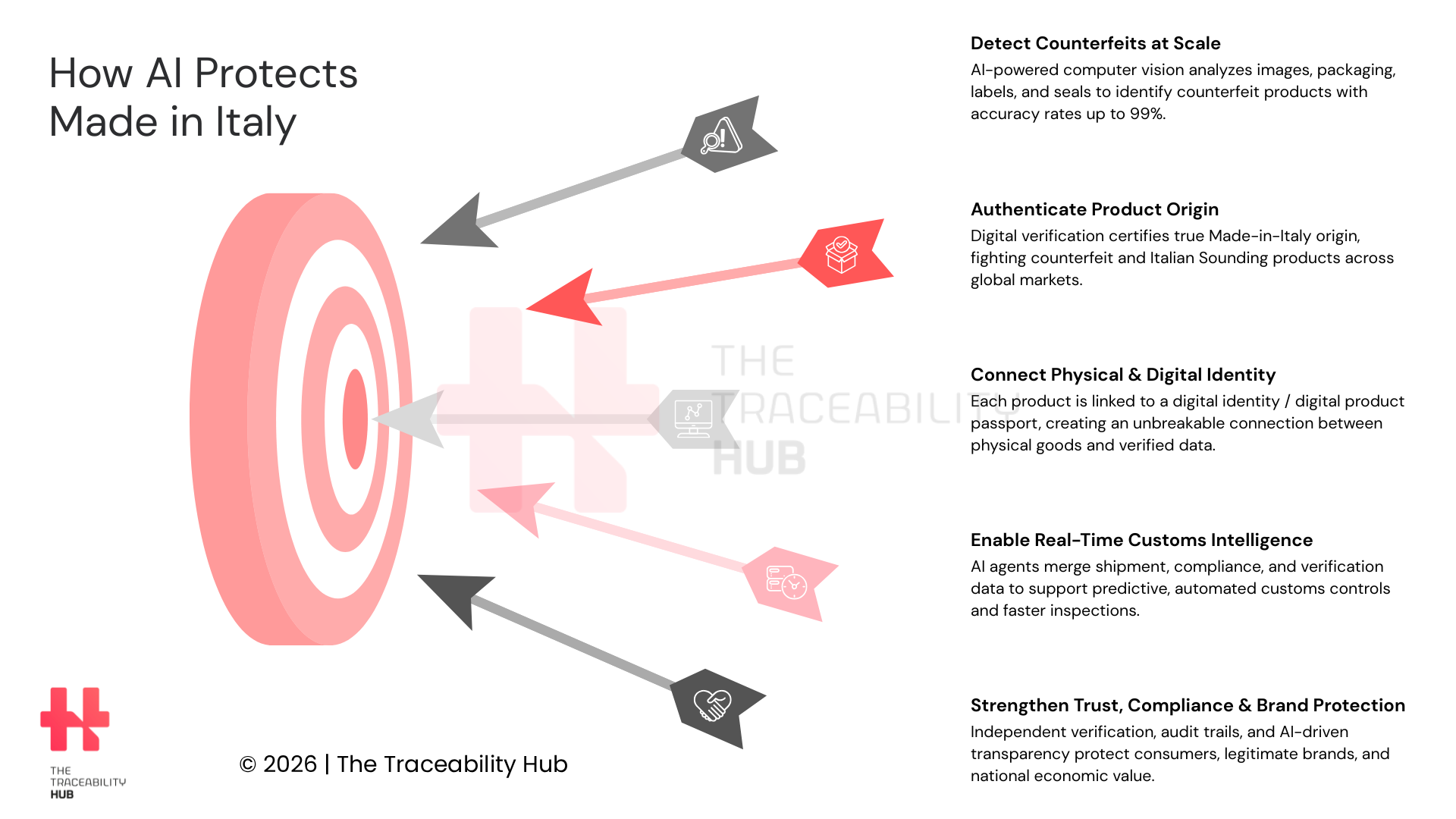
“Autentica” uses sophisticated computer vision algorithms to spot counterfeit products with exceptional precision leveraging AI-based product recognition systems. It means that inspection errors are reduced, and the quality of customs checks improves. The system also makes predictive and automated controls possible, which line up perfectly with European traceability standards and anti-fraud compliance requirements.
Globalization has made the counterfeit market more sophisticated. Fake luxury goods have become so well-made that even experts find it hard to tell real products from counterfeits. This challenge shows why AI-powered solutions like “Autentica” are essential for combatting global counterfeit trade, which continues to rise.
Modern artificial intelligence tools can now authenticate products with remarkable accuracy rates of up to 99.1%, thanks to extensive image databases and big data training sets Italian authorities want to protect genuine Italian craftsmanship’s reputation and integrity through this enterprise artificial intelligence implementation and secure product authentication ecosystem.
“Autentica” launched during Anti-Counterfeiting Week 2024, when customs officials reported almost 9,000 seizures of counterfeit products. They shut down 354 counterfeiting websites and issued over 2,000 fines under the new law protecting Made in Italy. These numbers show why Italy needs its artificial intelligence plan to effectively stop product fraud and strengthen brand protection strategies.
Autentica Uses AI to Authenticate Products and Detect Fakes
Autentica’s authentication system uses advanced convolutional neural networks (CNNs) that spot counterfeit products with 90% accuracy and 95% recall rates, performance aligned with state-of-the-art AI image recognition benchmarks. These AI models use sophisticated image processing algorithms to analyze visual data and identify subtle differences between genuine and fake items.
The system merges shipment, compliance, and verification data through AI agents that flag risks and maintain detailed audit trails (supporting regulatory compliance and supply chain transparency). On top of that, it uses molecular testing solutions from partners like Index Bio to verify product authenticity across the supply chain.
Index Bio is a certification system for 100% Made in Italy organic products. It ensures that the entire production cycle is carried out in Italy, with strict controls on origin and compliance with Italian regulations. And it provides a traceability framework that helps consumers and distributors distinguish authentic Italian organic goods from imitations.
The computer vision system of Autentica can spot product packaging, labels, and design inconsistencies that human inspectors might miss. Technology scans state seals through photos and provides applicable information about product origin, characteristics, and maybe even recommended pairings, enhancing consumer trust and transparency.
This AI system tackles a crucial market challenge – counterfeit goods make up about 2.5% of global trade and cost businesses billions in yearly revenue. The AI platform delivers up-to-the-minute data analysis and automated inspection processes that expand efficiently, supporting real-time customs intelligence.
Autentica builds an unbreakable connection between physical products and their digital records, creating a true digital passport and identity for goods. The system also enables milestone-based escrow and faster payments that end up reducing supply chain risk, which typically costs more than 10% of shipment value.
Italy Expands AI Strategy in Public Administration
Italy’s public administration sector is experiencing a radical alteration in artificial intelligence implementation that goes beyond product authentication and extends into e-government modernization. For over 48 years, Sogei, the IT company fully owned by the Italian Ministry of Economy and Finance, has played a crucial role in modernizing digital public services. The national digital transition agenda has shown results. A total of 576 public administrations have moved to the national cloud, which includes 211 central administrations, 221 local administrations, and 144 health authorities, an example of large-scale cloud adoption.
The Italian government has set ambitious goals for artificial intelligence implementation. They want 75% of government offices to employ cloud services by 2026. The tax sector has seen significant progress with the VeRa Algorithm a machine learning–driven tax fraud detection system. This system analyzes VAT filings and related transactions, and it identified over one million high-risk cases in 2022. The algorithm works by cross-checking data from multiple sources such as e-invoices, bank transactions, and customs records.
Healthcare has also embraced AI innovation. The algorithms check prescription consistency against clinical guidelines. An implementation in Puglia Region revealed that 40% of prescribed tests were not appropriate. The INPS (National Social Security Institute) has achieved similar success. They deployed a BERT classifier that sorts over 2 million Certified Emails automatically with accuracy above 80%. This innovation could save 30,000-40,000 working days each year, reflecting AI-driven automation in public services.
The 2024-2026 Italian Strategy for Artificial Intelligence has designated the Agency for Digital Italy (AgID) as one of two national AI authorities. The government has also allocated a €1 billion fund. This money will help seed startups and support an “Italian large language model” to keep sensitive public workloads under domestic control strengthening the nation’s AI sovereignty.
How AI Protects Made in Italy
Italy Launches AI-Powered Autentica to Protect Made-in-Italy Goods
Italy is pioneering technological breakthroughs with its detailed artificial intelligence strategy. “Autentica” marks a major milestone in the country’s battle against counterfeit products. The technology shows how AI can protect national economic interests and preserve cultural heritage using trusted product authentication technology.
Authentication systems have achieved impressive accuracy rates of up to 99.1%, proving AI’s effectiveness against sophisticated counterfeiters. Italian authorities now have powerful tools to protect consumers and legitimate manufacturers from fraud and strengthen global brand security.
Counterfeit goods make up about 2.5% of worldwide trade, but Italy has responded with determination and technical ingenuity. Anti-Counterfeiting Week 2024 saw thousands of counterfeit items seized, and hundreds of fraudulent websites shut down.
Italy’s broader AI implementation in public administration shows a nation that accepts new ideas and leads in European AI innovation. The government’s goal is to have 75% of offices using cloud services by 2026. VeRa, their algorithm, identifies high-risk tax cases efficiently. VeRa stands for “VERification Assisted by Artificial Intelligence,” a European research initiative designed to strengthen digital verification and fight disinformation and counterfeit content.
AI systems have revolutionized healthcare and social security sectors. They check prescription appropriateness and process millions of emails, which save thousands of working days each year through AI-enabled process automation.
Autentica and related AI initiatives have made Italy a European leader in real-life AI applications. The country balances breakthroughs while protecting its renowned craftsmanship and product quality. This all-encompassing approach provides a model for other nations battling counterfeit goods. As AI reshapes verification processes, Made-in-Italy products will enjoy unprecedented protection globally, preserving Italian excellence’s legacy for future generations.
Read more: Medical Tracking Done Right: Step-by-Step Device Lifecycle Management Guide