



Italy Fashion Certification Explained: What the Proposed Textile Supply Chain Rules Mean for Brands
In October 2025, Italy’s Senate committee approved a proposed fashion supply chain certification framework aimed at improving transparency in the Italian textile industry, backed by the Ministry of Enterprises and Made in Italy. The proposal included annual certification, production-site checks, a public registry, and sanctions for improper use of the “Filiera della moda certificata” wording. However, these provisions were later removed during the bill’s passage in the Chamber of Deputies, and the law was approved definitively on 4 March 2026 without the fashion certification chapter. This article explains what the proposal contained, why it mattered, and what brands should watch next in Italy’s evolving fashion compliance landscape.
Italy’s Proposed Fashion Supply Chain Certification Explained
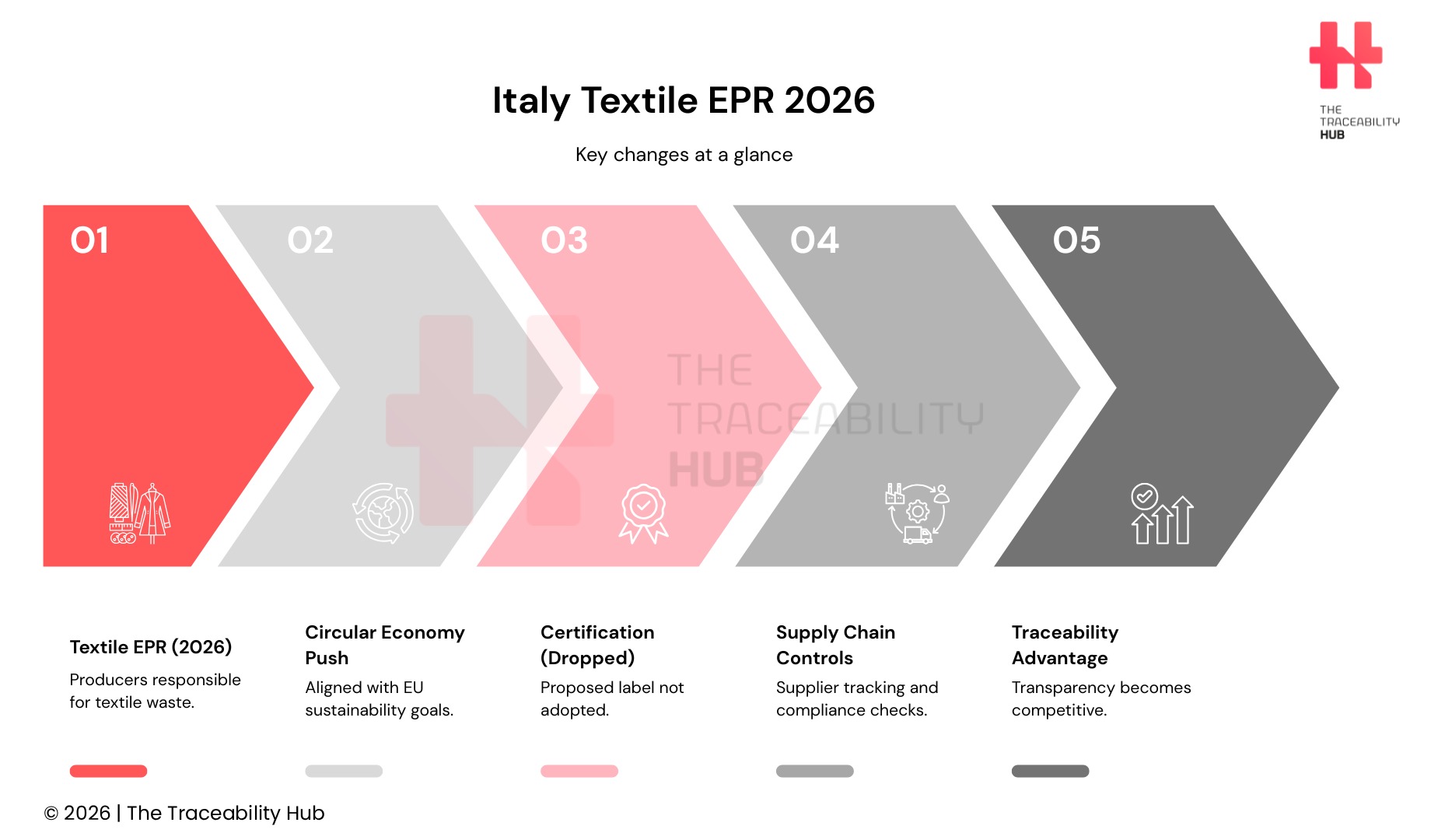
Italy is preparing major policy changes affecting fashion supply chains, particularly through the upcoming textile Extended Producer Responsibility (EPR) framework expected to begin around 2026. According to statements from Laura D’Aprile, Head of Sustainable Development at the Italian Ministry of the Environment and Energy Security, the planned system will extend producer responsibility to textile products including apparel, footwear, accessories, leather goods, and home textiles.
Under an EPR system, producers and importers are typically required to finance or organize the collection, recycling, and proper disposal of products at the end of their lifecycle. Italy’s initiative aligns with broader EU circular economy objectives and with the EU strategy for sustainable and circular textiles.
Alongside these sustainability policies, Italian lawmakers also debated a voluntary certification framework for fashion supply chains aimed at improving transparency in the domestic manufacturing ecosystem. The proposal introduced the designation “filiera della moda certificata” (“certified fashion supply chain”), which would identify companies operating within compliant and traceable production networks.
The draft framework defined a certified supply chain as a structure composed of a lead company and associated production partners connected through contractual relationships covering design, sampling, manufacturing, and processing activities. Companies working with subcontractors would have been required to include contractual provisions ensuring compliance with applicable labor laws and collective bargaining agreements.
Certification would have been issued by independent auditors or audit firms authorized under Legislative Decree 39/2010, Italy’s regulatory framework for statutory audit activities. These certifying bodies would verify compliance through documentation reviews, supply chain inspections, and production-site access when necessary. The draft proposal indicated certification decisions would be issued within 60 days of application submission.
Misuse of the certification designation was expected to be treated as an unfair commercial practice, with administrative penalties reported in policy proposals ranging from €10,000 to €50,000.
If introduced in the future, the framework would differ from product-focused certification systems such as OEKO-TEX and Global Organic Textile Standard. Those standards primarily verify environmental or chemical safety criteria in textile products, while the proposed Italian model was designed to emphasize supply chain transparency, traceability, and labor compliance across production networks.
Italy Textile EPR 2026
Key Requirements in Italy’s Proposed Fashion Supply Chain Certification Framework
Under the fashion supply-chain certification proposal debated in 2025, lead companies purchasing from suppliers in the Italian fashion industry would have been required to maintain a supplier register (“anagrafe dei fornitori”) and update it at least every six months. The framework also envisaged supplier qualification procedures based on guidelines developed by industry associations and subject to oversight by the Ministero delle Imprese e del Made in Italy.
The draft framework required lead companies to include contractual safeguards with all supply-chain partners and subcontractors. These provisions were intended to ensure compliance with applicable labor, tax, social security, and occupational health and safety regulations across the production network.
At the time of signing supply contracts, lead companies would have been required to collect and verify key compliance documentation from suppliers. This documentation included Chamber of Commerce registration certificates, the Documento Unico di Regolarità Contributiva (DURC) confirming social security compliance, the Documento Unico di Regolarità Fiscale (DURF) relating to tax compliance, and a declaration of technical-professional suitability required under Article 26 of Legislative Decree 81/2008. Where no formal legal deadline existed, suppliers would have needed to update this documentation at least every two years.
The proposal also required lead companies to adopt organizational, management, and control models pursuant to Articles 6 and 7 of Legislative Decree 231/2001. These models are commonly used in Italy to prevent corporate liability for certain offenses, including crimes related to unlawful labor intermediation and labor exploitation, money laundering, and the handling of assets derived from illicit activities.
Supply-chain contracts under the proposed framework would also have been required to include detailed obligations for subcontractors, including termination clauses for non-compliance and corrective measures to restore legal compliance when violations occur. Contracts were expected to require the application of the relevant national collective labor agreements (CCNL) applicable to the fashion or textile sector.
Certification of compliant supply chains would have been performed by independent auditors or audit firms authorized under Article 2 of Legislative Decree 39/2010. These certifying entities would have been able to verify compliance through document reviews, supply-chain inspections, and access to production sites. The draft framework indicated that certification decisions should be issued within 60 days, with a possible 30-day suspension period if additional information was required.
However, during the parliamentary process these certification provisions were removed from the final legislation approved in March 2026 by the Italian Parliament. As a result, the framework should currently be understood as a proposed regulatory model rather than an active certification system for the Italian fashion supply chain.
What These Developments Could Mean for Fashion Supply Chains in 2026
Italy’s fashion sector is entering a period of increasing regulatory attention as policymakers focus on sustainability, supply chain transparency, and responsible production practices. The expected introduction of textile EPR rules will likely require producers and importers to contribute to the costs of collecting, recycling, and managing textile waste, aligning Italy with broader European circular economy objectives and the EU requirement for separate textile waste collection.
Separate legislative discussions in Italy have also explored the possibility of introducing an Eco-Score system for textiles, inspired by similar sustainability labeling initiatives in Europe. Draft proposals have suggested environmental contributions for lower-rated products and potential advertising restrictions targeting certain fast-fashion practices. While these measures are still under discussion and have not been implemented as binding rules, they reflect a broader policy trend toward greater environmental accountability in the fashion sector.
For fashion brands, manufacturers, and supply-chain operators, these developments signal a clear direction of travel. Even where specific certification systems have not yet been adopted, regulators and industry stakeholders are increasingly emphasizing traceability, supplier oversight, and sustainability reporting throughout textile production networks. Companies that invest in stronger documentation systems, supplier due-diligence procedures, and transparent supply-chain governance may therefore be better positioned to adapt as Italy’s textile and fashion regulations continue to evolve.
Transparency Is Becoming the New Competitive Advantage
While Italy’s proposed fashion supply chain certification framework was ultimately removed from the final legislation, the policy discussions surrounding it reflect a broader shift in how regulators view transparency in the fashion industry. Italian and European initiatives are increasingly focused on traceability, supply chain accountability, and environmental responsibility across textile production networks.
Upcoming developments such as textile Extended Producer Responsibility (EPR) and potential sustainability labeling initiatives suggest that compliance expectations for fashion brands will continue to expand. For companies operating in Italy’s textile sector, this means strengthening supplier oversight, documentation practices, and supply chain governance.
In the evolving regulatory environment, traceable and well-documented supply chains are quickly becoming a competitive advantage rather than just a compliance requirement. Brands that invest early in transparency and responsible sourcing will be better prepared for future regulations and growing consumer expectations.
Read more: Digital Twins in Supply Chains: Building the Foundation for Intelligent Systems