



Key Made in Italy Sectors
Made in Italy Day 2026, celebrated on April 15, continues to expand as a nationwide initiative promoting Italy’s industrial excellence, Italian manufacturing strength, and cultural identity. Organized by the “Ministero delle Imprese e del Made in Italy”, the event brings together hundreds of initiatives across all regions, highlighting both traditional and emerging sectors within the broader Italian industrial ecosystem.
Key industries represented include agri-food, apparel, furnishings, and automotive, reflecting the breadth of Italy’s production ecosystem and its globally recognized Made in Italy industries and export-oriented manufacturing sectors.
While participation has grown significantly since the first edition in 2024, the Day is increasingly positioned not only as a celebration but also as a platform to strengthen skills development, innovation, and supply chain integration and value chain coordination, key pillars for the long-term competitiveness of Made in Italy and Italian exports.
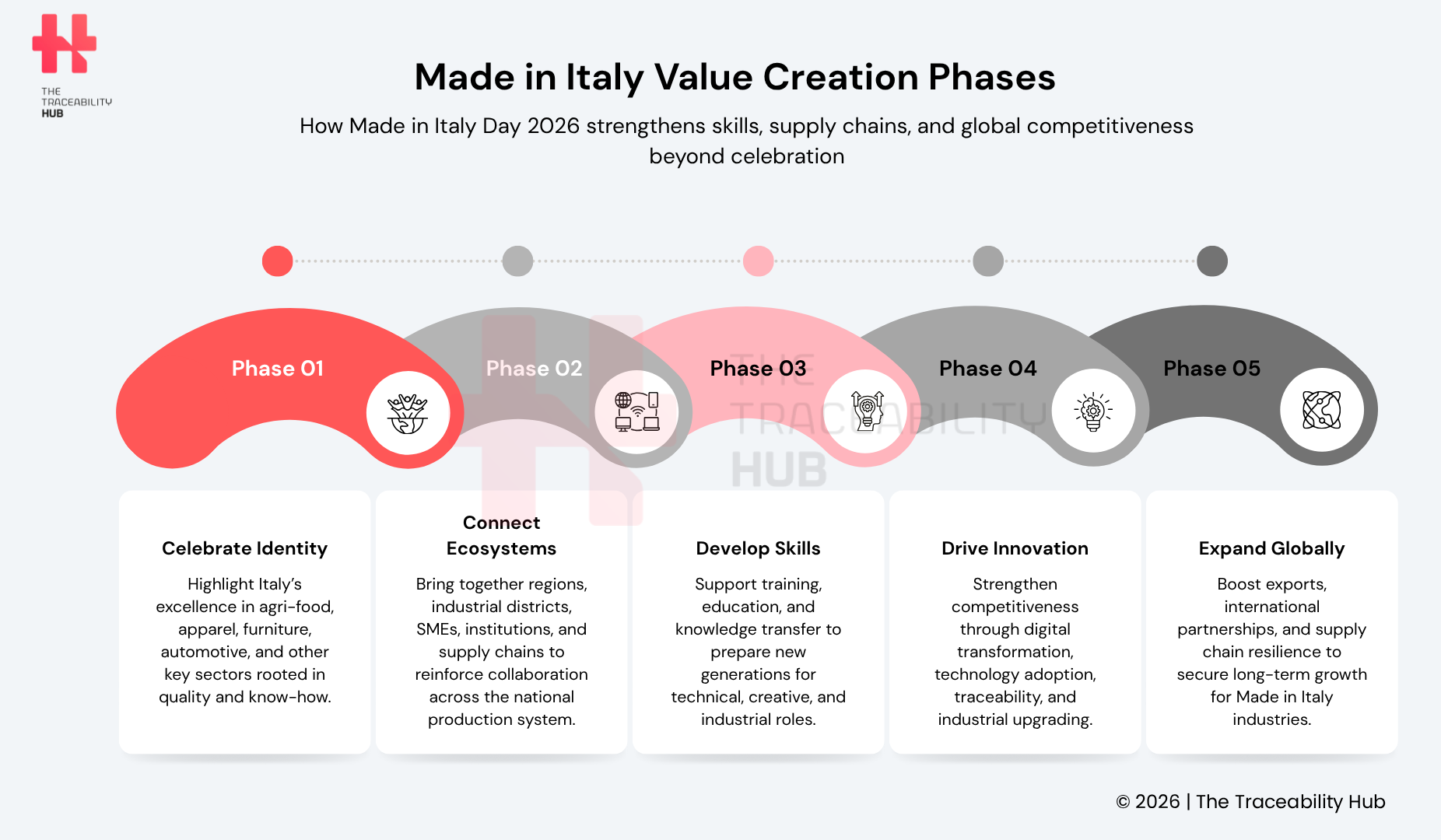
Made in Italy Value Creation Phases
Made in Italy Day 2026: Growth of a National Initiative
An Expanding Platform for Italian Excellence
The third edition of Made in Italy Day was presented by the Ministero delle Imprese e del Made in Italy at Palazzo Piacentini and will take place on April 15, a date chosen to honor Leonardo da Vinci’s birth anniversary.
Since its launch in 2024, the initiative has rapidly evolved into a nationwide platform promoting Italy’s productive system and Italian manufacturing ecosystem, with a growing number of events organized across regions and sectors. Each edition has increasingly highlighted key priorities for the country’s industrial ecosystem and manufacturing competitiveness, including identity, innovation, and skills development.
The 2026 edition places particular emphasis on training and the transmission of expertise, recognizing the central role of skills development in preserving and advancing the distinctive qualities of Made in Italy production.
According to Minister Adolfo Urso, the Day represents an opportunity to celebrate “quality, excellence, and know-how” rooted in the intersection between local traditions and innovation, key elements of Italian industrial excellence and global competitiveness.
Geographic Distribution Across Italian Regions
Made in Italy Day involves a broad territorial participation, with initiatives organized across all Italian regions reinforcing the strength of regional industrial ecosystems and local production systems.
While participation is widespread nationwide, the distribution of events reflects the diversity of Italy’s economic landscape, with strong engagement across the South, Central regions, and the industrial hubs of the North. This geographic spread highlights the role of Made in Italy as a unifying element connecting different industrial districts, supply chain, and production systems and local specializations.
The Core Sectors of Made in Italy
The initiative showcases the key industries that have historically defined Italian manufacturing excellence and global export competitiveness, often summarized in the traditional “A” sectors:
- Agri-food
- Apparel
- Furniture
- Automotive
- Automation
These sectors reflect Italy’s distinctive approach to production, combining craftsmanship, industrial capability, and a strong focus on products designed around people and quality of life, hallmarks of Italian manufacturing excellence and value-added production systems.
Emerging High-Value Sectors Expanding the Made in Italy Ecosystem
Made in Italy Day increasingly reflects a broader industrial landscape, where traditional sectors are complemented by emerging and high-value industries within the evolving Italian industrial ecosystem and innovation landscape.
Alongside established areas of excellence, growing attention is being given to sectors such as the blue economy, tourism, and cultural and creative industries, which play a significant role in strengthening Italy’s international positioning and export diversification strategy.
In parallel, advanced industries – including healthcare, aerospace, and defense – are becoming more visible within the wider Made in Italy ecosystem, highlighting the country’s capacity for innovation alongside its manufacturing heritage.
This evolution points to a progressive broadening of Made in Italy, extending beyond traditional definitions while maintaining its core focus on quality, expertise, and long-term value creation in global markets.
From Annual Celebration to Industrial Platform
Strengthening the Strategic Role of Made in Italy
Made in Italy Day is increasingly positioned not only as a symbolic celebration, but as part of a broader effort to reinforce Italy’s industrial ecosystem and strengthen national industrial policy priorities.
Recent policy discussions promoted by the Ministero delle Imprese e del Made in Italy have emphasized the importance of strategic value chains, skills development, and industrial innovation in sustaining the competitiveness of Made in Italy. These priorities reflect a growing focus on connecting traditional sectors with emerging industries such as digital technologies, health-related fields, and advanced manufacturing and Industry 4.0 solutions.
Extending Engagement Beyond a Single Day
While April 15 remains the focal point, initiatives linked to Made in Italy Day often extend over multiple days and include a broader program of events, particularly in Rome and other major cities, supporting industrial networking and ecosystem collaboration.
These activities typically feature institutional roundtables, industry discussions, and networking opportunities, with a strong emphasis on artisanal knowledge, production processes, and generational skills transfer within manufacturing sectors.
This extended format contributes to:
- Increasing visibility of Italian production systems
- Strengthening connections across supply chains
- Encouraging younger generations to engage with technical and creative professions, supporting future workforce development
How Training and Education Create Lasting Effect
The evolution of Made in Italy increasingly depends on the ability to develop advanced skills and foster innovation-oriented mindsets across education and industry, reinforcing long-term industrial competitiveness.
Strengthening the connection between education systems, technical training, and industrial needs is widely recognized as a key factor in supporting competitiveness. This includes not only craftsmanship and creativity, but also managerial and financial capabilities, which are essential for scaling businesses and navigating global markets.
Technology plays a central role in this transition, enabling companies to enhance efficiency, adopt digital transformation strategies, and integrate innovation while preserving the distinctive qualities of Italian production.
The Role of Historic Brands in Building Legacy
Italy’s industrial system includes a large number of companies recognized under the “Registro dei Marchi Storici di Interesse Nazionale”, Register of Historical Trademarks of National Interest, representing a significant heritage of expertise and identity, and industrial legacy within Italian manufacturing.
These brands illustrate how artisanal traditions can evolve alongside advanced production approaches, maintaining relevance in changing markets.
Ensuring their continuity requires:
- Supportive regulatory environments and effective industrial policy frameworks
- Targeted incentives for innovation and growth
- Effective mechanisms for knowledge transfer across generations
In this context, small and medium-sized enterprises (SMEs) play a central role, balancing international expansion with the preservation of their cultural and production identity.
Building Sustainable Value Through Strategic Initiatives
Strengthening International Engagement
The “Ministero degli Affari Esteri e della Cooperazione Internazionale” plays a key role in supporting the internationalization of Italian businesses through business diplomacy export promotion strategies, and global trade partnerships.
These initiatives and direct engagement between companies and foreign markets.
These activities include bilateral meetings, economic missions, and networking platforms, often involving Italian diplomatic representatives and private sector stakeholders. Under the leadership of minister Antonio Tajani, such initiatives have increasingly focused on expanding opportunities in strategic regions, including Asia, the Gulf, and Latin America.
This approach contributes to strengthening Italy’s position as one of Europe’s leading manufacturing economies and a major global exporter, reinforcing the role of Made in Italy industries in international markets
Connecting Skills, Industry, and Social Impact
Industry associations and local ecosystems are promoting digitalization and innovation strategies, and industry 4.0 adoption within manufacturing districts, with the aim of enhancing competitiveness across entire production systems, including small and medium-sized enterprises (SMEs).
At the same time, there is growing recognition of the need to align short-term economic support measures – such as incentives and access to credit – with long-term industrial development goals.
Social cooperatives represent an important component of this ecosystem, demonstrating how workforce development can be combined with social inclusion, particularly by integrating individuals from disadvantaged backgrounds into productive activities and local industrial value chains.
In parallel, increasing attention is being given to supply chain transparency and traceability, and ethical sourcing practices, with companies adopting frameworks and standards designed to promote ethical practices, prevent labor exploitation, and ensure safe working conditions across their networks.
Strengthening Supply Chains and Industrial Collaboration
Italy’s production system is characterized by a strong presence of small and medium-sized enterprises (SMEs), often organized within Industrial districts and regional manufacturing clusters. These ecosystems combine specialization, flexibility, and close integration across supply chains, enabling companies to respond quickly to market demand.
At the same time, ongoing challenges – such as access to capital, technological upgrading, and international scaling – highlight the need for greater coordination, investment, and collaboration mechanisms across value chains.
Economic Security and Export Route Protection
The United States represents one of Italy’s most important export markets, accounting for a significant share of national manufactured exports, estimated at around €60–65 billion annually, or roughly 10–11% of total exports.
To operate effectively in this context, Italian companies must adopt structured approaches that consider:
- Local demand dynamics and market-specific consumer trends
- Distribution and logistics channels within global supply chains
- Regulatory and compliance requirements across different U.S. States
Strengthening export resilience also involves diversification of markets, policy support for internationalization, and continuous adaptation to evolving trade conditions, reinforcing long-term export competitiveness.
The Movement’s Impact on Italy’s Industrial Future
Addressing Structural Challenges in Italian Manufacturing
Italy’s manufacturing system continues to face long-term structural challenges, particularly in terms of productivity growth and value-added expansion. According to recent policy analyses, manufacturing value added has shown limited growth since the mid-1990s, especially when compared to other major European economies.
Labor productivity has also increased at a slower pace than in countries such as France and Germany, highlighting the need for stronger investment in innovation, digital transformation, skills, and technology adoption. In this context, rising energy costs – particularly following recent shocks – have placed additional pressure on production, especially in energy-intensive sectors.
From Fragmented SMEs to Scalable Industrial Systems
Italy’s industrial structure is characterized by a high concentration of small and medium-sized enterprises (SMEs), often embedded in local production systems and Industrial districts that form the backbone of the Italian economy.
This model provides flexibility, specialization, and strong territorial identity, but also presents challenges in terms of:
- Access to capital and SME financing
- Scaling capabilities and business growth strategies
- International competitiveness
Compared to other European economies, Italy maintains a more fragmented industrial base, with a relatively lower weight of large enterprises. Strengthening connections across supply chains and enabling SMEs to scale – while preserving their distinctive capabilities – remains a central priority for industrial policy and economic development.
Energy Security and Supply Chain Resilience
Recent years have highlighted the importance of energy security and supply chain resilience for Italy’s industrial system. Efforts to diversify energy sources and reduce external dependencies have become a key component of national strategy and industrial sustainability planning.
At the same time, growing attention is being paid to critical dependencies in manufacturing inputs, reinforcing the need for:
- Supply chain visibility and risk management strategies
- Risk management
- Strategic sourcing
These elements are increasingly linked to broader discussions on economic security, industrial autonomy, and resilience in global supply chains.
Bridging Territorial Gaps
Reducing regional disparities remains a structural objective for Italy.
Strengthening balanced industrial development across all regions, particularly between the North and the South, is seen as essential not only for economic growth, but also for social cohesion and long-term stability.
In this perspective, industrial policy is increasingly connected to:
- Employment generation and job creation in manufacturing sectors
- Skills development and workforce training programs
- Local ecosystem strengthening and regional industrial development
International Partnerships and Export Strength
Italy continues to play a leading role in global trade, with manufacturing accounting for a significant share of national exports, above the European average: this reflects the strength of Made in Italy exports and specialized manufacturing sectors.
This performance is supported by a dense network of specialized SMEs and integrated supply chains, enabling Italian companies to compete internationally across multiple sectors and maintain export competitiveness.
Strengthening international partnerships and market access remains essential to sustaining this position, particularly in an environment shaped by geopolitical shifts, regulatory complexity, and evolving global demand.
Shaping Italy’s Industrial Future
Made in Italy Day 2026 reflects the growing scale and strategic relevance of the initiative. According to the Ministry of Enterprises and Made in Italy, nearly 800 events are scheduled around the April 15 celebration, confirming the expanding reach of the program in Italy and abroad.
Its significance, however, goes beyond a single day. The 2026 MIMIT white paper, Made in Italy 2030, places renewed emphasis on skills, industrial competitiveness, and value-chain coordination as long-term priorities for the country’s productive system.
In this context, the initiative can be read as part of a broader effort to address structural weaknesses while reinforcing the capabilities that distinguish Italian production, from craftsmanship and design to innovation and specialized manufacturing. The path forward depends on connecting traditional sectors with emerging industries, reducing territorial imbalances, and helping SMEs grow without losing the identity and expertise that make them distinctive within the global manufacturing landscape.
Coming soon: Building Reliable Digital Twins Through Unit-Level Traceability