



Proven Serialization Methods for Alcohol Supply Chains
Brazilian health authorities have investigated a cluster of suspected methanol poisonings linked to adulterated alcoholic beverages circulating within vulnerable supply chains. Initial updates from Brazil’s Health Ministry confirmed 11 cases associated with contaminated drinks, with 116 additional cases under investigation, and at least one confirmed death at the time of reporting.
In parallel, the UK Foreign Office expanded its travel advisories, adding 8 additional countries to its methanol-risk warning list following similar incidents globally.
Counterfeit or adulterated alcoholic beverages can closely resemble legitimate products but may contain dangerous concentrations of methanol. Toxicology sources indicate that ingestion of as little as approximately 25–30 ml of methanol can be fatal without prompt medical treatment.
These incidents highlight the increasing need for stronger product authentication, supply chain traceability, and anti-counterfeit safeguards in the alcoholic beverages sector.
Serialization has emerged as a powerful tool to combat counterfeit trade. By assigning a unique identifier, a digital identity, to each product unit, serialization enables verification throughout the supply chain via track-and-trace systems. The pharmaceutical industry has relied on serialization for over a decade under regulatory frameworks such as the EU’s Falsified Medicines Directive, helping to strengthen protection against falsified medicines.
According to the OECD, global trade in counterfeit and pirated goods is estimated at nearly half a trillion dollars annually, highlighting the scale of the challenge across multiple sectors.
The alcoholic beverages industry faces similar risks from illicit and adulterated products circulating within vulnerable supply chains. While estimates of the informal alcohol market vary by country and product category, illegal trade remains a significant concern for both consumer safety and brand integrity.
Serialization and track-and-trace systems represent an important layer of defense, supporting authentication, transparency, and accountability across alcohol supply chains. This analysis explores established serialization models and emerging authentication technologies designed to protect consumers and safeguard legitimate brands.
Understanding Serialization in Alcohol Supply Chains
Serialization in the alcohol industry serves as the main protection against counterfeit alcohol products entering proper supply chains and distribution networks.
Serialization Meaning in the Context of Alcohol Distribution
The alcohol distribution process uses serialization by giving each product unit a unique identifier (unit-level digital identity code). This makes it possible to track items throughout the supply chain. QR codes or Data Matrix barcodes contain this identifier along with key product details like origin, production date, and batch information. Serialization goes beyond simple product identification and creates a digital identity that anyone can verify during distribution (unit-level digital identity code).
Alcohol manufacturers can track every item from production to consumer purchase through serialization-based traceability systems. This creates what experts call a “digital passport” for each bottle. Companies can monitor product movement live (real-time supply chain visibility) and spot any suspicious activities quickly.
Difference Between Batch Coding and Serialization
Batch coding gives the same identifier to products made under similar conditions during a specific time. Each product unit gets its own unique identifier through serialization. These core differences show that:
- Batch numbers track production lots as groups to monitor quality easily.
- Serial numbers let you trace each single unit throughout its lifecycle (item-level traceability).
- Both systems work together to create better supply chain traceability.
Batch coding helps manufacturers trace groups of similar items. Serialization takes this further by letting them check individual bottles, which makes fighting counterfeits much easier.
Serialization in Pharma vs Alcohol: Key Differences
Both the pharmaceutical and alcoholic beverages industries use serialization, but within very different regulatory frameworks. In the United States, the Drug Supply Chain Security Act (DSCSA) mandates pharmaceutical serialization and electronic traceability across the supply chain. Similarly, in the European Union, medicines must comply with the Falsified Medicines Directive, which requires unique identifiers and verification at the point of dispensing.
In contrast, serialization requirements for alcohol vary significantly by jurisdiction. While some countries have implemented mandatory track-and-trace systems for excise control and anti-counterfeit enforcement, many others rely primarily on voluntary brand-protection initiatives.
Pharmaceutical traceability systems typically extend to pharmacies and hospitals, where products are verified before being dispensed to patients. Alcohol traceability frameworks, by comparison, are often focused on production, taxation, and distribution controls, depending on national policy objectives.
Russia’s implementation of the EGAIS alcohol tracking system illustrates how government-led digital monitoring can strengthen market oversight and reduce illicit trade or moonshiners. Although alcohol-related mortality has historically posed a significant public health challenge in the region, traceability measures are generally considered one component of broader regulatory and enforcement reforms.
These differences highlight how serialization serves distinct policy goals: patient safety and medicine integrity in pharmaceuticals, and a combination of consumer protection, tax compliance, and anti-counterfeit enforcement in the alcohol sector.
Core Serialization Methods for Alcohol Authentication
Advanced authentication technology provides several resilient ways to curb alcohol counterfeiting. Each method helps secure supply chains differently as products move from production to consumption across global distribution networks.
Unit-Level QR Code Serialization for Alcohol Bottles
Unit-level serialization using QR codes enables each alcohol bottle to carry a unique digital identifier that can be verified at different stages of the supply chain. Rather than storing extensive product data directly within the code, QR-based systems typically link to secure cloud databases where origin, production, and authentication records are maintained.
Some authentication platforms incorporate anti-duplication logic, such as anomaly detection or controlled scan validation, to identify suspicious duplicate scans that may indicate counterfeiting. The effectiveness of these systems depends on backend architecture rather than the QR code itself.
Premium wine producers, including historic brands, have explored digital authentication tools – such as QR codes, smart labels, NFC tags, and serialized identifiers – to strengthen product integrity and consumer trust.
Beyond digital codes, emerging physical authentication technologies – including optical or material-based tags designed to leverage unique micro- or nano-scale properties – are being evaluated for their resistance to replication. Certain systems allow verification via smartphone-enabled optical scanning, providing an additional layer of protection alongside digital traceability platforms.
RFID Tagging for Bulk Alcohol Shipments
Radio-frequency identification (RFID) technology enables non-line-of-sight tracking, embedded into labels when necessary, allowing products to be identified without the need for direct optical scanning. Unlike barcodes, RFID tags can be read wirelessly, which can improve efficiency in warehouse operations and large-scale distribution environments. However, performance depends on tag design, reader configuration, and environmental factors – particularly when tracking liquid products such as wine or spirits.
In the premium wine sector, some producers have adopted NFC-enabled tags (a subset of RFID technology) embedded in labels or closures to support digital authentication and consumer engagement. For example, Australian winery Seppeltsfield has implemented NFC solutions on select wines to enhance product verification and brand protection initiatives. Similarly, several Italian vineyards have explored NFC-enabled bottle closures to provide smartphone-verifiable digital identities.
In practice, RFID technologies are most deployed at the pallet, case, or barrel level, in warehouses and logistic, where they support inventory control, asset tracking during aging, and distribution visibility. At the individual bottle level, implementation is typically limited to high-value products due to cost and technical considerations.
Tamper-Evident Seals with Serialized Identifiers
Tamper-evident bottle closures are designed to provide visible signs of interference if a product has been opened or altered. These security features can include heat-shrink bands, induction foil seals, pressure-sensitive labels with VOID patterns, and breakaway caps.
More advanced configurations may integrate serialized identifiers, QR codes, or overt security elements such as holographic features. When connected to a backend verification system, serialized seals can support product authentication and supply chain traceability.
In the premium spirits segment, customized tamper-evident closures – including tear-strip capsules, anti-refill mechanisms, and enhanced visual security features – are often deployed in higher-risk markets to deter refilling and illicit reuse of genuine bottles. While no physical seal is entirely tamper-proof, combining physical security features with digital serialization can significantly strengthen product integrity and brand protection strategies.
Blockchain-Based Serialization for Immutable Records
When required, blockchain creates permanent digital records for alcohol products throughout their journey. Ethereum-based systems give each bottle an encrypted ID connected to a digital passport and identity with production, sale, and shipping data. Supply chain transfers check the bottle’s authenticity, update digital ownership, and add transaction details to the permanent record. This method solves two big problems: it secures data from all supply chain partners and creates labels that cannot be copied to link physical products with digital verification systems.
Securing Alcohol Supply Chains with Proven Serialization
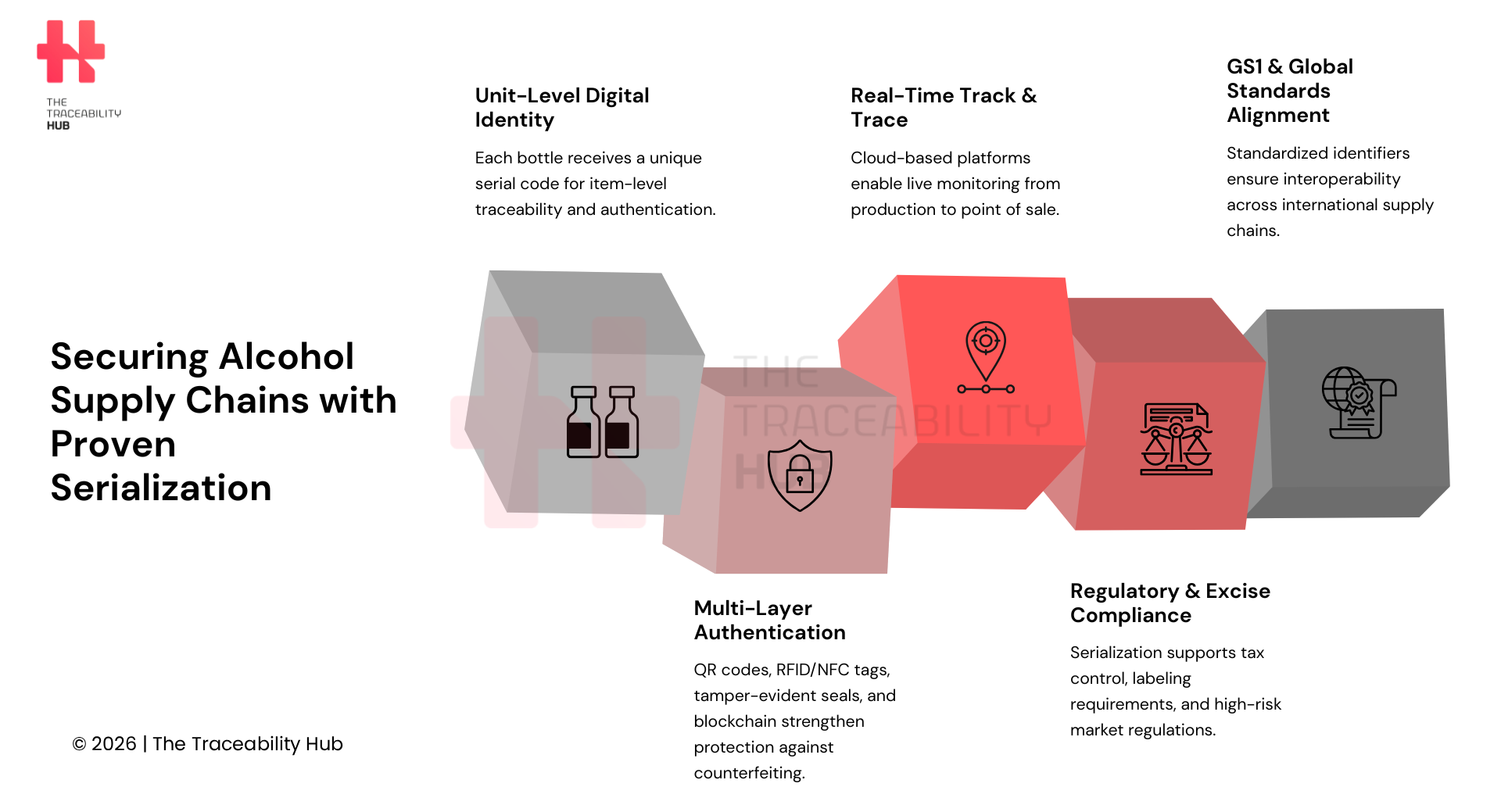
Implementing Serialization Track and Trace Systems
Track and trace infrastructure needs technology layers that blend naturally to implement serialization systems effectively across enterprise supply chains.
Integration with ERP and Supply Chain Software
For serialization and track-and-trace systems to function effectively, they must integrate with existing enterprise software environments. This typically includes enterprise resource planning (ERP) systems, warehouse management systems (WMS), manufacturing execution systems (MES), and, in some cases, customer relationship management (CRM) platforms.
Commercial serialization platforms are designed to operate at the corporate level, connecting internal IT infrastructures with external stakeholders such as regulatory authorities and supply chain partners. These systems can automate serial number generation, manage secure identifier issuance, and transmit required event data to reporting or compliance databases.
The integration process is often technically complex, requiring careful data mapping, API coordination, and governance controls. When properly implemented, integrated serialization architecture can improve data consistency, reduce duplication, and support operational integrity across interconnected supply chain systems.
Real-Time Tracking Using Cloud-Based Dashboards
Cloud-based dashboards let you see serialized product movement from one central location. These systems serve as a central hub for serial numbers and events that help trace items from start to finish and rebuild their history. Mobile apps that naturally blend with cloud solutions help with receiving, shipping, aggregation, inspection, and decommissioning. Manufacturers can track products from production to consumption with immediate monitoring and real-time visibility. They can spot potential counterfeit batches quickly and take corrective steps right away if health issues come up.
Data Storage and Access Control for Serialized Records
Strong data management serves as the foundation of good serialization. A complete system must confirm data early to stop inconsistencies, minimize corrections, and stay compliant. Detailed audit trails help track information changes and keep all instances consistent between source and destination systems. Protected clouds store electronic digital signatures that eliminate physical issuance risks while keeping authentication secure and verifiable.
Challenges in Serialization Adoption for Small Distilleries
Small distilleries encounter specific hurdles with serialization implementation. The original costs of specialized inventory management software and hardware create major obstacles. These businesses lack legal expertise to guide them through complex regulatory requirements. This forces distillers to spend valuable time trying to decode compliance details instead of developing products. Cloud-based technology adoption becomes necessary for these businesses to grow efficiently and meet state-specific laws that change faster, while still maintaining traceability capabilities.
Regulatory Compliance and Global Standards
Different regions worldwide have unique approaches to curb counterfeit alcohol products through serialization and regulatory enforcement frameworks.
EU and US Alcohol Serialization Regulations
Under Regulation (EU) No 1169/2011 on food information to consumers, alcoholic beverages containing more than 1.2% alcohol by volume were historically exempt from mandatory ingredient lists and nutrition declarations. However, following policy developments linked to Europe’s Beating Cancer Plan, new labeling requirements entered into force on 8 December 2023. From that date, alcoholic beverages placed on the EU market must provide ingredients information and nutrition declarations, with the possibility of delivering detailed information electronically (e-labels).
While discussions around stronger health warnings on alcoholic beverages continue at EU and national levels, there is currently no harmonized EU-wide requirement comparable to tobacco labeling rules. Some Member States, such as Ireland, have introduced additional national measures.
In the United States, alcohol regulation operates under a combination of federal and state-level frameworks. Excise tax stamp requirements and product identification practices vary by state, with stamps applied at either bottle or case level depending on jurisdiction. Similarly, within the European Union, excise stamp practices are determined at the national level rather than through a single harmonized EU rule.
These regional differences illustrate how alcohol compliance frameworks combine labeling, taxation, and traceability measures in distinct regulatory models across jurisdictions.
Serialization Requirements in High-Risk Regions
Strict controls exist in high-risk markets. Uzbekistan started alcohol and wine serialization on January 1, 2021. The country then expanded to aluminum packaging and ended up implementing aggregation hierarchy reporting. China has introduced track-and-trace systems to address widespread counterfeiting of alcoholic beverages. Brazil and Mexico are implementing serialization to boost tax compliance and supply chain transparency in Latin America.
Role of GS1 Standards in Alcohol Traceability
Standards developed by GS1 are widely recognized as a global “language of business” for product identification and data exchange. In the alcohol sector, GS1 identifiers such as GTIN, GLN, and SSCC support consistent product identification, location referencing, and logistics tracking across international supply chains.
When implemented using GS1 Digital Link architecture, QR codes can connect physical products to dynamic online data sources. This enables structured product information to be updated in backend systems without requiring changes to the printed code itself. Such standardization reduces manual data entry errors and improves interoperability between manufacturers, distributors, retailers, and regulatory systems.
GS1 has also developed sector-specific guidance for wine and spirits traceability, helping producers align with regulatory, excise, and cross-border trade requirements while maintaining operational efficiency. Although adoption is voluntary, GS1 standards are widely used to enable scalable and harmonized traceability infrastructures.
Proven Serialization Methods for Alcohol Supply Chains
Serialization serves as a strong defense against deadly counterfeit alcohol products worldwide. Recent deaths in Brazil and methanol poisoning cases highlight why we need reliable authentication systems in alcohol supply chains. Alcohol producers can choose from several technologies based on their needs – unit-level QR codes, RFID tagging, tamper-evident seals, and blockchain-based solutions.
These anti-counterfeit solutions need careful integration with existing business systems. Real-time visibility comes from cloud-based dashboards, and proper data management will give a solid foundation for serialized records. Small distilleries face budget barriers and complex regulations during adoption. All the same, cloud-based solutions and step-by-step implementation strategies can help overcome these challenges.
Global regulatory frameworks are changing at different speeds with varying rules. The European Union is moving toward stricter alcohol labeling regulations while high-risk regions put immediate controls in place. GS1 standards provide a universal language for alcohol traceability that works across international borders.
Serialization prevents counterfeit alcohol and ends up serving many purposes beyond keeping consumers safe. These systems boost tax compliance, protect brands, and improve supply chain efficiency. The alcohol industry now has both a challenge and a chance to turn serialization from a regulatory burden into a competitive edge. Companies that welcome complete serialization strategies will build consumer trust, improve consumer engagement, protect their brands, and help remove deadly counterfeits products from the market.
The human toll from counterfeit alcohol makes this rise in technology relevant. Serialization technologies are becoming more sophisticated and available. Their widespread adoption throughout the alcohol industry is inevitable because consumer safety depends on proven authenticity from production to consumption.
Read more: Beauty Exports to Russia: From Compliance Burden to Strategic Advantage