



How RFID Improves Retail Inventory Accuracy and Omnichannel Performance
Most traditional retail environments suffer from poor inventory record accuracy, with many studies showing that barcode-based systems often achieve accuracy levels in the 60–75% range before new technology adoption. Modern omnichannel operations require much higher levels of end-to-end visibility and synchronization across channels to minimize lost sales and fulfillment errors.
Radio-frequency identification (RFID) technology has been shown in multiple industry and academic reports to significantly improve inventory accuracy when implemented at the item level, often lifting accuracy into the mid-90s and above 98% in fully deployed systems. RFID systems use small electronic passive UHF RFID tags and automated readers that capture data without line-of-sight scanning, enabling real-time tracking and more complete unit-level visibility of stock.
Improving inventory accuracy through RFID tags has measurable business impacts. Research and case studies link higher inventory and supply chain visibility with reduced out-of-stock events, better product availability, and sales gains. For example, some apparel retailers reported SKU sales lifts in the low-double-digit range attributable to improved stock accuracy. Independent analyses also associate RFID adoption with labor efficiency gains, as much of the manual counting and reconciliation of work traditionally required is automated or eliminated, optimizing the return on investment (ROI).
The benefits of RFID extend beyond accuracy and labor savings; retailers achieving high visibility can better support omnichannel fulfillment, reduce stock discrepancies, and make data-driven decisions across supply chain operations.
This piece explores how RFID technology delivers these outcomes and outlines key factors for successful implementation.
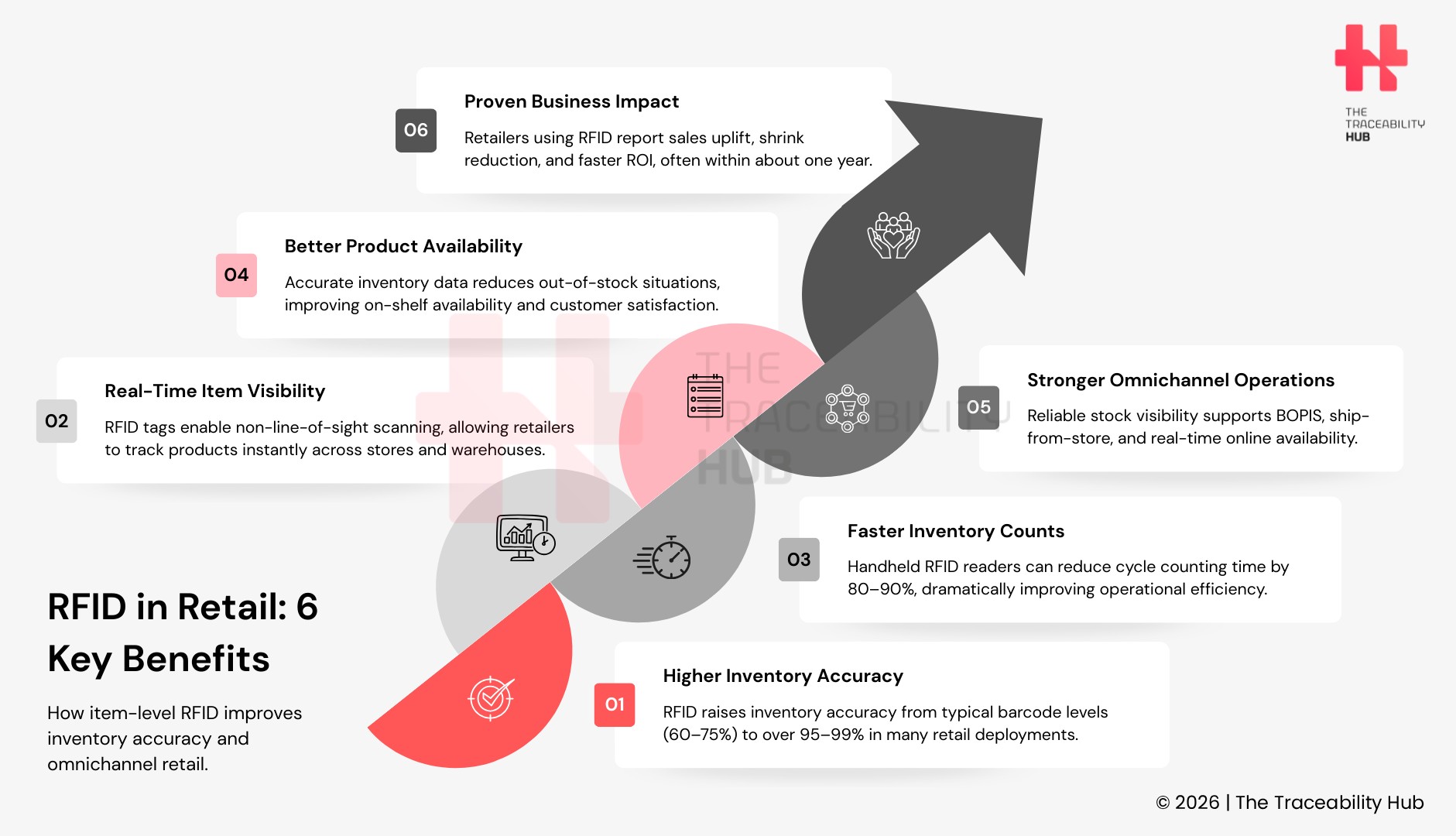
RFID in Retail 6 Key Benefits
Why RFID Retail Systems Are the New Standard for Modern Commerce
Inventory Accuracy Challenges in Traditional Retail
Retailers worldwide face a persistent and costly challenge: inventory distortion, the combined financial impact of overstock and out-of-stock. According to research from IHL Group, global inventory distortion amounts to approximately $1.7–$1.8 trillion annually, representing roughly 5–6% of total retail sales worldwide. This gap reflects the discrepancy between recorded inventory and actual shelf availability, a structural weakness that undermines profitability and customer satisfaction.
Inventory record inaccuracy is widespread. Research from the ECR Retail Loss Group indicates that a substantial share of retail SKU records contains discrepancies between system data and physical stock, with some studies suggesting that over 60% of inventory records are inaccurate at SKU level in traditional retail environments. Industry analyses frequently cite average inventory accuracy rates in the range of 60–70% in non-RFID environments, meaning that roughly one-third of recorded stock may be incorrect at any given time. Such inaccuracies create unreliable data foundations that compromise replenishment, forecasting, omnichannel fulfillment, and financial planning.
Traditional retail operations rely heavily on manual processes, including periodic cycle counts, barcode scanning, and paper-based receiving workflows. These methods are labor-intensive and susceptible to cumulative human errors. Receiving discrepancies, shrinkage, theft, mis-picks, product misplacement, and scanning mistakes all contribute to record inaccuracy. In categories such as grocery and fresh food, additional factors, including spoilage, waste, and process loss, further increase inventory volatility and complexity.
The financial implications are substantial. IHL Group estimates that out-of-stocks alone account for more than $1 trillion globally each year, representing the largest component of retail inventory distortion. Beyond lost sales, persistent stockouts erode customer loyalty and reduce conversion rates. Meanwhile, shrink and retail loss, tracked annually by the National Retail Federation (NRF), account for over $100 billion annually in the United States alone, underscoring the scale of inventory visibility challenges.
Collectively, these findings highlight a structural problem in traditional retail systems: without high-frequency, item-level visibility, retailers operate with incomplete and often inaccurate data. This is precisely the operational gap that RFID-enabled inventory systems are designed to address.
Meeting Customer Expectations for Real-Time Product Availability
Customer expectations for product availability have intensified in recent years, particularly as digital commerce and omnichannel fulfillment have become standard. During the pandemic period between March 2020 and February 2022, U.S. online shoppers encountered more than 60 billion out-of-stock messages, underscoring the visibility of inventory disruption in digital channels.
Research consistently shows that repeated stockouts erode loyalty. Studies from McKinsey and ECR Retail Loss indicate that when customers cannot find products, they frequently switch brands, substitute products, or move to competing retailers. Even a small number of negative availability experiences can alter purchasing behavior, customer loyalty, and reduce long-term retention.
Omnichannel retail further increases the need for high-accuracy inventory data. Retailers must provide reliable product availability information across websites, marketplaces, mobile apps, and physical stores. This requires accurate Available-to-Promise (ATP) visibility across the supply network. Inaccurate inventory records lead to both underselling (when stock exists but is not visible) and overselling (when systems show stock that is not physically available). These distortions contribute to longer fulfillment times, inflated safety stock, forecasting errors, higher carrying costs, and diminished customer satisfaction.
Transitioning from Manual Counting to Automated WMS Integration
Retail and warehouse operations have traditionally relied on manual processes for inventory counting, replenishment, and order fulfillment. These processes are labor-intensive and increasingly difficult to sustain in high-volume, omnichannel environments. Industry research consistently shows that labor represents the largest single cost component in warehouse operations, often accounting for 50-70% of total fulfillment costs, depending on the level of automation.
Manual inventory audits and cycle counts require significant staff time, diverting employees from customer service, fulfillment, and value-added activities. Beyond direct wages, retailers incur opportunity costs when skilled labor is allocated to repetitive counting tasks rather than revenue-generating functions. As complexity increases across distribution networks, manual processes struggle to deliver the speed and accuracy required for modern retail.
Human-dependent workflows also introduce measurable error rates. Studies of warehouse operations show that manual picking accuracy typically ranges between 96-99%, meaning error rates of 1-4% are common in traditional environments. Even small error rates scale rapidly in high-volume operations. Research in supply chain management estimates that each picking error can cost retailers tens of dollars per incident, factoring in reverse logistics, reprocessing, customer service intervention, and potential customer dissatisfaction.
Data integrity challenges compound these operational risks. Spreadsheets contain errors, highlighting the fragility of manual data handling systems in operational decision-making. When inventory and financial decisions rely on error-prone data inputs, forecasting accuracy, replenishment efficiency, and margin control are directly affected.
In response, retailers are accelerating investment in supply chain automation. According to Zebra Technologies’ Warehousing Vision Study (WMS), a significant share of warehouse leaders is already investing in automation and expect to continue expanding technology adoption over the next several years, with many planning to implement automation to augment labor and modernize operations.
Research indicates that automated systems, including warehouse management systems (WMS) integrated with RFID technology, can achieve inventory accuracy rates approaching 99% and significantly reduce errors compared with manual processes. When RFID tags are combined with an automated WMS, warehouses can track inventory with impressive precision, often up to 99% accuracy, greatly reducing mismatches and enhancing real-time tracking. Additionally, studies from the Auburn University RFID Lab confirm that item-level RFID raises inventory accuracy into the 95%+ range compared with traditional approaches. Automation and technology also improve consistency and visibility throughout warehouse operations, reducing reliance on manual counting and enabling more reliable decision-making in logistics and fulfillment.
The broader technology shift is reflected in market growth. According to multiple independent market research firms, the global RFID market is projected to grow substantially over the coming decade as adoption expands across retail, logistics, manufacturing, healthcare, and other industries. For example, Fortune Business Insights forecasts that the market will grow from about USD 19.01 billion in 2026 to approximately USD 46.2 billion by 2034, at a compound annual growth rate (CAGR) of about 11.7%. Similar forecasts from Mordor Intelligence and other analysts also anticipate double-digit CAGR growth through the early 2030s, reflecting broad demand for real-time visibility and automated tracking solutions
Taken together, the evidence indicates a structural transition underway: as operational complexity increases and labor constraints persist, manual systems are no longer sufficient to sustain accuracy, speed, and scalability. Automation is becoming a foundational component of resilient, data-driven retail operations.
How RFID Retail Technology Operates in Store Environments
RFID Tags and Readers: The Core Components
RFID systems used in retail environments are built around three primary components: tags, readers, and antennas, supported by software that processes captured data. This architecture is defined in international RFID standards and widely documented by organizations such as GS1 and EPC global.
- RFID tags consist of a microchip and an antenna embedded in a label or inlay. The microchip stores a unique identifier, typically encoded using the Electronic Product Code (EPC) standard, which allows individual items to be identified at the unit level. In retail, passive UHF (ultra-high frequency) RFID tags are most used. Passive tags do not contain an internal power source. Instead, they are energized by radio waves emitted from an RFID reader. When activated, the tag transmits its stored identifier back to the reader. This design makes passive tags cost-effective and suitable for large-scale item-level deployment.
- RFID readers generate radio frequency signals that power passive tags within range and capture the data they transmit. Readers are deployed in two primary configurations in retail environments:
- Fixed readers, installed at key transition points such as distribution center dock doors, backroom entryways, or point-of-sale zones. These installations enable automated data capture as merchandise moves through defined areas of the store or supply chain.
- Handheld (mobile) readers, used by store associates for cycle counting, inventory audits, and item location tasks. Research from the Auburn University RFID Lab shows that handheld RFID readers significantly increase inventory counting speed compared to barcode scanning by enabling bulk, non-line-of-sight reading.
RFID systems can read multiple tags simultaneously without requiring line-of-sight alignment, unlike barcode systems. Modern UHF RFID readers can read hundreds to over a thousand tags per second, depending on configuration, environmental conditions, and tag density.
- Antennas, either integrated into handheld devices or externally mounted in fixed installations, transmit and receive radio signals between tags and readers. In portal configurations (such as doorways), multiple antennas are often used to optimize read coverage and minimize blind spots. The exact number depends on the physical layout, materials, and performance requirements of the installation.
Optimizing Real-Time Data Capture and Transmission
In retail environments, passive UHF RFID systems operate according to internationally recognized standards such as ISO/IEC 18000-63. RFID readers emit radio frequency energy that activates passive tags within range. Once energized, the tag transmits its unique identifier, typically an Electronic Product Code (EPC), back to the reader. The EPC serves as a reference key that links product information stored in backend systems; detailed product data is not usually stored directly on the tag itself (GS1 EPC Tag Data Standard).
Unlike barcode systems, RFID does not require line-of-sight scanning. Readers can interrogate multiple tags simultaneously using anti-collision protocols, enabling bulk data capture from items stored on shelves, grouped in cartons, or moving through dock doors and transition points. Read performance depends on environmental conditions such as tag orientation, packaging materials, and interference from metals or liquids; factors documented extensively in research from the Auburn University RFID Lab.
Captured tag reads are filtered and processed by RFID middleware before being transmitted to enterprise platforms such as inventory management systems, warehouse management systems (WMS), or enterprise resource planning (ERP) systems. This architecture enables near real-time visibility into stock levels and product movement across store floors, backrooms, and distribution centers, depending on read frequency and system configuration.
Integration with Existing Retail Systems
Retail RFID deployments are typically designed to integrate with existing IT infrastructure rather than replace it. Data collected from readers is processed through middleware solutions that translate raw tag reads into structured business events (e.g., “item received,” “item moved,” “item sold”). Standards such as GS1’s EPCIS (Electronic Product Code Information Services) framework support interoperability and data sharing across enterprise systems.
By using middleware to bridge RFID hardware and legacy software platforms, retailers can implement RFID technology in phases, for example, beginning with selected product categories, pilot stores, or specific operational workflows. This phased approach is widely recommended in industry implementation guidelines and allows organizations to evaluate performance impacts before scaling.
As adoption expands, RFID data is commonly aggregated into centralized platforms that provide visibility across multiple store locations and distribution centers. While operational and financial outcomes depend on execution quality, centralized RFID data management can support improved inventory accuracy, more consistent processes, and enhanced decision-making across the retail network.
Cost Development: From Expensive Pilot Programs to Scalable Deployment
Over the past two decades, the cost of passive UHF RFID technology has declined significantly. Industry analyses show that tag prices have fallen from well above one dollar in the early 2000s to only a few cents per unit in high-volume retail deployments today. While exact pricing varies by order volume and chip type, large-scale apparel programs can achieve tag costs in the low single-digit cent range.
In parallel, improvements in semiconductor sensitivity, antenna design, and reader performance have enhanced read reliability and expanded effective read ranges under optimized conditions. These technical advances, combined with global standardization efforts led by GS1 EPC global, have improved system interoperability and reduced integration complexity.
Although infrastructure requirements remain deployment-specific, increased chip sensitivity and better system design have improved read performance compared to earlier generations of RFID technology. Together with cloud-based middleware and enterprise integration platforms, these developments have lowered the operational barriers that once limited RFID adoption to only the largest retailers.
As a result, RFID technology has transitioned from high-cost pilot technology into a scalable inventory management solution increasingly adopted by mid-sized and emerging retail brands seeking improved inventory accuracy and omnichannel visibility.
Measuring Success: ROI and Financial Impact of RFID Adoption
Evaluating the financial impact of RFID in retail requires tracking measurable operational and commercial outcomes. Retailers moving from pilot programs to enterprise-wide deployment typically assess performance across inventory accuracy, labor productivity, sales uplift and shrink reduction.
Inventory Accuracy Improvements
Multiple industry studies indicate that item-level inventory accuracy in traditional retail environments often ranges between 60% and 75%, particularly in apparel and specialty categories. Research conducted by GS1 and the Auburn University RFID Lab shows that retailers implementing item-level RFID frequently improve inventory accuracy into the 93–99% range, depending on deployment quality and compliance.
Higher inventory accuracy enables more reliable replenishment, improved size availability, and stronger omnichannel execution.
A documented example comes from Lululemon, which achieved 98% inventory accuracy across nearly 500 stores and reported a payback period of one year or less following RFID implementation.
Tripling Labor Productivity and Cycle Counting Efficiency
RFID significantly reduces the time required for inventory counting. Case studies from the Auburn University RFID Lab and retailer deployments show that full-store cycle counts that previously required hours using barcode methods can often be completed in a fraction of the time with handheld RFID readers.
For example:
- Industry case studies report inventory counting time reductions of up to 80–90% in apparel environments.
- McKinsey reports that Decathlon tripled labor productivity following RFID deployment as part of broader operational improvements.
Driving Sales Lift through Better On-Shelf Availability
Improved inventory accuracy reduces out-of-stock and improves product availability, which in turn drives sales performance.
Research indicates that retailers implementing RFID have reported sales uplifts in the range of 1.5% to 5.5%, largely attributed to better on-shelf availability and improved replenishment accuracy.
Reducing Shrink and Mitigating Return Fraud
Item-level RFID tracking improves the ability to reconcile physical inventory with point-of-sale data, making discrepancies easier to detect and investigate. Research from the ECR Retail Loss Group highlights that improved inventory record accuracy strengthens exception management and supports more effective loss analysis. Case studies further indicate that enhanced visibility can contribute to measurable shrink reduction.
For example, Decathlon reported a 9% reduction in shrinkage following its RFID deployment, alongside broader gains in inventory accuracy and operational efficiency. While results vary by retailer and execution model, improved inventory visibility is consistently associated with stronger loss identification and more proactive inventory control processes.
In parallel, the broader financial impact of returns and fraud remains significant. According to the National Retail Federation (NRF) and Appriss Retail, return fraud accounted for approximately $101 billion in the United States in 2023, underscoring the importance of item-level verification and tracking systems in loss mitigation.
Implementing RFID Retail Systems Successfully
Ensuring Cross-Functional Leadership and Governance
RFID initiatives typically affect multiple functions simultaneously, including store operations, supply chain, IT, merchandising, loss prevention, and omnichannel fulfillment. Because inventory accuracy influences planning, allocation, e-commerce availability, and shrink analysis, effective deployments extend well beyond IT ownership.
Research and case studies indicate that executive sponsorship plays a critical role in setting strategic priorities, allocating resources, and aligning operational processes with RFID objectives. Cross-functional governance – involving operations, supply chain, finance, merchandising, and technology teams – helps ensure that implementation decisions support measurable business outcomes rather than isolated technical upgrades.
Prioritizing High-Impact Use Cases for Early ROI
Industry evidence shows that retailers achieve the strongest early returns when RFID is deployed against clearly defined, measurable use cases. Common starting points include:
- Improving item-level inventory accuracy
- Reducing stockouts
- Accelerating cycle counting
- Supporting omnichannel fulfillment (e.g., BOPIS – Buy Online, Pick Up In-Store)
Building a quantified business case based on accuracy gains, labor savings, or sales uplift is widely recommended before enterprise-wide scaling.
While automated replenishment may benefit from improved accuracy, its impact depends on integration with existing ERP and planning systems; therefore, outcomes vary by retailer and maturity level.
Reducing Risk with Phased Rollout Strategies
Published implementation guidance consistently recommends phased rollouts rather than full-scale deployments from the outset. Retailers commonly begin with pilot programs and stores or selected product categories to validate technical performance, refine workflows, and measure ROI.
Pilot programs allow organizations to:
- Assess inventory accuracy improvements
- Validate integration with existing manual systems
- Measure labor efficiency and sales impact
- Identify operational adjustments
Lessons from pilot phases inform broader rollout strategies and reduce operational risk during expansion.
Store-Level Adoption and Change Management
Operational adoption is a decisive factor in realizing RFID benefits. Research across retail transformation initiatives emphasizes that technology alone does not produce sustained value without process integration and staff engagement.
Structured RFID integration training programs typically include:
- Hands-on use of handheld readers and software tools
- Workflow integration into receiving, replenishment, and cycle counting
- Clear communication of how improved accuracy benefits store performance
Many retailers use cascaded training approaches (often described as “train-the-trainer” models) to support scale. While structures vary by organization, localized accountability and reinforcement are widely associated with stronger adoption outcomes.
The Future of RFID in Retail: Accuracy, ROI, and Total Inventory Control
RFID in retail has moved from experimental pilots to a proven tool for improving inventory performance. Higher accuracy supports better stock availability, stronger omnichannel fulfillment, and measurable sales improvements in categories such as apparel and specialty retail.
Operationally, retailers frequently report substantial reductions in cycle counting time and improved labor productivity, allowing store teams to shift effort from manual inventory tasks to customer-facing activities. While return on investment varies by retailer, shrink profile, and deployment scale, published case studies demonstrate that payback within approximately one year is achievable under the right conditions.
Successful implementation rarely comes from large-scale overhauls at the outset. Retailers tend to generate the strongest early results by prioritizing high-impact use cases – such as improving inventory accuracy or enabling reliable omnichannel services – and scaling through phased rollouts. Cross-functional leadership alignment across operations, merchandising, supply chain, and IT help ensure that technology decisions translate into measurable business outcomes. Structured training and local accountability further support adoption at store level.
With declining tag costs, improved system interoperability, and standardized data frameworks, RFID technology is no longer limited to enterprise-scale experimentation. Retailers that deploy item-level visibility strategically are better positioned to meet rising customer expectations for product availability while strengthening operational control and margin performance in an increasingly complex retail environment.
Read more: The Digital Divide in Agriculture: Proven Strategies to Help Italy’s Traditional Farms Catch Up