

The Tracking Technology Decision
For operations leaders in manufacturing, food & beverage, chemicals, and life sciences, tracking technology for supply chains is no longer a back-office consideration. It is a strategic choice that directly affects operational efficiency, regulatory compliance, and supply chain resilience. As pressure increases to improve traceability, reduce manual work, and gain real-time visibility, one question keeps surfacing: RFID vs barcode tracking – which is right for your operations?
At first glance, the RFID vs barcode comparison may seem straightforward. Barcodes are familiar, inexpensive, and widely adopted. RFID promises automation, speed, and richer data. But the real tracking technology decision goes far beyond hardware costs or scanning range. Choosing the wrong tracking technology can lock organizations into rigid processes, limit visibility beyond Tier 1 suppliers, and create long-term integration challenges.
Today’s operations run across extended, multi-tier supply chains where data must move seamlessly between internal systems and external partners. Supply chain Tracking technologies must support more than item identification: they must enable end-to-end visibility, integrate with legacy ERP, WMS and MES systems, and provide reliable, real-time data integration that can be shared across organizational boundaries.
The right tracking technology can reduce labor dependency, minimize human error, and strengthen compliance with increasingly data-driven regulations. The wrong one can increase operational friction, slow down decision-making, and undermine traceability initiatives before they scale.
This article breaks down the practical differences between RFID and barcode tracking, not in abstract technical terms, but through an operational and supply chain lens. The goal is to help you understand where each technology excels, where it falls short, and how to choose the option that aligns with your operational complexity, regulatory environment, and long-term traceability strategy.
What Is Barcode Tracking and Where Does It Work Best?
Barcode tracking has been the backbone of operational and inventory traceability for decades. At its core, the technology relies on printed labels, typically one-dimensional (1D) or two-dimensional (2D) barcodes, that are scanned using optical readers to identify products, assets, or batches at specific points in a process.
In practice, barcode-based tracking systems are used to track items at unit, case, pallet, or batch level, capturing key events such as production, storage, shipment, and receipt. Because of their simplicity and broad GS1 standardization, barcodes are deeply embedded in global supply chains and remain in the default inventory tracking technology for many operations.
Strengths of Barcode Tracking
Barcode systems continue to perform well in environments where processes are stable, controlled, and highly standardized.
- Low cost: Barcode labels are cheap to print, and handheld barcode scanners are widely available at relatively low cost. This makes barcodes accessible even for operations with tight budgets or high SKU volumes.
- Simplicity and standardization: Barcodes tracking systems are easy to deploy and universally understood. Global standards such as GS1, UPC, and EAN barcode ensure interoperability across suppliers, distributors, and customers, reducing onboarding friction and complexity.
- Reliability in controlled environments: In warehouses, production lines, and distribution centers with predictable workflows, barcode scanning delivers high accuracy and consistency. When labels are applied correctly and scanning points are well defined, error rates remain low.
- Lowest total cost of ownership at scale: For commodity goods and high-volume distribution, barcodes offer the lowest total cost of ownership. Infrastructure requirements are minimal; maintenance is straightforward, and training costs are low.
Limitations of Barcode Tracking
Despite their advantages, barcodes introduce structural constraints that become more visible as operations scale or supply chain complexity increases.
- Line-of-sight dependency: Each barcode must be individually visible and scanned. This line-of-sight scanning requirement slows down operations in high-throughput environments and limits the ability to automate identification at speed.
- Labor-intensive processes: Because scanning is manual, barcode-based systems rely heavily on human intervention. This increases labor costs and introduces variability, especially in environments with high turnover or time pressure.
- Physical vulnerability of labels: Printed labels can be smudged, torn, or damaged by moisture, chemicals, heat, or abrasion. In industrial or outdoor settings, label degradation can quickly impact scan reliability.
- Limited data capacity: Barcodes typically encode only a unique identifier. They do not store dynamic data such as temperature, handling events, or condition status. Any additional information must be retrieved from backend systems, increasing system dependency.
When Barcodes Are the Right Choice
Barcode tracking remains an excellent solution for high-volume, low-risk items where advanced automation, real-time supply chain visibility, or condition monitoring are not required. For many organizations, barcodes provide a cost-efficient and reliable foundation for basic traceability and inventory control.
However, as operations demand faster throughput, reduced manual handling, and richer data across the extended supply chain, the limitations of barcode tracking often become the trigger for evaluating more automated tracking technologies.
What Is RFID and How Does It Compare?
Radio Frequency Identification (RFID) is a tracking technology that uses wireless communication between tags and readers to identify and capture data automatically. Unlike barcodes, RFID tags do not require a line of sight to be read. Multiple tagged items can be detected simultaneously, even when they are inside cases, on pallets, or moving through a facility.
RFID systems typically consist of three components:
- RFID Tags, which store unique identifiers and, in some cases, additional data
- RFID Readers and antennas, which capture tag signals
- Software platforms, which process, store, and share RFID data
Because RFID operates passively in the background, it fundamentally changes how data is collected across operations, shifting from manual scanning to continuous, automated visibility.
Strengths of RFID Tracking
RFID tracking excels in environments where speed, automation, and data depth are critical.
- High throughput and speed: RFID readers can capture data from hundreds of tags in a single reading event. This dramatically increases throughput at key process points such as receiving, picking, shipping, and production handoffs, eliminating scanning bottlenecks.
- Automation and labor reduction: by removing the need for manual scans, RFID tracking reduces labor dependency and minimizes human error. This is particularly valuable in high-volume operations, facilities with labor constraints, or processes that run continuously.
- Durability in harsh environments: RFID tags are more resistant than paper labels to heat, moisture, chemicals, abrasion, and repeated handling. This makes RFID well suited for industrial manufacturing, chemicals, cold chain logistics, and outdoor operations.
- Richer, more granular data: Beyond simple identification, RFID tags can support additional data such as batch information, timestamps, and—in the case of sensor-enabled RFID tags, environmental conditions like temperature, humidity, or shock. This enables deeper supply chain traceability and condition monitoring.
- Real-time integration across the extended supply chain: RFID data can be streamed directly into enterprise systems and partner collaboration platforms, enabling near real-time data sharing across manufacturers, logistics providers, and downstream partners. This capability is especially valuable for regulated industries and multi-tier supply chains.
Limitations of RFID Tracking
While RFID offers powerful capabilities, it also introduces considerations that must be evaluated carefully.
- Higher upfront investment: RFID tags, readers, antennas, and supporting infrastructure are more expensive than barcode systems. The business case typically depends on labor savings, throughput gains, risk reduction, or compliance requirements rather than hardware cost alone.
- System setup and integration complexity: Deploying RFID requires thoughtful system design, including reader placement, process alignment, and integration with existing ERP, WMS, or MES systems. Implementation is more complex than printing and scanning labels.
- Environmental sensitivity: RFID performance can be affected by materials such as metals, liquids, or densely packed items. While modern RFID standards and tag designs continue to improve reliability, these factors must be accounted for during system design and testing.
When RFID Is the Right Choice
RFID is the stronger fit when speed, automation, and granular visibility are essential to operations. This includes environments with:
- high-value or regulated products
- complex, multi-partner supply chains
- high throughput requirements
- limited tolerance for manual error or delays
For organizations pursuing advanced traceability, real-time visibility, or compliance with data-intensive regulations, RFID tracking often becomes not just a tracking upgrade, but a foundational enabler of smarter, more resilient operations.
RFID vs Barcode
RFID vs Barcode Tracking: A Practical Comparison
When evaluated side by side, barcode and RFID tracking reveal fundamentally different operational models. Barcode systems offer very low upfront costs, relying on inexpensive labels and handheld scanners, but require line-of-sight scanning of one item at a time, making them labor-intensive and less scalable.
RFID tracking, by contrast, involves a higher initial investment in tags and readers, yet enables simultaneous, non-line-of-sight reading of hundreds of items, significantly reducing manual effort. While barcodes are limited to encoding a simple identifier and are vulnerable to wear or damage, RFID tags are designed for harsher environments and can store richer information, including batch and condition data. Most importantly, barcode tracking tends to constrain visibility within organizational boundaries, whereas RFID supports near real-time data sharing across the extended supply chain, making it better suited for complex, multi-partner operations.
Case Study 1: When RFID Enables Real-Time Partner Traceability
A global life sciences manufacturer is experiencing recurring delays and visibility gaps with its external packaging partners. While internal operations relied on barcode-based tracking (traditional barcode scanning using 1D and 2D barcodes), data from contract packagers was only shared after manual uploads, often arriving late. This created blind spots across regulated, high-value product flows and increased the effort required for compliance reporting and audits.
To address these issues, the company integrated RFID tracking technology (using passive RFID tags and RFID readers) into its contract packaging sites and connected those data streams through a Partner Collaboration Platform. This shift enabled real-time traceability across external partners, eliminating the lag between physical events and digital visibility.
As a result, the manufacturer:
- gained continuous, real-time insight into packaging and handoff activities across partners (extended supply chain traceability)
- automated compliance reporting, reducing audit preparation time by 40%
- reduced lead times by 30%, freeing up production capacity and lowering operational costs
Notably, the company did not replace barcodes entirely. Barcode tracking remained in place for lower-value, lower-risk items. However, for regulated industries and high-value product tracking, RFID delivered automation, speed, and reliability that barcode-based processes could not support at scale. With Antares Vision Group acting as the integration layer, both RFID and barcode technologies operate seamlessly within the existing ERP environment, enabling a hybrid RFID vs barcode tracking strategy.
Case Study 2: Improving Performance in Barcode-Heavy Operations
While RFID delivered clear ROI in a highly regulated context, efficiency gains are not limited to RFID-only environments. In a separate inbound and outbound shipments initiative, a global manufacturer faced frequent errors and delays caused by manual barcode scanning and late data exchanges with external logistics partners across a multi-tier supply chain.
Rather than replacing barcode infrastructure (UPC, EAN, and GS1-standard barcodes), the company focused on improving data flow, real-time data integration, and collaboration. By integrating shipment-level barcode data into a Partner Collaboration Platform, the manufacturer created a shared, near real-time view of inbound and outbound movements.
The results were immediate:
- improved shipment accuracy and operational traceability
- fewer manual errors and reduced rework in operations tracking
- faster inbound and outbound processing
This case highlights an important point: RFID barcodes remain essential in high-volume operations, especially where cost efficiency is critical. However, when barcode data is combined with real-time collaboration and structured data sharing across partners, operational friction is reduced, and shipments move faster, even without full RFID automation.
How to Decide Between RFID and Barcode Today
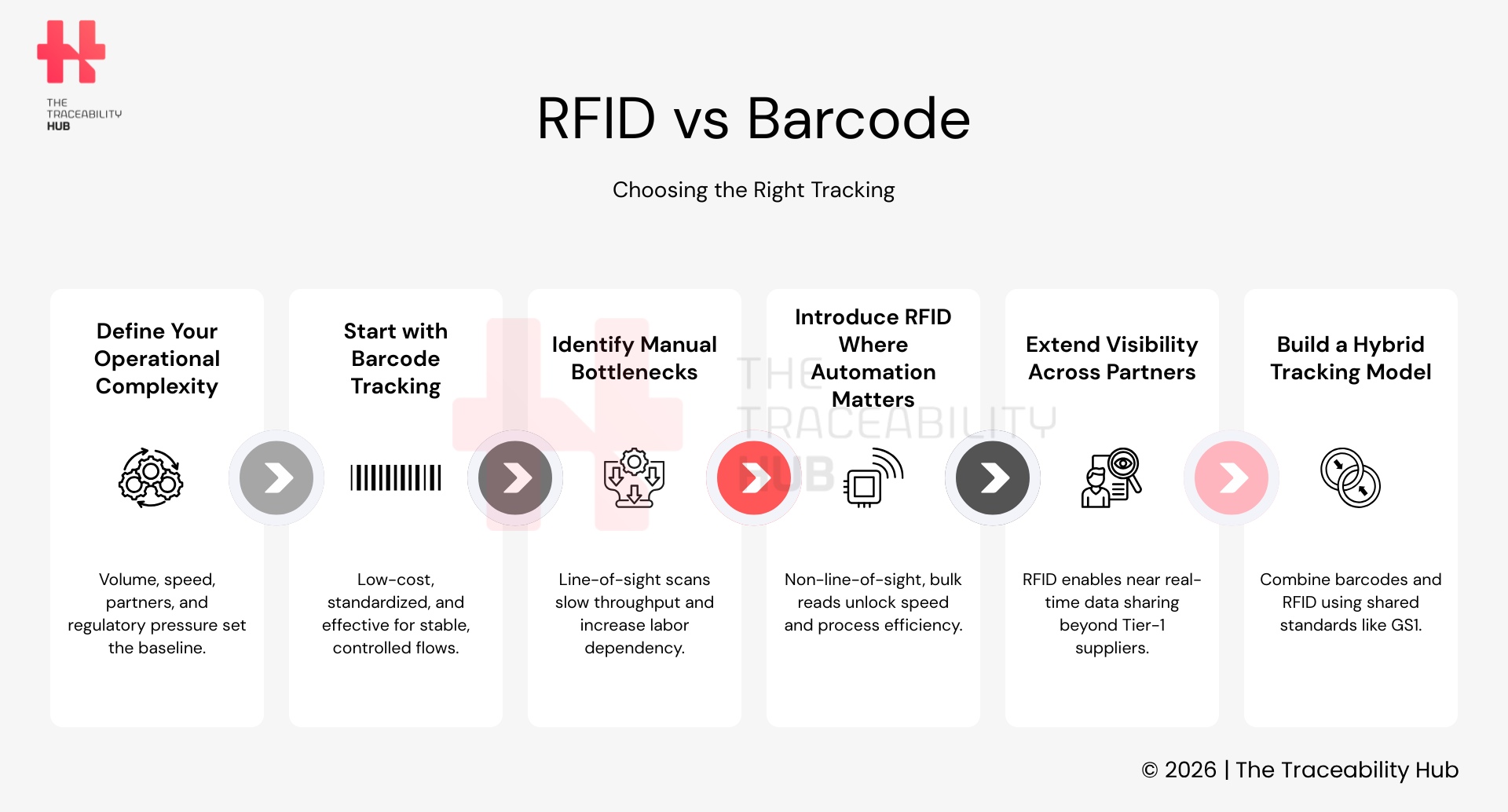
Choosing between RFID vs barcode tracking is less about selecting a single technology and more about aligning tracking capabilities with operational value, risk, and complexity. Both RFID tracking and barcode tracking remain relevant, but they serve different purposes within modern supply chains’ tracking technology.
- Scale and operational complexity: As supply networks grow larger and more distributed, manual processes become harder to manage. High-volume operations with multiple sites, external partners, or high-value products tend to benefit more from RFID, which scales through automation tracking systems rather than labor.
- Compliance and traceability requirements: In regulated industries, the ability to capture reliable, time-stamped data across multiple handoffs is critical. RFID tracking simplifies compliance by automating data capture and reducing the risk of missing or inconsistent records, making it better suited for environments with stringent traceability obligations.
- Cost sensitivity and risk profile: Barcodes remain the lowest-cost option for low-risk, high-volume flows where advanced visibility is not essential. For many organizations, barcodes tracking technology continues to deliver excellent value when operational risk and compliance exposure are limited.
- ERP integration and data quality: Both barcode and RFID systems can integrate with legacy ERP environments. The key difference lies in data richness and timeliness. Barcode systems typically feed discrete, event-based updates, while RFID enables continuous, near real-time data streams that support faster decision-making.
- Partner collaboration and data sharing: When operations depend on suppliers, contract manufacturers, logistics providers, or distributors, extended supply chain visibility beyond organizational boundaries becomes essential. RFID is inherently better suited to real-time data sharing across partner networks, reducing delays and coordination gaps and blind spots in multi-tier supply chains.
For most organizations, the optimal strategy is hybrid. Barcodes handle basic, cost-sensitive tracking efficiently, while RFID traceability is deployed selectively for high-risk, high-value, or highly regulated flows where automation and visibility deliver the greatest return.
Actionable Insights for Operations Leaders
Turning RFID vs barcode tracking decisions into results requires a structured, value-driven approach.
Map your extended supply chain: Start by identifying where data is delayed, incomplete, or manually handled. These blind spots often signal where asset tracking technology and automation can deliver the greatest impact.
Match technology to value and risk: Use barcode tracking where cost efficiency is the primary driver. Deploy RFID tracking where speed, compliance, or granular visibility materially affects performance or risk exposure.
Pilot RFID in high-risk areas: Begin with targeted RFID pilots in regulated processes, external partner handoffs, or high-value product flows. Measure performance improvements and ROI before scaling across operations.
Leverage collaboration platforms: Integrate both barcode and RFID data through a Partner Collaboration Platform to unify visibility across internal systems and external partners. For example, with Antares Vision Group acting as the integration layer, organizations can connect legacy ERP systems with real-time partner data, enabling informed decisions without disrupting existing operations.
Moving Toward Smarter Tracking
In today’s operating environment, the RFID vs barcode tracking decision is not about choosing a single winner. It is about aligning each tracking technology with the operational context where it delivers the most value. Barcodes continue to provide a reliable, cost-effective solution for high-volume, low-risk tracking. RFID, on the other hand, enables the automation, resilience, and real-time visibility required in more complex and highly regulated supply chains.
The greatest advantage emerges when these technologies are combined rather than compared. By integrating both barcode and RFID data into a unified collaboration layer, organizations can eliminate visibility gaps without disrupting existing systems. A Partner Collaboration Platform allows manufacturers to consolidate tracking data, integrate seamlessly with legacy ERP environments, and extend real-time visibility beyond their own facilities to suppliers, logistics providers, and downstream partners.
As supply chains become more data-driven and regulation intensifies, smarter tracking is no longer about technology choice alone, it is about building an integrated traceability foundation that supports efficiency today and resilience tomorrow.
Read more: Securing Cosmetic Supply Chains: Your Guide to Grey Market Prevention