

How Grey Market Cosmetics Erode Brand Value and Channel Trust
Hight-end luxury beauty brands face a growing challenge from gray market cosmetics worldwide. The rise of cross border e-commerce has led to authentic cosmetic products landing in millions of digital shopping carts through unauthorized channels. These gray market products differ from counterfeits: they are genuine items sold through unauthorized distribution channels. This creates major headaches for brands and retailers.
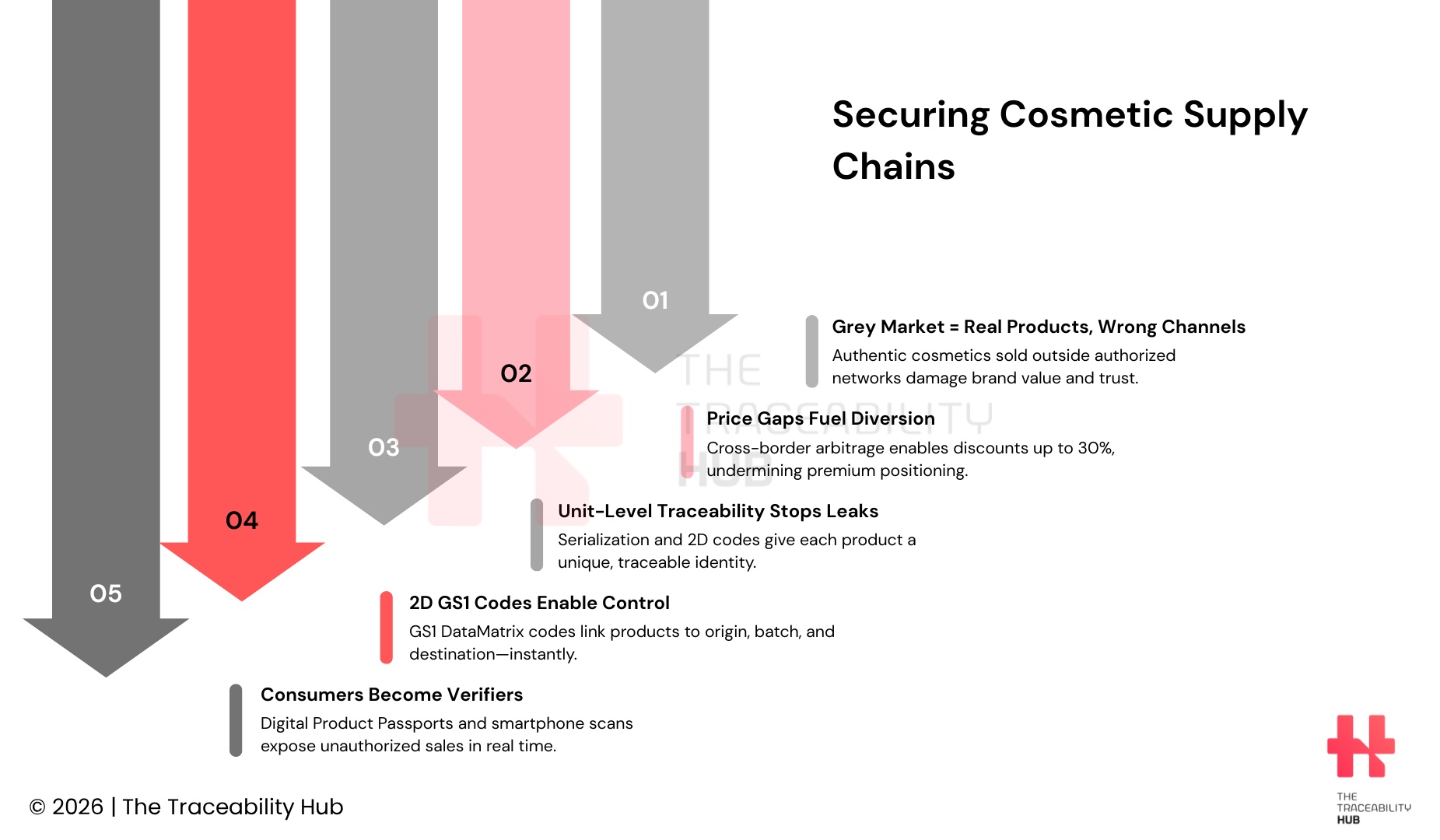
Global price arbitrage drives the beauty gray market. To cite an instance, wholesalers buy luxury perfumes in markets where prices are lower and sell them online elsewhere at higher prices. When unauthorized sellers distribute these luxury cosmetics, they can offer discounts up to 30% below official retail prices. So, this erodes brand value and hurts official retail partners.
Buyers should know the risks of purchasing through unauthorized channels. Gray market cosmetics might be authentic, but customers struggle to tell genuine products from dangerous illegal counterfeits. The situation becomes more worrying because counterfeit cosmetics often contain harmful substances like arsenic and lead.
This piece examines how beauty brands can protect their distribution networks. Companies need strong product traceability systems and effective serialization technologies. Digital verification systems help curb market diversion in cosmetics. These prevention strategies let companies secure their global supply chains better against gray market challenges.
Understanding the Gray Market in Cosmetics
The beauty industry struggles with unauthorized sales channels that operate in legal gray market areas. Gray market cosmetics are authentic products that find their way through unauthorized distribution channels. These products are genuine and legally carry out the original company logo, but sellers import or resell them without the original manufacturer’s permission, usually at lower and unofficial prices.
Difference Between Gray, Black, Diversion and Counterfeit Markets
Gray market operations are quite different from black market activities.
- Gray markets deal with authentic goods through unauthorized dealers, while black markets handle illegal or prohibited items. The products’ origins tell different stories, gray market items come from authorized dealers but sell through unofficial channels
- Black market goods usually come from illegal sources like smuggling or theft.
- Diversion is a term widely used in the beauty industry, especially by professional brands (salon haircare, skincare), and it refers to when a product is “diverted” from the intended channel, it moves from an authorized distributor or retailer to an unauthorized one. Or it ends up in stores, marketplaces, or countries not covered by the contract. Diversion is the process (the diversion of goods), while grey market is the result (selling outside the channel). For this reason, in the everyday language of the industry, many professionals use the two terms almost as synonyms.
- Counterfeit cosmetics pose bigger health risks than gray market products because they might contain harmful substances. This is a big deal as it means that gray market goods affect the US economy by $63 billion yearly, based on 2009 estimates.
How Parallel Trade Cosmetics Operate Across Borders
Parallel trade (another name for gray market activity) takes advantage of regional price differences between markets. Companies use this practice, also known as parallel importing, to bypass official franchise holders of expensive branded goods by buying directly from overseas wholesale suppliers. These situations pop up due to different international prices, foreign licensees going beyond their territory limits, excess inventory, and unauthorized production. Some fragrance brands see parallel imports making up a great amount of their total perfume sales.
Unauthorized Distribution Channels in Beauty Industry
Unauthorized sales have grown beyond just offering lower prices. They now handle everything from redirected inventory to expired products. Brand reports show that unauthorized sellers have hurt consumer trust and distributor relationships for more than half of all brands. Some beauty segments run higher risks than others, luxury brands often fall prey to gray market activities, while cheaper popular brands deal more with counterfeits. On top of that, brands need several days to regain control of their marketplace presence after unauthorized listings show up.
Securing Cosmetic Supply Chains
Market Diversion and Its Impact on Brand Value
Price differences in global markets drive market diversion in the cosmetics industry. These gaps create big challenges that affect brand integrity, distributor relationships, and how consumers view product value. It is a problem in the beauty industry because it harms salons and official retailers, it compromises brand perception and it makes it difficult to ensure quality, storage, and authenticity. Or it can violate international distribution agreements.
Price Arbitrage and Regional Disparities
Different prices around the world create money-making opportunities in international markets. The global beauty market reached USD 446 billion in 2023, which was 10% higher than the previous year. This growth hides price gaps that lead to gray market activities. Luxury goods cost about 24% more in Beijing than in Paris (regional price disparities), which creates opportunities for cross-border trading.
China’s multi-billion-dollar Daigou trade shows this perfectly, as it’s a massive business based on parallel imports of luxury items and cosmetics. Consumers can get authentic products at prices up to 30% lower than official retail stores. This happens even though brands try hard to control their prices and keep products exclusive through pricing integrity strategies.
Erosion of Channel Partner Trust
Unauthorized sales hurt relationships with official retailers and distributors. Gray market goods that enter local markets at lower prices undercut the brand’s pricing strategy. Official retailers must then either cut their prices or watch their sales drop.
The brand’s authorized retail partners spend lots of money on marketing, customer service, and brand representation. Gray market sellers hurt these efforts because they don’t contribute anything but still benefit from the brand’s reputation. Salon owners and professional partners feel betrayed when products are meant just for them to show up in unauthorized stores.
Reduced Willingness to Pay in Premium Segments
Premium positioning becomes hard to maintain once consumers get used to lower gray market prices. Studies show that most consumers will only pay 10-12% more for premium or green products. Just 11% of them accept a 25% price increase. This limit on perceived value threatens luxury positioning directly.
Luxury brands face more pressure to justify their prices now. About 83% of consumers think hair care products are affordable, but this drops to 67% for fragrances. Up to 20% of consumers in mature markets like the United States and Europe have switched to cheaper brands. This shows that people won’t pay premium prices after gray market alternatives set lower price expectations.
Unit-Level Traceability and Serialization Technologies
Innovative product tracing technologies protect against gray market cosmetics that infiltrate legitimate supply chains. These solutions show exactly how products move from manufacturing floor to consumer doors.
2D GS1 Codes for Cosmetic Product Identity
Modern 2D barcodes (specifically GS1 DataMatrix codes) are far better than traditional UPC codes for beauty products. These compact codes can store up to 7,089 numeric or 4,296 alphanumeric characters in the same space as traditional barcodes. A single scan connects consumers to product details and gives retailers inventory data and expiration dates. These 2D barcodes make products recall management easier by targeting specific batches instead of entire product categories. Furthermore, they are compliant with GS1 Sunrise 2027, the global GS1 program stating that by 2027 all retail POS systems worldwide must be able to scan 2D barcodes, not just the traditional EAN/UPC linear codes.
Batch-Level vs. Unit-Level Traceability in Beauty
Batch-level traceability tracks groups of products made under similar conditions and remains standard in many cosmetic operations. Brands can monitor production quality and track distribution movement for entire batches with this approach. Unit-level traceability gives unique identities to individual product items. This detail becomes vital for premium cosmetics or items that need stricter control to prevent diversion.
Serialization for Market and Channel Mapping
Unit-level serialization gives unique identifiers to individual units and has become crucial as counterfeiting becomes more profitable. Serialization technology creates an unbreakable chain of custody throughout distribution channels. Brands can authenticate serialized products anywhere and spot diversions right away.
Geofencing and Anomaly Detection in Distribution
Advanced protection systems use geofencing to keep NFC-tagged cosmetic items within specific geographic boundaries. The system alerts immediately when products leave authorized channels and identify unauthorized distribution networks. GPS tracking combines with these systems to learn about consumer and supply chain patterns while protecting against theft and counterfeiting.
Digital Product Passport and Consumer Verification
Digital verification technologies now serve as powerful tools to fight unauthorized distribution of beauty products. These systems blend regulatory compliance with consumer participation to build effective anti-diversion mechanisms.
ESPR Regulation and Digital Product Passport (DPP)
The Ecodesign for Sustainable Products Regulation (ESPR) started on July 18, 2024. It creates a framework that demands unprecedented transparency for products in the European market. The Digital Product Passport (DPP) stands at its core, a digital “identity card” that stores product information available to consumers, manufacturers, and authorities. Beauty product manufacturers will have to soon adopt DPP to move their products across Europe. This digital labeling system requires brands to keep accurate, verifiable information about material composition, manufacturing processes, and environmental performance.
Consumer Scanning for Authenticity and Warranty Activation
Today’s smartphones can scan standard-based codes through built-in camera apps easily. The Kind Pen saw a 75% boost in post-sale loyalty and 72% warranty registrations after they added digital verification. Syska’s numbers tell a similar story: they achieved 28% repeat sales and doubled customer involvement using warranty solutions that built strong consumer connections. These systems collect valuable consumer preference data while they establish verification checkpoints.
Crowd-Sourced Data for Gray Market Detection
Mobile consumer scanning creates an unmatched scale of verification data. Brands now get millions of verification points since 85% of Americans own smartphones. Consumers become supply chain monitors without knowing it, each scan shows location data that reveals products outside their intended markets. These scanning patterns expose copied or spoofed identities and reveal problematic distribution channels quickly. Advanced systems employ this crowdsourced model by tracking products using images, trademarks, barcodes, and serial numbers while they watch for pricing anomalies that point to gray market activity.
Building a Multi-Layer Defense Against Grey Market Cosmetics
Beauty brands need complete strategies that combine advanced technology with proactive management to curb gray market cosmetics. These unauthorized distribution channels create major challenges for luxury beauty brands. They damage brand value and hurt official retail partnerships. Safety becomes a serious concern when genuine products mix with potentially dangerous counterfeits in unauthorized markets.
Price differences between regions are without doubt the main driver of this parallel trade. Unauthorized sellers can offer products at 30% below official retail rates. This hurts relationships with authorized distributors who put money and effort into customer service and brand representation.
New product traceability solutions provide strong weapons against market diversion. Brands can track products from factory to consumer by using 2D GS1 codes, unit-level serialization, and geofencing technologies. These systems create solid chains of custody across distribution channels. They quickly spot products that stray from authorized paths.
Digital Product Passports (DPPs) required by the Ecodesign for Sustainable Products Regulation will soon make verification stronger. On top of that, they get consumers involved in the authentication process. Customers become supply chain monitors when they scan products with their smartphones. Each scan provides location data that reveals unauthorized sales channels.
Brands that effectively curb gray market infiltration protect their premium position and customer trust. Multiple defense layers against unauthorized distribution come from combining resilient serialization technologies, digital verification systems, and crowd-based monitoring. Companies should see these protective measures as vital investments, not optional costs. Their brand integrity and customer relationships depend on it.
Read more: Digital Provenance: Why Content Authentication Matters in 2026