


Digital Transformation Is No Longer Optional in Beauty
For years, “digital transformation” has circulated as one of the beauty industry’s favorite buzzwords, invoked in conference panels, sustainability reports, and investor decks. But today, something fundamental has shifted.
In beauty, digital transformation is no longer about experimentation or pilot projects. It is about infrastructure.
Leading global beauty players are moving beyond isolated blockchain trials or limited traceability initiatives. They are embedding unit-level serialization, ingredient tracking, digital product passports (DPP), and data-led trust verification directly into their operational backbone. What was once a side project owned by innovation teams is now a board-level priority, integrated into supply chain strategy, regulatory compliance planning, and brand positioning.
And the reason is clear: traceability is no longer a defensive exercise driven purely by compliance.
It is becoming:
- A brand asset, strengthening premium positioning and perceived product integrity
- A mechanism for trust verification, offering verifiable proof in an era of skeptical consumers
- A competitive differentiator, influencing retail partnerships, international expansion, and long-term brand equity
- Ideal for mitigating diversion and combating counterfeiting.
In a market where transparency is quickly becoming the new luxury, the ability to track, verify, and communicate product journeys is reshaping what “quality” means.
Which brings us to a critical question:
If global leaders are investing now, building traceability into the core of their business, can others really afford to wait?
The Signal: A Global Partnership That Raises the Bar
In 2025, Antares Vision Group announced a partnership with a U.S.-based Fast-Moving Consumer Goods (FMCG) multinational operating across beauty, family care, feminine hygiene, and baby care categories. Antares Vision Group was selected as a global technology partner to implement a corporate-level (Level 4) serialization and traceability platform designed to support end-to-end supply chain visibility across cosmetics and related product categories.
The scope of the initiative is described as scalable to the management of billions of unique product identities, supporting multiple markets and product categories. The implementation is positioned at corporate level, rather than limited to a single geography or brand line, reflecting a centralized digital traceability architecture.
At the core of the initiative is DIAMIND, Antares Vision Group’s integrated and modular ecosystem, developed to enable data exchange and visibility across supply chain levels. The traceability platform supports unit-level serialization, aggregation, and real-time data exchange, connecting production lines with downstream distribution channels. Through unit-level serialization, products are assigned unique digital identifiers that enable tracking and data association throughout their lifecycle.
The initiative clearly frames serialization and traceability as strategic infrastructure: the stated objectives include enhancing transparency, supporting regulatory compliance across markets, enabling scalable data management, and strengthening supply chain oversight.
The broader implication is structural: when large multinational groups deploy corporate-level serialization platforms capable of managing billions of serialized units, traceability moves beyond isolated pilots or regional compliance exercises. It becomes embedded within global operational systems.
As regulatory requirements and market expectations for transparency continue to expand, the competitive question shifts accordingly. The issue is no longer whether traceability matters, but how rapidly organizations can implement scalable, interoperable systems capable of meeting emerging global standards.
Why This Matters for Professional Beauty & Haircare
For professional beauty and haircare brands, traceability is not a theoretical advantage: it addresses very real structural vulnerabilities.
Unlike many mass-market categories, professional haircare often moves through fragmented salon networks, distributors, and hybrid retail channels. Products circulate across borders, through grey markets, and via parallel trade routes that are difficult to monitor in real time. Add to this, the increasing complexity of international regulatory frameworks, and the risk landscape becomes clear.
The sector is particularly exposed to:
- Parallel imports, which undermine pricing strategies and brand positioning
- Counterfeiting, which damages trust and can compromise consumer safety
- Regulatory inconsistency across markets, creating compliance risks and operational friction
In this context, unit-level serialization is not simply about meeting legal requirements; it is a mechanism of control.
From a brand perspective, serialization enables companies to:
- Protect brand integrity, ensuring that only authentic products reach salons and consumers.
- Distinguish authorized from unauthorized product resale, preserving distribution strategy and margin structures.
- Ensure regulatory compliance across multiple jurisdictions without slowing down operations.
- Trace the origin, movement, and real-time status of every single unit, from production to point of sale.
For export-driven professional brands, this capability is transformative. Growth in international markets increasingly depends on trust verification from distributors, trust from regulators, and trust from consumers. And in today’s environment, trust is no longer built on reputation alone. It is built on verification and proven authenticity.
In professional beauty and haircare, unit-level serialization is not a defensive cost. It is a growth enabler.
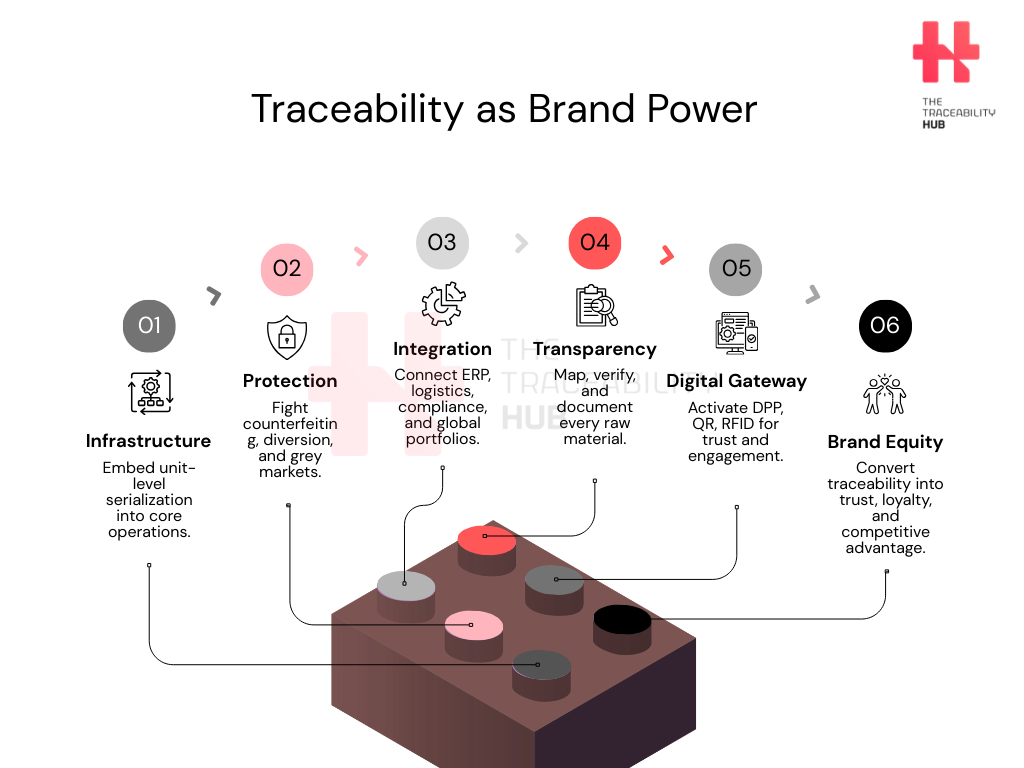
Traceability as Brand Power
Inside the Platform: What “Industrial-Grade” Traceability Really Looks Like
If traceability is to become a core infrastructure, it must operate on an industrial scale. That means going beyond basic QR codes or isolated tracking pilots and building a system capable of handling the complexity, volume, and regulatory demands of global beauty operations.
This is where the Antares Vision DIAMIND traceability platform comes into play.
Granular Traceability at Unit Level
At the foundation of DIAMIND is unit-level identification. Every single product, whether a shampoo bottle, a styling spray, or a serum, receives a unique digital ID.
This granular approach ensures that traceability is not limited to batches or pallets. Each unit can be individually tracked, authenticated, and verified throughout its lifecycle. For professional beauty brands, this level of precision is critical to combat counterfeiting, monitor and mitigate parallel trade, monitor distribution flows, and ensure product and brand integrity.
End-to-End Integration Across Systems
Industrial-grade traceability cannot exist in isolation. It must connect seamlessly with existing enterprise infrastructure.
Traceability platform DIAMIND integrates across:
- ERP systems for production and inventory management
- Logistics platforms for shipment and warehouse visibility
- Customs systems for cross-border compliance
- Digital compliance tools to meet evolving regulatory requirements
This integration ensures that traceability data flows across the organization instead of sitting in silos. The result is operational continuity rather than added complexity.
Scalability for Global Portfolios
For multinational beauty groups, traceability must operate across:
- Billions of serialized items
- High SKU complexity
- Multiple brands and categories
- Multiple international markets
Scalability is not optional, it is essential. A platform must support large production volumes without slowing down packaging lines or disrupting time-to-market. DIAMIND is designed to handle this scale while maintaining data accuracy and system performance.
Built for Future Readiness
Regulatory environments are evolving rapidly, from serialization mandates to Digital Product Passports (DPP) and ESG reporting obligations. A static solution quickly becomes obsolete.
Industrial-grade traceability must be future-ready, capable of adapting to:
- Changing international regulations
- Growing ESG transparency requirements
- Cross-market interoperability demands
This flexibility allows brands to respond proactively rather than reactively to compliance changes.
What This Enables in Practice
When these elements come together, granularity, integration, scalability, and adaptability, the impact extends far beyond compliance.
Brands gain the ability to:
- Respond faster to product recalls, safety alerts, or market disruptions
- Reduce waste through better inventory visibility and stock management
- Make better decisions across supply chain, quality assurance, and brand management teams
- Mitigate diversion
In short, industrial-grade traceability transforms data into operational intelligence. It gives beauty companies not just visibility, but control, and in a competitive global market, control is a strategic advantage.
From Compliance to Connection: How Packaging Is Changing Its Role
For decades, packaging in beauty served a clear and limited function: it was a container and a label. Its purpose was to protect the product, communicate mandatory information, and reinforce brand aesthetics on the shelf.
That packaging model is rapidly evolving.
In a traceability-driven landscape, product packaging is no longer just a physical wrapper. It is becoming a digital interface gateway between the brand, the product, and the end user.
With serialization and digital identities embedded at unit-level, packaging can now enable:
- Interactive QR codes experiences, linking consumers directly to verified product information
- Loyalty programs and education, offering tutorials, professional guidance, or personalized content
- Sustainability credentials, showing sourcing origins, environmental impact data, or ingredient transparency
- Faster recalls and real-time safety alerts, strengthening consumer protection and brand responsiveness
This shift transforms packaging from a static communication tool into a dynamic, data-enabled touchpoint.
What This Means for Professional Haircare Products?
In professional beauty and haircare, where products often pass through salons, distributors, and international markets, this packaging evolution carries significant strategic weight.
Interactive and traceable product packaging supports:
- Stronger distributor trust, thanks to verifiable authenticity and controlled distribution flows
- Higher credibility in global markets, particularly where regulatory scrutiny is increasing
- Clearer differentiation beyond formulation, positioning brands not only as high performing, but as transparent and technologically advanced.
- Data collection from consumers (precious data for Marketing and Business Intelligence)
In a global industry where information exchange between brands and consumers remains essential, traceable packaging adds a new competitive layer: proof.
The formula may win the first purchase. Transparency and verification are what sustain long-term trust.
This Is Not an Isolated Case: A Broader Industry Shift Is Underway
The partnership between a major U.S. beauty multinational and Antares Vision Group is not a one-off initiative. It is part of a broader, unmistakable pattern.
Across the industry, global beauty brands are investing heavily in traceability infrastructure, not as a marketing experiment, but as a structural upgrade to their global supply chains. Serialization platforms, blockchain traceability ecosystems, RFID-enabled tracking, and Digital Product Passports (DPP) are moving from pilot programs into enterprise-wide deployment.
And as these investments scale, expectations are shifting.
Retailers are demanding stronger authentication and transparency standards from brand partners.
Regulators are tightening compliance frameworks and increasing digital reporting requirements.
Consumers are becoming more skeptical of unverified claims and more attentive to product provenance and safety.
Traceability now is no longer confined to back-office compliance teams. It now directly influences:
- Market access, especially in regions introducing digital labeling and digital product passport requirements
- Retail partnerships, where product transparency is becoming a condition for shelf space
- Brand credibility and integrity, in a marketplace where trust must be proven, not promised
In this evolving landscape, infrastructure matters as much as formulation.
Italy’s Expanding Role in Global Beauty
This transformation also highlights a broader shift in how innovation in beauty is defined. Italy has long been recognized for product excellence, formulation expertise, premium product packaging, and design. Today, it is also contributing to something equally strategic: the technological backbone enabling global traceability standards.
Through companies like Antares Vision Group, Italy is not just exporting beauty products. It is exporting digital infrastructure, and interoperability protocols shaping how beauty products are tracked, verified, and trusted worldwide.
Traceability is no longer an optional upgrade. It is becoming a global standard. And the brands investing today are helping define what that standard will look like tomorrow.
How Leading Brands Are Implementing Traceability: Different Paths, Same Direction
Traceability in the beauty sector is no longer theoretical. Major brands and retailers are actively investing in digital systems, ingredient and quality transparency standards, supplier verification programs, and unit-level product identification.
While the technologies and governance models differ, the common direction is clear: structured, verifiable transparency embedded into core operations.
Below are examples of how leading players are approaching traceability today.
L’Oréal: Digital Transformation and AI-Enabled Sustainability
L’Oréal has publicly emphasized digital transformation across its supply chain and sustainability operations. The group has invested heavily in data systems, automation, and artificial intelligence to improve planning, sourcing visibility, and beauty product development.
In 2025, L’Oréal announced a collaboration with IBM to develop an AI model aimed at advancing sustainable cosmetics formulation. The initiative focuses on leveraging AI to optimize ingredient selection and reduce environmental impact.
The company’s broader digital supply chain strategy reflects increasing integration of data-driven tools to strengthen supply chain transparency, regulatory alignment, and operational control at global scale.
The strategic signal is clear: digital infrastructure is becoming central to sustainability and compliance management.
The Body Shop: Community Fair Trade and Independent Verification
The Body Shop has long positioned ethical sourcing at the center of its brand identity through its Community Fair Trade program. The initiative involves direct partnerships with producer communities and suppliers across multiple countries.
The program includes structured documentation and third-party verification processes, including independent auditing (such as ECOCERT oversight in certain markets). This model ensures that sourcing claims are supported by documented standards and external review.
Rather than relying solely on brand storytelling, the company’s approach integrates verifiable sourcing criteria and audit mechanisms – reinforcing traceability through governance and documentation of provenance systems.
Sephora: Ingredient Transparency as Retail Standard
Sephora has introduced retail-level transparency standards through its “Clean at Sephora” initiative. Products carrying the designation must comply with clearly defined ingredient exclusion criteria.
Sephora has also published public chemicals policies outlining expectations for ingredient disclosure, including transparency around intentionally added ingredients and fragrance allergens.
Although “Clean at Sephora” is not a full supply chain traceability system, it establishes structured ingredient transparency requirements at the retail level. This creates pressure upstream, encouraging beauty brands and suppliers to align with clearer disclosure and formulation standards.
Retail transparency thus becomes a lever influencing traceability practices across the value chain.
Bastille Parfums: RFID-Enabled Unit-Level Traceability
French fragrance brand Bastille Parfums has adopted RFID tag technology in partnership to assign unique digital identities to individual product units.
Through RFID tagging and connected product cloud infrastructure, Bastille enables item-level tracking across production, distribution, and retail environments. This system supports improved inventory accuracy, supply chain visibility, and anti-counterfeiting efforts.
In this case, product traceability moves beyond documentation toward serialized, unit-level digital identity – linking physical products with digital data in real time.
Different Product Traceability Technologies, Same Direction
The examples above illustrate different technological and governance approaches:
- AI-driven sustainability and digital supply chain systems
- Community sourcing with third-party verification
- Retail-enforced ingredient transparency standards
- RFID tag-based item-level serialization
The implementation paths vary, but the underlying objective is consistent: creating systems that allow brands to substantiate claims, improve supply chain visibility, and strengthen costumer’s trust.
Traceability is not uniform in method, but it is increasingly visible in strategy.
In an industry built on safety, authenticity, and consumer trust, the ability to demonstrate – rather than simply declare – transparency is becoming a defining capability.
Ingredient Traceability as the New Baseline
In today’s beauty landscape, ingredient traceability is no longer a competitive differentiator. It is becoming the baseline expectation.
For R&D teams, formulators, and sourcing managers, the implications are profound. Every ingredient entering a formulation must now be:
- Mapped across the supply chain, from raw material origin to finished product
- Auditable in terms of provenance, with documented sourcing data and verifiable supplier records
- Designed for regulatory compliance and safety from the outset, rather than retrofitted to meet regulatory checks
Traceability is no longer a post-production validation step. It is embedded directly into product development. Compliance and safety are shifting from reactive obligations to proactive design principles.
A Strategic Reframing of the Formula
The strategic question for beauty brands has evolved.
It is no longer sufficient to ask: What is in the formula?
Today, the more relevant – and increasingly decisive – questions are:
- Where did each ingredient come from?
- How was it cultivated, extracted, or synthesized?
- Under what environmental, social, and regulatory conditions was it produced?
This reframing reflects a deeper market transformation. Consumers, regulators, and retail partners are demanding transparency not just at the product level, but at the ingredient level.
For professional beauty and haircare brands, this shift carries weight. Performance remains essential, but performance alone is no longer enough. The credibility of a product now rests as much on its documented origin as on its efficacy.
Ingredient traceability is not simply a technical capability. It is the foundation of trust in a market where proof increasingly outweighs promise.
From Data to Storytelling: When Provenance Becomes a Content Layer
As traceability becomes standard practice, the brands that win won’t be the ones with the most data – but the ones that know how to translate that data into trust.
A clear, best-practice shift is emerging: provenance data is evolving into a content layer, not a compliance appendix. In other words, the most effective traceability strategies don’t end in PDFs, internal dashboards, or static reports. They are designed to be activated – customer-facing, brand-aligned, and easy to understand.
Above all the future adoption of the GS1 Digital Link QR Code, the next standard GS1 Sunrise 2027, a unique code, will transform product packaging into a digital portal, enabling brands to deliver dynamic content, engaging storytelling, and verifiable proof of authenticity to the end consumer with a single scan.
Beyond “Proof”: Making Transparency Feel Real
When traceability is treated as storytelling infrastructure, brands can turn complex supply chain information into experiences people engage with. For example:
- Ingredient maps that show where key raw materials come from – visually, instantly, and credibly.
- Cultivation or production videos that bring suppliers, farms, and processing steps to life.
- Third-party audit trails surfaced in a way that feels accessible (not technical).
- Dynamic lifecycle metrics (impact, recyclability, footprint) that update by region, product line, or packaging format.
This is where transparency stops being a defensive move and becomes a brand-building tool.
Why It Works: Emotional Anchoring + Alignment
When provenance is communicated as content, it doesn’t just inform – it anchors consumers emotionally. It turns ingredients into “characters” and the supply chain into a narrative the consumer can relate to.
The outcomes are tangible:
- Stronger consumer–brand alignment, because values are demonstrated, not claimed.
- Higher retention, especially among Gen Z audiences who are skeptical of marketing but highly responsive to verifiable authenticity.
- More durable trust, because the brand consistently shows how it operates, not just what it promises.
- It opens a communication channel with the consumers
In this new era, traceability isn’t only about being able to prove something under audit. It’s about being able to show it – clearly, credibly, and in a way that reinforces why the brand deserves loyalty.
Traceability as a Core Brand Capability
Traceability in beauty has crossed a critical threshold. It is no longer an optional enhancement, nor a back-end compliance mechanism operating quietly behind the scenes.
It has become a core brand capability.
Today, traceability functions simultaneously as:
- Infrastructure: The digital backbone connecting production, logistics integration, compliance, and retail.
- A trust protocol: Enabling brands to authenticate products, protect brand integrity, validate sourcing, and protect consumers.
- A storytelling engine: Transforming supply chain data into credible, engaging narratives.
The industry is moving decisively from a model built on claims to one grounded in verifiable narratives. Product sustainability, safety, authenticity, and quality are no longer persuasive because they are stated, they are persuasive because they can be demonstrated.
For professional beauty and haircare brands in particular, this shift is strategic. Trust, performance, and customers credibility are central to long-term success – and all three increasingly depend on proof.
The leaders investing in serialization platforms, Digital Product Passports (DPP), digital traceability ecosystems, and end-to-end traceability today are doing more than upgrading operations. They are:
- Future-proofing compliance in an environment of tightening global regulation
- Strengthening brand equity through demonstrable transparency
- Redefining what luxury and quality mean in a digitally native, trust-driven market
- Opening a communication channel with the end consumers
- Mitigate diversion
- Fight counterfeiting
In the next chapter of beauty, formulation excellence remains essential. But infrastructure, verification, and transparent storytelling will define who leads.
Traceability is no longer a support function. It is a strategic asset, and a decisive differentiator in the global beauty industry.
Coming soon: GCC Regulatory Affairs Summit 2026: Compliance & Digital Transformation