


How Consumer Goods Supply Chain Leaders Are Accelerating Supply Chain Digital Transformation
Digital technologies are changing the consumer goods supply chain sector. Digital transformation proves to boost supply chain resilience, which makes a strong case to modernize. The food and fast-moving consumer goods industries generate more than one-third of global emissions, mostly from upstream supply chains. Smart operations (including IoT-enabled supply chain visibility) have become crucial now more than ever.
Companies can predict demand patterns and optimize inventory levels thanks to data analytics, a revolutionary force in supply chain management. AI agents will make 15% of day-to-day supply chain decisions by 2028, according to industry experts, highlighting the rapid rise of AI supply chain automation.
Many companies have already achieved an 80% reduction in administrative time by forming mutually beneficial alliances with digital logistics providers.
In this piece, we will get into why consumer goods companies increasingly adopt up-to-the-minute data analysis tools to improve supply chain resilience and operational excellence. Better supply chain decisions emerge from these adoptions. Our discussion covers current challenges in CPG supply chain management, digital solutions’ role in addressing these issues, and ground examples of successful implementations.
Core Challenges in Modern Consumer Goods Logistics
CPG, Consumer Packaged Goods, companies face critical challenges in their supply chains that hurt their efficiency and environmental responsibility. We have made progress with technology, but major gaps still exist in visibility, communication, and measuring environmental effects throughout the industry, especially in end-to-end supply chain visibility and sustainability tracking.
Lack of Real-Time Shipment and Inventory Tracking
Consumer Packaged Goods companies don’t deal very well with outdated inventory management systems that block accurate stock visibility (and limit real-time supply chain monitoring). Companies often find differences between their actual inventory and system records because they can’t track things immediately. This leads to overselling or understocking, which frustrates customers and loses sales opportunities. Products moving through the supply chain become harder to track because legacy systems don’t work well together. Data stays trapped in different systems, and manual fixes often create errors and outdated information that hurt important decisions.
Money gets wasted quickly. Companies pay extra charges for containers sitting too long at ports because they don’t have up-to-date shipment data, a common issue solved by digital freight visibility tools. Their sales cycles also get disrupted when they can’t see incoming goods. In spite of that, about 80% of Third-Party Logistics providers see this problem and plan to add new technologies in 2024 (especially IoT supply chain sensors).
Disconnected Supplier Communication Channels
Poor communication between Consumer-Packaged Goods companies and their suppliers creates major operational problems across the consumer goods supply chain network. About 59% of suppliers say they can’t perform their best for major customers, while 98% need better communication from their biggest clients. This problem gets worse because of scattered data collection, the typical enterprise collects information from 400 different sources, with data growing 63% monthly, driving a need for centralized supply chain data platforms.
Not knowing supplier inventory levels and production schedules leads directly to delayed shipments and product shortages. It gets even harder with smaller suppliers because they might not know about international rules or what retailers need in target markets.
Sustainability Blind Spots in Upstream Operations
The most worrying fact is that 80-90% of a typical CPG company’s environmental effect, including greenhouse gasses, harm to biodiversity, water usage, and land use, happens within their supply chain (a clear case for carbon tracking tools and sustainability analytics dashboards). Organizations stay vulnerable to supply chain problems and miss chances to fix environmental issues when they can’t see what’s happening upstream.
Forward-thinking companies that use environmentally responsible practices have cut operational costs by 10-30% through circularity initiatives. Studies show that using these techniques can boost profits by 78%, even with a 29% drop in yield. But most CPG companies still lack digital tools to track these sustainability metrics across their supplier networks – such as real-time ESG monitoring platforms.
How Real-Time Analytics Tools Are Closing the Gaps in CPG supply chain
Technology is closing supply chain gaps in consumer goods faster through live analytics and real-time decision-making capabilities. Digital tools now show unprecedented visibility and help teams work together better. These systems track sustainability in ways that old methods simply couldn’t match.
IoT-Enabled Supply Chain Visibility in Action: Live Inventory Monitoring with IoT Sensors
Walmart shows how powerful IoT can be in supply chain management. The retail giant has placed millions of ambient IoT sensors across its U.S. operations a strong example of IoT supply chain transformation. These battery-free sensors track live data about temperature, location, humidity, and dwell time. Their network spans 4,600 retail locations and over 40 distribution centers. The sensors feed high-resolution supply chain data straight into their AI systems.
This technology sends automatic alerts about inventory issues right away. Store workers can act faster and spend more time helping customers. These sensors prove especially useful in cold chain storage by making sure produce moves quickly to coolers after reaching stores.
AI-Powered Demand Forecasting for Stock Optimization
AI-driven demand forecasting beats traditional methods in accuracy by:
- Finding patterns in big datasets that humans might miss
- Using external data like market trends and economic forecasts
- Learning and adapting as new information comes in
Machine learning algorithms power these advanced systems (key tools in predictive analytics for supply chains). They look at multiple factors, seasons, market trends, and promotional effects, to predict demand accurately. Companies can cut overproduction, storage costs, and waste risks by matching production more closely to actual demand.
Digital Collaboration Platforms for Supplier Coordination
Supplier collaboration software creates a central hub to collect, store, share, and track key supplier information. Cloud-based systems help businesses digitize their supply chain interactions and share data with partners using digital procurement and supplier management tools.
Suppliers can update their profiles, catalogs, and pricing through vendor dashboards. This reduces work for procurement teams and lets them focus on core operations. Teams can now work together in real time with all partners, which makes the entire value chain more responsive.
Carbon Tracking Dashboards for Sustainable Sourcing
Carbon tracking dashboards show emissions impact using verified carbon accounting methods (a critical capability for sustainable supply chain management). Companies use these tools to watch both direct and indirect greenhouse gas emissions from their operations. Organizations can measure their progress with custom metrics, show stakeholders their improvements, and spot ways to cut carbon.
Carbon action manager tools rate suppliers and create scorecards. This helps companies guide less experienced suppliers while working on new ideas with advanced partners.
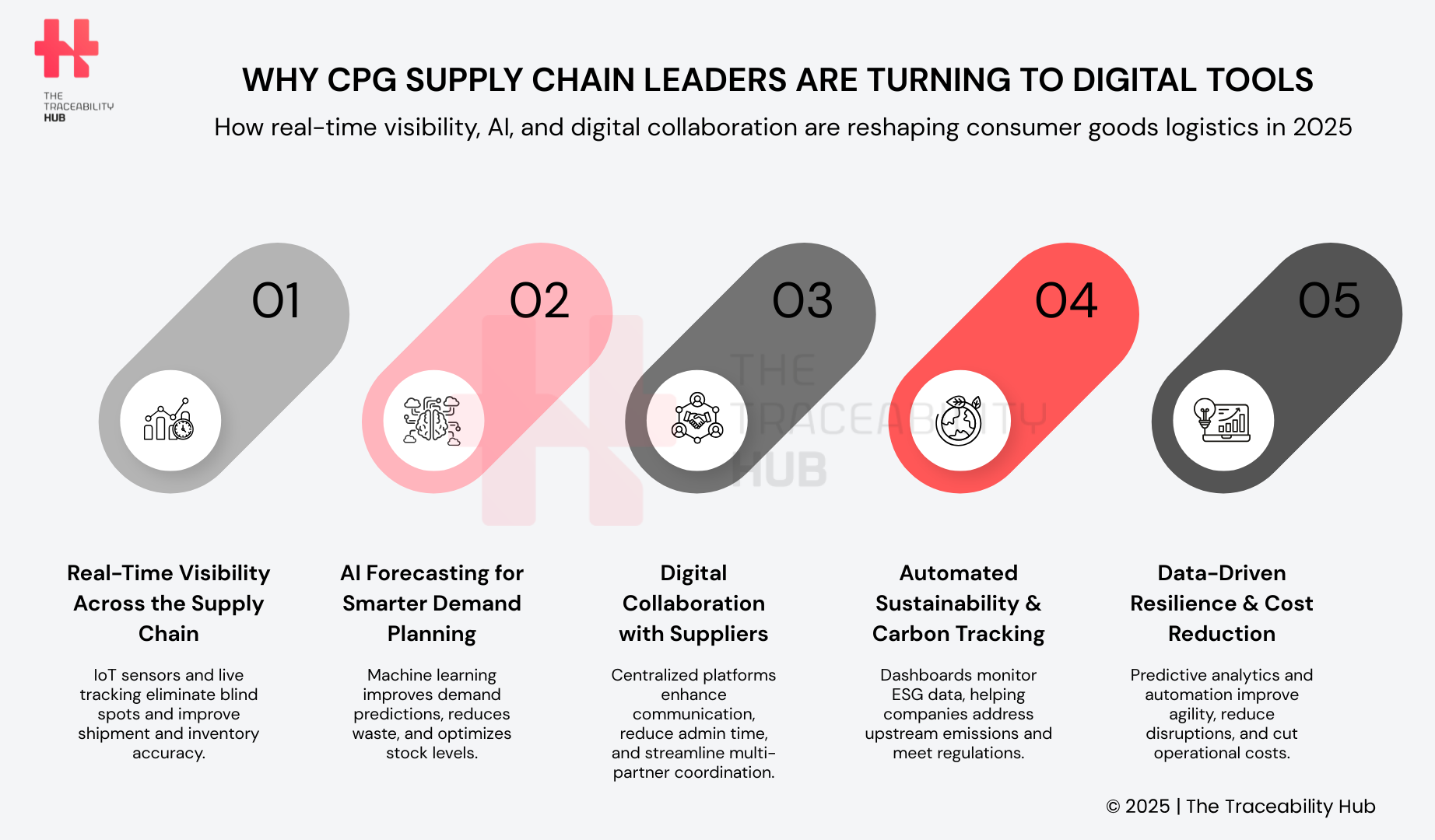
Why CPG Supply Chain Leaders Are Turning to Digital Tools
Case Studies: Real-World Examples of Data-Driven Supply Chain Optimization
Consumer brands are getting great results by using digital tools in their supply chains. These real-world examples are a great way to get practical insights into implementing data-driven supply chain strategies.
Estrid: 80% Admin Time Reduction via Digital Logistics Platforms
Swedish razor subscription company Estrid faced heavy pressure from worldwide supply chain challenges after the pandemic. The company couldn’t afford to miss deliveries because of its subscription model.
Estrid’s new Digital Logistics Platform improved supply chain visibility and helped make better decisions about resource use using centralized logistics analytics. The results were impressive – Estrid’s subscriptions grew by 200% while keeping customer acquisition costs low.
CLOUD NINE: Weekly 4-Hour Savings through Automated Supply Chain Reporting in Shipment Tracking
Premium hair styling brand CLOUD NINE changed its operations with digital logistics solutions to fix its complex supply chain management. The company used to spend over an hour checking multiple platforms just to answer simple questions about shipping costs.
The new system now saves them 4 hours every week on shipment tracking and KPI monitoring thanks to automated supply chain reporting. George Sweeney, Supply Chain Manager, puts it simply: “It’s so much quicker to keep track of important business KPIs thanks to the reporting feature… now it can be done with one click”.
Blokker: €300,000 Saved Through Advanced Visibility and Supply Chain Optimization
Dutch retailer Blokker’s century-old business managed promotional campaigns through Excel files, which created confusion and mistakes. The company needed to rebuild its supply chain because of falling profits and tough competition. Blokker’s new digital platform gave them complete oversight of their promotion process. Better visibility helped them make evidence-based decisions, reducing waste through advanced supply chain visibility tools, and ended up saving €300,000.
Strategic Roadmap for Digital Supply Chain Transformation
Consumer goods supply chains need a structured approach to implement digital technologies and AI-driven automation frameworks. This approach should balance breakthroughs with practical business needs. Leading industry experts recommend a step-by-step strategy for companies that want to modernize their operations through advanced analytics and automation.
Building a Resilient Supply Chain with Predictive Analytics Strengthening Risk Mitigation & Agility
Supply chain problems are systemic even after years of technological investments. Recent data shows trends. About 25% of supply chain leaders say their organizations can’t handle geopolitical tensions. A quarter of them aren’t ready for transportation disruptions, and 23% would struggle with another health crisis. These problems exist because traditional tools like legacy ERP systems can’t meet modern supply chains’ real-time needs. These systems were built for batch processing.
Predictive analytics gives companies a better way to deal with disruptions. Companies can spot problems before they happen instead of just reacting to them, an essential capability in risk mitigation and supply chain resilience. This shifts supply chain management from reactive to preventive mode. The tools can spot suppliers who might fail to deliver or face financial trouble. They also predict weather delays and route problems to help plan logistics better.
CPG companies see real benefits when they use predictive analytics. Retailers who use AI-driven models cut logistics costs by 15%. Their inventory accuracy improved by 35%, and service levels got better by up to 65%.
Integrating Real-Time Data into Decision Making
A unified data model forms the base for supply chain transformation. This model brings different data sources together (including IoT, cloud, and ERP data pipelines) into one clear view. Companies get a live picture of their entire supply chain by connecting IoT devices, sensors, and cloud platforms to create a full supply chain picture. But CPG data splits across retailers, distributors, consumers, and many other sources.
Companies should create data products to fix this split. These products work like building blocks that teams and systems can easily use. Business teams, not just IT, should own these data products. They need to set and track important metrics like fulfillment and on-time delivery.
Data virtualization platforms let companies combine information from different sources in real time. This creates a clear view of the whole supply chain. Companies can save more than 15% of their end-to-end supply chain costs by integrating data properly.
Connecting Transformation to Business Strategy: Aligning Digital Tools with Operational Excellence Goals
Digital transformation works best when companies have a clear vision of their future supply chain. This vision should match their strategic goals. Strategic objectives, continuous improvement methodologies, and supply chain vision must now consider pressures and opportunities in our digital economy.
Companies should turn their vision into specific business and technical goals once they set it. For example, they might want better decisions through machine learning systems that suggest solutions for specific situations. They should then create a detailed plan for several years. This plan should identify ways to improve operations and digital solutions that build on what they already have.
Digital transformation promotes a complete culture of continuous improvement. This culture plays a significant role in achieving operational excellence. Companies must check their current digital maturity, create a custom implementation plan, and keep improving.
Preparing for AI-Driven Supply Chain Automation (GenAI and Machine Learning for Future-Ready Operations)
AI-driven automation leads to the next wave of supply chain management. Generative AI applications could boost operations performance by about USD 18 billion in supply chain operations alone. This technology makes the value chain better, from core operations like planning to support functions like procurement and customer experience.
Companies should create a good supply chain strategy that puts customers first before they start using Gen AI. They need workflows that help teams work together across departments and with outside partners. Information should flow easily through real-time updates.
CPG companies need top technical talent in-house to use AI well. They should offer meaningful work, chances to learn, and an environment where tech experts can grow. They also need flexible system architecture. A team of central IT experts and market leaders should work together to design this system.
The Future of CPG Supply Chain Management Lies in Real-Time Analytics and AI-Driven Automation
Digital revolution in consumer goods supply chains represents a major milestone for the industry. Live analytics tools provide solutions to old problems that were used to stymie operational efficiency. Companies that adopt these technologies see dramatic improvements in their key performance indicators. This proves that the business case for digital transformation is right.
IoT sensors help eliminate visibility gaps that seemed impossible to bridge before. Walmart has shown this through their massive sensor rollout across thousands of stores. This gives organizations unprecedented insight into inventory movements. They can now manage proactively instead of just reacting to shortages or overstock situations.
AI-powered demand forecasting systems have changed demand planning from educated guesses into evidence-based science. These systems look at complex patterns across multiple variables. This leads to more accurate stock optimization and lower risks from excess inventory costs and stockouts.
Digital collaboration platforms have changed how companies work with suppliers. Data sharing runs smoothly, communication works better, and teams handle less paperwork. Estrid, CLOUD NINE, and Blokker’s results show these benefits clearly. They cut administrative time by 80% and saved hundreds of thousands in costs.
Specialized carbon dashboards now make sustainability tracking possible even in complex supply networks. CPG companies can finally tackle 80-90% of environmental effects that happen upstream in their supply chains. This helps them meet growing consumer and regulatory requirements for responsible production.
The roadmap to implement these changes involves building predictive capabilities and integrating live data streams. Companies need to arrange digital tools with operational goals and prepare for AI-driven automation. Organizations that follow this well-laid-out approach put themselves in a great position for future supply chain management.
Live analytics is more than just a tech upgrade – it’s a fundamental change in how consumer goods companies work. Companies that embrace digital tools today will without doubt gain competitive edges through better resilience, smarter decisions, and more sustainable operations. The shift from reactive to predictive supply chain management ended up delivering what matters most – better customer experiences and stronger business results.
Read more: Chestny ZNAK Fines Explained: Russia’s Strict Labeling Penalties