



Understanding Russia’s Strict Digital Labeling Compliance
Russian product compliance regulations rank among the world’s toughest, with penalties reaching 300,000 rubles for individual entrepreneurs and 500,000 rubles for legal entities. The national track and trace system, Chestny ZNAK, makes digital marking mandatory for products of all types. These include tobacco, footwear, perfumes, cameras, tires, and pharmaceuticals. This complete system substantially affects everyone in the supply chain, from manufacturers to retailers.
The digital marking compliance framework uses unique Data Matrix codes and RFID tags that track products throughout their product lifecycle. Companies risk major financial and operational setbacks if they fail to meet these serialization requirements.
The legal foundations of these regulations come from Federal Law 487-FZ, which sets clear penalties for unmarked goods. The system goes beyond basic product marking. It includes aggregation codes that track parent-child relationships between packaged goods, which adds another layer of complexity to compliance.
This piece gets into the full scope of Russian labeling penalties, serialization requirements, and compliance challenges. Businesses need to understand these elements to direct their operations effectively in the Russian market.
Legal Basis for Labeling Penalties in Russia
Federal Law No. 487-FZ is the foreground of Russia’s strict product labeling system. The Russian law establishes mandatory digital identification requirements for products of all types. This framework dictates how companies must trace goods through the supply chain, starting from manufacturing and ending with the final sale.
Federal Law No. 487-FZ and Its Role in Russia’s Digital Product Labeling System
Russia’s digital marking system rests on a legal foundation that mandates unique identification marks on regulated products. We designed this legislation to curb counterfeit goods and tax evasion. The law requires companies to send accurate product-movement data to the Chestny ZNAK operator. Product tracking continues at every stage until reaching the end consumer, which creates an unbroken chain of accountability.
Mandatory Use of Data Matrix Codes and RFID Tags for Compliance
Federal Law No. 487-FZ requires products to carry either Data Matrix codes or RFID tags based on their category. These digital identifiers act as the product’s “digital passport” throughout its product lifecycle. Each code must:
- Stay scannable with proper application
- Remain unique to each product unit
- Have registration in the Chestny ZNAK system
- Stay undamaged and in good condition
Companies must avoid using false, duplicated, altered, or corrupted codes since these violations carry their own penalties.
Who Must Comply: Manufacturers, Importers, Retailers
Market participants have specific duties under the Russian law. Domestic and foreign manufacturers must apply codes before their products enter Russian circulation. Russian market importers must ensure proper labeling during import. Distributors and logistics providers need to keep accurate aggregation hierarchies during transport. Retailers and online sellers must check code validity before sales and report final consumer transactions.
Every participant needs digital records ready for audits and inspections. This ensures the Chestny ZNAK data platform shows up-to-the-minute status of goods in circulation.
Administrative and Criminal Penalties Under Chestny ZNAK Regulations
Russia enforces penalties through a structured system to ensure products comply with mandatory labeling requirements. The government uses a tiered approach where penalties become more severe based on violation type and scale.
Administrative Fines for Unmarked or Improperly Labeled Goods
You will face immediate administrative penalties (fines and confiscation) if you produce, import, store, transport, or sell goods without mandatory labeling. Legal entities receive the toughest penalties; fines range from 2,000 to 4,000 rubles if you are an individual. Company officials must pay higher fines between 5,000 to 10,000 rubles and their products will be confiscated. Legal entities receive the toughest penalties – fines from 50,000 to 300,000 rubles plus mandatory confiscation.
Data-related violations (submitting false or inaccurate information to the Chestny ZNAK system) carry separate penalties. Companies that submit false or inaccurate information to the Chestny ZNAK system must pay fines between 50,000 to 100,000 rubles. Responsible officials could face fines from 1,000 to 10,000 rubles. Regulatory bodies like Rospotrebnadzor and customs offices can seize and destroy products that don’t comply.
Criminal Liability for Large-Scale Violations and Counterfeit Codes
Criminal charges apply when violations are large-scale or someone deliberately uses counterfeit labeling identifiers. The total value of non-compliant goods determines if criminal prosecution happens.
The penalties for unmarked goods worth more than 400,000 rubles include:
- Fines up to 400,000 rubles or salary-equivalent for up to 2 years
- Forced labor for up to 3 years
- Imprisonment for up to 3 years plus fines up to 80,000 rubles
This is a big deal as it means that when values exceed 1.5 million rubles, penalties increase to:
- Fines up to 700,000 rubles
- Forced labor extending to 5 years
- Imprisonment for up to 6 years plus fines reaching 1,000,000 rubles
Confiscation, Customs Restrictions, and Market Access Limitations
Russian authorities can confiscate and remove non-compliant products in all violation cases. Non-compliance creates immediate business barriers that go beyond direct penalties. Products without proper marking:
- Get rejected at Russian customs
- Cannot enter wholesale or retail channels legally
- Face blocks from physical and online sales
The business impact usually exceeds direct financial penalties since market access becomes impossible without proper compliance.
Role of Aggregation Codes in Chestny ZNAK Compliance
Aggregation codes play a key role in Russia’s Chestny ZNAK system, beyond just marking individual products. These codes help companies stay compliant and avoid penalties by streamlining how batches move through supply chains.
Definition and Function of Aggregation Codes
Aggregation codes are digital IDs that track logistic units with multiple marked products. They work as parent identifiers and connect all DataMatrix or RFID codes inside a single package – whether it’s a box, carton, or pallet. Supply chain partners can scan just one code instead of each item to get complete product details. This parent-child connection between codes builds a structure that keeps products traceable without slowing down operations.
Use Cases in Warehousing, Customs, and Distribution
Russian regulations recognize aggregation codes in many business settings:
- Moving goods in bulk through transport and logistics
- Managing warehouses and tracking inventory
- Clearing customs and verifying items at borders
- Processing import documents and meeting regulations
- Moving products between wholesalers and retailers
These codes speed up operations while tracking every product. One quick scan gives authorities instant access to all items inside, which removes the need to check each product yet keeps the supply chain visible.
Keeping Accurate Aggregation Hierarchies to Avoid Penalties
Federal Law No. 487-FZ requires companies to keep aggregation hierarchies accurate. Businesses must tell the Chestny ZNAK operator about all aggregation changes and update hierarchies as products move through distribution. Wrong hierarchies or mistakes in parent-child relationships can lead to the same penalties as having unmarked goods.
Companies must avoid using fake, duplicate, or damaged codes. The Chestny ZNAK platform needs to show exactly where goods are, with proper aggregation data records. Inspectors often check if physical inventory matches the reported aggregation hierarchies.
Operational and Commercial Risks of Non-Compliance in Russia
Not following Chestny ZNAK requirements creates business problems way beyond direct penalties. Business activities in Russia’s market can stop faster when companies face operational barriers.
Blocked Imports and Supply Chain Disruptions Caused by Non-Compliant Labeling
Russian customs won’t allow products without proper digital marks to enter. Border authorities reject shipments that don’t have valid DataMatrix codes or RFID tags. This leads to return shipments that get pricey or rack up warehouse storage fees. Any goods that somehow make it into the country without proper marking get stuck in the supply chain because legitimate distributors can’t legally accept them.
Loss of Market Access and Partner Trust in the Russian Supply Chain
No one can legally sell unmarked products in physical or online stores. Russian business partners put their own compliance at risk by handling non-compliant goods. This creates a situation where products become impossible to sell through legitimate channels.
Increased Inspections and Higher Regulatory Scrutiny for Violations
Repeat offenders often get classified as high-risk entities by authorities. This classification leads to more intense inspections of all operations and demands for extra documentation. These additional compliances check drain management’s resources and create ongoing friction in operations.
Impact on Brand Reputation in the Russian Market
Non-compliance damages trust with partners and consumers. Russian consumers now recognize Chestny ZNAK markings as signs of authentic products. Unmarked goods make people question the product’s origin and quality, which hurts the brand’s long-term value (hurts the brand’s reputation).
The Chestny ZNAK Compliance Cycle
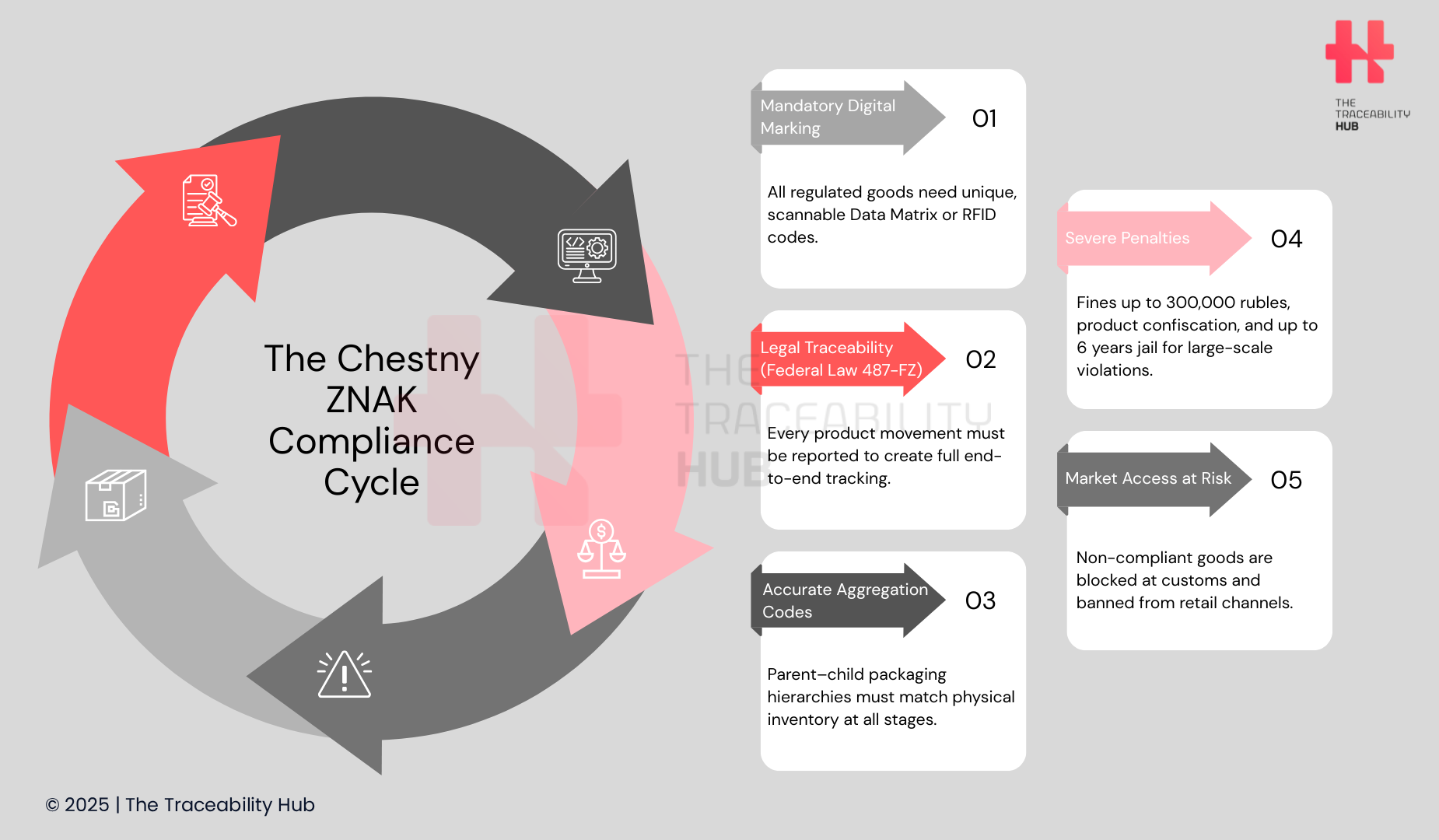
Why Full Chestny ZNAK Compliance Is Essential for Operating in Russia
Chestny ZNAK stands as one of the world’s toughest product tracking systems. This system has changed how businesses must operate in the Russian market. Companies that fail to follow these mandatory labeling rules face serious consequences. The Russian penalties start with administrative fines of 2,000 rubles if you have violations. These can lead to criminal prosecution and jail time for big violations worth more than 1.5 million rubles.
This complete system affects everyone in the supply chain. Manufacturers must put the right codes on products before they go to the market. Distributors must keep track of product groupings during transport. All but one of these retailers must check everything before selling. One weak link in this connected system can derail the whole trip.
The impact goes beyond just paying fines. Products without proper digital marks can’t be sold through regular channels. On top of that, it leads to stopped imports, supply problems, and extra attention from regulators. These challenges create problems that are nowhere near as simple as paying a fine.
The Russian government created this system to curb fake goods and tax dodging. Russian market success depends on following these rules – it’s not just red tape anymore. Companies that don’t blend these labeling rules into their daily work risk getting shut out completely. Success with Russia’s labeling rules needs deep knowledge, perfect execution, and constant watchfulness.
Read more: The Evolution of Supply Chain Analytics and Decision Intelligence