



Complete Compliance Guide for the Russian Market
Russian markets have identified millions of counterfeit products since early 2018. Substandard goods distribution creates significant problems for consumers and manufacturers alike. The illegal circulation has reached approximately 35% in manufacturing, 20% in perfumes, and up to 10% in medicines.
Russia launched Chestny ZNAK, a national digital labeling and track and trace product traceability system, that effectively tackles these challenges.
In Russian, “Честный” means honest or fair.
“ЗНАК” means sign, mark, or symbol.
So, “Chestny ZNAK” can be translated as “Honest Mark” or “Trusted Sign”.
This innovative tracking system helps manufacturers monitor their products and enhance service quality. Recent regulations mandate all consumer goods sold in Russia must carry special digital codes that verify their authenticity.
Chestny ZNAK represents the government’s solution to product traceability and anti-counterfeiting challenges. Each product receives a unique Data Matrix code that acts as its digital passport and tracks its experience from factory to store. Russia’s product labeling initiative verifies product authenticity, maintains high quality standards, and helps curb counterfeit goods effectively.
This detailed guide shows businesses how to prepare their products for the Chestny ZNAK system, covering everything from registration to implementation and compliance with Russian serialization requirements.
What is Chestny ZNAK? Importance of Russia’s Digital Labeling System
Chestny ZNAK is Russia’s ambitious national track and trace digital product labeling system that’s 5 years old. The system works as a public-private partnership under the Center for Research in Perspective Technologies (CRPT). This creates one of the world’s most complete product serialization and supply chain traceability networks.
Overview of the Russian Track and Trace System (Chestny ZNAK Framework)
The main goal of Chestny ZNAK is to ensure consumers get authentic products with their declared quality. The system tracks products from manufacture to final sale through five detailed steps. The CRPT gives manufacturers unique cryptographic codes for each product unit. These codes serve as unchangeable “passports” that validate products at every supply chain point, and all ownership changes must be recorded in the Russian track-and-trace database.
Products must pass scanning confirmation at retail locations before they go on sale. The Russian system takes a stricter stance than EU and US regulations by requiring even over-the-counter drugs to have labels, scans, and records. The system gets notified that “the code has left circulation” through point-of-sale scanning during checkout. Consumers play their part as supply chain guardians by using the Chestny ZNAK mobile app to verify their purchases and check digital authentication data.
How Chestny ZNAK Prevents Counterfeit Goods in the Russian Market
A reliable digital tracking infrastructure helps fight fake products effectively. Each product carries a Data Matrix code with two vital components:
- an ID code showing the product’s tracking system position
- a verification code or “crypto-tail”
This system works well – illegal tobacco dropped by 25% in just one year.
On top of that, it helped legalize 18 tobacco production facilities while shutting down 45 illegal operations. The system’s impact goes beyond tobacco. Substandard dairy products fell 12-fold, illegal perfume trade decreased by 20%, and the illicit tire market shrank more than two-fold thanks to strict product identification and serialization controls.
Industries Covered by Mandatory Chestny ZNAK Product Labeling
Since its launch in 2019, Chestny ZNAK has progressively expanded across a wide range of product categories. Today, the mandatory digital marking system covers the following certified groups:
- Pharmaceuticals (all prescriptions and OTC medicines)
- Medical devices and technical rehabilitation aids, including wheelchairs
- Tobacco products
- Footwear
- Light-industry goods (clothing, textiles, leather goods)
- Fur products
- Perfumes and eau-de-toilette
- Cosmetics and personal-care items (including deodorants, shaving products, soaps, detergents)
- Tires and tire covers
- Photographic equipment (cameras and flashbulbs)
- Packaged water (including mineral water)
- Dairy products (milk, cheese, ice cream, fermented products)
- Beer and beer-based beverages
- Non-alcoholic beer
- Antiseptics and disinfectants
- Biologically active supplements / dietary supplements
- Veterinary medicinal products
- Pet food
- Caviar and fish roe (sturgeon, salmon)
- Vegetable oils (sunflower, rapeseed, olive, etc.)
- Canned foods (including canned fish, vegetables, fruits, olives, anchovies and similar preserved products)
- Snacks, sauces, and spices
- Household chemicals and cleaning agents
In addition to these established categories, Russian authorities have announced future expansions that may soon extend digital marking requirements to new groups. Under evaluation are:
- Coffee products (beans, ground coffee, instant coffee, capsules
- Additional packaged foods
- Children’s goods
- Construction materials and industrial chemicals
- Selected personal-care and home-care categories
Some categories of food and beverages first entered through pilot phases (“experiments”), including beer, dietary supplements and antiseptics, before transitioning toward full mandatory marking.
For any company exporting to or operating within the Russian market, proper integration with Chestny ZNAK is essential. Non-compliance can result in severe financial penalties, product confiscation, and complete market exclusion, making adherence to the system a critical regulatory requirement for supply chain compliance.
Getting Your Products Chestny ZNAK Ready in 2025
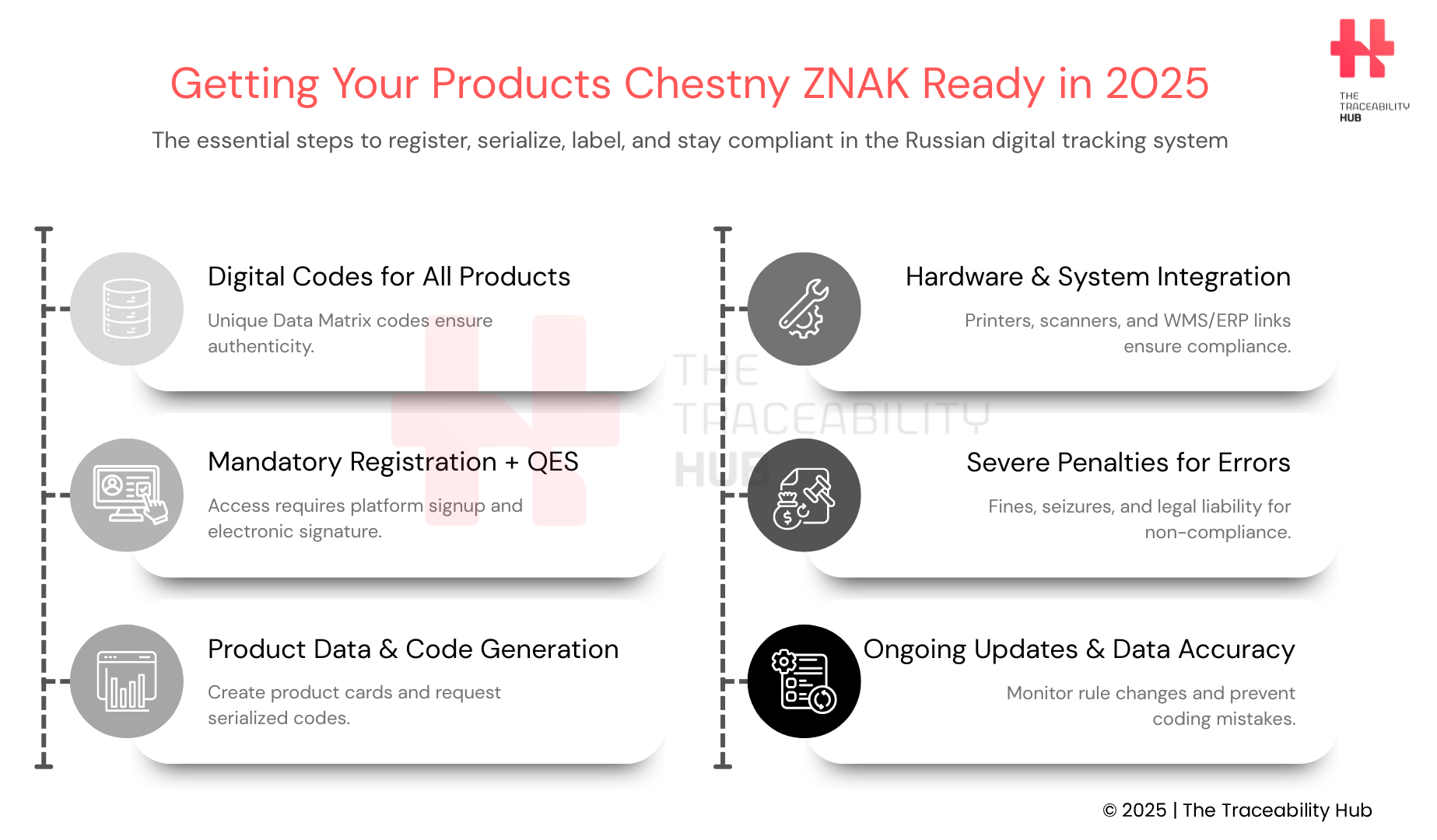
Step-by-Step: How to Register for Chestny ZNAK and Get Started
Starting with Chestny ZNAK demands precise steps to comply with Russia’s track and trace system. Businesses must complete several significant stages during the registration process.
Create an Account on the Chestny ZNAK Platform
Russian product labeling system requires registration on the official Chestny ZNAK platform. Russian tax residents (importers) must create an account as the first owner of goods within the Russian Federation. Legal entities’ registration needs their TIN (Taxpayer Identification Number) and CRN (Company Registration Number). Individual entrepreneurs need only their personal TIN.
This step ensures access to the national labeling system.
Get a Qualified Electronic Signature (QES)
Access to Chestny ZNAK’s personal account requires a qualified electronic signature. The company’s CEO or authorized representative must get this digital signature through certification centers accredited by Russia’s Ministry of Communications and Media. Companies need to install signature software from the certification center after getting the QES. All transactions and document submissions use this signature for authentication and secure data transmission.
Register Your Products and Request Data Matrix Codes
Businesses must add detailed product information to the data monitoring system after registration. Product cards need specific attributes like product name, TN VED code (Russian tariff code), GTIN, and trademark information.
Companies can then order and pay for marking codes through the system.
The system offers two payment options: by emission or by application report. Businesses get 60 days to use the codes once approved, following Russian serialization and labeling rules.
Understand GTIN, Serial Numbers and Data Matrix Code Structure
Chestny ZNAK’s Data Matrix codes contain specific structured information. Each code of makeup consists of a 14-digit GTIN (Global Trade Item Number), a 13-digit serial number, a 4-digit verification key, and a verification code (crypto-tail).
These elements create an 85-character alphanumeric sequence that works as the product’s digital passport. Industry requirements may vary – to name just one example; pharmaceuticals might need extra details like batch numbers and certification identifiers under pharma serialization guidelines.
Integrating Chestny ZNAK into Your Packaging and Supply Chain
Your supply chain needs specialized equipment and strategic integration to implement Chestny ZNAK. Your Russian tracks and trace compliance success depends on how well these most important components work together naturally.
Choosing the Right Barcode Printers and Scanners for Data Matrix Codes
The right hardware selection is a vital part of Chestny ZNAK compliance.
You need high-performance barcode printers with 2D imaging capabilities to produce Data Matrix codes. These printers should create precise, durable markings on packaging materials of all types. Your scanners must include high-resolution imaging technology that reads dense Data Matrix codes accurately.
You should look for scanners that can recognize GS1-encoded fields within the codes, including GTIN, serial numbers, and crypto-codes used in product serialization and aggregation.
Applying Chestny ZNAK Data Matrix Codes on Packaging
Each product needs a unique Data Matrix code with four key data points: a 14-digit GTIN, a 13-digit serial number, a 4-digit verification key, and a 44-digit verification code (crypto-code). These codes act as digital passports throughout the product’s lifecycle. Your specific industry might require additional information like expiration dates or manufacturing details in these codes to comply with sector-specific labeling rules.
Connecting Chestny ZNAK with Inventory, WMS, and Logistics Systems
Your Chestny ZNAK system must merge well with existing systems. Companies with high volumes should use API connections instead of relying on simple interfaces. Modern warehouse management systems can automate code handling at every stage – from stock receipt through order assembly and returns.
These systems can also send required information directly to the national track and trace platform through automated serialization workflows.
Using Aggregation Codes for Bulk Shipments
Combined codes help handle multiple items through a structured hierarchy. Every package and pallet needs an aggregated code that links all individual product codes inside. The core team must keep this parent-child relationship intact throughout the supply chain. Aggregation codes let the system register all connected individual codes at once, which makes logistics processes faster while keeping full traceability and compliance with Russian aggregation standards.
Chestny ZNAK Compliance: Legal Requirements, Benefits, and Common Pitfalls
Russian law sets strict rules for Chestny ZNAK compliance through Federal Law No. 425-FZ. This system stands as one of the world’s toughest track and trace frameworks and forms the backbone of anti-counterfeit regulation in Russia.
Legal Requirements and Penalties for Non-Compliance
Breaking Chestny ZNAK rules come with harsh penalties. Companies must pay fines between 50,000 and 300,000 rubles, and authorities will seize non-compliant products. The law punishes people who sell unmarked goods worth over 1.5 million rubles with forced labor or up to three years in prison.
Business leaders face even tougher sanctions – up to six years behind bars plus fines of 1 million rubles for serious violations under Russian product marking legislation.
Operational Benefits for Manufacturers, Retailers, and Consumers
Chestny ZNAK offers advantages across the supply chain. Companies can track their products live, which cuts delays and improves logistics. Manufacturers protect their brand’s reputation and market share by fighting counterfeits. Customers get guaranteed authentic products and detailed information through the Chestny ZNAK mobile app, improving supply chain transparency.
Common Implementation Errors and How to Avoid Them
Companies often run into data transmission problems. Wrong product codes, duplicate serials, and missing aggregation links lead to customs rejecting goods. Businesses should use automated error-checking systems and reliable data verification processes to prevent these issues and ensure serialization accuracy.
Staying Updated with Chestny ZNAK Rules and Updates
Rules and deadlines change quickly, often without proper notice. Companies need strong connections with certification bodies. They should also watch official CRPT communications closely to stay compliant with new labeling requirements.
Why Strong Chestny ZNAK Integration Determines Success in the Russian Market
Chestny ZNAK marks a turning point in Russia’s battle against fake products and reshapes how businesses work in this market. Companies need to know that good implementation does more than just meet rules, it guards their reputation and ensures customers get real products. This Russian track and trace system needs careful planning, especially when it comes to buying hardware, connecting software, and training staff.
Companies looking to enter the Russian market should focus first on learning what their specific product types require. The system might look complicated at first, but it ended up making operations smoother through better inventory control and fewer losses from counterfeits. It also builds customer trust through its mobile checking feature, which gives rules-following companies an edge over others.
Missing the mark on Chestny ZNAK rules can hurt badly, with penalties ranging from heavy fines to being kicked out of the market completely. Without doubt, investing in the proper setup pays off by making supply chains clearer and keeping illegal competitors at bay. Smart companies see these rules as chances to show their quality and dedication to Russian buyers, not as roadblocks.
The system will grow to cover more product types as it proves to work. Success with these rules depends on watching updates and keeping proper records throughout the supply chain. Companies that accept these tracks and trace systems rather than fight them will thrive in Russia’s marketplace for years to come.
Read more: Why Consumer Goods Supply Chain Leaders Are Switching to Digital Tools