

Rethinking What Makes Fashion Sustainable
Sustainability in fashion has long been framed through the lens of materials, certifications, and production impact – often within traditional sustainable fashion metrics. While these elements remain important, they capture only part of the picture. An increasing body of research and industry practice is pointing toward a more fundamental principle: the true sustainability of a garment is defined by how long it stays in use (garment longevity and lifecycle extension).
Extending the active life of clothing has been identified as one of the most effective ways to reduce its overall environmental footprint within a circular fashion model. According to the Ellen MacArthur Foundation, increasing the number of times a garment is worn significantly lowers its impact per use, shifting the focus from how products are made to how they are used, maintained, and retained over time (lifecycle thinking in fashion), and retained over time (lifecycle thinking in fashion).
This perspective reframes sustainability from a production-centric model to a lifecycle-oriented approach, where value is preserved rather than continuously replaced. Within this circular economy framework, three interconnected dimensions become critical:
- Longevity (garment durability and emotional durability): Both emotional and practical, determining whether a garment is kept and cared for
- Resale potential (fashion recommerce and second-hand value): The ability of a product to retain value and move across multiple users
- Design for repair and recycling (circular design strategies): The extent to which products are intentionally created to enable maintenance, disassembly, and end-of-life recovery
Together, these dimensions shift the conversation from “sustainable products” to products designed to remain relevant, usable, and valuable over time within a circular fashion system.
Longevity: The Foundation of Sustainability
A garment’s lifespan is not guaranteed solely by superior craftsmanship or material quality. While durability plays a significant role (physical garment durability), long-term usage is achieved through the interplay of two key factors: emotional durability in fashion and practical maintainability.
Emotional value influences whether consumers opt to retain and care for a garment over time. Apparel is more likely to remain in use when it:
- Aligns with personal identity (consumer-product connection)
- Is regarded as valuable (perceived product value)
- Embodies stories, memories, or significance
Additionally, garment longevity relies on repair accessibility (repair ecosystem in fashion) and the ease of maintenance to prolong its functional life. Even items of high sentimental worth may be discarded if upkeep becomes challenging, ambiguous, or unavailable.
This perspective underscores an important principle: longevity is embedded both in the design of the product (design for durability) and supported by the broader ecosystem in which it exists (circular fashion infrastructure).
The Repair Gap: A Missing Link in Circular Fashion
One of the main barriers to garment longevity today is not a lack of willingness from consumers, but a lack of access to repair services and information.
In practice, many consumers:
- Lack knowledge regarding suitable locations for garment repair (repair accessibility gap)
- Are unable to assess whether repairing an item is justified by the associated costs or effort
- Receive limited guidance from brands on maintenance and repair
This has led to a structural disconnect within the circular fashion ecosystem. Although repair services are available, they remain fragmented, difficult to access, and mostly dissociated from the overall product experience.
Consequently, there exists a repair gap, an unrealized opportunity where products capable of being maintained and extended are instead prematurely discarded, limiting lifecycle extension.
For brands and industry ecosystems, addressing this gap represents a significant area for intervention. Bridging this disconnect necessitates transitioning from passive product delivery to active lifecycle support (product lifecycle services), which may include:
- Offering clear and accessible repair instructions (repair guidance integration)
- Connecting consumers with local or certified repair providers (repair networks)
- Integrating repair information within digital product platforms (digital traceability tools)
Resale: Extending Life Beyond the First User
A significant aspect of sustainability is resale (fashion resale and recommerce), the capacity for a garment to transition through multiple ownership cycles while remaining actively utilized. The act of reselling extends the product’s lifecycle, thus mitigating the demand for new manufacturing and diminishing its overall environmental impact per use (circular economy benefit).
This concept aligns with circular economy models advocated by organizations like the Ellen MacArthur Foundation, which prioritize maintaining products in circulation for extended periods (closed-loop fashion systems).
Resale further contributes to:
- Lifecycle extension across various owners (multi-owner lifecycle)
- Impact distribution, lowering the environmental footprint associated with each use
- Economic value preservation (resale value retention), ensuring continued relevance beyond initial purchase
Resale Is Driven by Value
A garment’s resale potential is fundamentally associated with its ability to maintain value over time (product value retention in fashion).
Resale viability varies among products and is influenced by several factors:
- Perceived and intrinsic quality (durability and craftsmanship)
- Brand reputation and consumer trust
- Condition and longevity during use
These components collectively determine whether an item remains attractive within the second-hand market (recommerce ecosystem).
A crucial observation emerges: only garments that preserve functional, emotional, or economic value are positioned to be successfully transferred between multiple owners within a circular fashion model.
Designing for Repair and Recycling
Longevity and resale are outcomes that result primarily from decisions made during the design phase (circular product design). The way a garment is conceptualized, constructed, and specified plays a crucial role in determining its potential for maintenance, lifecycle extension, or recovery at the end of its lifecycle.
To achieve genuine circular design in fashion, products must be deliberately engineered to:
- Be readily repairable (design for repair), allowing individual components to be fixed or replaced without compromising the integrity of the garment.
- Facilitate disassembly (design for disassembly) as required, ensuring accessibility to various parts and materials.
- Be recyclable (design for recycling) upon reaching the end of their useful life, enabling material recovery and reintegration into subsequent production cycles.
This approach necessitates a transition from designing solely for aesthetics and cost to prioritizing lifecycle performance (lifecycle-driven design strategy). Key factors include:
- Selection of sustainable materials compatible with circular models and recycling methodologies
- Adoption of construction techniques that support intervention, such as modularity or minimizing stitching complexity
- Elimination of unnecessary complexity, which often impedes both repair and recycling efforts
Thus, product design serves as a strategic driver, influencing not only the manufacturing process but also the garment’s durability, ease of maintenance, and recoverability of materials, ultimately shaping its place within a circular economy.
Informing the Consumer: The Missing Layer
Even when products are engineered with circularity as a priority (circular design and sustainable garment design), a fundamental issue persists: is the consumer aware of this? Frequently, the answer is negative. The intrinsic value embedded in product design —such as repairability, recyclability, and durability— seldom achieves tangible impact, largely because essential information is not readily available at the point of use.
Currently, consumers are seldom informed regarding:
- Methods for repairing a product (repair instructions and maintenance guidance)
- Whether the product can be recycled and, if so, how (end-of-life garment solutions)
- Available services that support its lifecycle (repair, resale, and recycling ecosystems)
Such a lack of transparency fosters a disconnect between designed circular potential and actual consumer behavior. For instance, a garment may technically be repairable or recyclable; however, uninformed users are likely to dispose of it in a linear manner, reducing its lifecycle extension potential.
As emphasized by the European Commission through the Ecodesign for Sustainable Products Regulation (ESPR), providing clear, structured, and accurate product information is crucial to promoting more sustainable consumption in fashion and enabling circular economy behaviors.
Bridging this informational divide requires treating product information as a core component of the product itself (data-enabled products), rather than an additional feature. Absent this approach, even optimally designed circular products cannot fully realize their intended benefits.
The Role of Information and Traceability
Maximizing the potential of circular products requires that information remains accessible, reliable, and actionable throughout the entire product lifecycle (end-to-end lifecycle data management). Absent this informational foundation, even advanced design strategies may not be fully leveraged.
For circularity to operate effectively, products must be linked to a comprehensive and structured set of lifecycle data, including:
- Repair instructions: Facilitating ongoing maintenance, repairable clothing practices, and extending product life
- Material composition: Enabling informed utilization and appropriate end-of-life management (textile recyclability)
- End-of-life options: Specifying recyclability and providing guidance on proper disposal
- Access points: Connecting users to services for repair, resale, and recycling (circular service ecosystems)
Product Traceability in fashion is essential in this context, as it enables structured, long-term accessibility of product data, thereby transforming standalone products into integrated assets within a circular system.
Within Europe, this methodology is being formalized through regulatory initiatives such as the Ecodesign for Sustainable Products Regulation (ESPR), led by the European Commission. ESPR introduces the concept of Digital Product Passports (DPP), a key enabler of digital traceability in fashion.
Digital Product Passports (DPPs) are intended to:
- Connect products to services, including repair networks, recycling systems, and resale platforms
- Enhance lifecycle data visibility, spanning production, usage, and end-of-life phases
- Support informed decision-making, benefiting both consumers and stakeholders across the supply chain
Complementing DPPs, various certified and standardized frameworks contribute to increased transparency and traceability:
- Systems conforming to GS1 standards, which promote consistent product identification and seamless data exchange across value chains
- Third-party certifications (e.g., material and product standards), which uphold data credibility, trust, and comparability
- Digital traceability platforms, integrating product information with broader service ecosystems
Collectively, these advancements transcend mere regulatory compliance, establishing the foundational elements for an effective circular fashion model. In such a model, products are engineered for durability, repairability, and recyclability and are supported by the requisite digital information to realize these capabilities in practice.
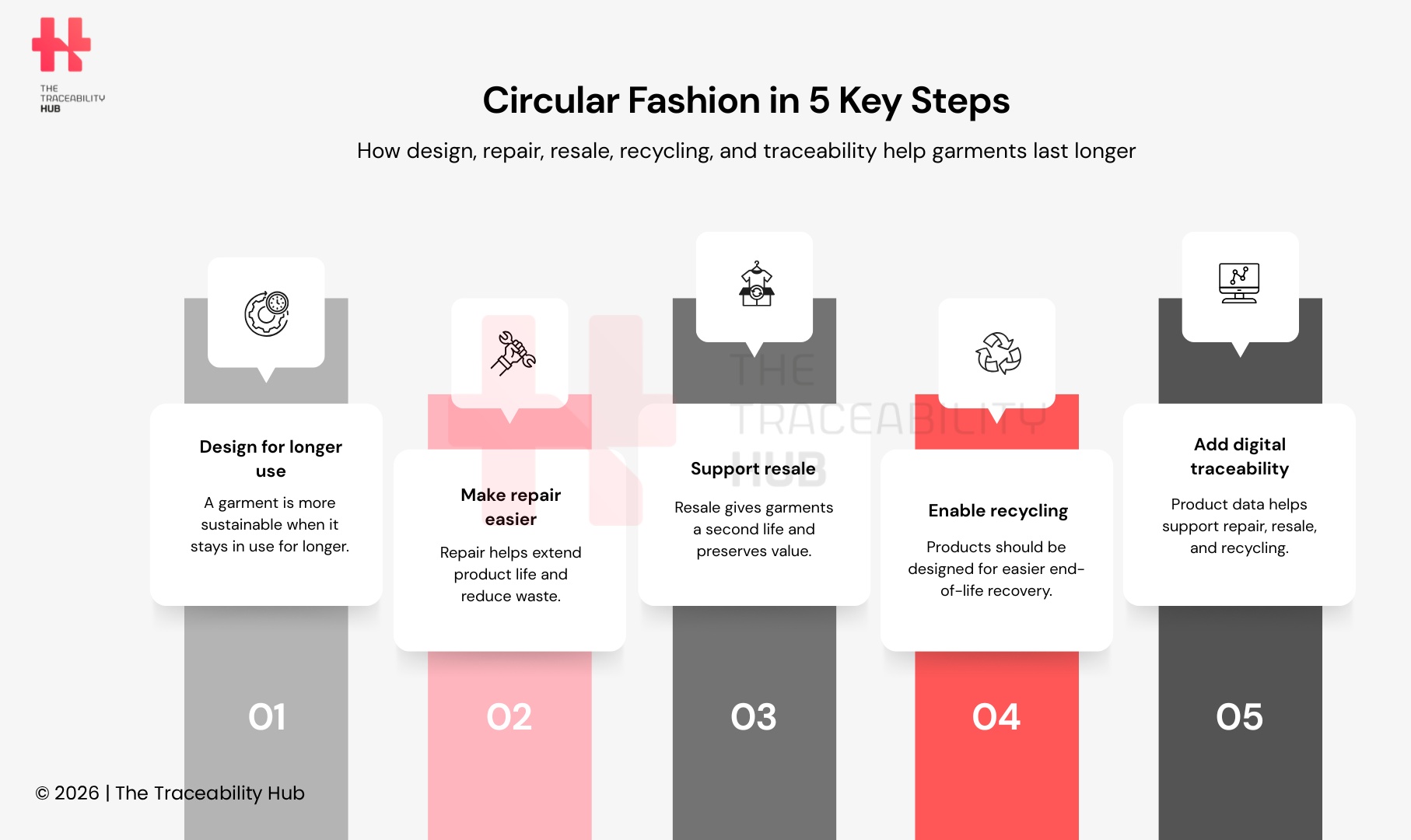
Circular Fashion in 5 Key Steps
A Circular Fashion Case Study from the Luxury Footwear Sector
The future of product management in fashion and luxury is increasingly circular. In this shift, product traceability and digital identity play a central role in improving supply chain visibility, enabling new lifecycle services, and enhancing both sustainability and customer experience.
A strong example of this transformation comes from Antares Vision Group, which developed a proof of concept for a premium shoe factory serving a leading international fashion brand in Italy. The project shows how a luxury shoe can move beyond static identification and become a digitally managed asset across its full lifecycle.
Focused on low-top sneakers produced in the Marche region, the pilot demonstrates how digital identity can support traceability, ownership tracking, after-sales services, and end-of-life management within a circular luxury model.
How Digital Product Identity Improves Traceability and Lifecycle Management
Rather than storing only a product ID, the system captures essential lifecycle data such as material composition, production details, shipping milestones, sale status, and changes in ownership. This creates a reliable digital record that supports better logistics decisions and more sustainable product handling.
By making product information accessible throughout the lifecycle, the proof of concept helps brands increase operational efficiency, reduce waste, and create a stronger foundation for circular logistics in the luxury sector.
Value-Added Circular Services: Repair, Resale, and End-of-Life Support
The implementation of a comprehensive digital identity allows the product lifecycle to be extended far beyond the initial purchase, transforming logistical support into a long-term customer relationship service:
- Repair management: Having precise knowledge of the shoe’s materials and history (e.g., a “sole replacement” performed on a specific date) allows us to direct the customer to qualified, authorized, and certified repair centers, and to provide the technician with all the necessary specifications for a high-quality repair. This reduces waste and strengthens the brand’s perceived value.
- Secondhand market management: Traceability and the Product Authentication feature eliminate the risk of counterfeiting in the secondhand market. A system that records the current and previous owners (e.g., “Current Owner: MB” and “Previous Owner: Code A001”) facilitates rental, resale, and buyback processes, transforming used shoes into a managed and profitable logistics stream for the brand.
- Circular economy (end-of-life): The PoC addresses the final phase of the life cycle in a structured manner. The system can generate a QR code for recycling and providing detailed instructions on materials. By recording the destination at the recycling center (e.g., “Recycled: Recycling Center”) and calculating the Total Carbon Footprint (e.g., 23 kg CO2), measurable sustainability data is obtained, ensuring a responsible end-of-life for the product.
In summary, Antares Vision’s project is not merely a technological advancement, but a Logistics 4.0 model that positions the company at the forefront of integrating luxury manufacturing, digital innovation, and environmental responsibility.
This digital identity, in fact, is not just a guarantee but the driving force behind the activation of additional services that redefine the relationship between the object, the brand, and the modern consumer.
From Product to Lifecycle Thinking
Achieving sustainability in the fashion industry necessitates a fundamental transformation: shifting from simply selling products to designing items that maintain their value over time (lifecycle-driven fashion strategy). This approach involves producing garments intended for long-term use, capable of being repaired, resold, and ultimately reintegrated into circular systems.
The European Commission is supporting this transition through initiatives such as the Ecodesign for Sustainable Products Regulation (ESPR) and Digital Product Passports (DPP), which incorporate lifecycle considerations into product requirements. In addition, certified and standardized practices—including GS1 standards, third-party certification, and digital traceability platforms—ensure products remain linked to essential services and information throughout their lifespan.
In summary, true sustainability in fashion is determined not only by its manufacturing processes, but also by the duration and quality of its use and how well they are supported by traceability, data, and lifecycle systems.
Read more: Enhancing Warehouse Traceability with Edge Execution Systems (WES)