



From Traditional DRS to Digital DRS
As sustainability regulations tighten across Europe, driven by frameworks such as Extended Producer Responsibility (EPR) and the upcoming Ecodesign for Sustainable Products Regulation (ESPR), the Deposit Return Scheme (DRS) is undergoing a fundamental transformation. What was once a physical, infrastructure-heavy system is now evolving into a data-driven, digital ecosystem: the Digital Deposit Return Scheme (Digital DRS or DDRS), a next-generation model for smart recycling and packaging traceability.
At its core, Digital DRS represents a convergence of unit-level serialization, digital consumer engagement, and circular economy objectives, turning every single beverage container into a traceable data-enabled asset rather than a disposable item.
Traditional DRS models, widely implemented in countries such as Germany, Finland, and the Netherlands, have proven effective in increasing collection rates and supporting waste management systems. However, they rely on a rigid operational model: consumers must return bottles or cans to designated collection points, typically through reverse vending machines (RVMs), to reclaim their deposit. While robust, this system comes with significant infrastructure costs, logistical complexity, and consumer friction, limiting scalability.
Digital DRS reimagines this process entirely through digital transformation in recycling systems.
Instead of relying solely on physical return points, each container is equipped with a unique serialized code, typically a QR code or DataMatrix code, printed directly on the packaging. Unlike traditional barcodes, these serialized identifiers (unique identifiers or UIDs) are unique to each individual item and can be scanned only once.
This enables a radically simplified, app-based recycling user journey:
- Consumers scan the product using a smartphone (mobile-enabled recycling interaction)
- The deposit is redeemed digitally (via wallet, bank transfer, or app-based credit)
- The packaging is disposed of through standard recycling streams, such as curbside collection (when waste or recycling is collected directly from outside homes or buildings).
By shifting the interaction from physical infrastructure to digital platforms and mobile interfaces, Digital DRS removes key barriers to participation. There is no need to travel to return points, queue at machines, or depend on retail locations. Instead, recycling becomes an integrated, everyday action, aligned with digital consumer behavior and smart packaging ecosystems.
Beyond convenience, this transition reflects a deeper systemic shift toward data-driven circular economy models. Digital DRS is not just about improving recycling rates; it is about embedding end-to-end traceability into packaging at scale. Each scan becomes a verified interaction, transforming waste into valuable data and enabling a new level of visibility across the product lifecycle.
In this sense, Digital DRS marks the evolution of deposit systems from operational tools into digital infrastructure for sustainability, laying the foundation for more connected, measurable, and intelligent circular economy models.
Serialization at Unit Level: The Real Gamechanger
The defining innovation behind Digital DRS is not the app, the incentive, or even the user experience, it is unit-level serialization, the core enabler of product traceability and digital product identity.
This is the true technological shift that enables the entire system to function as a data-driven traceability platform.
Unlike traditional barcodes, which are identical across every unit of the same product, serialized QR or DataMatrix codes assign a unique digital identity to each individual container. In other words, every single bottle or can becomes distinguishable, trackable, and verifiable.
These codes possess the following characteristics:
- Unique per item: Each package is assigned an exclusive identifier (UID)
- Scannable once only: This feature eliminates duplication or improper use
- Traceable across the lifecycle: Enabling end-to-end product lifecycle tracking from manufacturing to final disposal
This seemingly simple change unlocks a completely new layer of capabilities—transforming packaging from passive material into an active data carrier.
From Anti-Fraud to System Integrity
One of the most immediate benefits is fraud prevention in DRS systems. Traditional DRS systems are vulnerable to abuse, including cross-border arbitrage and multiple redemptions of the same container.
With serialization, each code can only be redeemed once, and its status is validated in real time through secure data validation systems. This creates a closed-loop system where every transaction is authenticated, dramatically increasing trust and system integrity.
Enabling Verified Recycling
Beyond fraud prevention, serialization enables accurate verified recycling validation.
In a Digital DRS model, the act of scanning is not just a trigger for payment, it is a verified data event confirming that a specific item has entered the recycling stream. When combined with downstream data from sorting facilities or recycling partners, this creates a much clearer picture of actual material recovery and recycling performance.
This is a critical step forward compared to traditional systems, where collection does not always equal effective recycling, and visibility often stops at the point of return.
Turning Consumption into Data
Perhaps the most transformative aspect is the ability to generate granular, real-time data analytics.
Every scan becomes a data point, capturing:
- When and where a product is consumed
- When it is returned to the system
- How consumers interact with digital recycling incentives
This data-driven intelligence layer is what elevates Digital DRS from a compliance mechanism to a strategic intelligence tool. Brands can better understand consumption patterns, recyclers can optimize operations, and regulators gain access to more reliable real-time performance metrics.
A Natural Bridge to the Digital Product Passport
Unit-level serialization also positions Digital DRS as a natural enabler of broader regulatory and technological frameworks, most notably the Digital Product Passport (DPP).
As Europe moves toward mandatory product-level data transparency, the ability to assign and manage unique identities on a scale becomes essential. Digital DRS effectively acts as a real-world application of DPP principles, where each product carries its own structured, accessible data layer and interacts dynamically with digital systems throughout its lifecycle.
From Pharma Logic to FMCG Scale
Digital DRS introduces a model that has already demonstrated its effectiveness in highly regulated sectors, such as pharmaceuticals, to the fast-moving consumer goods (FMCG) industry.
Serialization has traditionally been employed in pharmaceutical contexts to ensure product authenticity, anti-counterfeiting, traceability, and regulatory compliance. Digital DRS adapts these principles to everyday packaging on a large scale. This development represents a significant shift: packaging evolves from a disposable item to a traceable asset within an integrated system, capable of creating value well beyond its physical composition. This marks the onset of substantive transformation within the industry.
Digital DRS in 5 Key Ideas
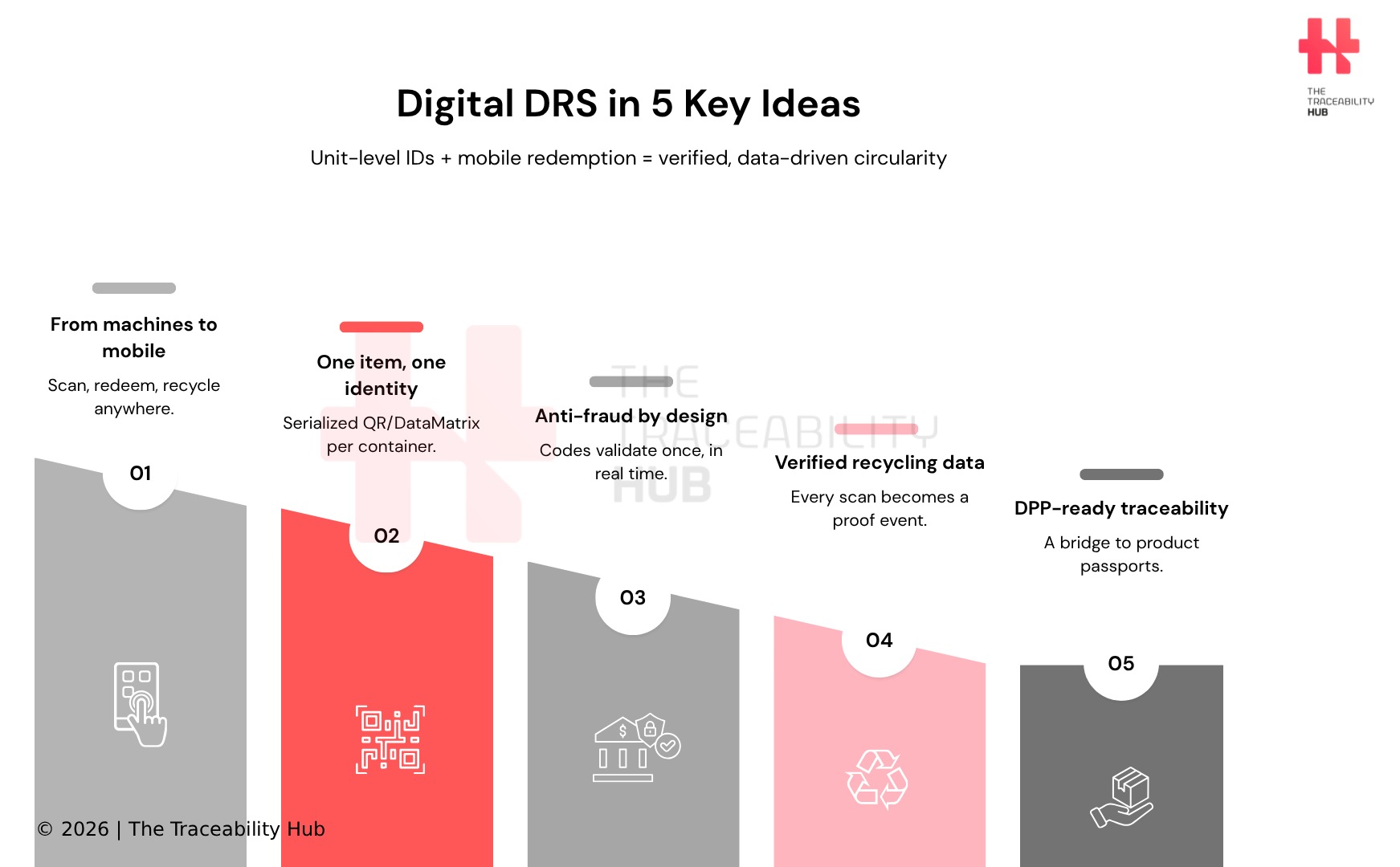
How Digital DRS Works
While the concept of Digital DRS is rooted in advanced technologies like serialization and data infrastructures, its success ultimately depends on simplicity at the user level.
From the consumer’s perspective, the experience is designed to be intuitive, frictionless, and fully aligned with existing habits. Behind the scenes, however, each interaction feeds into a much more sophisticated system of validation, tracking, and data analytics system.
Purchase & Consumption
The journey begins at the point of purchase. Consumers select a beverage product—such as a plastic bottle or aluminum can, that features a unique serialized QR or DataMatrix code printed directly onto the packaging.
This code serves as far more than a simple label. It functions as the product’s unique digital identity, linking each specific unit to a comprehensive traceability system capable of tracking and verifying its lifecycle.
Once the product has been consumed, the packaging is no longer viewed as mere waste. Instead, the consumer holds a digitally enabled recyclable asset ready to be reintroduced into the system.
Scan & Redeem
Once the product has been consumed, the user scans the code using a dedicated mobile application (app-based recycling system).
This is the pivotal interaction. The scan triggers:
- Authentication and Verification of the code’s authenticity and uniqueness
- Confirmation that the item has not been previously redeemed
- Activation of the digital deposit return
The financial incentive, whether through a digital wallet, bank transfer, or app-based credit, is then issued directly to the user.
This step replaces the need for physical return points, shifting the entire redemption process into the digital space. At the same time, it creates a direct-to-consumer engagement channel between brands and consumers, opening new possibilities for communication, incentives, and education.
Recycling
After product scanning, the consumer disposes of the container through existing recycling infrastructure, such as curbside collection or designated bins.
This is a critical aspect of Digital DRS: it does not require the creation of entirely new logistics systems. Instead, it leverages and enhances current waste management processes, making participation easier and more scalable.
By removing the need to return packaging to specific locations, Digital DRS significantly lowers the barrier to entry, one of the main limitations of traditional systems.
Data Capture & Validation
Every scan within a Digital DRS system is more than a transaction, it is a verified data event.
At the moment of scanning, multiple layers of information are captured and processed, including:
- Product identity (via the serialized code)
- Time and location of the interaction
- User engagement patterns
This data is then validated within the system, ensuring that each item is accounted for and that no duplicate claims occur.
Over time, these individual verified data event points aggregate into a powerful dataset that enables a range of advanced capabilities. This comprehensive dataset supports end-to-end traceability of packaging, allowing organizations to follow each item throughout its lifecycle. It also facilitates real-time monitoring of system performance, ensuring that operations are running efficiently and any issues can be quickly identified. Additionally, the data provides a solid foundation for evidence-based reporting, which is crucial for meeting regulatory compliance requirements.
In essence, the workflow of Digital DRS transforms a simple consumer action into a critical input for a much larger product traceability ecosystem.
While it may initially seem like a simple scan-and-reward process, this action actually initiates an integrated system where physical products, digital identities, and circular economy goals intersect.
Beyond Recycling: A Data Engine for Circularity
Each scan within a Digital DRS system constitutes not only a transaction but also a high-value, verified data event within a data-driven recycling ecosystem.
This is where Digital DRS moves beyond its traditional role as a recycling incentive mechanism and becomes something far more strategic: a real-time data engine for the circular economy and packaging traceability.
Each interaction, each scan, each redemption, each verified return, adds a new layer of data intelligence and traceability insights to the system. Over time, this creates a continuous feedback loop that connects all stakeholders across the value chain and provide more data for insight and analysis.
A Multi-Stakeholder Feedback Loop
For brands, Digital DRS unlocks a level of granular product visibility that was previously unattainable. Instead of relying on aggregated sales data or estimated recycling rates, companies can begin to understand actual consumption and disposal behaviors at unit level.
This enables insights such as:
- Where and when products are consumed (geo-localized consumption data)
- How quickly they re-enter the recycling stream (recycling cycle time)
- Which incentives drive higher engagement (behavioral analytics)
For recyclers, this real-time data can be used to improve sorting efficiency and material quality. When combined with material recovery facility (MRF) technologies at material recovery facilities, serialized data can help validate inputs, reduce contamination, and optimize processing flows, ultimately increasing the value of recycled materials.
For regulators, Digital DRS provides a much-needed layer of transparency and accountability. Instead of relying on indirect reporting or estimates, authorities can access verified recycling metrics, real-time data to monitor performance, enforce compliance, and design more effective policies.
For consumers, the system becomes more engaging and transparent. Recycling is no longer an abstract environmental action, but a measurable, incentivized and digitally rewarded behavior, supported by immediate feedback and rewards. This shift is critical in driving long-term behavioral changes.
From Physical Flow to Data Flow
What makes Digital DRS particularly powerful is its ability to connect the physical flow of materials with a parallel digital flow of information.
Historically, product visibility diminished significantly after the point of sale. The post-consumption phase, which is arguably pivotal for advancing circularity, was not adequately tracked. Digital DRS addresses this challenge by assigning a persistent digital identity to each item and recording interactions across its lifecycle. This approach enables both materials and data to progress concurrently, a dual-flow system (material + data) that is fundamental for developing scalable and verifiable circular economy models.
Accelerating a Data-Enabled Circular Economy
In this context, Digital DRS should not be seen as a standalone solution, but as part of a broader transition toward data-enabled sustainability infrastructures.
It acts as a bridge between:
- Physical products and digital identities (smart packaging systems)
- Consumer actions and system-level insights (behavioral data analytics)
- Recycling operations and regulatory frameworks (compliance data systems)
Digital DRS redefines recycling, shifting it from a linear end-of-life procedure to a connected, measurable, and optimizable process. This advancement facilitates progress toward a circular economy, enabling data-driven decisions based on verified information generated at scale, rather than assumptions.
Real-World Pilots and Momentum
Digital DRS is developing, but UK and European pilots show the model works and can be scaled.
One of the most significant real-world applications has been the large-scale implementation on milk bottles in the UK, where millions of units were equipped with unique serialized QR codes for packaging traceability and digital deposit redemption. These pilots, led by technology providers and major retailers, have provided a tangible proof point for how Digital DRS can function in everyday consumption contexts.
- The core components of these initiatives are as follows:
- Mass serialization at scale: Millions of bottles are uniquely identified and tracked
- Direct-to-consumer incentives: Consumers typically receive approximately £0.20 per returned container, credited digitally
- High engagement rates: Participation is enhanced by a streamlined app-based interface
What makes these pilots particularly relevant is not just the technology itself, but the behavioral shift enabled by digital convenience. By removing friction and aligning with digital habits, participation rates have shown strong potential, suggesting that convenience is a critical lever for increasing recycling performance.
Expanding the Experimentation Landscape
Beyond single pilots, a broader ecosystem of Digital DRS pilot programs and trials is emerging across the UK and Europe, exploring different configurations of Digital DRS. These include:
- App-based redemption systems, where the entire interaction, from scan to reward, is managed through mobile platforms.
- Digital wallets and micropayments, enabling instant, seamless financial incentives and reducing reliance on vouchers or physical refunds.
- Hybrid models, combining traditional reverse vending machines (RVMs) with digital validation layers, allowing systems to evolve rather than be fully replaced.
For example, trials in regions such as Scotland have explored the integration of digital payments systems into existing DRS infrastructures, while other initiatives have tested fully “at-home recycling” models, where consumers can scan and redeem without ever visiting a return point.
These differences underscore a key observation: Digital DRS does not currently exist as a unified, standardized model, but instead represents an evolving spectrum of methodologies. Various markets are evaluating distinct combinations of physical and digital infrastructure according to regulatory requirements, consumer preferences, and the structure of their waste management systems.
From Pilots to Systemic Adoption
Despite this diversity, the general trajectory is becoming more defined. Digital DRS is gaining significant traction as it effectively addresses fundamental limitations of conventional systems, particularly in terms of scalability challenges, cost efficiency, and user convenience, while enabling innovative functionalities through enhanced data management and traceability.
At the same time, regulatory discussions across the UK and the European Union are beginning to take these models into account, evaluating how Digital DRS could complement, or in some cases reshape, existing deposit return frameworks.
In this context, current pilots should not be seen as isolated experiments, but as early building blocks of next-generation recycling infrastructure.
They demonstrate that serialization at scale, consumer engagement through digital incentives, and integration with existing recycling systems are not only feasible, but increasingly viable.
And as these pilots continue to expand and mature, they are laying the groundwork for Digital DRS to move from experimentation to mainstream adoption.
Implications for Industry Players
For manufacturers, particularly within the beverage industry and FMCG sectors, Digital DRS represents more than a matter of regulatory compliance; it is a significant strategic milestone.
What may initially seem to be a regulatory obligation, associated with recycling targets and deposit schemes, is, in fact, an avenue for comprehensive product traceability, data generation and analytics, and innovative consumer engagement.
Within this framework, Digital DRS should be viewed not as a cost burden, but as a strategic opportunity to enhance operational resilience and create additional value streams.
From Packaging to Digital Infrastructure
The foremost implication is the necessity to facilitate serialization on a scale. Manufacturers must advance beyond conventional labeling methods and adopt systems that generate and manage unit-level unique identifiers at production on high-speed production lines. This upgrade is complex, requiring a reassessment of packaging processes, including printing, verification, and integration with digital infrastructure.
In essence, the shift toward serialization represents a pivotal step in bridging traditional packaging with advanced digital infrastructure. As manufacturers take on this challenge, they not only enhance product traceability but also lay the foundation for integrating vision systems and inspection technologies that ensure every code is compliant, scannable, and uniquely assigned.
The seamless integration of serialization with digital quality control is essential for meeting the dynamic demands of Digital DRS frameworks. By linking unique product identifiers to robust inspection systems, manufacturers ensure that every item can be reliably tracked and validated throughout its lifecycle, supporting both regulatory compliance and operational efficiency.
Data Integrity and Inspection Systems
Serialization by itself is not sufficient to guarantee traceability and data integrity. Each code must be:
- Correctly printed to avoid errors or duplication
- Machine-readable at high speed to match the pace of modern production lines
- Verified in real time, ensuring immediate detection and correction of any issues
This is where vision systems and inspection technologies become critical. Advanced solutions, such as those provided by players like FT System or Applied Vision, ensure that every code applied to a product is compliant, scannable, and uniquely assigned.
In a Digital DRS context, a single unreadable or duplicated code is not just a quality issue, it is a break in the traceability chain. As a result, quality control evolves into data integrity control.
Alignment with GS1 Standards and DPP
Another key implication is the alignment with global standards and emerging regulatory frameworks.
Digital DRS systems increasingly rely on GS1 standards to ensure interoperability, scalability, and consistency across markets. At the same time, the rise of the Digital Product Passport (DPP) in Europe is pushing manufacturers toward a future where every product must carry structured, accessible, and verifiable data.
In this scenario, digital serialization implemented for Digital DRS can serve as a foundational layer for DPP readiness, reducing future compliance gaps and enabling smoother transitions as regulations evolve.
New Frontiers in Consumer Engagement
In addition to enhancing operations and compliance, Digital DRS is a consumer touchpoint and introduces significant opportunities for direct consumer engagement.
Each scan is not only a redemption event, but also a touchpoint. Brands can:
- Deliver personalized content or incentives
- Educate consumers on recycling and sustainability
- Build loyalty programs linked to circular recycling behaviors
This transforms packaging into a digital communication channel, where interaction does not end at the point of sale but continues through the product’s lifecycle.
Bridging Physical Production and Digital Traceability
Ultimately, Digital DRS forces a convergence between two worlds that have traditionally operated separately:
- Physical production systems (packaging lines, inspection, quality control)
- Digital ecosystems (data platforms, consumer apps, regulatory reporting)
Traceability technologies that combine inspection and serialization act as the bridge between these domains, ensuring that every physical product is accurately mirrored by a reliable digital identity.
For industry players, the message is clear: Digital DRS is not just about adapting to a new recycling model—it is about building the capabilities required for a traceable, data-driven product economy.
Challenges and Open Questions
Although Digital DRS demonstrates considerable promise, it currently remains in an early and transitional stage, with several technical, regulatory, and adoption challenges yet to be addressed. These encompass not only technical concerns but also broader systemic considerations that will influence the model’s scalability and adoption across various markets.
Standardization Across Countries
A significant obstacle is the absence of harmonization at the European level.
Currently, Deposit Return Schemes differ considerably between countries regarding:
- Deposit values
- Accepted materials and formats
- Operational models and infrastructure
Introducing a digital layer on top of this fragmented landscape raises important questions around Code standardization, data structures, and validation processes.
Without harmonization, there is a risk of creating multiple, incompatible Digital DRS systems, limiting scalability and increasing complexity for multinational brands.
Adoption Barriers and Inclusivity
Although Digital DRS is intended to enhance convenience, it introduces additional dependencies, particularly related to smartphones, connectivity and digital literacy.
This raises important considerations regarding accessibility:
- Some consumers do not possess or routinely use smartphones.
- Certain demographic groups may be less familiar with app-based interactions.
- Connectivity and usability may differ among regions.
For Digital DRS to achieve widespread adoption, inclusive recycling systems must be designed with inclusivity as a priority, potentially integrating both digital and physical touchpoints to ensure no user group is overlooked.
System Interoperability
A significant challenge is achieving interoperability within and between systems. Digital DRS necessitates seamless integration among various stakeholders, including:
- Manufacturers and packaging lines
- App providers and digital platforms
- Retailers and payment systems
- Waste management and recycling facilities
Maintaining consistent and secure data exchange across these entities is vital. Inadequate interoperability may result in the creation of data silos that can undermine traceability effectiveness.
Regulatory Alignment with Traditional DRS
Regulatory considerations represent one of the most intricate challenges. In numerous countries, conventional Deposit Return Scheme (DRS) frameworks are well-established, regulated, and operational.
The introduction of Digital DRS prompts fundamental questions regarding equivalency between digital redemption and physical returns, large-scale fraud prevention mechanisms and monitoring, and the methods for measuring and verifying collection and recycling targets. Regulators are tasked with balancing innovative advancements with system reliability to ensure that new models sustain or enhance the effectiveness of existing schemes.
Complement or Replacement?
All these challenges converge into a broader, strategic question:
Will Digital DRS complement or replace traditional systems?
In the coming years, particularly through regulatory decisions in the UK and the European Union, we are likely to see one of two scenarios emerge:
- A complementary model, where Digital DRS enhances traditional systems, adding a digital layer to existing infrastructure
- Transition toward fully digital model, where digital interactions progressively reduce, or even eliminate, the need for physical return points
The outcome will largely be determined by the effectiveness with which present challenges are managed, as well as the speed at which stakeholders reach consensus regarding standards, traceability technologies, and governance structures.
It is evident that Digital DRS has transformed the discourse, shifting focus from methods of packaging collection to approaches for tracking, validating, and optimizing these processes at scale.
From Recycling Scheme to Traceability Infrastructure
Digital DRS is more than an evolution of deposit systems: it represents the emergence of a new layer of traceability infrastructure for packaging. What was once a mechanism to incentivize returns is becoming a system capable of assigning identity, capturing data, and validating circular flows at scale.
By combining unit-level serialization (unique product identity), direct consumer interaction, and real-time data generation (data-driven insights), Digital DRS transforms recycling into a measurable, verifiable, and data-optimizable process. It shifts the focus from simple collection rates to data-driven performance, where every item can be tracked, every action recorded, and every outcome analyzed.
Within The Traceability Hub ecosystem, Digital DRS sits at the intersection of three critical pillars:
- Serialization, as the foundation for unique product identity
- Digital Product Passport (DPP), as the framework for structured and accessible product data
- Circular Economy, as the system-level objective of closing material loops
In this convergence, Digital DRS emerges as one of the most concrete and scalable real-world applications of digital traceability in everyday products. It brings advanced concepts, often discussed at regulatory or technological level, into real-world consumer interactions, bridging the gap between theory and implementation.
As the model continues to evolve, its significance will extend beyond recycling. Digital DRS has the potential to redefine how products are tracked, how value is retained in materials, and how data becomes a central driver of circularity, marking a decisive step toward a more connected, intelligent and accountable product ecosystem, where packaging becomes data, and recycling becomes measurable.
Among the different suppliers, Antares Vision is uniquely positioned to bridge the gap between fragmented national DRS architectures and the scalable, interoperable digital layer that multinational brands and regulators urgently need. This is thanks to the experience in implementing national traceability programs across multiple countries and regulatory environments – from pharmaceutical serialization under EU FMD to government-mandated track-and-trace platforms in emerging markets.
Read more: Why the DSCSA Playbook Won’t Work for the FDA NDC12 Transition