



Digital Twins in Supply Chain Management: Real-Time Visibility & Optimization
Digital twins are reshaping modern supply chain management and accelerating supply chain digitalization. The global digital twin market is expanding rapidly, with some estimates projecting it could reach around $73.5 billion by 2027, driven by the increasing adoption of IoT, AI, and advanced analytics across industries. Digital twin technology enables organizations to create virtual replicas of supply chains, assets, or logistics networks, allowing real-time monitoring, simulation, and predictive insights. These capabilities help companies improve supply chain visibility, anticipate disruptions, and optimize operations across complex global networks. This article explores what digital twins are, the main types used in supply chain and logistics environments, practical implementation steps, and the business benefits demonstrated across manufacturing, logistics, and retail sectors.
What Is a Digital Twin in Supply Chain Management?
A digital twin in supply chain management is a dynamic virtual representation of physical supply chain assets, logistics infrastructure, and operational systems that update real-time data feeds. These models reflect real-world operations and support data-driven supply chain optimization and decision-making. Data streams from warehouses, transportation networks, and production facilities feed into the digital twin to provide continuous visibility into operational performance. The technology creates a persistent connection between physical and digital environments, where changes in real operations update the virtual model and enable simulation, monitoring, and predictive analysis.
Digital Twin vs Traditional Supply Chain Simulations
The difference between digital twins and traditional supply chain simulation software lies mainly in data connectivity and operational purpose. Traditional simulation tools typically use static or historical datasets to test hypothetical scenarios and analyze specific processes within logistics networks or manufacturing workflows. These simulations are valuable during planning and design phases but usually operate independently from live operations and real-time data streams.
Digital twins, in contrast, maintain a continuous data connection with physical supply chain systems through IoT sensors and connected operational technologies. This integration allows the digital model to reflect current conditions rather than past states. While traditional simulations often require manual data updates to test scenarios, digital twins enable automated monitoring, diagnostics, and predictive insights based on live operational data.
Another key difference is adaptability. Traditional simulations are most effective in stable environments where assumptions remain consistent. Digital twins operate in dynamic supply chain settings by enabling continuous what-if analysis and real-time scenario modeling. This capability allows organizations to explore alternative strategies, improve maintenance planning, and adjust operational processes as conditions change.
Real-Time Data Integration in Supply Chain Digital Twins
Real-time data integration transforms digital twins from static models into dynamic operational platforms for intelligent supply chain management. Without continuous data feeds, a digital twin becomes only a digital snapshot that quickly loses relevance as conditions change. Sensors and connected devices transmit operational data through IoT-enabled monitoring systems, allowing changes in the physical environment to be reflected in the virtual model in near real time.
This integration helps bridge the historical gap between physical operations and digital planning systems. Digital twins can connect with enterprise platforms such as ERP systems, warehouse management systems (WMS), and operational technologies used in production environments. These integrations allow machine and logistics data to flow directly into analytics and planning tools without manual updates, supporting real-time supply chain visibility and data-driven decision-making. As a result, organizations can reduce traditional information silos where planning, logistics, and operations rely on separate systems and manual coordination.
For example, if warehouse inventory for critical components drops below predefined thresholds while inbound shipments are delayed, digital twin systems can flag potential disruptions and support faster sourcing decisions or alternative logistics strategies. This capability shifts supply chain planning from periodic analysis to continuous monitoring and scenario evaluation. When combined with advanced analytics, artificial intelligence, and machine learning, digital twins can help organizations test operational scenarios, improve service levels, and enhance overall supply chain performance.
Key Components: Sensors, IoT Devices, and Cloud Infrastructure
IoT sensors are a core data source for many digital twin systems, monitoring physical assets and streaming operational data to their virtual representations in real-time supply chain monitoring environments. These sensors track parameters such as temperature, vibration, pressure, humidity, acceleration, stress, energy consumption, and equipment usage in industrial settings. In some implementations, digital twins also use advanced sensing technologies including 3D cameras, thermal imaging devices, and LiDAR scanners to capture spatial data and build detailed digital representations of facilities, assets, and logistics environments.
Cloud-to-edge computing architecture supports digital twin operations by combining scalability with processing speed. Cloud platforms provide large-scale data storage, advanced analytics, historical data processing, and integration with enterprise systems. Edge computing processes time-sensitive data close to physical assets, reducing latency and enabling faster operational responses in industrial logistics and manufacturing environments. This hybrid architecture allows organizations to perform rapid operational monitoring at the edge while supporting deeper analysis and simulation in the cloud.
Digital twins can also support predictive maintenance by analyzing sensor data and equipment performance patterns to identify early signs of wear. These systems can trigger maintenance alerts before failures occur, helping organizations reduce unplanned downtime and improve asset reliability. In sectors such as aviation, continuous monitoring of aircraft components allows maintenance teams to forecast service requirements and prevent unexpected disruptions. By combining historical performance data with real-time monitoring, digital twins help organizations schedule maintenance more efficiently across asset-intensive supply chain operations.
How Digital Twins Work
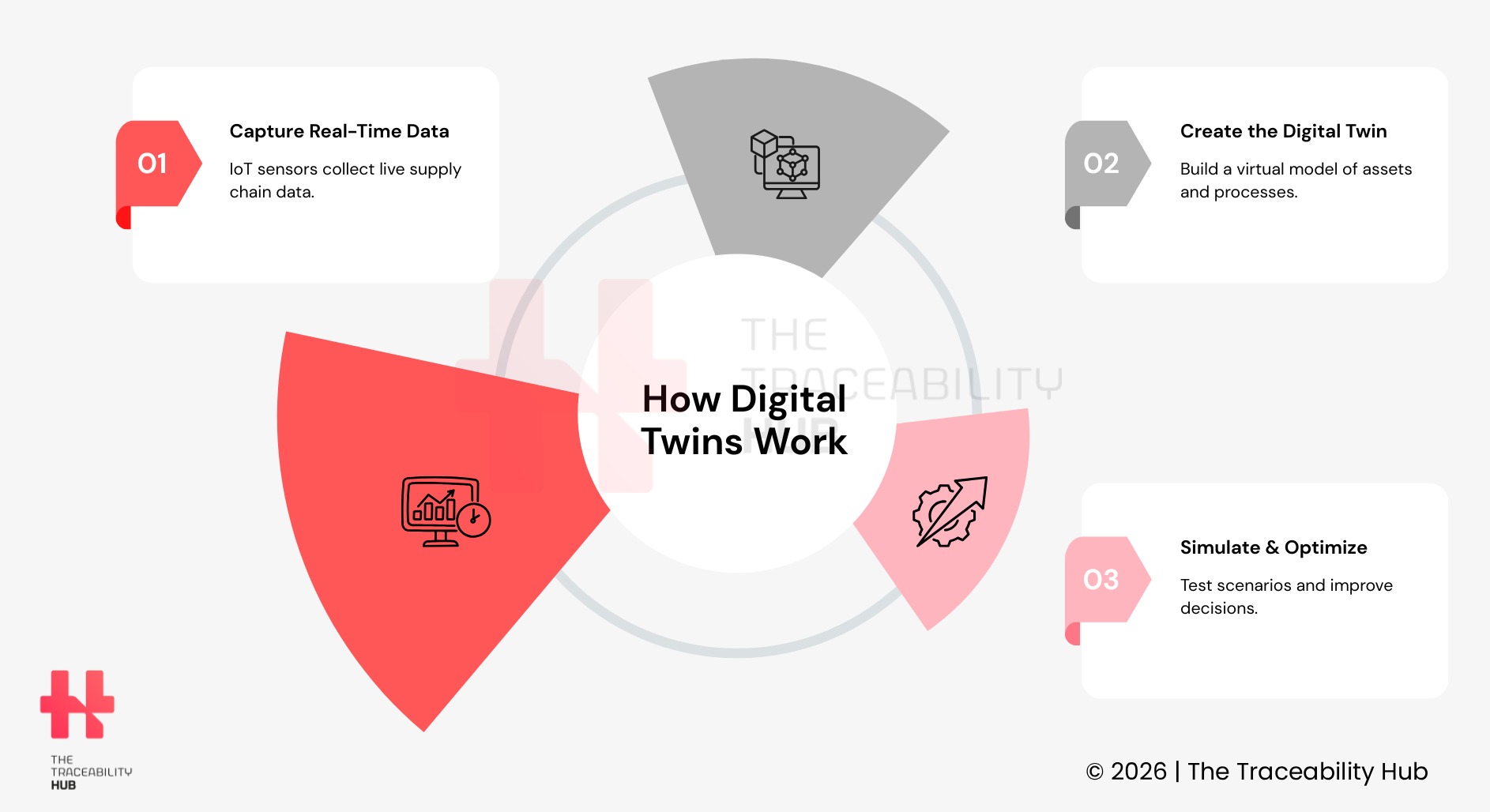
Types of Digital Twins for Supply Chain Operations
Supply chain organizations deploy several types of digital twins to support operational visibility and supply chain optimization. Many industry frameworks group digital twins into four main categories, each designed to represent different levels of assets, systems, or operational processes. These classifications help businesses select the most appropriate digital twin approach based on their operational priorities, data availability, and analytical needs.
Product Twins: Tracking Items Through the Supply Chain
Product digital twins create virtual representations of individual physical items and monitor their performance and condition throughout the product lifecycle. These twins allow organizations to track products under different operating conditions, evaluate performance parameters, and identify potential issues early. Industries such as manufacturing, automotive, aerospace, and healthcare use product twins to optimize product design, improve reliability, and extend product lifespans through data-driven product lifecycle management.
In supply chain environments, product twins can also support monitoring of perishable goods from origin to destination through sensor-enabled tracking systems. Organizations collect condition and location data to help estimate remaining shelf life and support informed decisions about inventory rotation and distribution timing. This granular visibility allows businesses to adjust routing, storage, and handling practices based on real-time product condition data rather than relying only on predefined schedules.
System Twins: Modeling End-to-End Supply Chain Networks
System twins represent complex operational systems by modeling how multiple assets, processes, and logistics flows interact within a broader network. In supply chain environments, these digital twins simulate entire supply chain structures, including suppliers, production facilities, warehouses, transportation routes, and customer demand nodes. By representing these interconnected elements in a virtual environment, system twins allow decision-makers to evaluate how operational changes in one part of the network can influence overall supply chain performance.
These models can support advanced supply chain visibility platforms and control tower systems by providing a dynamic environment for scenario analysis and planning. Organizations can simulate disruptions, evaluate alternative source strategies, and test logistics network configurations before implementing operational changes.
For example, companies may use network-level digital twins to analyze port congestion, transportation lead times, or shifting demand signals across global markets. By combining operational data with advanced analytics, organizations can better understand cost-to-serve impacts, improve service levels, and optimize supply chain network design while balancing cost, resilience, and sustainability considerations.
Process Twins: Optimizing Warehouse and Distribution Operations
Process twins model how multiple supply chain elements interact within operational workflows and simulate the behavior of logistics and distribution processes. These digital twins integrate data from enterprise systems such as warehouse management systems (WMS), logistics databases, transportation platforms, and retail or point-of-sale systems to create a virtual environment for analyzing operational performance.
In warehouse environments, digital twins can simulate layout configurations, picking paths, and order fulfillment workflows to improve efficiency and overall supply chain throughput. By analyzing movement patterns and operational data, these models can help identify optimal shelving arrangements, reduce congestion in high-traffic zones, and improve material flow across the facility.
Process twins also allow organizations to test different staffing levels, automation strategies, and operational processes before implementing physical changes. This ability to simulate operational adjustments helps companies evaluate potential improvements while minimizing disruption and supporting more informed investment decisions.
Data Twins: Real-Time Visibility into Inventory and Logistics
Data-driven digital twins focus on integrating operational data streams to create unified views of inventory positions and logistics status across dispersed locations within a supply chain digital twin platform. These models combine information from enterprise systems, logistics platforms, and sensor-enabled monitoring tools to provide real-time or near-real-time visibility into the location, status, and movement of inventory across the supply chain.
Organizations can use these data-driven models to track returned products, analyze return reasons, and improve reverse logistics processes through advanced supply chain analytics. Enhanced visibility across return flows helps organizations shift from reactive handling of returned goods to more proactive management strategies. As a result, companies can improve recovery value from returned products while reducing operational inefficiencies associated with reverse logistics.
Building a Supply Chain Digital Twin: Step-by-Step Process
Implementing a supply chain digital twin requires structured planning and a phased approach to technology deployment and data integration. Organizations typically follow a multi-stage process that includes defining objectives, integrating operational data sources, building digital models, and deploying analytics capabilities. A structured implementation approach helps reduce technical complexity, accelerate early value delivery, and support the development of intelligent supply chain systems powered by digital twin technology.
Step 1: Identify Critical Supply Chain Assets and Processes
Organizations should assess their current supply chain maturity before investing in sensors, data platforms, or digital twin software solutions. This evaluation typically includes reviewing whether operations rely on manual processes, spreadsheets, or fragmented legacy systems. The assessment should examine process workflows, data flows, existing system usage, stakeholder communication patterns, and operational pain points such as delays or visibility gaps in logistics and supply chain planning processes.
Companies should also identify critical assets, processes, and operational knowledge associated with core products and services that provide competitive advantage. Assets with high downtime costs, safety risks, or operational bottlenecks are often prioritized to maximize the potential impact of digital twin initiatives. Focusing on these high-value areas can help organizations demonstrate early operational improvements while building the foundation for broader supply chain digital twin deployment.
Step 2: Set Up Data Collection Infrastructure
Organizations deploy IoT sensors and connected monitoring devices to capture operational parameters across supply chain nodes such as warehouses, distribution centers, transportation assets, and retail locations. Large retailers and logistics networks increasingly use sensor-enabled tracking technologies to improve visibility into inventory movement, environmental conditions, and asset utilization across complex supply chain operations.
These monitoring systems may include temperature sensors, location trackers, humidity monitors, and other IoT devices designed to collect real-time operational data. In implementations, energy-efficient or battery-free sensors can harvest power from radio frequency signals or other ambient sources to support long-term monitoring without frequent maintenance.
Establishing strong data governance frameworks is essential for managing the large volumes of data generated by these systems. Organizations should define standards for data quality, security, interoperability, and partner access across digital supply chain ecosystems. Integrating information technology systems with operational technology allows data from warehouses, transportation networks, and suppliers to flow into centralized platforms for analysis through cloud-based supply chain data infrastructure.
Step 3: Create the Digital Model of Your Supply Chain
Defining the purpose and scope of the digital twin before development begins. Organizations should determine whether the model will represent individual components, operational subsystems, or entire supply chain networks within the digital twin architecture.
When operational data is limited, organizations may rely on physics-based models derived from engineering principles. When sufficient historical data is available, data-driven models using machine learning and predictive analytics can be applied. The digital model should represent subsystems and their interactions, network connections across supply chain nodes, and environmental parameters such as temperature or external conditions that influence logistics and distribution performance.
Digital twin architectures typically integrate existing data sources and technologies through APIs and middleware, allowing data from multiple supply chain platforms to be synchronized in real time or near real time.
Step 4: Connect Data Feeds
Organizations integrate operational data sources such as ERP systems, warehouse management systems (WMS), and transportation databases through APIs and integration platforms. Cloud infrastructure enables centralized storage and data sharing across distributed locations while supporting supply chain visibility dashboards and analytics.
Edge computing can process time-sensitive data close to physical assets within IoT-enabled logistics environments. This hybrid architecture balances scalability and processing speed while supporting faster operational responses. Automated alerts and monitoring systems can reduce reliance on manual checks while providing continuous visibility into supply chain conditions.
Step 5: Implement Simulation and Testing Capabilities
Organizations can implement optimization and simulation capabilities within the digital twin environment to evaluate operational scenarios. These tools allow teams to test alternative strategies, assess increased production loads, or evaluate logistics changes without disrupting ongoing operations.
Many organizations begin with pilot implementations on specific assets, warehouse areas, or logistics processes before scaling across the broader supply chain network. This phased approach helps validate data integration, refine system models, and build organizational confidence in digital twin adoption.
Step 6: Maintain and Update the Digital Twin
Performance metrics and validation processes should be established to ensure that the digital twin remains accurate over time. Continuous monitoring allows organizations to compare digital model outputs with real operational data to verify reliability.
When discrepancies arise, organizations may adjust model parameters or rebuild components of the model to maintain accuracy. Ongoing maintenance ensures that the digital twin evolves alongside physical operations and continues to support supply chain optimization and predictive planning.
Business Benefits of Digital Twin Technology in Supply Chains
Enterprises that adopt digital twin technology in supply chain operations often report measurable improvements in operational efficiency, forecasting accuracy, disruption management, and inventory performance. These benefits arise from the ability of digital twins to simulate supply chain conditions, analyze operational data, and support more informed decision-making.
By combining real-time data, predictive analytics, and scenario modeling, digital twins help organizations shift from reactive supply chain management toward more proactive and data-driven decision processes.
Reducing Operational Costs Through Predictive Analytics
Predictive analytics integrated within digital twin environments can help organizations identify optimization opportunities that traditional planning methods may overlook in complex logistics networks and global supply chains. By combining operational data with simulation and scenario analysis, digital twins allow teams to evaluate alternative sourcing strategies, logistics configurations, and operational policies before implementing changes in real-world operations.
Procurement and supply chain teams can use these insights to better analyze supplier relationships, evaluate price trends, and understand cross-supplier dependencies. These capabilities help organizations make more informed sourcing and logistics decisions while improving overall cost management.
Digital twins can also support distribution network optimization. For example, organizations may simulate warehouse demand patterns, labor allocation strategies, and inventory flows to identify opportunities to improve operational efficiency across distribution centers.
In addition, automation of planning activities through advanced analytics and AI-enabled supply chain models can significantly reduce the time required to analyze scenarios and generate operational plans. By automating repetitive planning tasks and providing faster insights, digital twins help organizations respond more quickly to changing supply chain conditions.
Improving Demand Forecasting Accuracy
Digital twins combined with advanced analytics and AI-based forecasting models can improve demand planning by providing more detailed visibility into supply chain dynamics. Probabilistic forecasting approaches allow organizations to evaluate a wider range of potential demand scenarios, including long-tail variations that traditional planning models often overlook.
By analyzing historical demand patterns, supply performance, inventory movements, and consumption trends, these models help organizations generate more accurate forecasts across complex supply chain networks. Digital twins can also incorporate external signals such as logistics congestion data, industry indicators, or shipping activity to provide additional context for planning decisions.
The ability to simulate supply chain scenarios enables organizations to anticipate potential disruptions earlier and evaluate alternative production, sourcing, or logistics strategies before operational problems occur. This proactive planning approach helps organizations improve service levels, manage inventory more effectively, and respond more quickly to changing market conditions.
Enhancing Supply Chain Resilience Against Disruptions
Organizations with mature supply chain risk management capabilities are generally better positioned to respond to disruptions and recover more quickly when unexpected events occur. Digital twins support this resilience by enabling organizations to stress test supply chain strategies and evaluate how networks respond to demand volatility, lead time variations, or supplier disruptions across global logistics systems.
Using simulation and advanced analytics, organizations can evaluate multiple demand and supply scenarios to estimate how supply chain systems may perform under different conditions. These simulations help decision-makers assess potential impacts on service levels, operational performance, and financial outcomes across complex supply chain networks.
By testing alternative sourcing strategies, inventory policies, and logistics configurations in a virtual environment, digital twins help organizations prepare more robust contingency plans and strengthen supply chain resilience.
Optimizing Inventory Management and Reducing Waste
Digital twin frameworks that integrate machine learning, predictive analytics, and simulation can support more advanced inventory management strategies. These systems allow organizations to evaluate inventory policies, analyze demand patterns, and simulate replenishment decisions across complex supply chain networks. By improving visibility into inventory flows, digital twins can help organizations improve working capital management and optimize replenishment planning.
AI-enabled digital twin platforms can analyze stock levels, demand fluctuations, and logistics constraints across multiple distribution nodes. When demand changes across locations, analytics models can recommend inventory reallocation strategies that shift stock from lower-demand locations to higher-priority areas.
These capabilities help organizations improve supply chain visibility, reduce excess inventory, and support more efficient distribution planning across supply chain operations.
Real-World Applications: How Companies Use Supply Chain Digital Twins
Organizations across multiple industries are deploying digital twin technology to address sector-specific operational challenges. Digital twin implementations support supply chain visibility, operational simulation, and planning optimization across complex logistics and production networks. These applications span industries ranging from manufacturing and logistics operations to energy and infrastructure systems.
Manufacturing: Production Line Optimization
Digital twins are increasingly used in manufacturing environments to simulate production lines and evaluate alternative scheduling strategies. By combining simulation models with advanced optimization algorithms, organizations can analyze large numbers of potential production sequences to identify more efficient operating plans without requiring additional capital investment.
In some implementations, digital twin platforms allow manufacturers to test revised production schedules, adjust line balancing strategies, and evaluate different staffing or shift configurations. These simulations can help organizations reduce operational bottlenecks, improve throughput, and optimize resource utilization across production systems.
When integrated with manufacturing execution systems (MES) and IoT-enabled monitoring devices, digital twins can provide real-time visibility into production processes and support more adaptive production scheduling. This integration helps manufacturers minimize downtime, improve production efficiency, and respond more effectively to changes in demand or operational conditions.
Logistics: Route Planning and Fleet Management
Fleet operators increasingly use digital twin technology to support predictive maintenance and optimize logistics operations. By combining sensor data, operational analytics, and simulation models, digital twins allow transportation companies to monitor vehicle components, evaluate maintenance requirements, and optimize route planning across fleet networks.
Predictive analytics can help identify early indicators of component wear or potential equipment failures, allowing maintenance teams to schedule service before disruptions occur. These systems can also coordinate maintenance planning with logistics operations by ensuring spare parts availability and scheduling repairs at appropriate service hubs.
In addition, digital twins can simulate transportation routes and fleet utilization patterns to evaluate alternative logistics strategies. This capability helps organizations improve fleet reliability, reduce operational disruptions, and enhance overall transportation efficiency across complex logistics networks.
Retail: Store Operations and Customer Journey Mapping
Retail organizations are beginning to adopt digital twin and sensor-based monitoring technologies to improve store operations and equipment management. Large retailers have implemented connected monitoring systems for refrigeration and facility equipment, using sensor data and analytics to identify maintenance issues earlier and improve operational reliability across store networks.
Retailers are also experimenting with digital store models and augmented reality tools to support store operations. For example, Lowe’s has tested augmented reality headsets that allow store associates to visualize store layouts, compare planned shelf configurations with actual arrangements, and access inventory information that may not be easily visible on the sales floor.
These technologies help improve store planning, inventory visibility, and operational efficiency while supporting better coordination between retail operations and supply chain management systems.
Energy and Utilities: Grid Management and Distribution
Utilities and infrastructure operators are increasingly exploring digital twin technologies to improve monitoring and operational management of complex networks. Digital twins can model infrastructure systems such as electrical grids, water distribution networks, and energy assets, allowing operators to simulate system behavior and evaluate operational scenarios.
In water utilities, digital models of distribution systems can help operators monitor parameters such as tank levels, flow rates, and water age to maintain water quality and optimize distribution operations. By combining sensor data with infrastructure models, these systems can help identify potential anomalies in distribution networks and support more proactive infrastructure management.
These capabilities improve asset monitoring, support maintenance planning, and help utilities maintain reliable service across critical infrastructure networks.
Supply Chain Digital Twins: Building Intelligent, Data-Driven Supply Chains
Digital twin technology is transforming supply chain operations by enabling organizations to move from reactive processes toward more predictive and data-driven decision-making. By combining real-time data, simulation models, and advanced analytics, digital twins allow organizations to monitor operations, test scenarios, and optimize supply chain performance across complex logistics networks.
The step-by-step implementation process outlined in this guide provides a structured roadmap for organizations pursuing digital supply chain transformation. It begins with identifying critical assets and processes and continues through model development, data integration, testing, and ongoing maintenance.
Real-world applications across manufacturing, logistics, retail, and energy sectors demonstrate how digital twins can improve supply chain visibility, resilience, and operational efficiency. As organizations strengthen their data infrastructure, IoT connectivity, and system integration capabilities, digital twins are likely to play an increasingly important role in building more intelligent and adaptive supply chain networks.
Read more: Unit-Level Track and Trace: Solving Supply Chain Blind Spots with Serialization