



Turning Fragmented Data into Actionable Insight
The global Customer Data Platform (CDP) market has experienced rapid expansion in recent years, driven by the growing need for organizations to unify fragmented customer data and build a single source of truth for customer data management. Industry analyses estimate that the market was valued at approximately $3–4 billion in the early 2020s and is projected to surpass $14–15 billion by the mid-decade, reflecting strong double-digit annual growth in data-driven marketing technologies.
This acceleration highlights a structural shift: businesses increasingly recognize that disconnected customer data across systems limits their ability to deliver consistent, personalized experiences and data-driven customer engagement. As customer interactions span multiple channels, online, offline, and across devices, the challenge is no longer data collection, but customers’ data integration and activation.
Customer Data Platforms address this challenge by aggregating first-party customer data from multiple sources into a unified customer profile. Unlike traditional data management tools, CDPs are designed to create persistent, accessible, and marketer-friendly datasets, enabling organizations to:
- Break down internal data silos and enable cross-channel data integration
- Build a holistic view of customer behavior across the lifecycle
- Enable real-time or near-real-time data activation and personalization across channels
By transforming raw, fragmented data into structured and actionable insights, CDPs support more relevant engagement strategies, improved customer retention, and measurable business outcomes. As privacy regulations and first-party data strategies become central to digital operations, CDPs are increasingly positioned as a foundational component of modern customer data infrastructure and marketing technology stacks (MarTech).
What Customer Data Platforms Do with Your Raw Data
Raw Data Comes from Everywhere
Organizations generate and collect customer data across a wide range of digital and physical touchpoints, creating vast volumes of omnichannel customer data. These include websites and mobile applications that capture behavioral interactions, Customer Relationship Management (CRM) systems that store contact and sales data, and point-of-sale systems that record in-store transactions. Additional inputs come from customer service platforms (e.g. support tickets and call center logs), email marketing systems, and social media channels that provide engagement signals and customer interaction data.
This diversity of sources creates significant complexity in customer data management and data integration. Each system is typically designed for a specific operational purpose, such as managing transactions, marketing campaigns, or customer support, and not for unified data sharing.
As a result, customer information often remains fragmented across multiple environments, limiting data visibility and actionable insights.
The characteristics collected may evolve as additional data is acquired. Each campaign encompasses multiple fields:
- Engagement behavior: Identification of users who interact most frequently with reels or posts
- Purchase signals: Analysis of individuals who click, visit, or redeem offers
- Seasonal intent: Monitoring of current browsing interests
- Location or proximity: Pinpointing users located near the store who have recently engaged
- Lookalike behavior: Detection of new users whose profiles align closely with those of top customers
Targeting becomes therefore dynamic when the audience is updated based on different signals – for example via Meta Ads Manager, Google Ads, or CRM segmentation tools.
Customer Data Platforms address this challenge by ingesting and consolidating data from heterogeneous sources, including enterprise applications, cloud storage systems, third-party tools, and data warehouses. According to industry definitions, CDPs are designed to handle multiple data types, including:
- Structured data (e.g. transaction records, customer profiles)
- Semi-structured data (e.g. JSON or log files)
- Unstructured data (e.g. emails, chat transcripts, or customer service notes)
By integrating these diverse inputs, CDPs create a unified and persistent customer dataset (often called a customer data layer) that can be used across business functions, enabling more consistent analysis and data-driven activation.
CDPs Connect Scattered Information
Fragmented data environments remain one of the main barriers to effective customer understanding and customer data analytics. In many organizations, customer information is distributed across multiple systems, such as email marketing platforms, CRM databases, e-commerce systems, and customer support tools. This often results in duplicate, inconsistent, or incomplete records, where the same individual appears under different identifiers or across disconnected datasets.
Because these systems are typically built for specific functions, sales, marketing, or service, they are rarely designed to interoperate seamlessly. This siloed architecture makes it difficult to link customer interactions across channels – limiting customer journey visibility and cross-channel analytics – or measure outcomes holistically.
Customer Data Platforms address this challenge by aggregating and harmonizing data from multiple internal and external sources into a centralized customer data platform environment.
CDPs ingest data from channels such as web, mobile, CRM, and offline systems, and standardize it into a consistent format. Integration is typically achieved through APIs, software development kits (SDKs), and pre-built connectors, depending on the vendor and architecture.
Once ingested, CDPs apply data processing steps such as deduplication, normalization, and quality checks, ensuring that information from different systems can be reliably combined, analyzed, and activated for personalized marketing and customer engagement.
Creating One View of Each Customer
The core capability of Customer Data Platforms is identity resolution, the process of linking multiple identifiers to a single individual or entity to create a unified customer profile. CDPs use a combination of deterministic matching (e.g. exact matches on email or login credentials) and, in some cases, probabilistic techniques (e.g. behavioral or device-based signals) to associate records across systems.
This allows organizations to connect known identifiers, such as email addresses or customer IDs, with earlier or parallel interactions, including anonymous digital behaviors (e.g. cookies or device IDs), where permitted by privacy and consent frameworks and data governance policies.
The result is the creation of unified customer profiles, which consolidate data such as:
- Contact and account information
- Demographic attributes (where available)
- Transaction and purchase history
- Digital behavior (e.g. website or app interactions)
- Campaign engagement and communication history
- Customer service interactions
These profiles are generally updated continuously or in near real-time, based on system architecture, allowing organizations to maintain an accurate perspective of customer activity across multiple channels. This integration shifts traditional buyer personas from static models to dynamic, data-driven profiles that adapt as new information becomes available.
- Transitioning from assumptions to behavior-based insights
- Moving from aggregate averages to detailed segmentation
- Evolving from static to dynamic personas
- Progressing from broad narratives to targeted personalization
By centralizing this information, CDPs enable different business functions to operate from a shared, consistent data foundation. Marketing, sales, and customer service teams can access aligned insights without manually reconciling multiple data sources, improving coordination, decision-making, and data-driven customer experience optimization.
How CDPs Turn Customer Data into Results
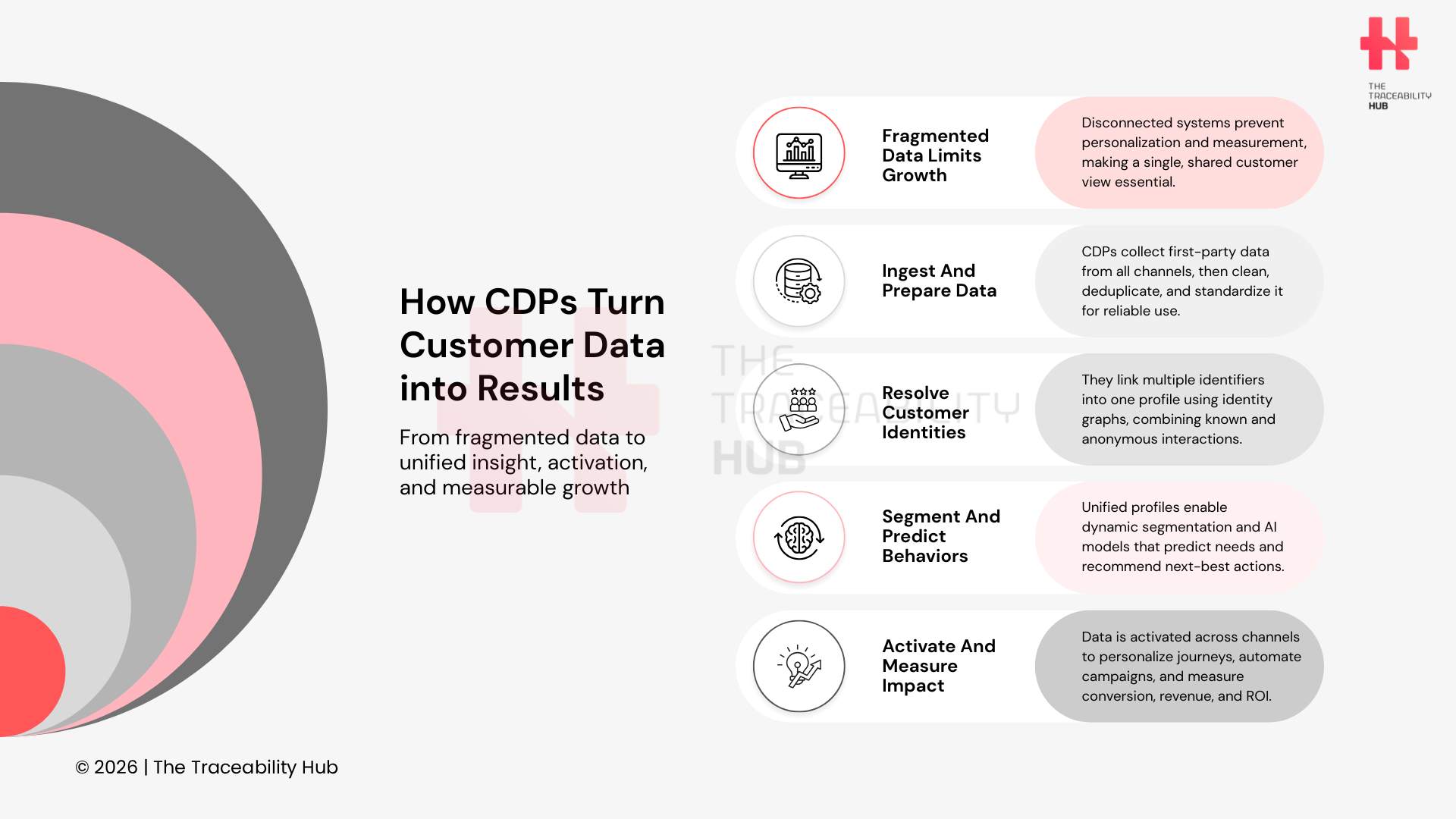
How CDPs Collect and Unify Customer Data from Multiple Sources
Data Ingestion from Online and Offline Touchpoints
Customer Data Platforms are designed to ingest data from a wide range of systems that generate customer-related information, both digital and physical, supporting omnichannel data collection strategies. These systems typically include websites and mobile applications, CRM platforms, email and marketing automation tools, point-of-sale systems, loyalty programs, customer support platforms, and, in some cases, connected devices.
Integration is generally achieved through a combination of application programming interfaces (APIs), software development kits (SDKs), webhooks, and pre-built connectors, depending on the platform and use case. These mechanisms allow CDPs to collect data from operational systems and external sources in a scalable and standardized way, enabling real-time data ingestion and processing.
CDPs are built to handle multiple data formats, including:
- Structured data (e.g. relational database records, transactions)
- Semi-structured data (e.g. JSON files, event logs)
- Unstructured data (e.g. text from emails, chat transcripts, or support notes)
Identity Resolution for Devices and Channels
Identity resolution is a core capability of Customer Data Platforms, enabling organizations to link multiple customer identifiers into a unified and persistent profile. often referred to as an identity graph or customer identity resolution system. In practice, customer data is often fragmented across systems and channels, with identifiers such as email addresses, device IDs, phone numbers, cookies, loyalty program IDs, and CRM records stored separately.
CDPs address this by analyzing and connecting these disparate identifiers, creating what is commonly referred to as an identity graph—a structured representation of the relationships between identifiers, devices, and interactions associated with a customer across channels.
Two primary approaches are used:
- Deterministic matching, which links records based on exact, verified identifiers (e.g. matching the same email address or customer ID across systems). This method provides a high level of confidence, as it relies on known and consistent data points.
- Probabilistic matching, which uses statistical models to infer relationships between identifiers based on signals such as device characteristics, behavioral patterns, or network data. This approach estimates the likelihood that different identifiers belong to the same individual or household but inherently involves a degree of uncertainty.
Most CDPs apply a combination of deterministic and probabilistic techniques, depending on the use case, data availability, and regulatory constraints.
Once identifiers are linked, the platform assigns a persistent internal identifier to each profile. This allows customer interactions to be tracked across sessions, devices, and channels over time, within the limits of consent, applicable privacy regulations, and data compliance frameworks (e.g. GDPR).
Identity resolution processes are typically continuous or near real-time, updating profiles as new data becomes available, enabling real-time customer data unification and activation. However, implementation varies by platform and architecture, and some systems may still rely on periodic updates for certain data sources.
Data Cleaning and Standardization
Data quality is a well-documented challenge in customer data management. Industry research consistently shows that poor data quality can lead to inefficiencies, wasted spending, and reduced campaign effectiveness, particularly when duplicate records, outdated contact details, or inconsistent formats are present.
While estimates vary by organization and methodology, the impact is widely recognized across marketing and data management functions.
Customer Data Platforms (CDPs) address these issues by applying data cleaning, validation, and standardization processes, also thanks to Artificial Intelligence, as part of data integration.
These processes typically include:
- Deduplication, where multiple records referring to the same individual are identified and merged
- Validation, such as checking the structure and plausibility of email addresses or phone numbers
- Error correction, where feasible (e.g. formatting inconsistencies or incomplete fields)
- Normalization, aligning data from different sources into consistent formats and naming conventions
Data Standardization ensures that data collected from heterogeneous systems can be interpreted and used consistently across teams and applications. This often involves mapping incoming data to a common data model or schema, which defines how customer attributes, events, and relationships are structured within the platform.
Building Unified Customer Profiles
Following identity resolution and data preparation, CDPs create unified customer profiles—centralized records that consolidate all known and relevant data about an individual or entity.
These customers profiles typically include:
- Core identity and contact information
- Transactional and purchase history
- Behavioral data from digital interactions
- Engagement data from marketing campaigns
- Customer service and brand support history
- Declared preferences or consent signals
Unified customers’ profiles are designed to be persistent and continuously updated, reflecting new interactions as they occur. Depending on the platform architecture, updates may occur in real time or near real time, enabling more timely access to current customer data.
Transforming Unified Data into Actionable Customer Insights
Customer Segmentation Based on Behavior and Attributes
Once unified customer profiles are in place, organizations can segment customers based on shared attributes and behaviors using advanced customer segmentation and audience segmentation strategies. Customer Data Platforms enable grouping across multiple dimensions, including demographics, transaction history, and digital interactions, supporting data-driven customer segmentation.
Segmentation can be rule-based (e.g. recent purchasers or inactive users) or more advanced, incorporating behavioral signals such as browsing activity, purchase frequency, and campaign engagement. Many CDPs support dynamic segmentation, where customers automatically move between segments as their behavior changes, enabling real-time segmentation and audience management.
Behavioral segmentation analyses customer interactions with a brand, including website visits, product views, and completed or abandoned transactions. Leveraging these insights enables the development of targeted and relevant engagement strategies, which consistently outperform generic campaigns and enhance conversion rates as well as customer engagement.
Some organizations also apply preference-based or psychographic segmentation, where data is available, to better understand customer motivations and interests. At the same time, growing customer expectations for personalization are driving the adoption of more advanced approaches such as AI-driven segmentation and predictive customer analytics.
To address this, many CDPs integrate AI and machine learning capabilities to identify patterns across large datasets and support predictive use cases, such as identifying high-value audiences or anticipating future behavior.
Predictive Analytics and AI-Powered Recommendations
Predictive analytics uses statistical models and machine learning to anticipate future customer behavior based on historical data. Within Customer Data Platforms, these models can support use cases such as identifying churn risk, estimating conversion likelihood, and highlighting potential upsell or cross-sell opportunities, contributing to predictive customer intelligence.
Some CDPs also enable next-best action recommendations, helping organizations determine the most relevant interaction for a given customer in real time. These capabilities support more proactive decision-making and AI-powered personalization strategies, although outcomes depend on data quality, model design, and implementation.
AI-driven approaches allow organizations to analyze large volumes of customer data across touchpoints and generate timely, data-informed insights that improve customer experience optimization and personalization on a scale. Industry research consistently shows that customer expectations for personalization are increasing, with many consumers expecting more relevant and responsive experiences as digital capabilities evolve.
Immediate Behavioral Tracking
Many CDPs support real-time or near real-time data processing, enabling organizations to track customer interactions as they occur and leverage real-time customer data analytics. Customer profiles can be updated continuously, depending on system architecture, providing a more current view of behavior across channels.
This allows for event-driven use cases, such as triggering communications after specific actions (e.g. cart abandonment, app integrations, or product views). Dynamic segmentation and content personalization can be applied based on recent interactions, although latency and responsiveness vary by platform.
Customer Journey Mapping
Customer Data Platforms can support customer journey mapping and analysis by consolidating interactions across touchpoints into a single unified view. This enables organizations to better understand how customers move between channels and stages over time.
Advanced analytics, including machine learning, can help identify patterns, friction points, and drop-off stages, as well as opportunities to improve engagement and conversion. These insights are used to optimize customer experiences across the lifecycle, from initial awareness to retention and loyalty, supporting end-to-end customer journey optimization.
Activating Customer Data Across Channels to Drive Results
Individual-Specific Email and SMS Campaigns
Activation is where unified customer data is used to deliver tar e geted communications across channels, such as email and SMS/WhatsApp enabling personalized marketing campaigns and cross-channel activation. Customer Data Platforms enable messages to be triggered by specific behaviors, preferences, or lifecycle events using marketing automation and real-time triggers.
Common use cases include abandoned cart reminders, personalized product recommendations, and event-based campaigns (e.g. loyalty milestones or customer anniversaries). Messages can dynamically adapt based on recent interactions, purchase history, and engagement data, supporting hyper-personalization and customer engagement optimization.
Some organizations also use location-based triggers, where permitted, to deliver timely offers when customers are near physical locations, enhancing contextual marketing and proximity-based engagement.
Industry research consistently shows that behavior-based and personalized campaigns outperform generic messaging, although results vary depending on execution and data quality. CDPs support this by providing a centralized, continuously updated customer view across channels.
Website and Mobile App Personalization
Personalization in websites and mobile apps uses customer data to adapt user experiences based on behavior, preferences, and context, enabling real-time personalization and digital experience optimization. This can include tailored product recommendations, dynamic content, and targeted notifications.
Common use cases include push notifications to re-engage users, highlight relevant offers, discounts, or remind customers of incomplete actions (e.g. abandoned carts). Personalization can also reflect factors such as recent interactions, device type, or location, where permitted, supporting context-aware personalization strategies.
Industry research consistently shows that personalization is a priority for most organizations and is associated with improved engagement and customer experience, although impact varies by execution.
Cross-Channel Marketing Automation
Customer Data Platforms enable organizations to coordinate customer interactions across multiple channels, including email, SMS/WhatsApp, web, and paid media, supporting omnichannel marketing automation and customer engagement orchestration.
For example, a customer who abandons a cart may receive a follow-up email, see relevant ads, or receive a reminder via another channel. This approach supports sequenced and consistent communication, reducing overlap and improving relevance across touchpoints while enhancing customer journey consistency and marketing efficiency.
Targeted Advertising with First-Party Data
CDPs can activate audiences using first-party data by integrating with advertising platforms such as Google, Meta, Amazon, and LinkedIn, enabling data-driven advertising and audience targeting.
This enables more precise targeting and suppression strategies, such as excluding recent purchasers or existing customers from certain campaigns to reduce wasted spending and improve marketing ROI and campaign efficiency.
Activation can be updated frequently or in near real time, depending on system architecture, allowing campaigns to reflect recent customer behavior more accurately.
Measuring Business Outcomes from Customer Data Platform Implementation
Revenue Growth and Conversion Rate Improvements
The business value of a Customer Data Platform is usually measured through better personalization, more efficient targeting, and improved conversion performance, all driven by data-driven marketing and customer analytics. CDPs help unify customer data from marketing, sales, service, and commerce sources, making it easier to create coordinated audiences, trigger relevant experiences, and inform campaign decisions.
Research from McKinsey indicates that effective personalization can lift revenue by 5% to 15% and increase marketing ROI by 10% to 30%, although results vary significantly by sector, execution quality, and data maturity. McKinsey also reports that personalization can reduce customer acquisition costs by as much as 50% in some contexts.
Customer Lifetime Value Increases
A unified customer view can also support higher customer lifetime value (CLV) by improving retention, cross-sell, and upsell decisions through customer lifecycle management and predictive analytics. McKinsey reports that faster-growing companies derive 40% more of their revenue from personalization than their slower-growing peers, suggesting that better use of customer data can contribute to stronger long-term commercial performance and customer lifetime value optimization.
Reduced Customer Acquisition Costs
Another measurable outcome is lower wasted media spending. When customer data is unified, organizations can suppress existing customers from acquisition campaigns, avoid duplicating targeting, and align offers more closely with recent behavior. This is one reason personalization and first-party data activation are associated with lower acquisition costs and better marketing efficiency.
Marketing Efficiency Gains
CDPs can improve operational efficiency by giving teams a shared customer data foundation instead of requiring manual reconciliation across disconnected systems. The consultancy company Gartner describes CDPs as platforms that unify customer data to support audience creation, decisioning, triggers, and analysis across cross-functional systems.
In practice, this can shorten campaign preparation time and improve coordination between teams (marketing, sales, and service teams), though the scale of the benefit depends on implementation of quality and internal processes.
ROI Tracking Across Campaigns
Organizations typically evaluate CDP performance through metrics such as conversion rate, revenue per customer, return on marketing investment, customer retention, and acquisition efficiency, all enabled by customer data analytics and performance measurement.
In most cases, short-term gains are more visible in campaign targeting and suppression, while longer-term outcomes emerge as unified profiles become more complete and are used consistently across channels. That timing varies by architecture, governance, and organizational maturity, so fixed ROI timeframes should be treated cautiously.
From Data Fragmentation to Customer-Centric Growth
Customer Data Platforms help organizations transform fragmented customer data into a more unified and actionable foundation for decision-making, enabling customer-centric data strategies and digital transformation. By consolidating information from multiple sources, CDPs enable a more consistent view of the customer and reduce reliance on disconnected systems.
This unified approach supports more relevant customer experiences, improved targeting, and better coordination across teams and channels. Industry research consistently shows that effective use of customer data and personalization, and data-driven marketing strategies is associated with improvements in engagement, conversion, and long-term customer value, although results depend on data quality, execution, and organizational maturity.
Adopting a CDP is therefore not only a technical decision, but a strategic step toward managing customer relationships more effectively on a scale. As expectations for personalization and consistency continue to rise, organizations that invest in integrated data capabilities, real-time data processing, and customer data platform solutions are better positioned to adapt, optimize performance, and make more informed use of their marketing resources.
Read more: What Is D’Amico’s Digital Product Passport and Why It Matters for Food Transparency