

Green Steel and the EU’s Net Zero Transition
Green steel represents a critical transition within one of the world’s most carbon-intensive industries. Steel production is responsible for approximately 7–9% of global CO₂ emissions, making it a key focus area for decarbonization and climate change mitigation strategies.
In Europe, the steel sector produces around 130 million tons annually and accounts for roughly 4-5% of total EU greenhouse gas emissions. As part of the European Union’s climate strategy, and net zero transition roadmap, the industry faces increasing pressure to reduce its carbon footprint in line with the “Fit for 55” target, which aims to cut net emissions by at least 55% by 2030 (compared to 1990 levels) and achieve climate neutrality by 2050.
This regulatory momentum is accelerating transformation across the sector. Investment in low-carbon technologies-such as hydrogen-based direct reduced iron (DRI), electric arc furnaces (EAF) powered by renewable energy, and carbon capture, utilization and storage (CCUS) – is rapidly scaling.
While market projections vary significantly, the European green steel market is widely expected to experience strong double-digit growth over the coming decade, driven by policy support, corporate decarbonization commitments, and demand from downstream industries such as automotive manufacturing and sustainable construction.
This article explores the key green steel production technologies, highlights leading companies driving the transition, and examines the technical and economic challenges shaping Europe’s pathway toward net zero steel production.
Green Steel Production Technology: From Blast Furnaces to Hydrogen-Based Methods
Traditional BF-BOF vs DRI-EAF Production Routes
Steel production today relies primarily on the blast furnace–basic oxygen furnace (BF-BOF) route and the electric arc furnace (EAF) route, with DRI-EAF representing a growing hybrid low-carbon steelmaking pathway.
The BF-BOF route remains the dominant global method for primary steelmaking. It uses iron ore as the main input, with coke and coal acting as reducing agents and energy sources. This process is highly carbon-intensive, with average emissions of around 2.2–2.4 tons of CO₂ per ton of crude steel. The blast furnace stage alone accounts for the majority of emissions in this pathway due to its reliance on coal-based reduction and fossil fuel inputs.
In contrast, the EAF route, particularly when based on recycled scrap steel, offers significantly lower emissions. Scrap-based EAF steelmaking typically generates around 0.6-0.8 tons of CO₂ per ton of steel, depending largely on the carbon intensity of the electricity used. This makes it one of the lowest-emission steelmaking routes currently available on a scale.
A hybrid pathway is the DRI-EAF route (direct reduced iron combined with electric arc furnace technology), where iron ore is first reduced to direct reduced iron and then melted in an electric arc furnace. When natural gas is used as the reducing agent, emissions typically fall in the range of ~1.2-1.6 tons of CO₂ per ton of steel, offering a meaningful reduction compared to BF-BOF, though still higher than scrap-based EAF.
From an energy perspective, BF-BOF is also more intensive, generally requiring significantly higher total energy input than EAF-based routes. While exact figures vary depending on system boundaries and plant efficiency, EAF, especially scrap-based, consistently demonstrates lower energy demand due to the avoidance of iron ore reduction processes.
Overall, scrap-based EAF can reduce emissions by approximately 60–75% compared to BF-BOF on a global average basis, depending on electricity sources, while DRI-EAF provides an intermediate decarbonization pathway.
The next step in this evolution is hydrogen-based DRI (green hydrogen steelmaking), which replaces natural gas with green hydrogen and has the potential to reduce emissions close to zero when powered by renewable energy sources.
Hydrogen-Based Direct Reduction Process
Hydrogen-based direct reduction (hydrogen DRI technology) is a cornerstone of emerging green steel production. In this process, hydrogen removes oxygen from iron ore to produce metallic iron, generating water vapor instead of carbon dioxide. A simplified overall reaction is Fe₂O₃ + 3H₂ → 2Fe + 3H₂O, though the industrial process involves multiple reaction steps and advanced metallurgical control systems.
Compared with natural-gas-based DRI, the use of pure hydrogen can reduce direct process CO₂ emissions by around 90% or more in the reduction stage, although the exact reduction depends on system boundaries and plant configuration.
The full climate benefit also depends on the availability of renewable electricity for hydrogen production (via electrolysis) and downstream steelmaking processes.
In commercial shaft furnaces, hot reducing gas flows counter-current through iron ore pellets or lump ore, typically achieving metallization levels above 90%.
This makes hydrogen-based DRI a technically viable route for producing low-carbon iron for use in electric arc furnaces (EAF steelmaking).
Commercial plant size can vary significantly, but modern DRI shaft furnaces are commonly designed for around 1 to 2 million tons of annual output. Hydrogen demand at that scale is substantial, which means industrial green steel projects usually require very large renewable power and electrolysis capacity, electrolysis infrastructure, and integrated energy systems.
Electric Arc Furnace Integration with Renewable Energy
Electric arc furnaces (EAFs) are central to low-carbon steelmaking, as they rely primarily on electricity rather than coal-based fuels. Electricity consumption in EAF steel production typically ranges from ~300 to 600 kWh per ton of crude steel, depending on factors such as scrap quality, process configuration, and the share of direct reduced iron (DRI).
To achieve meaningful emissions reductions, the carbon intensity of electricity becomes a critical factor. Integrating renewable energy sources-such as wind power and solar energy – into EAF operations is therefore essential for producing truly low-carbon or “green” steel.
Further efficiency gains can be achieved through hot charging of direct reduced iron (DRI). When DRI is fed into the EAF at elevated temperatures (typically ~600–700°C), electricity consumption can be reduced by approximately 15–25% compared to cold charging, as less energy is required to heat the material to melting conditions.
As a result, the combination of EAF technology, renewable electricity integration, and optimized material flows (such as hot DRI charging and scrap recycling) represents one of the most effective pathways currently available for reducing emissions in steel production and achieving net zero steel targets.
Carbon Capture and Storage as Complementary Approach
Carbon capture, utilization and storage (CCUS) represent a complementary decarbonization pathway for existing steelmaking assets, particularly for blast furnace–basic oxygen furnace (BF-BOF) facilities where full process replacement is not immediately feasible.
One of the most prominent industrial examples is the Al Reyadah CCUS facility in Abu Dhabi, linked to Emirates Steel. The project captures up to 800,000 tons of CO₂ per year from a direct reduced iron (DRI) plant, with the captured CO₂ primarily used for enhanced oil recovery. While not applied to BF-BOF steelmaking, it demonstrates the technical feasibility of carbon capture in steel-related industrial processes.
To date, commercial deployment of CCS in the steel sector remains limited, with most projects at pilot or early industrial scale. However, CCUS is widely considered an important transitional solution, particularly for regions with a large installed base of blast furnace capacity and high industrial emissions.
The effectiveness of carbon capture varies depending on the technology and integration point. Post-combustion capture systems applied to BF-BOF processes can typically achieve emissions reductions of around 50–60%, while more advanced or integrated approaches (such as top-gas recycling or oxyfuel combustion systems) have the potential to reach significantly higher capture rates under optimal conditions.
According to scenarios from the International Energy Agency (IEA), CCUS is expected to play a supporting role in steel decarbonization, contributing a meaningful but not dominant share of emissions reductions alongside electrification, hydrogen-based direct reduction, and increased scrap recycling rates.
Overall, CCUS is best understood as a bridging or transitional solution—enabling emissions reductions from existing high-carbon assets—rather than a standalone pathway to fully decarbonized or net zero steel production.
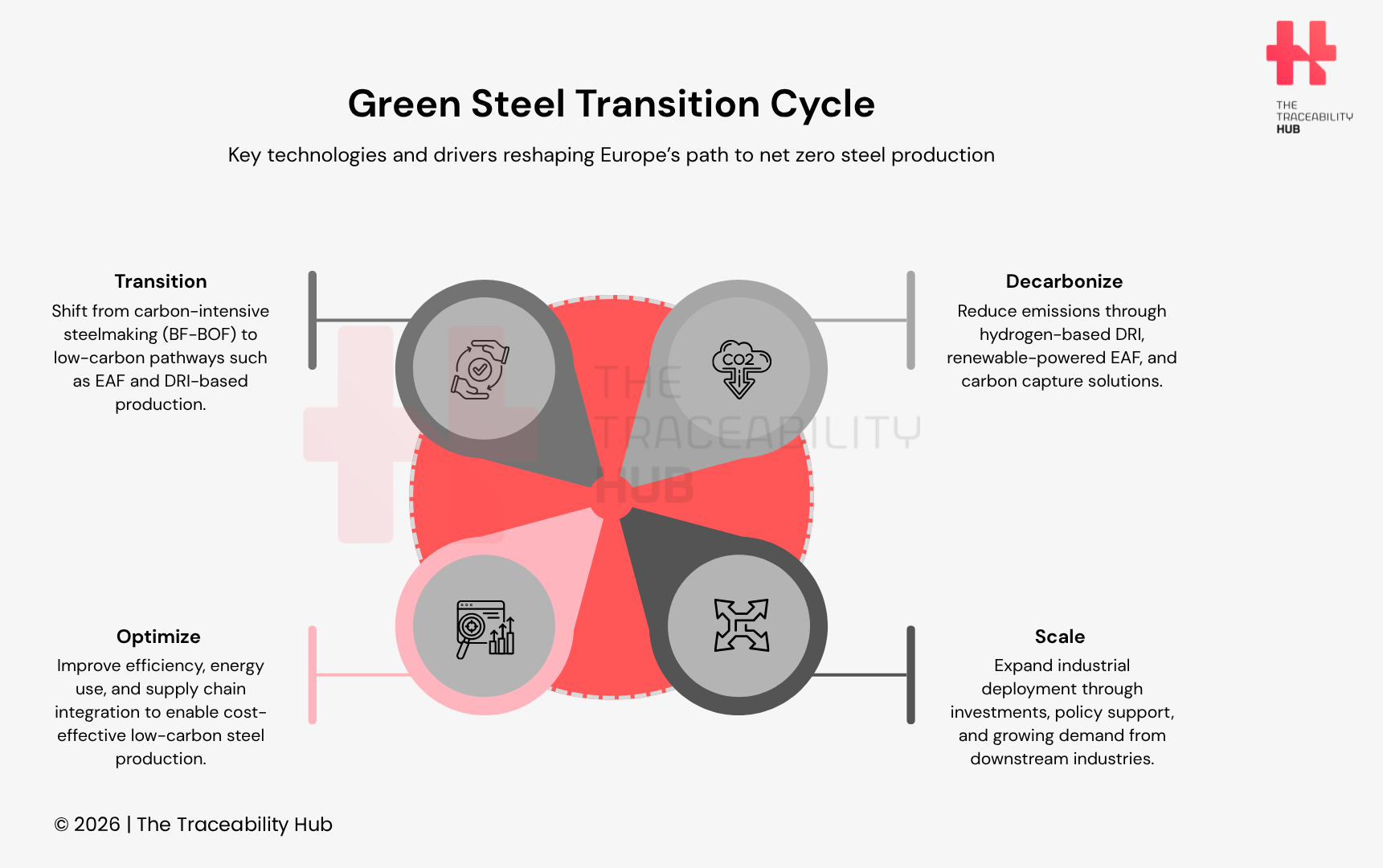
Green Steel Transition Cycle
Major Green Steel Companies Leading Europe’s Decarbonization
SSAB’s HYBRIT Project in Sweden
SSAB, LKAB, and Vattenfall launched the HYBRIT initiative in 2016 with the goal of developing the world’s first fossil-free, ore-based steelmaking value chain using hydrogen-based steel production instead of coal.
A pilot plant for hydrogen-based direct reduction began operations in Luleå in 2020, marking a key milestone in demonstrating the technical feasibility of green steel production at scale. Since then, the project has produced pilot-scale volumes of fossil-free sponge iron, which SSAB has used to manufacture and deliver the first batches of fossil-free steel to customers starting in 2021, including early industrial partners in automotive and heavy industry sectors.
The broader HYBRIT concept aims to transform the entire iron and steel value chain – from mining to finished steel – by replacing coking coal with fossil-free hydrogen and renewable electricity. If deployed at full scale, this transition could significantly reduce emissions in the Nordic region. According to HYBRIT project estimates (SSAB, LKAB, Vattenfall), decarbonizing the full value chain could reduce Sweden’s CO₂ emissions by around 10% and Finland’s by approximately 7%, reflecting the central role of steelmaking in these economies.
The next phase of the project includes scaling up to industrial production, with plans for large-scale hydrogen-based DRI facilities, such as the demonstration plant in Gällivare, designed to supply fossil-free iron for electric arc furnace for steelmaking. These developments are expected to play a key role in moving from pilot validation to commercial deployment of green steel technologies in Europe.
Thyssenkrupp and Salzgitter AG Initiatives in Germany
Thyssenkrupp Steel Europe is advancing one of Europe’s largest low-carbon steel and industrial decarbonization projects through the construction of a hydrogen-ready direct reduction (DRI) plant at its Duisburg (Germany) site.
The first module is expected to be operational around 2026–2027, forming part of a broader transition toward low-carbon steel production. The project represents a multi-billion-euro investment and is supported by public funding mechanisms.
At full scale, the initial DRI module is expected to reduce emissions by several million tons of CO₂ annually, with long-term plans to progressively replace blast furnace capacity. Hydrogen demand is expected to be substantial, potentially reaching hundreds of thousands of tons per year once the full transformation is complete, although this will depend on the pace of hydrogen infrastructure and renewable energy availability.
Salzgitter AG, a German company, one of the largest steel producers in Europe, is pursuing a similar transformation through its SALCOS (Salzgitter Low CO₂ Steelmaking) program. The company has secured significant public funding alongside private investment, supporting a total program value in the multi-billion-euro range. The first stage includes the installation of a DRI plant and electric arc furnace, with initial production targeted for the second half of the decade (around 2026–2027).
SALCOS aims to achieve up to ~95% reduction in CO₂ emissions compared to conventional steelmaking once fully implemented, positioning it as one of the most ambitious decarbonization programs in European steel industry.
ArcelorMittal’s Multi-Country Transition Strategy
ArcelorMittal, one of the world’s largest steel producers in the world, is pursuing a diversified decarbonization strategy across multiple European sites, combining EAF deployment, DRI development, and carbon capture technologies.
In the plant of Dunkirk (France), the company has announced plans to invest in electric arc furnace capacity as part of its transition away from blast furnace-based production and toward low-carbon steel manufacturing. Project timelines and investment decisions remain subject to policy support, energy costs, and regulatory conditions, and have evolved over time.
In the plant of Gijón (Spain), ArcelorMittal has progressed with plans for an electric arc furnace (around 1 million tons capacity) as part of a broader site transformation toward sustainable steel production, although project timing has also been influenced by market and policy conditions.
More broadly, ArcelorMittal has delayed or reconsidered several decarbonization investments in Europe, particularly in Germany, citing high electricity prices, energy market uncertainty, and the need for a more supportive policy framework.
This highlights the structural challenges facing large-scale green steel deployment in Europe.
Equipment Manufacturers: Midrex and GreenIron Technologies
Midrex Technologies is one of the leading suppliers of direct reduced iron (DRI) technology globally and plays a central role in enabling hydrogen-based steelmaking. The company has been selected to supply the DRI plant for H2 Green Steel’s flagship green steel project in Boden, Sweden.
The Boden facility is designed with a planned capacity of approximately 2.0–2.1 million tons of DRI per year and is intended to operate using 100% hydrogen as the reducing agent, making it a cornerstone project in Europe’s green steel ecosystem. While often described as a first-of-its-kind commercial-scale hydrogen DRI plant, its classification depends on final configuration and ramp-up. Project timelines have evolved, with initial production now expected in the mid-to-late 2020s rather than a fixed 2025 start date.
GreenIron, a Swedish metal technology company delivering reduction and recycling as a service, is developing an alternative hydrogen-based reduction technology focused on circular material streams, including steel industry residues and mining waste, and secondary raw materials. The company has operated a pilot-scale furnace since around 2020 to validate its innovative low-carbon steel production process.
GreenIron’s technology differs from conventional DRI by targeting waste and residual materials rather than primary iron ore, positioning it as a complementary solution within the broader green steel ecosystem. The company has announced plans for commercial-scale facilities in Sweden, though timelines and operational status remain subject to project development and financing.
GreenIron has also entered a collaboration with H2 Green Steel to explore the recycling of industrial residues, with indicative volumes in the range of up to ~150,000 tonnes per year, depending on project scope and implementation.
Economic and Regulatory Drivers Accelerating Transition
EU Emissions Trading System and Rising Carbon Prices
The European Union Emissions Trading System (EU ETS), in place since 2005, is a central policy instrument driving decarbonization in the European steel sector by putting a price on carbon emissions and incentivizing low-carbon steel production.
In recent years, carbon prices have increased significantly, generally ranging between €60 and €90 per ton of CO₂, with annual averages around €80/tCO₂ in 2023. Prices have shown volatility and softened somewhat in 2024, reflecting broader energy market dynamics.
Under the EU’s “Fit for 55” climate package framework, free allocation of emissions allowances to industry is being gradually phased out in parallel with the introduction of the Carbon Border Adjustment Mechanism (CBAM).
The phase-out begins in 2026 and progresses gradually until 2034, when free allocation is expected to be fully eliminated for sectors covered by CBAM.
As free allowances decline and carbon prices remain elevated, effective carbon costs for steel producers are expected to increase significantly, strengthening the economic case for low-carbon production technologies such as hydrogen-based DRI and electric arc furnaces powered by renewable energy—becomes increasingly compelling.
Carbon Border Adjustment Mechanism Implementation Impact
The Carbon Border Adjustment Mechanism (CBAM) entered a transitional phase in 2023, requiring importers to report embedded emissions in carbon-intensive goods such as steel.
Full financial implementation is scheduled to begin in 2026, when importers will need to purchase CBAM certificates reflecting the carbon price under the EU ETS.
CBAM is designed to level the playing field between EU producers – who face carbon costs – and foreign producers operating in jurisdictions with less stringent climate policies. Over time, this mechanism is expected to increase the cost of carbon-intensive imports and encourage lower-carbon emission steel production globally.
The precise impact of CBAM on trade flows, import volumes, and price differentials remains uncertain and highly dependent on future carbon prices, global policy alignment, and industry responses. However, it is widely expected to reshape global steel trade and competitiveness in the steel sector and reinforce the transition toward low-carbon production in Europe.
Government Subsidies, Corporate Demand and Public Procurement
Public funding and state are playing a central role in accelerating steel industrial decarbonization in Europe. According to the European Commission’s Steel and Metals Action Plan, from October 2022 to February 2025 the Commission approved close to €9 billion in State aid for 10 individual steel decarbonization projects.
France’s support for ArcelorMittal Dunkirk, for example, includes an officially approved €850 million aid measure, while major projects in Germany have also received substantial backing.
At the same time, downstream industries’ buyers are beginning to create demand for lower-carbon steel. Industry assessments have highlighted Volvo as a leading automaker in steel supply-chain decarbonization, while Tesla has disclosed commodity-level emissions data showing steel as a measurable share of its supply-chain footprint. Outside automotive, Trane Technologies has reported that low-carbon EAF steel already accounts for 20% of its annual steel purchases and is expected to cut emissions by around 16,000 metric tons per year.
Public procurement also represents a major demand level.
The European Commission states that public procurement represents around 14% of EU GDP, or roughly €1.9–2.0 trillion annually. In March 2026, the Commission proposed new measures that would introduce minimum low-carbon material content requirements in supported projects, including a requirement that at least 25% of the steel volume used be low-carbon. However, this should currently be described as a proposed measure, not as an already applicable EU-wide mandate.
Critical Challenges Facing the Green Steel Production Process
High Electricity Costs and Power Supply Requirements
High electricity prices remain one of the most significant barriers to green steel production in Europe. According to the European Commission, industrial electricity and gas prices in the EU are still 2–4 times higher than in major trading partners, while EUROFER has said that restoring electricity prices closer to pre-2021 levels of around €44/MWh is critical to unlocking investment in low-carbon steel production.
Electricity is a major cost component for electric arc furnace (EAF) steelmaking and, during periods of elevated power prices, can account for up to around 20% of total production costs. Full decarbonization of the European steel sector would also require a major expansion of renewable energy power supply, with EUROFER estimating demand could rise to around 400 TWh of CO₂-free electricity potentially reaching hundreds of terawatt-hours annually by 2050.
Hydrogen-based steelmaking adds further power requirements because large-scale electrolysis is needed to produce green hydrogen. These needs are measured in hundreds of megawatts per plant, not per ton of steel. For example, the HYBRIT demonstration project in Sweden includes around 500 MW of electrolyze capacity to support roughly 1.2–1.3 million tons of annual steel production.
Green Hydrogen Availability and Production Scaling
Green hydrogen availability is one of the most critical bottlenecks in scaling hydrogen-based steel production. The IEA reports that global installed water electrolyze capacity reached about 1.4 GW by the end of 2023, while announced projects could bring total capacity to roughly 520 GW by 2030 if delivered. In practice, however, only a small fraction of that pipeline has reached its final investment decision, meaning the current steel supply chain is still far below what would be needed for large-scale steel industrial decarbonization.
Costs also remain high, with renewable hydrogen prices significantly above fossil-based alternatives. Recent industry analysis puts the current levelized cost of renewable hydrogen at roughly USD 4.5–6.5 per kilogram, with declines expected over time as electrolyze manufacturing scales and renewable electricity becomes cheaper. Even so, major steelmakers continue to warn that hydrogen is not yet available at the volume and price needed for industrial transformation. As ArcelorMittal has stated, hydrogen is not available at the scale required for the company’s Europe’s green steel transition plans.
DR-Grade Iron Ore Supply Constraints
Hydrogen-based DRI generally requires high-quality DR-grade iron ore with low impurity levels, typically in the form of DR-grade pellets or concentrates. In practice, this usually means iron content in the high-67% Fe range or above, together with tight limits on gangue and other impurities, although the exact specification depends on the technology route and plant design.
Supply of DR-grade iron and material is widely viewed as one of the key bottlenecks in scaling European green steel.
McKinsey notes that announced DRI capacity is outpacing announced mining capacity for high-grade input materials, pointing to a likely supply shortfall as the sector expands. However, it is safer to say that supply chain is structurally tight and expected to remain constrained, rather than stating definitively that the market “will remain in deficit until 2030” unless you are citing a specific forecast.
The market has also been shaped by disruptions in Brazil. Vale’s tailings dam failures at Brumadinho and earlier at Samarco had a major impact on iron ore availability, and Reuters reported that more than 70 million tons per year of production were shuttered after the 2019 disaster.
Investment Delays Due to Economic Uncertainties
Economic uncertainty, high capital costs, and policy complexity are already slowing parts of Europe’s green steel transition. In September 2025, Salzgitter said it would delay the later stages of its SALCOS green steel program by three years, freeing up about €1 billion in capital expenditure. The company cited worsening economic conditions, slow hydrogen market development, and missing or delayed regulatory support, while keeping the first phase on track.
ArcelorMittal has also scaled back or dropped some German decarbonization plans, citing high energy costs and an unfavorable investment environment. More broadly, Reuters reported in March 2026 that around 18 million tons of planned green steel capacity would be in Europe, but only about one-third of that capacity was under construction. This underlines the gap between announced ambition and projects that have reached the build phase.
Scaling the Transition from Pilot to Industrial Reality
Europe’s green steel transformation represents a fundamental shift in the decarbonization of one of the world’s most emissions-intensive industries. Emerging technologies, particularly hydrogen-based direct reduction, are playing a central role, supported by evolving regulatory frameworks such as the European Union’s climate policies.
Leading industrial players have already demonstrated the technical feasibility of low-carbon steel production through pilot projects and early-stage commercial deployments. However, the sector is now approaching a critical phase in which scaling these solutions remains the primary key challenge.
The success of net zero steel transition will depend on addressing several structural constraints, including:
- Access to affordable and abundant renewable electricity
- Large-scale availability of green hydrogen
- And the supply of high-grade iron ore is suitable for low-carbon production routes
While market outlooks consistently point to strong long-term growth in green steel over the coming decade, projections vary significantly depending on assumptions around policy, energy prices, and technology deployment. As a result, the pace of transition will ultimately depend on sustained steel investment, supportive policy frameworks, and improved economic conditions.
Read more: What Mondelez International Learned Scaling Agricultural Traceability Across Thousands of Farms