


Why Cotton Traceability Has Become a Global Imperative
The global cotton industry now produces 114 million bales in 2023/2024, making cotton traceability a critical requirement across the cotton supply chain. Cotton moves through a highly complex and fragmented textile supply chain, where smallholder farmers in multiple countries grow raw cotton that passes through numerous intermediaries. These actors manage key production stages such as ginning, spinning, weaving, dyeing, and garment manufacturing, often across different geographies. As cotton-based products cross borders several times, achieving end-to-end textile traceability and farm to fashion transparency becomes increasingly difficult for brands.
The implementation of the Uyghur Forced Labor Prevention Act (UFLPA) has significantly increased regulatory pressure on ethical cotton sourcing and forced labor compliance. Authorities have detained more than 2,200 shipments of apparel, textiles, and footwear, valued at nearly $92 million, due to insufficient cotton origin verification. As a result, companies are seeking innovative cotton traceability solutions to meet UFLPA cotton compliance requirements. In late 2023, the Better Cotton Initiative launched a new cotton traceability program designed to track traceable cotton back to its country of origin, with the long-term goal of tracing fibers to individual farms. Similarly, the U.S. Cotton Trust Protocol has achieved comparable results by tracking large volumes of cotton fiber through scalable digital traceability platforms.
At the same time, modern traceability technologies are reshaping how brands verify supply chain claims. Forensic fiber fingerprinting, including stable isotope analysis and DNA-based molecular tagging, allows companies to scientifically confirm the geographic origin of cotton fibers. These advanced cotton traceability technologies provide a robust foundation for addressing sustainability, ESG verification, and ethical sourcing risks in the global fashion industry.
Cotton Traceability
Understanding Cotton Traceability in the Global Supply Chain
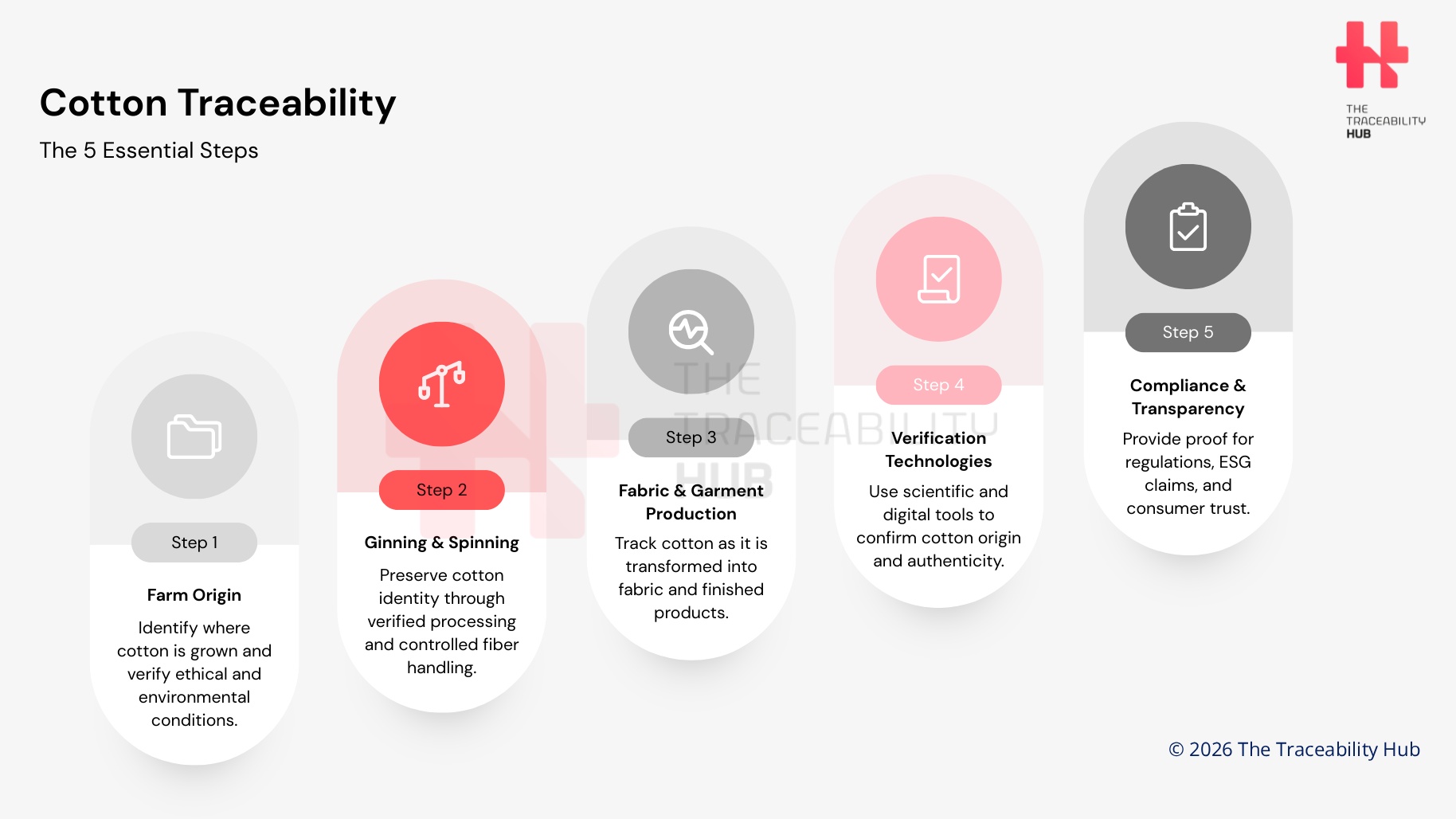
Cotton traceability is reshaping how fashion brands monitor and manage their cotton supply chains. Traditional cotton tracking methods typically identify only direct suppliers, offering limited supply chain visibility. True textile traceability, instead, provides full farm to fashion traceability, mapping the entire journey of cotton fibers, from their origin at the farm level through processing, manufacturing, and distribution, all the way to finished garments.
Definition of Traceable Cotton and Its Scope
Traceable cotton refers to the physical cotton fibers contained in a product that brands can track at every stage of the textile supply chain. According to Better Cotton Initiative, traceable cotton is cotton that can be followed from its source through ginning, spinning, fabric production, and garment manufacturing. This approach differs fundamentally from mass balance models, which only reconcile volumes on paper without verifying the actual physical movement of cotton through the supply chain.
Effective cotton traceability systems require verifiable transaction records between supply chain partners, supported by documentation and digital data. They do not rely solely on supplier self-declarations but instead demand objective proof that cotton has moved through each processing step as claimed.
Cotton traceability operates within global supply networks that connect millions of farmers, processors, traders, and manufacturers. The most robust systems rely on Hard Identity Preserved (HIP) Chain of Custody models, which ensure that certified cotton remains physically segregated from non-certified cotton at every stage. To support this, several organizations have developed digital traceability platforms. Better Cotton’s traceability platform, for example, is built on ChainPoint software, enabling secure data exchange and end-to-end cotton traceability.
Stages from Farm to Fashion: Ginning, Spinning, Weaving, Dyeing
The cotton supply chain consists of several critical stages that must be tracked to achieve farm to garment traceability. After harvesting, cotton balls are transported to gins, where fibers are separated from seeds and plant matter. The cleaned cotton then undergoes carding and combing, processes that align and straighten fibers before spinning twists them into continuous yarn suitable for fabric production.
Yarn is transformed into fabric through weaving or knitting, depending on the desired material properties. Weaving interlaces yarns to create stable fabrics, while knitting forms loops for flexibility and stretch. Final textile processing stages, including washing, bleaching, dyeing, printing, and finishing, enhance fabric appearance and performance before garments are cut and sewn. Each of these steps represents a potential traceability risk point if not properly documented and verified.
Why Trace Cotton from Farm to Garment Matters
Cotton traceability enables brands to substantiate sustainability, ethical sourcing, and ESG claims with verified data rather than assumptions. It helps companies reduce supply chain risks by identifying weak points, ensuring regulatory compliance, and improving overall supply chain transparency.
Through robust traceable cotton systems, brands can detect issues such as counterfeiting, material substitution, tampering, and unauthorized subcontracting, all of which can compromise product quality and brand reputation. Consumer trust increases when companies can clearly demonstrate where their raw materials originate, supported by data-driven evidence and third-party verification.
Accurate impact reporting is impossible without reliable traceability. Brands seeking to make credible claims about reducing environmental and social impacts depend on traceable cotton supply chains to measure performance, report results accurately and avoid greenwashing risks.
Why Cotton Traceability Is Essential for Modern Brands
Growing regulatory pressure has transformed cotton traceability from a strategic option into a business necessity for modern fashion brands. Today, companies are expected to provide verifiable proof of sustainable and ethical practices across the entire cotton and textile supply chain, rather than relying on high-level sustainability commitments or supplier assurances.
Forced Labor Compliance Under UFLPA and EUDR
The Uyghur Forced Labor Prevention Act (UFLPA) presumes that cotton sourced from high-risk regions is linked to forced labor unless proven otherwise. Importers must present clear and convincing evidence of ethical cotton sourcing and cotton origin verification to avoid shipment detentions. Companies typically have only 30 to 60 days to submit traceability documentation before goods face border seizure or rejection.
In parallel, the EU’s Corporate Sustainability Due Diligence Directive (CSDDD) strengthens requirements for human rights due diligence in raw material sourcing, including cotton. U.S. Customs and Border Protection (CBP) reported a 25% increase in detained apparel and textile shipments in 2024 compared to 2023, with an average of 428 detentions per month, underscoring the growing enforcement focus on cotton supply chain transparency and UFLPA cotton compliance.
Greenwashing Risk and ESG Claim Verification
Robust cotton traceability systems play a critical role in preventing greenwashing by ensuring that ESG and sustainability claims are supported by verifiable supply chain data. Textile supply chains that lack proper tracking mechanisms produce unreliable sustainability reporting and expose brands to regulatory, legal, and reputational risks.
This challenge is particularly visible in organic cotton traceability, where reported sales volumes significantly exceed verified production levels. Brands making claims related to sustainable cotton, low-impact materials, or responsible sourcing must substantiate these statements with traceable cotton data, or risk losing consumer trust and facing increased scrutiny from regulators and investors.
Ethical Sourcing and Consumer Trust
Consumer expectations around ethical sourcing and supply chain transparency continue to rise. Research shows that 70% of consumers care about ethical production, while 39% believe manufacturers should take responsibility for conditions across their supply chains. Fashion brands that can demonstrate verified cotton origin, supported by third-party audits and digital traceability tools, are better positioned to build long-term customer loyalty.
By providing clear evidence of ethical cotton sourcing, companies differentiate themselves in competitive markets and strengthen their credibility with increasingly informed and sustainability-conscious consumers.
Organic Cotton Certification and Sustainability Goals
While organic cotton certification confirms that farms comply with organic agricultural standards, achieving end-to-end organic cotton traceability across the full farm to fashion supply chain remains challenging. To address this, GOTS has introduced mandatory Farm-to-Gin Registry requirements and is developing a Global Trace Base to improve visibility throughout the organic cotton lifecycle.
Similarly, the U.S. Cotton Trust Protocol has rapidly expanded its digital cotton traceability platform, growing by 413% in a single year. This expansion enabled 20 brands to trace 126,000 tons of cotton fiber, equivalent to approximately 690 million finished products, highlighting how scalable traceability solutions support corporate sustainability and ESG goals.
How Cotton Traceability Works: Tools and Technologies
Modern traceability technologies have transformed cotton traceability across highly complex and global cotton supply chains. Scientific and digital solutions now provide a reliable alternative to traditional paper-based tracking systems, which often fail to deliver accurate end-to-end textile traceability or verifiable proof of origin.
Forensic Fiber Fingerprinting Using Isotope Analysis
Brands and authorities can now verify cotton origin through forensic fiber fingerprinting based on stable isotope analysis. This scientific traceability method analyzes the ratios of carbon, hydrogen, and oxygen isotopes present in cotton fibers. Environmental variables such as soil composition, climate conditions, altitude, and rainfall create a unique geographic origin fingerprint that links cotton to specific growing regions.
This form of cotton origin verification is increasingly used for forced labor compliance and UFLPA enforcement. The U.S. Customs and Border Protection applies isotopic testing to screen high-risk cotton and textile shipments and actively encourages companies to adopt forensic traceability technologies as part of robust supply chain due diligence programs.
DNA Tagging and Molecular Markers in Cotton Fibers
DNA tagging technology enables microscopic identification of cotton fibers using synthetic molecular markers. These markers are typically applied at controlled points in the cotton supply chain, most commonly at the gin, and adhere permanently to fibers. Acting as microscopic barcodes, DNA markers allow cotton to be tracked through spinning, weaving, dyeing, finishing, and garment manufacturing without degrading.
This solution supports traceable cotton programs by enabling scientific verification of fiber identity throughout the textile production process.
Blockchain-Based Digital Traceability Platforms
Blockchain-based traceability platforms play a growing role in digital supply chain traceability for cotton and textiles. Blockchain technology creates secure, immutable records of transactions and movements across the farm to fashion supply chain. These systems typically follow EPCIS standards, capturing key traceability data elements such as who, what, where, when, why, and how at each step.
While blockchain cotton traceability improves data transparency and auditability, its effectiveness ultimately depends on the accuracy of the data entered the system. Blockchain solutions manage information securely but do not, on their own, provide physical or scientific verification of cotton origin.
Limitations of Supplier Self-Declarations
Despite their widespread use, supplier self-declarations and paper documentation often fail to deliver reliable cotton traceability. Incomplete, inconsistent, or inaccurate records create significant verification gaps and expose brands to compliance and greenwashing risks. In contrast, technology-driven traceability solutions, such as forensic testing, DNA tagging, and digital platforms, offer more objective methods for verifying cotton origin claims.
Even advanced tools like AI-based mapping and risk analytics depend on the quality of the original data. If initial inputs are flawed, digital systems can unintentionally propagate incorrect information across the supply chain, reinforcing the need for scientifically validated cotton traceability technologies.
Challenges in Implementing Cotton Traceability Programs
Despite significant advances in cotton traceability technologies, implementing effective traceable cotton programs remains challenging across global and highly fragmented cotton supply chains. Structural, economic, and operational barriers continue to limit end-to-end supply chain transparency, even for brands actively investing in traceability solutions.
H3: Supply Chain Fragmentation and Lack of Visibility
The cotton supply chain involves a large number of intermediaries operating across multiple countries, resulting in severe supply chain fragmentation and limited traceability visibility. Research indicates that only 34% of the top 100 apparel companies actively track their full value chains, while roughly half can see no further than their tier-one suppliers.
Complexity increases significantly once cotton reaches spinning mills, where fibers from multiple origins are blended. This blending process makes cotton origin identification extremely difficult without advanced physical traceability systems. Additionally, many fashion retailers rely on third-party agents rather than maintaining direct supplier relationships, further distancing brands from raw material sources and weakening farm to fashion traceability.
Data Integrity Issues and Verification Gaps
Data integrity remains one of the most critical weaknesses in cotton traceability systems. In many cotton-producing regions, documentation still relies heavily on paper records and supplier self-declarations, which are often incomplete, inconsistent, or inaccurate. As a result, even advanced AI-driven traceability platforms can propagate unreliable information if the original data inputs are flawed.
Multiple studies reveal significant discrepancies between certified cotton volumes purchased by brands and the figures reported by industry organizations. These verification gaps undermine the credibility of sustainability and ESG claims, exposing companies to greenwashing risks, regulatory scrutiny, and reputational damage.
Cost and Infrastructure Barriers for Small Suppliers
Cost and infrastructure constraints disproportionately affect smaller actors within the cotton supply chain, including smallholder farmers, ginners, and local manufacturers. Implementing robust cotton traceability technology requires substantial investment in digital systems, training, and ongoing compliance, resources that many small-scale suppliers lack.
Ginners and merchants often absorb the upfront costs of traceability implementation without receiving adequate price premiums for traceable cotton. As a result, traceable cotton is frequently sold into conventional markets, reducing financial incentives and slowing broader adoption of supply chain traceability solutions.
Lack of Harmonized Global Standards
The absence of harmonized global traceability standards continues to limit the effectiveness of cotton traceability programs. Different regions apply varying requirements for documentation, verification methods, data coverage, and chain-of-custody models, leading to inconsistent implementation across borders.
These regulatory and operational inconsistencies create systemic gaps where material substitution, misrepresentation, and fraud can occur throughout the textile supply chain. As industry experts frequently note, “when everyone works with their own systems, the systems don’t work together.” This fragmentation highlights the urgent need for common global standards to enable interoperable, scalable, and credible cotton traceability worldwide.
The Foundation of Sustainable and Ethical Sourcing
Cotton traceability is a fundamental requirement in today’s fashion and textile supply chain. Achieving true farm to fashion traceability depends on reliable cotton tracking systems that can verify cotton origin, processing stages, and material flows from raw fiber to finished garments. Digital technologies and digital traceability platforms now offer unprecedented supply chain transparency in what were once opaque cotton and apparel supply networks.
Regulatory frameworks such as the Uyghur Forced Labor Prevention Act (UFLPA) and emerging EU due diligence regulations have accelerated the adoption of cotton traceability solutions. Brands lacking adequate traceability documentation face shipment detentions, financial penalties, and significant reputational risk. To avoid business disruptions, companies must now provide “clear and convincing evidence” of ethical cotton sourcing and forced labor compliance across their supply chains.
At the same time, consumer demand for transparency is driving further momentum toward traceable cotton programs. Modern consumers expect fashion brands to substantiate sustainability and ESG claims with verifiable data, not marketing statements. Companies that implement end-to-end cotton traceability systems gain a competitive advantage through stronger consumer trust, improved brand credibility, and more authentic sustainability communication.
These benefits come with persistent challenges. Supply chain fragmentation continues to limit visibility, particularly after cotton enters spinning and textile manufacturing stages. The coexistence of paper-based records and digital traceability systems creates data integrity issues, while small-scale suppliers often lack the financial and technical capacity to adopt new technologies. In addition, the absence of harmonized global traceability standards leaves verification gaps across regions and markets.
Addressing these challenges requires industry-wide collaboration. Common global standards for cotton traceability would reduce verification inconsistencies and enable interoperable systems across borders. New cost-sharing and incentive models are needed to distribute the financial burden of traceability more equitably among supply chain actors. At the same time, traceability technologies must continue evolving to balance scientific accuracy, regulatory compliance, and operational scalability.
Cotton traceability is enhancing sustainable fashion supply chain. Understanding and documenting cotton’s journey from farm to garment enables brands to combat forced labor risks, substantiate environmental and social impact claims, and build genuine connections with consumers. While obstacles remain, the foundations are now in place for a more transparent, resilient, and responsible cotton industry, one that delivers value for farmers, manufacturers, brands, regulators, and consumers alike.
Read more: Why Traceability in Manufacturing Goes Beyond Compliance: Hidden Profit Centers