



From Containers to Strategic Assets
For decades, packaging in food & beverage was treated as a “last mile” necessity: protect the product, print the label, and move on. That logic no longer holds.
Today, food packaging technologies are becoming a strategic layer of the supply chain, a place where data, food safety, quality assurance, and sustainability converge. The shift is driven by a simple reality: brands are being evaluated not only on taste and price, but on how well they protect freshness, prevent food waste, and prove what they claim.
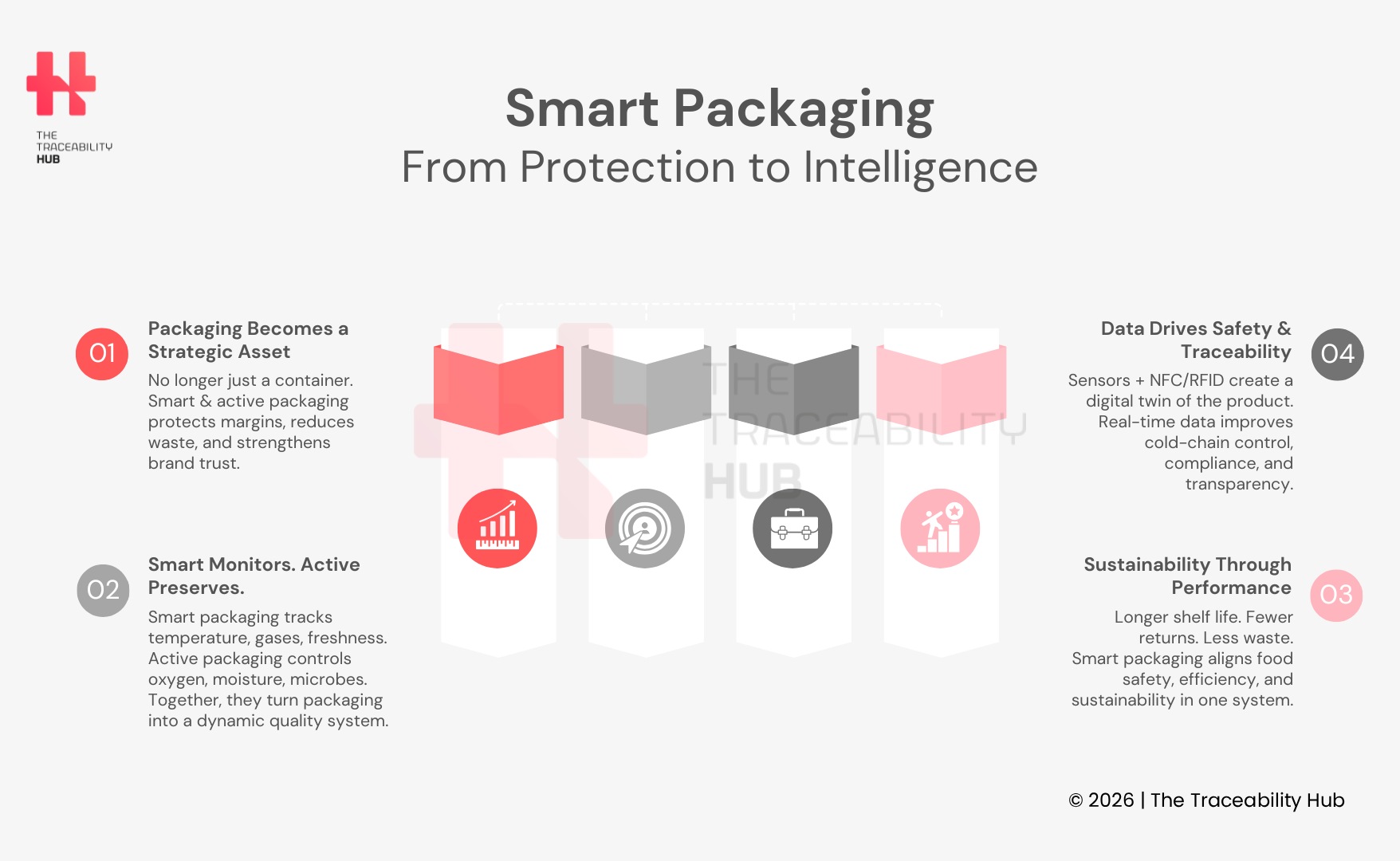
Smart and active packaging technologies are accelerating this transformation. A package can now record thermal history, detect micro-leaks in modified atmosphere packs, or signal early spoilage markers. In parallel, active food packaging materials can absorb oxygen, regulate moisture, or release natural antimicrobial compounds to slow deterioration, often without adding preservatives to the food itself. The result is intelligent food packaging that doesn’t just contain a product but helps manage its lifecycle.
For producers, this evolution translates into measurable gains: less spoilage, fewer returns, stronger quality guarantees, and easier compliance, especially in complex cold chains and export routes and food traceability workflow. For distributors and retailers, it means better inventory performance, fewer disruptions, and products that stand out with a clear freshness and safety narrative on the shelf.
Packaging is no longer a cost to minimize. It’s a strategic packaging asset that can protect margins, strengthen brand trust, and unlock new markets.
Smart vs. Active Packaging: Understanding the Difference
As packaging takes on a more strategic role in food supply chains, two terms are often used interchangeably, smart (or intelligent) packaging and active packaging. In practice, they serve distinct but complementary functions, and understanding the difference is essential for making the right food packaging technology and business choices.
Smart packaging is primarily about monitoring and visibility. It provides information on the condition of the product and its environment throughout the supply chain. Technologies such as time–temperature indicators (TTI), gas and freshness sensors, and NFC or RFID-enabled packaging labels track variables like temperature history, oxygen or CO₂ levels, and handling conditions. In essence, smart packaging answers the question: “What is happening to this product right now, and what has happened to it so far?”
This data-driven layer supports food quality control, cold-chain compliance, traceability, and transparent communication with distributors and consumers.
Active packaging, by contrast, is designed to interact with the internal environment of the package. Instead of only observing changes, it actively helps manage them. Common active packaging technologies include oxygen and moisture absorbers, CO₂ regulators, and controlled-release antimicrobial or antioxidant agents. These systems slow down oxidation, microbial growth, and other degradation processes, often extending shelf life without relying on chemical preservatives, an increasingly important factor for health-conscious and sustainability-focused consumers.
Real innovation lies in how these two approaches work together.
- Smart packaging detects risk or deterioration early
- Active packaging responds by stabilizing the product environment
Together, smart and active food packaging, transform packaging from a passive barrier into a dynamic system for quality, safety, and sustainability, enabling food producers and distributors to reduce waste, protect brand value, and meet rising expectations for transparency and performance.
Recent Advances in Smart & Active Packaging
Over the last decade, smart and active packaging has moved well beyond simple visual cues. What began as basic color-changing indicators has evolved into a new generation of integrated, data-driven food packaging systems capable of monitoring freshness, detecting defects, and supporting real-time decision-making across the food supply chain.
From Visual Indicators to Smart Sensing
Traditional indicators remain relevant thanks to their simplicity and low cost, but innovation is rapidly shifting toward embedded smart packaging sensors that provide higher accuracy and richer information. These systems are designed to track what happens inside the package, often before spoilage becomes visible or detectable by smell, giving producers and distributors a critical time advantage in food safety management.
Time–Temperature Indicators (TTI)
Among the most mature smart food packaging solutions, time–temperature indicators translate a product’s thermal history into an easy-to-read visual signal. Because temperature abuse is one of the leading causes of food waste and safety issues, TTIs have become especially important for meat, seafood, dairy, and ready-to-eat foods.
Recent developments include digital TTIs integrated with NFC or RFID, which store temperature data and make it accessible via smartphones or professional readers. This effectively creates a “thermal identity” for each product, supporting cold-chain audits, compliance checks, and more precise shelf-life management.
Gas and Freshness Sensors (CO₂, NH₃, O₂)
Another major leap forward in intelligent food packaging is the use of sensors targeting key gases linked to food degradation. Oxygen, carbon dioxide, and ammonia are among the most informative markers of quality loss and microbial activity.
- CO₂ increases often signal microbial growth
- Ammonia and volatile amines are early indicators of spoilage in fish and seafood
- Oxygen presence can reveal micro-leaks or sealing failures in modified atmosphere packaging
These food freshness sensors are increasingly used not only to assess freshness, but also to act as sentinels, flagging packaging defects before products reach retailers or consumers.
PH-Sensitive Films for Seafood
Seafood applications have become a testbed for smart packaging innovation. PH-sensitive labels and films can change color when spoilage compounds form, detecting quality loss earlier than traditional sensory methods. This is particularly valuable in high-risk food categories where shelf life is short, and quality degradation can be rapid.
Printable, Low-Cost Optoelectronics
Perhaps the most disruptive advance in smart food packaging technologies is the emergence of printable optoelectronic platforms. By printing sensors directly onto flexible packaging materials, manufacturers can deploy smart functionality on a scale, without redesigning production lines or dramatically increasing costs.
These plug-and-play solutions are helping smart packaging move decisively from research labs to industrial environments, making advanced monitoring accessible even for high-volume, cost-sensitive food categories.
Together, these innovations mark a clear shift: smart and active packaging is no longer experimental. It is becoming a practical, scalable tool for improving food safety, extending shelf life, and reducing waste, while laying the foundation for deeper digital integration across the food supply chain.
From Protection to Intelligence
Active Technologies: Extending Shelf Life Naturally
While smart packaging focuses on seeing what happens to food, active packaging is about acting. These technologies directly manage the internal environment of the package, slowing degradation processes and preserving quality, often without relying on chemical preservatives, a growing concern for health-conscious consumers.
Oxygen Absorbers: Fighting Oxidation at the Source
Oxygen is one of the main drivers of food spoilage. Its presence accelerates oxidation and supports microbial growth, shortening shelf life, and compromising sensory quality.
To counter this, active food packaging increasingly uses oxygen scavengers, typically:
- Iron-based systems, either as sachets or integrated into multilayer packaging
- Polymer-embedded absorbers, incorporated directly into films or trays
Beyond extending shelf life, these active packaging solutions also act as early warning tools. A rise in oxygen levels can reveal micro-holes or sealing defects in modified atmosphere packaging, allowing producers and distributors to identify issues before products reach the market.
Moisture Regulators: Balancing Humidity for Quality
Moisture control is equally critical, but highly product-specific.
- Desiccants and humidity absorbers help baked goods and snacks maintain crispness
- Moisture-regulating materials prevent condensation that could trigger mold or texture loss
- For fresh produce, managing naturally released gases such as CO₂ and ethylene helps slow ripening and senescence
By stabilizing the microclimate inside the package, these active packaging technologies reduce quality variability and improve consistency across distribution and retail.
Antimicrobial Packaging: Protection on Demand
One of the most promising frontiers in active food packaging is antimicrobial active packaging, designed to inhibit microbial growth using natural compounds rather than synthetic additives.
Some paper based smart labels, color-changing sensors, for shelf-life monitoring, monitor protein foods freshness by chemical recognition of volatile spoilage markers, communicated to the users by the means of well-visible and real-time color transitions on the label itself.
Common approaches include:
- Nisin, a well-known antimicrobial peptide already authorized for specific food applications
- Essential oils, incorporated into packaging materials
- Micro- and nano-encapsulation, enabling gradual, controlled release over time
Controlled release is crucial. Instead of a short-lived burst of activity, these systems deliver sustained protection, activating when conditions favor microbial growth. Research has shown that this approach can significantly extend shelf life, especially for highly perishable products such as fresh fruit, while preserving a “clean label” positioning.
From Passive Protection to Active Preservation
Taken together, oxygen control, moisture regulation, and antimicrobial release represent a fundamental shift in how food packaging technologies contribute to food quality. Packaging is no longer just a barrier, it becomes an active preservation system, working continuously to maintain freshness, safety, and sensory integrity.
For producers and distributors, this translates into:
- Longer shelf life without artificial preservatives
- Lower food waste and fewer returns
- Stronger alignment with consumer expectations around health and sustainability
Active technologies are not simply extending self-life; they are reshaping how value is protected throughout the food supply chain.
Integration and Digitalization: Toward Smart-Active Hybrid Systems
The most advanced smart technologies for food safety and quality no longer fall neatly into “smart” or “active” categories. The real innovation is happening where monitoring and intervention converge, giving rise to smart-active hybrid systems that both sense changes and respond to them.
From Monitoring to Action: Real-Time Freshness Management
Early smart packaging solutions focused on visibility, tracking temperature, gases, or freshness indicators for food quality monitoring. Today, that data can trigger targeted responses. Hybrid systems are being designed to:
- Continuously monitor freshness indicators (temperature, O₂, CO₂, pH) throughout storage and distribution
- Activate controlled release of antioxidants or antimicrobials when degradation begins
- Maintain optimal internal conditions throughout distribution and storage
This shift turns packaging into a dynamic freshness management and food safety control layer, not just a diagnostic tool. Instead of discovering quality loss after it occurs, producers can slow deterioration in real time, reducing waste and protecting shelf-life.
NFC and RFID: Packaging as a Digital Twin
When sensors and active elements are combined with NFC or RFID smart packaging labels, each package becomes a connected object with its own digital twin. This virtual identity stores and updates key data such as:
- Thermal history and handling conditions across the cold chain
- Integrity of seals and atmosphere packaging
- Shelf-life evolution and freshness over time
Distributors, retailers, and even consumers can access this information instantly, via professional readers or smartphones, transforming packaging into a data interface between the physical product and digital systems.
ERP and Blockchain Integration: End-to-End Traceability
The real strategic leap happens when smart-active packaging data flows beyond the pack itself. By integrating smart-active systems with ERP platforms and blockchain-based food traceability, companies gain:
- End-to-end visibility across the food supply chain
- Stronger quality audits and compliance documentation
- Verifiable proof to support freshness, safety, and sustainability claims
If required, blockchain adds a further layer of trust, ensuring that data collected by sensors and tags is tamper-resistant and shareable across multiple stakeholders, from producers and logistics partners to regulators and buyers.
Why Hybrid Systems Matter Strategically
For food businesses, smart-active hybrid packaging is not just about technology adoption. It enables:
- Fewer returns and recalls through early risk detection
- Better coordination between production, logistics, and sales
- Clear, data-backed communication with markets and consumers
As costs fall and interoperability improves, these integrated smart and active packaging systems are moving from pilot projects to scalable solutions. The direction is clear: the future of food packaging lies in connected systems that monitor, decide, and act, continuously and intelligently.
Strategic Advantages Across the Supply Chain
Smart and active packaging delivers value far beyond technology itself. When deployed at scale, these advanced food packaging solutions reshape how producers and distributors manage risk, optimize performance, and compete in increasingly demanding markets. The strategic benefits are tangible, and measurable, across the entire supply chain.
For Producers: from Cost Control to Market Leverage
- Waste reduction and stronger ROI: One of the most immediate impacts is economic. By monitoring freshness, detecting packaging failures early, and actively slowing degradation, smart and active food packaging solutions significantly reduce spoilage, write-offs, and returns. Fewer losses translate directly into better inventory turnover and faster ROI, especially for high-value or highly perishable food products.
- Enhanced brand positioning and regulatory compliance: Packaging visibly proves freshness, safety, and controlled shelf life becomes a brand and compliance asset. It supports compliance with food safety and traceability requirements while reinforcing a brand narrative built around responsibility, transparency, and innovation. In markets where trust is critical, this differentiation can be decisive.
- Easier access to export and long-distance markets: For producers targeting international or remote markets, packaging performance can make or break commercial opportunities. Smart monitoring and active shelf-life extension reduce uncertainty in complex cold chains, lowering the risk of rejection at destination and enabling producers to serve markets that were previously considered too risky or costly.
For Distributors: Efficiency, Reliability, and Shelf Impact
- Fewer returns and simplified logistics: Distributors benefit from packaging that reduces variability. Real-time condition data and longer shelf-life mean fewer disputes, fewer emergency interventions, and smoother logistics planning. Products arrive in better condition and stay sellable longer, easing pressure on warehousing and retail operations.
- Stronger consumer trust and shelf differentiation: At the point of sale, smart and active packaging for food products becomes a communication tool. Clear signals of freshness, safety, and responsible preservation help products stand out on crowded shelves. For distributors and retailers, this translates into higher confidence in the assortment, fewer complaints, and stronger alignment with consumer expectations, especially around health and sustainability.
A Shared Competitive Advantage
What makes these technologies truly strategic is that value is created on both sides of the supply chain. Producers protect product quality and brand equity; distributors gain reliability and differentiation. In a market where quality, safety, and sustainability increasingly drive purchasing decisions, smart and active packaging acts as a shared lever for competitiveness, not just a technical upgrade.
Knowledge as a Competitive Lever
In a landscape where smart and active packaging technologies are evolving at high speed, knowledge itself becomes a source of competitive advantage. The challenge for food producers and distributors is no longer whether innovation exists, but how to navigate it effectively, selecting the right solutions, at the right time, for the right products.
Why Staying Informed Matters
- Rapid technological evolution across food categories: Smart and active packaging is not a one-size-fits-all solution. Technologies that work well for fresh seafood, such as pH-sensitive freshness indicators or ammonia sensors, may be irrelevant or economically inefficient for bakery, dairy, or ambient products. New sensor platforms, printable electronics, and controlled-release systems are emerging continuously, each with different performance profiles, costs, and integration requirements.
Staying informed allows decision-makers to match technologies to specific product needs, packaging technology to product risk, avoiding over-engineering while capturing real value. - The role of trade fairs, R&D partnerships, and supplier validation: Because innovation moves faster than standards and best practices, companies cannot rely solely on internal knowledge. Specialized trade fairs applied to research projects, and collaborations with technology providers play a critical role in understanding what is truly market-ready for smart packaging solutions versus what remains experimental.
Equally important is supplier validation. Not all smart or active packaging solutions are equally robust on an industrial scale. Evaluating suppliers on technical maturity, regulatory readiness, production reliability, and post-deployment support is essential to reduce risk and ensure continuity. - Balancing innovation, ROI, and regulatory compliance: Innovation delivers value only when it is economically and operationally sustainable. Smart and active packaging investments must be assessed not just on technical appeal, but on return on investment, scalability, and compliance with food-contact and labelling regulations.
The most successful companies adopt a structured approach: pilot projects to validate performance, clear KPIs tied to waste reduction or logistics efficiency, and early alignment with regulatory requirements. This balance prevents innovation from becoming a cost burden and turns it into a measurable business driver.
From Information to Strategy
Ultimately, knowledge enables better decisions. Companies that actively track technological advances, validate solutions rigorously, and align innovation with business objectives are better positioned to move faster, and more confidently, than competitors. In smart and active food packaging, being informed is not optional: it is the foundation for long-term competitiveness in a market where quality, safety, and sustainability increasingly define success.
The Future of Food Packaging
The evolution of food packaging is reaching a decisive turning point. What was once designed primarily to contain and protect is becoming a connected, intelligent, and sustainability-driven system, capable of monitoring product conditions, actively preserving freshness, and communicating value across the supply chain.
Smart and active technologies are increasingly converging into integrated solutions that observe, interpret, and intervene. Sensors, indicators, and digital tags provide visibility and traceability, while active materials regulate oxygen, moisture, and microbial growth. Together, they enable longer shelf life, safer food products, and lower waste, often without relying on chemical preservatives, a critical factor for today’s health- and sustainability-conscious consumers.
For the food & beverage industry, the implications go far beyond technology adoption. Packaging is becoming a strategic lever for:
- Improving operational resilience in complex and global supply chains
- Strengthening brand credibility through transparency and measurable performance
- Supporting sustainability goals by reducing losses, optimizing resources, and enabling data-driven decisions
Companies that view packaging as an integral part of their quality, food safety, and sustainability strategy, not just a cost or compliance requirement, will be better positioned to adapt to regulatory pressure, shifting consumer expectations, and competitive intensity.
In this sense, smart and active packaging is not simply an innovative trend. It is a long-term strategy for growth, one that aligns efficiency with responsibility and turns packaging into a driver of trust, differentiation, and lasting value in the food system of tomorrow.
Read more: Europe Steps Up Protection for DOP and IGP: New Action Plans, Investments and Anti-Fraud Tools