



How Italy’s Logistics Industry is Evolving with Smart Supply Chains
The Italian logistics industry (a core part of Italy’s national supply chain ecosystem) remains a vital pillar of the national economy. Valued at around 205 billion euros in 2024, equivalent to roughly 8% of Italy’s GDP, the sector has continued to expand throughout 2025, closing the year with an estimated turnover of 112.4 billion euros, up 1.9% from the previous year. Nearly 79,000 companies make up this industry that now moves faster beyond traditional models to welcome smart supply chain solutions and digital logistics innovation.
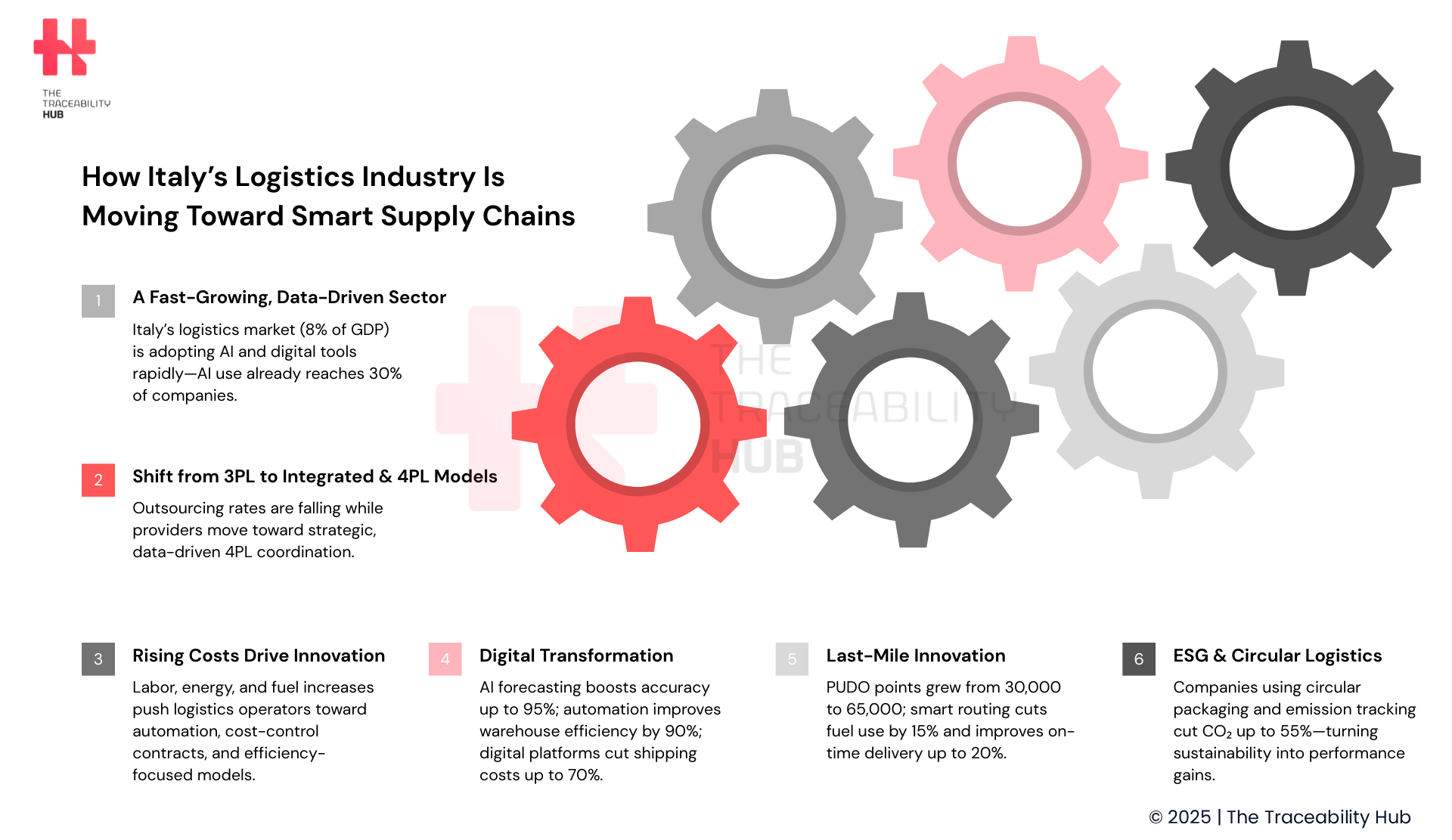
Digital transformation now reshapes supply chain management throughout Italy, driving what many experts describe as a shift toward data-driven logistics. AI projects have already found their way into 30% of Italian logistics companies. This number should climb to 44% in the next three years. Companies that adopted AI solutions report impressive results: 81% of them see concrete benefits. The industry’s response to customer needs is shown in the explosive growth of pickup and delivery points (PUDO), a key pillar of last-mile delivery optimization. These locations jumped from 30,000 in 2020 to over 65,000 in 2024.
The logistics sector still faces its most important challenges. Current inefficiencies drain about 30 billion euros from the Italian economy each year. So, companies now turn to automation technologies, third-party logistics innovations, and green practices to boost operations. This piece examines how Italian logistics revolutionizes through integrated models, AI adoption, last-mile delivery solutions, and ESG compliance to build smarter and more efficient supply chains.
From Traditional Logistics to Smart Supply Chains
Italy’s logistics sector faces a dramatic transformation as it moves beyond conventional service models toward integrated, technology-driven supply chains (including omnichannel and e-commerce supply chains). This change comes as a strategic response to market volatility and changing customer expectations.
Shift from Third-Party Logistics to Integrated Models
Traditional third-party logistics (3PL) providers now see major structural changes in their business approach. The sector bounced back to growth in 2024 and 2025 after a contraction in 2023, yet the outsourcing rate fell from 45.5% in 2022 to 43.4% in 2023. Contract durations have become shorter, and average warehousing agreements have dropped from 3.4 to 3 years.
Many providers now move toward fourth-party logistics (4PL) models and take strategic oversight roles instead of handling physical operations. This change helps companies expand value-added services while cutting fixed operational costs. The global 4PL market should grow by more than 7% and reach approximately USD 112 billion by 2031, reflecting global logistics transformation trends.
Impact of Rising Operational Costs on Logistics Operations
Rising expenses have become crucial in shaping industry decisions. Labor costs jumped 4.4% in 2025, pushing the average annual employee cost to €46,451. Energy prices climbed by 7.9% while rental charges grew by 3.5%. These increases follow a broader trend, as the Italian logistics sector saw a 15% rise in operational costs in the last three years, driven by inflation, fuel volatility, and supply chain risk factors. Market uncertainty has changed contractual practices. Indexed elements now appear in 74% of transport agreements and 68% of warehousing contracts. Almost all transport contracts (96%) include fuel cost clauses, insurance policies and guarantee feature in 46% and 41% of contracts respectively, showing the growing importance of cost-control strategies in logistics.
Vertical Integration Trends in Italian Logistics
Vertical integration emerges as a strategic response to market volatility and the need for end-to-end supply chain visibility. The 43 largest logistics operators increased direct employment from 30,700 in 2022 to 34,600 in 2023, while outsourced services dropped from 71.9% to 68.9% of turnover. The industry saw 24 acquisition deals in 2025 that aimed to strengthen competitive positions in specific market segments. This integration trend creates better physical and information flows while improving inventory management and transportation systems. Companies that implement vertical integration can cut out intermediaries and pass savings to consumers while keeping higher margins, key goals in supply chain optimization.
How Italy’s Logistics Industry Is Moving Toward Smart Supply Chains
Digital Transformation in Logistics Operations
Italian logistics operations have seen rapid technology adoption over the last several years. About 45% of logistics companies now use digital technologies like AI and IoT (alongside cloud-based platforms and robotics) to optimize their operations. These changes are reshaping how supply chains work throughout the country.
AI Adoption in Order Management and Demand Forecasting
Companies using AI-driven demand forecasting show remarkable improvements in accuracy. Businesses with well-laid-out processes achieve 5-10% better accuracy, while those starting with unstructured processes see improvements up to 95%. Better forecasting leads to improved inventory management.
Italian logistics operations have cut waste by 50% and reduced emergency shipments through better planning. AI algorithms analyze factors like seasonality, promotions, and market dynamics to create forecasts that adapt to changing conditions. Logistics managers can then prioritize deliveries of products that affect customer satisfaction and profitability by supporting predictive supply chain planning.
Up-to-the-Minute Tracking Via Logistics Digital platforms in Italy
Digital logistics platforms have reshaped visibility in Italian supply chains, enabling real-time tracking, IoT-enabled monitoring, and integrated workflows. These systems merge user interactions and transactions through cloud, IoT, and AI technologies. Companies that use these platforms report streamlined processes that almost eliminate manual labor and lower operational costs.
The right digital platform can reduce shipping costs by up to 70% and cut carbon emissions by 20%. Italian logistics projects like LogIN Business now build connected national ecosystems that integrate digital documentation using eCMR standards. This integration removes paper processes and enables CO2 emission tracking, supporting green logistics initiatives.
Automation in Warehouse and Transport Operations
Warehouse automation has produced exceptional results in Italy. ABB’s instrumentation factory in Ossuccio boosted overall logistics efficiency by 90% after using a fully automated storage and retrieval system. Their solution eliminated manual handling and cut final assembly time by 30%. Refresco Italia’s new automated warehouse created a continuous flow from production lines through shipment. They use laser-guided vehicles and a software platform for system integration, a model of Industry 4.0 logistics.
This approach has helped scale production from original operations to nearly 400 million bottles annually. Transport automation proves just as effective – AI-powered logistics solutions reduce fuel consumption by 15% and boost on-time deliveries by 10-20%.
Proximity and Last-Mile Delivery Innovations
Last-mile delivery in Italy’s logistics scene shows remarkable progress through expanded pickup and drop-off (PUDO) networks and tech solutions supporting urban logistics efficiency.
Growth of PUDO Networks: 30,000 to 65,000 Points
Italy’s PUDO network has grown significantly reflecting trends in European e-commerce delivery logistics. The network follows the European trend where such points increased by 40% since 2019. Italy now has about 36,000 PUDO points. This places the country fourth in Europe after Germany (51,000), France (49,280), and the UK (45,000). Experts suggest one PUDO point per 10,000 people as the minimum density needed for success.
Reducing Last-Mile Delivery Costs Through Smart Routing
AI-powered route optimization reshapes delivery efficiency across Italian logistics operations. These advanced systems analyze live traffic data, road conditions, and weather patterns to determine the best delivery sequences. Companies that use smart routing technologies save up to 20% on transportation costs. They also cut fuel consumption by 15% and improve on-time deliveries by 10-20%: key advantages in cost-efficient last-mile logistics.
Integration of Digital Platforms with physical delivery points
Digital platforms and physical delivery infrastructure blend to create a smooth customer experience. Modern PUDO systems work with mobile apps, QR codes, and smart routing technologies. This gives customers access to their parcels 24/7. The results speak for themselves – parcel lockers cut delivery costs by up to 60% in urban areas and reduce CO₂ emissions by up to 73% in cities, reinforcing the rise of sustainable last-mile delivery.
Sustainability and ESG Compliance in Supply Chains
The logistics sector in Italy now sees environmental sustainability as a key business advantage that goes well beyond just following regulations, reflecting broader ESG trends in supply chain management.
Packaging Redesign for Circular Logistics
Italian supply chains are embracing circular economy practices, and about 39% of companies now use recycled materials. Packaging redesign offers a great chance to reduce environmental effects, since European targets need at least a 30% cut in energy use. Companies at the forefront use Life-Cycle Assessment (LCA) analysis to measure their carbon footprint and learn about crucial production phases to make better design choices.
This method can cut emissions by up to 40% throughout the packaging containers’ lifecycle. To name just one example, see the project that turns eggshell waste into green packaging materials supporting circular logistics.
For example in France, Paul-Gilles and Florence Chedaleux have developed an innovative process to recycle eggshells and give them new life in the form of eco-friendly packaging. Through a series of drying and sifting steps, they managed to separate the inner membrane from the actual shell. A task far from trivial, considering that the membrane is an organic substance that can deteriorate over time. But once this “obstacle” is removed, the shell transforms into a very fine powder, similar to talcum powder. A versatile and valuable raw material, ready to be reinvented in countless ways.
Emission tracking and environmental performance metrics
Standard measurement systems help Italian logistics companies track their environmental performance. The Lean & Green program stands out with its 500 member companies achieving a soaring win – a 55% drop in emissions. The European Commission’s new methodology will soon require companies to report on Scope 3 emissions from external logistics providers. This marks a transformation since companies now tend to report the smallest possible subset of emissions. ARERA, Italy’s regulatory authority, actively promotes measurement systems by recognizing costs for network losses based on standard criteria to motivate companies to limit methane emissions, boosting sustainable logistics compliance.
ESG Compliance as a Competitive Advantage
ESG performance brings clear business benefits to Italian logistics operators beyond just meeting regulations. Research shows that better ESG implementation leads to improved financial results. Climate Policy Uncertainty (CPU) has pushed Italian firms to enhance their ESG performance, resulting in measurable drops in carbon and pollutant emissions. Companies that arrange their logistics environmental sustainability with corporate strategies gain a competitive edge through better firm performance.
Support from top management proves vital by giving employees the motivation and resources they need to implement environmental actions successfully. Yet small and medium enterprises show weaker improvements because they lack resources, highlighting inequalities in ESG readiness across supply chain actors.
Italy’s Shift to Smart Supply Chains
The Italian logistics sector faces a turning point as it moves beyond traditional methods toward technologically advanced, integrated supply chain models. Companies across Italy now see the value of smart supply chains. This recognition is shown in their growing use of AI solutions, digital platforms, and automation systems — key enablers of supply chain excellence. These technologies have produced remarkable results: 95% better demand forecasting accuracy, 90% gains in warehouse efficiency, and lower operational costs.
Last-mile delivery has become another area of major change. More than 65,000 PUDO network points now exist across Italy. This expansion shows the industry’s dedication to meeting customer needs while cutting delivery costs. Smart routing technologies have cut fuel use by 15% and improved on-time deliveries by up to 20%.
Companies now see sustainability as a competitive necessity rather than just a regulatory requirement. Those using circular logistics practices have achieved impressive environmental gains. Some have cut emissions by 55% through standardized measurement frameworks. This focus on environmental performance fits with broader industry moves toward ESG compliance, which studies link to better financial results.
Progress continues despite ongoing challenges. Operating costs keep rising for logistics providers. Labor expenses grew 4.4%, and energy prices jumped 7.9% in 2025 alone. All the same, the industry adapts through strategic collaborations and new contractual practices. Major operators now show reduced outsourcing rates and increased direct employment.
Italian logistics companies that embrace these breakthroughs gain advantages in an increasingly competitive marketplace. Their success comes from knowing how to adapt to changing conditions while delivering better efficiency, sustainability, and customer satisfaction. This ongoing progress strengthens the industry’s economic contribution and sets new standards for logistics excellence throughout Europe.
Read more: Platform vs Point Solutions: The Real Value Gap in Supply Chain Tech