



EU Tobacco Traceability: Combating Illicit Trade Through Transparency
Tobacco traceability systems play a vital role to curb illegal tobacco trade that affects global health, society, and economies. The European Union took a major step by implementing a complete track and trace system on May 20, 2019. This new system requires unique identifiers on all tobacco product unit packets. Such a move represents a milestone in making supply chains more transparent.
The EU’s tobacco traceability system demands live recording of tobacco products throughout the supply chain. These recordings start from manufacturers and continue until the last economic operator before retail. Economic operators must record and transfer all handling and transport events to a central database. EU authorities can access this information to enforce regulations, which create unprecedented industry oversight.
This evidence-based strategy wants to reduce non-compliant tobacco products in circulation. It also provides quality investigative leads for areas that face higher risks of illegal trade. The system has been mandatory for cigarettes and roll-your-own tobacco products since May 2019, and as of May 20, 2024, it has been extended to include all other tobacco products. This article explores the core technologies driving this comprehensive traceability system and their crucial role in ensuring compliance and transparency across the global tobacco supply chain.
Legal Foundations of Global Tobacco Traceability
Legal frameworks and international agreements provide solid backing to the worldwide battle against illegal tobacco trade. These laws require advanced tracking systems throughout the tobacco supply chain, which brings unprecedented transparency to the industry.
Articles 15 and 16 of the Tobacco Products Directive (TPD)
Articles 15 and 16 of Directive 2014/40/EU are the core of the EU’s strategy to curb illegal tobacco trade. Article 15 requires unique identifiers on all tobacco product packets to track their movement through the supply chain. This tracking system lets authorities follow products from manufacturing to the first retail outlet and monitor the distribution path.
Article 16 deals with security features that prove tobacco products are genuine. All tobacco packaging must have tamper-proof security elements you can both see and not see. These security features help authorities check if products are real, which helps stop counterfeiting. Cigarettes and roll-your-own tobacco have been required to meet these rules since May 20, 2019, and as of May 20, 2024, all other tobacco products are also subject to the same compliance requirements.
WHO FCTC Protocol and Global Commitments
The Protocol to Eliminate Illicit Trade in Tobacco Products builds on Article 15 of the WHO Framework Convention on Tobacco Control (FCTC). This international treaty brings countries together to wipe out illegal tobacco trade.
The Protocol required the establishment of a global tracking system within five years of its entry into force, setting a deadline of September 2023. By that date, the target had been reached, with 67 countries having joined the Protocol, including 28 high-income, 15 upper-middle-income, 14 lower-middle-income, and 10 low-income nations. The Protocol tackles several big problems: health risks from cheap tobacco products, huge tax revenue losses, and money going to international criminals. Article 8 sets up rules to track tobacco products using secure unique identifiers.
Commission Implementing Regulation (EU) 2018/574 Overview
Commission Implementing Regulation (EU) 2018/574 of December 15, 2017 established the technical standards for the tobacco tracking and traceability system mandated under the TPD. This regulation spells out complete technical details about:
- How to create and apply unique identifiers
- How member states should pick competent ID issuers
- Data storage setup with primary and secondary repositories
- Rules to keep third-party providers independent
- IDs for economic operators and facilities to track the supply chain
Each member state must pick an organization (ID issuer) to create and give out unique identifiers. On top of that, the tracking system must stay independent from tobacco manufacturers and importers, as Article 8 of the WHO FCTC Protocol requires.
The repository system setup lets manufacturers pick independent third-party data storage providers. At the same time, authorities keep full access to stored data to monitor and enforce rules.
These connected legal frameworks now let authorities track tobacco products from factory to store. This transparent supply chain helps fight illegal trade and protects public health and government money.
Solving Global Tobacco Tracking
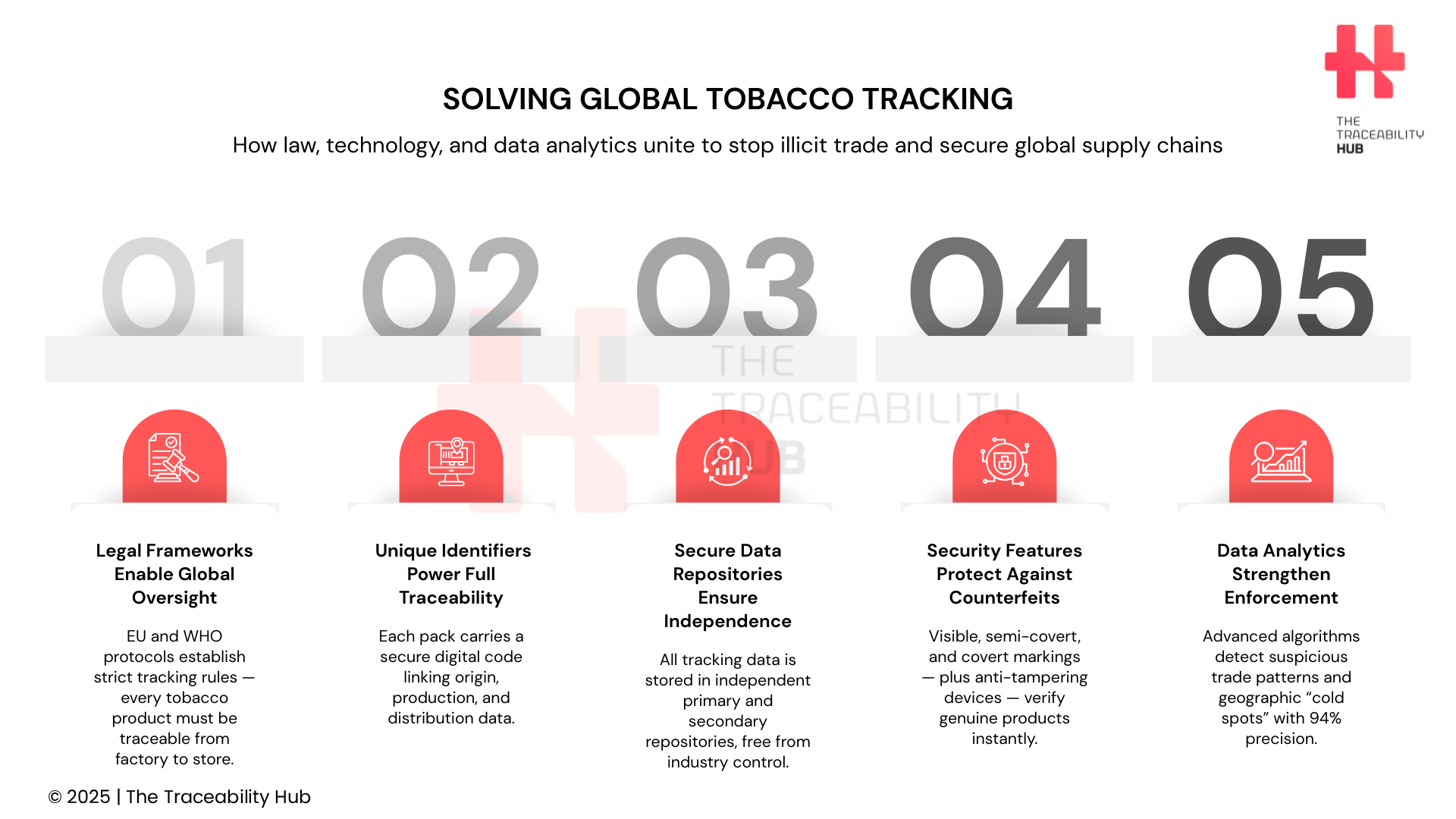
Core Components of the EU Tobacco Traceability System
The EU tobacco traceability system depends on exact technical specifications and standard components that are the foundations of a resilient tracking infrastructure. Each component plays a unique role in giving a complete view of the supply chain from production to retail.
Unique Identifier (UI) Generation and Encoding Rules
The unique identifier (UI) is central to tobacco traceability – an alphanumeric code that goes on each unit packet and combined packaging. This code contains specific information about origin, manufacturing date, and destination. The EU system needs UIs to follow a particular structure. Fixed positions exist for elements like ID issuer prefix, serial number, product code, and timestamp. These UIs stay valid for six months and expire if not used on products. Manufacturers and importers must request these codes from competent ID issuers for unit packets. Economic operators can either request or self-generate codes for combined packaging by following ISO/IEC 15459-1:2014 or 15459-4:2014 standards.
The UIs arrive electronically or physically based on what member states decide. They become machine-readable data carriers (usually barcodes) that let authorities check products with handheld devices. These carriers must stick permanently to packaging. Manufacturers need to verify if they applied them correctly and can read them.
Role of Competent ID Issuers per Article 3
Article 3(1) of Commission Implementing Regulation (EU) 2018/574 requires each EU member state to appoint an ID issuer. This entity generates and issues unique identifiers. These entities must stay independent from the tobacco industry in financial and legal terms. Their job goes beyond making codes. They must:
- Register economic operators throughout the supply chain
- Give economic operator identifier codes (EOIDs)
- Provide facility identifier codes (FIDs) for production sites, warehouses, and retail outlets
- Issue machine identifier codes for production equipment
- Keep registration portals running for everyone in the system
Article 4’s strict competence rules guide ID issuers. These rules determine which issuer handles products for specific markets. This creates clear accountability and prevents conflicts of interest.
Primary and Secondary Repository Architecture
The EU system uses two types of repositories to store and access data. Manufacturers and importers must work with independent third-party providers to create primary repositories. These repositories only store data about their products. The Commission must approve these contracts to ensure provider independence. A central surveillance data storage solution – the secondary repository – keeps a complete copy of all primary repository data. This creates a completely logical view that authorities can access.
The secondary repository offers crucial oversight capabilities. For example, the Swiss secondary repository provider handles over two billion unique identifiers on unit packets each month. It processes about 0.567 billion events and messages from more than 965,000 economic operators and 1.8 million facilities across the EU supply chain.
Router and Data Dictionary Specifications
The repository system has a key component called the Router. This central reporting point helps economic operators send their data. The Router enables smooth reporting of product movements and transactional events by distributors and wholesalers. Economic operators are required to record and report these events within three hours whenever tobacco products change hands, with a 24-hour reporting window remaining in effect for certain events until May 2028. The secondary repository provider created a common data dictionary and technical specifications based on Annex II of Implementing Regulation (EU) 2018/574. These specifications standardize how all system components exchange data. They define the exact format to record product movements, aggregation events, and supply chain transactions.
Security Features and Anti-Tampering Mechanisms
Security features serve as a vital defense against counterfeit tobacco products and work among other elements of the traceability system to verify product authenticity. These tamper-evident components are the foundations of the complete EU tobacco tracking framework.
Tamper-Proof Elements: Visible and Invisible Layers
Each unit packet must have a tamper-proof security feature with both visible and invisible elements to authenticate tobacco products. This layered defense gives strong protection against counterfeiting. Swedish regulations demand cigarettes and roll-your-own tobacco to have at least five different authentication elements. These security elements split into three categories:
- Overt (visible) elements – Features you can see with your eyes, including guilloche patterns (ornamental designs with interlaced bands printed in multiple non-standard colors) and color-changing inks that show different colors from various angles
- Semi-covert (partially visible) elements – Features that need simple tools to verify, such as microprint text you can read only with magnification and ultraviolet ink printing on UV-dull paper that shows up under special UV light
- Covert (invisible) elements – Features that only specialized equipment can detect, such as anti-Stokes inks
Among the authentication categories we may also include:
- Forensinc Scientific and technical analysis of evidence (e.g. DNA, fingerprints, digital forensics)
An independent third-party provider must supply at least one authentication element among the three. This rule ensures separation from tobacco industry influence.
Anti-Tampering Device Requirements under Article 25
Independent third parties must supply and install anti-tampering devices to protect the verification of unit-level unique identifiers in the EU tobacco traceability system. The system verifies these identifiers right after application to confirm proper placement and readability.
The process creates an auditable verification trail for companies of all sizes. The regulations recognize operational differences, especially when you have varying production outputs and manufacturing processes. This approach prevents excessive burdens on smaller operators and SMEs.
Verification Protocols for Retail and Customs Authorities
Both authorities and consumers can verify product authenticity through standardized verification protocols thanks to the security feature system. UK legislation’s Article 14 requires manufacturers and importers to provide tobacco product samples in unit packet format with security features within 30 days of authorities’ request.
Products must maintain their authentication capability throughout their market life. These features protect against replacement, reuse, or modification while remaining visible despite tax stamps, price marks, or other required markings.
The tobacco traceability system uses these complete security measures and anti-tampering mechanisms to create a powerful framework. This system helps distinguish legitimate products from illicit ones and supports enforcement actions against counterfeit and smuggled tobacco products.
Data Storage, Access Control, and Audit Trail
A reliable data management system supports the EU’s tobacco traceability system. The regulations strictly control storage, access, and audit procedures. The system works effectively because it handles information securely without industry interference.
Primary Data Storage Contracts under Delegated Regulation (EU) 2018/573
The Tobacco Products Directive’s Article 15(8) requires manufacturers and importers to set up data storage contracts with independent third parties for primary repositories. Commission Delegated Regulation (EU) 2018/573 outlines what these contracts need, including details about operation, availability, and performance. Manufacturers must send their chosen provider’s details and draft contract to the Commission within two months after the regulation starts. They need to include written statements about technical expertise and legal independence, plus tables showing how contract clauses match regulatory requirements. Primary repositories must guarantee 99.5% uptime each month. These repositories store information about tobacco products from individual manufacturers.
Annual Audit Reports: Article 15(8) Compliance
External auditors check primary repository activities to maintain data integrity and spot problems. Manufacturers suggest and pay for these auditors, but the Commission must approve them before they start work. Auditors may conduct both planned and unannounced evaluations during the audit period running from May 20 to May 19, and they are required to submit detailed reports to national authorities and the European Commission by the end of October each year.
These reports focus on two vital areas: checking for data access problems and confirming all information stays intact. The audit follows ISO/IEC 27001:2013 standards for Information Security Management Systems.
Audit Trail Requirements: Article 25(1)(m)
Each repository keeps complete records of all data operations. The system logs all user’s actions and tracks how they access information. Auditors must check these audit trails before confirming compliance. This helps authorities spot unauthorized access attempts and detect data tampering.
Access Restrictions for Manufacturers and Importers
TPD Articles 15(8) and 15(9) limit what economic operators, especially manufacturers and importers with repository contracts, can do with stored data. These limits stop tobacco companies from changing traceability information. The WHO FCTC Protocol states that unique identifier creation and secure storage must stay free from tobacco industry influence. Governments keep full control of their traceability systems, which prevents industry interference that could affect supply chain transparency.
Fraud Detection and Enforcement Using Traceability Data
Statistical methods now convert tobacco traceability data into practical information for enforcement agencies. Law enforcement can spot suspicious activities that conventional approaches often miss.
Local Moran’s I for Spatial Fraud Detection
Local Moran’s I (a statistical measure used in spatial analysis to identify clusters and outliers in geographic data), acts as a reliable indicator of spatial association and detects clusters of non-stationarity and local outliers in tobacco sales data.
The technique measures weighted associations between retail outlets’ sales differences and their neighboring stores. This measurement helps identify regions with unusual patterns that might suggest illicit trade.
Regression Modeling of Retail Sales Anomalies
Evidence-based anomaly detection systems spot unexpected changes in tobacco sales patterns. Researchers have created models that link tobacco sales to price, GDP, and population demographics through supervised learning methods. These models set upper and lower prediction intervals using conditional quantiles and create a statistical framework that identifies unusual sales behavior.
Cold Spot Identification for Illicit Trade Zones
“Cold spots” are geographic areas where sales fall substantially below predicted values. These locations show negative differences surrounded by similarly low values in nearby areas. Such low-low patterns suggest a common factor affects the whole area, possibly due to illicit product influx.
Simulation Results: 94% Precision in Detection
Synthetic data testing proves these methods work in a variety of scenarios. The three-step detection strategy achieves 94% precision under primary scenario parameters. This system guides investigators toward geographic areas where illicit trade might flourish.
Tobacco Traceability: A Data-Driven Weapon Against Illicit Trade
Modern tobacco traceability systems represent a most important step forward in the fight against illegal tobacco trade. Authorities can now track tobacco products from factory to store with pinpoint accuracy thanks to complete tracking technologies. This transparent supply chain blends legal requirements with advanced tech solutions.
The core of this system lies in unique identifiers on each packet. These work among other tamper-proof security features that verify genuine products. A well-designed repository architecture keeps data available to proper authorities while maintaining security. The system’s independence requirements prevent tobacco manufacturers from tampering with it and protect data integrity across the supply chain.
Advanced fraud detection makes the system even more powerful. Statistical tools like Local Moran’s I formula and regression modeling help authorities spot suspicious patterns they might otherwise miss. Cold spot analysis works best when you have geographic areas at risk of illegal trade. Recent simulations show 94% accuracy in detecting these patterns.
The system faced one major milestone in May 2024, when all tobacco products beyond cigarettes and roll-your-own tobacco were integrated into the EU-wide tracking system. This expanded coverage has further strengthened tobacco distribution controls and compliance both across the EU and globally. Today’s technology builds a foundation that will grow stronger as data analysis capabilities improve.
Tobacco traceability systems offer a tech-based answer to a complex health and economic challenge. Evidence-based enforcement, precise tracking, and secure authentication give authorities the tools they need. These tools help cut down illegal trade, protect tax money, and ended up safeguarding public health from unregulated tobacco products.
Read more: Designing National Traceability Systems with Manufacturers at the Core: The Pharma Industry Case