


Building Transparent Steel Supply Chains Through Advanced Traceability Systems
Steel traceability enables manufacturers to track materials and finished products across key stages of the steel supply chain, from raw material sourcing through processing, manufacturing, and distribution.
By improving visibility into production and logistics processes, steel traceability systems and digital supply chain traceability technologies support regulatory compliance, quality control, and customer trust in an industry where product integrity and safety are critical.
Steel material traceability involves documenting the history, location, and movement of materials throughout the steel manufacturing supply chain.
This documentation provides the accountability needed to confirm steel geographical origin, validate processing methods, and demonstrate compliance with quality, environmental, and governance standards. Through mechanisms such as batch identification, heat numbers (heat codes), and mill test certificates (MTCs), organizations can verify product specifications while mitigating supply chain risks.
This article explores the core steel tracking technologies and origin-verification methods that help strengthen transparency and resilience in modern global steel supply chains.
Market Context and Challenges
Steel is one of the most closely monitored commodities in global trade, subject to extensive trade compliance regulations, customs origin rules, and international trade defense measures. In the European Union, the introduction of the Carbon Border Adjustment Mechanism (CBAM) adds new reporting obligations for importers, who must declare the embedded emissions associated with imported steel products in addition to existing customs country-of-origin documentation requirements.
At the same time, ongoing trade tensions and measures such as U.S. Section 232 tariffs on steel imports have increased the importance of accurately verifying the geographical origin of steel products. Determining origin can be complex because multiple processing steps – including rolling, galvanizing, or coating – may affect customs classification or raise questions about whether a product has undergone substantial transformation rules under international trade law.
Without sufficient visibility across the steel supply chain, companies may face increased compliance costs, customs delays, or exposure to penalties related to trade regulations, sustainability reporting obligations, or carbon disclosure frameworks.
Why Geographical Traceability Matters
Customs authorities and environmental regulators increasingly require companies to maintain clear documentation about the origin and processing of materials within global steel supply chains. This may include information such as:
- The declared country of origin of steel materials and intermediate products.
- Key processing stages, such as rolling, annealing, or galvanizing, may determine whether substantial transformation has occurred under customs origin rules.
- The embedded CO₂ emissions associated with the production of imported materials, as required under mechanisms such as the EU Carbon Border Adjustment Mechanism (CBAM) and other carbon reporting regulations.
- And the country where the last substantial transformation took place, which determines the final customs origin of the product.
Without robust systems for documenting geographical traceability, companies may face financial, legal, and reputational risks, including customs disputes, regulatory penalties, and challenges in demonstrating compliance with sustainability standards, ESG reporting expectations, and responsible sourcing policies.
Regulatory Framework
Geographical traceability in steel supply chains is influenced by several intersecting regulatory frameworks:
- EU Carbon Border Adjustment Mechanism (CBAM) – Regulation (EU) 2023/956: Requires importers to report the embedded greenhouse gas emissions associated with certain carbon-intensive goods, including iron and steel products, as part of EU carbon reporting and climate policy requirements.
- Union Customs Code – Regulation (EU) No 952/2013: Establishes the legal criteria for determining the country of origin of goods, primarily through the concepts of wholly obtained products or the country of last substantial transformation.
- International trade defense measures: Anti-dumping duties, safeguards, and other trade measures applied by the EU and other jurisdictions may require companies to provide documentation verifying steel product origin, custom classification, and production processes.
Together, these frameworks make reliable steel origin documentation and production transparency increasingly important for regulatory compliance, market access, supply chain risk management, and sustainability reporting.
Steel Traceability Framework
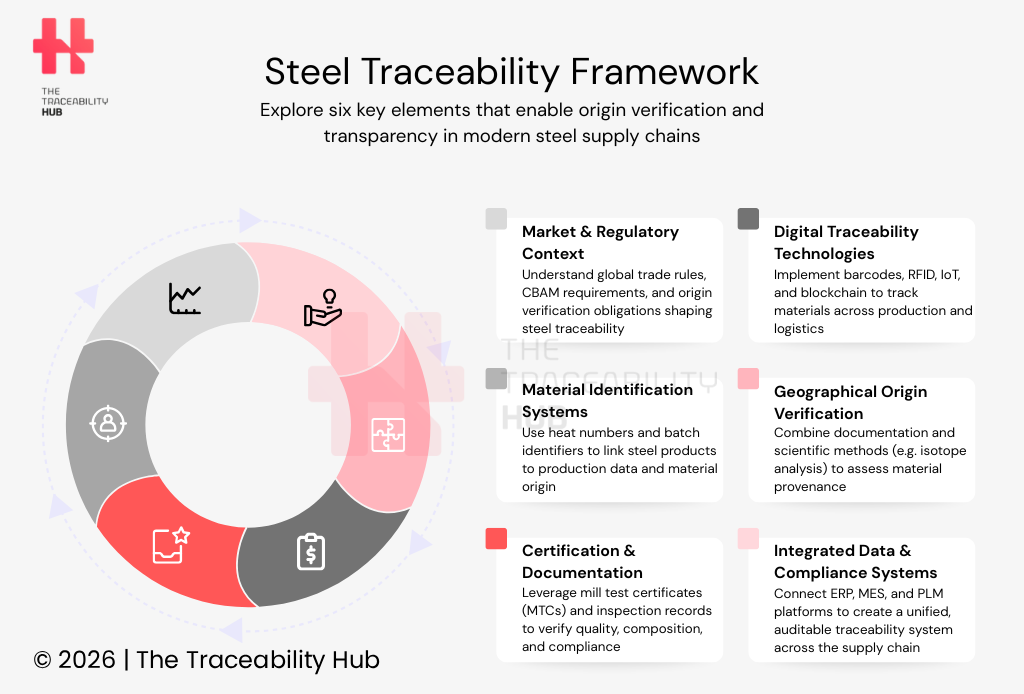
Core Steel Material Traceability Technologies
Multiple steel identification technologies form the foundation of modern steel traceability systems, each addressing specific operational challenges within steel manufacturing environments and industrial supply chains.
Barcode and QR code systems provide an accessible entry-level solution for tracking raw materials, work-in-progress inventory, and finished steel products throughout production facilities.
These codes can store identifiers linked to production data, inspection records, and test results in enterprise systems, enabling manufacturers to monitor inventory levels and support automated inventory management and material tracking processes.
RFID technology extends tracking capabilities beyond line-of-sight limitations. Specialized anti-metal RFID tags are designed to operate reliably on metallic surfaces, while high-temperature RFID tags can withstand harsh industrial conditions encountered in steel production and metallurgical processing environments. Passive UHF RFID systems enable automated bulk scanning through portals or handheld readers, allowing facilities to capture steel material movement data with limited manual intervention. Many manufacturers report operational improvements in inventory accuracy and asset tracking after deploying RFID-based steel traceability systems.
Industrial IoT sensors for manufacturing traceability monitor parameters such as temperature, pressure, and production conditions across manufacturing lines, providing real-time data that can be integrated into manufacturing execution systems (MES) or enterprise resource planning (ERP) platforms for process monitoring and quality control.
Blockchain-based platforms are also being explored for steel supply chain traceability and provenance verification. These systems create distributed records of transactions and product data across multiple stakeholders, which can support secure data sharing, material provenance verification, and auditability in complex supply chains. In some implementations, automated workflows or smart contracts are used to streamline supplier communications, compliance documentation, and traceability data validation.
Industry Standards for Steel Traceability
Beyond digital tracking technologies, steel traceability in manufacturing and steel supply chain traceability systems also rely on well-established industry identification and documentation practices.
Heat numbers (or heat codes) are one of the primary identifiers used in steel production and steel material traceability systems.
Each melt or production heat in a furnace is assigned to a unique heat number that links the material to its chemical composition, production parameters, and quality control records. This identifier is typically maintained through downstream processing stages such as rolling, forging, or fabrication, allowing manufacturers and customers to trace materials back to the original steel production heat and metallurgical batch origin.
Mill Test Certificates (MTCs) provide documented verification of a steel product’s mechanical properties, chemical composition, and conformity with applicable material standards and quality assurance requirements. In many markets, these inspection documents are issued in accordance with EN 10204 certification standards, which defines several types of inspection documentation, including the widely used 3.1 inspection certificate, validated by the manufacturer’s authorized inspection representative.
Together, heat numbers and mill test certificates form a core steel traceability framework and steel material verification system that links physical steel products to verified production and testing data.
When combined with digital technologies such as barcodes, RFID tracking systems, and enterprise data systems, these identifiers help manufacturers support quality assurance, steel regulatory compliance, and reliable steel supply chain documentation for customers, regulators, and auditors.
Geographical Origin Tracking Methods
Geographical origin verification can rely on two complementary approaches. Document-based traceability systems track the flow of materials and production data across supply chains through records such as certificates, batch identifiers, and production documentation. Geochemical or isotopic analysis, by contrast, examines the elemental and isotopic characteristics of materials to support steel provenance investigations and origin verification.
Isotope fingerprinting measures natural variations in elemental isotope ratios that can reflect geological source characteristics of raw materials used in steel production. Lead isotopes (²⁰⁴Pb, ²⁰⁶Pb, ²⁰⁷Pb, and ²⁰⁸Pb) are commonly used as tracers because their relative abundances vary depending on the geological history of ore deposits. Similarly, strontium isotope ratios (⁸⁷Sr/⁸⁶Sr) can provide information about the age and composition of the source rock. In some research contexts, these isotopic signatures are analyzed to help infer the geographical origin of raw materials used in metallurgical production and steel manufacturing supply chains.
Iron isotope analysis and multi-element geochemical profiling may also contribute to provenance investigations. However, because steel production involves processes such as smelting, refining, and alloying – often using materials from multiple sources – analytical methods typically support origin assessment in combination with documentary traceability, systems and steel supply chain documentation, rather than providing definitive proof of origin on their own.
High-precision analytical techniques are used to measure isotopic signatures in metallurgical and geochemical traceability research. Multi-Collector Inductively Coupled Plasma Mass Spectrometry (MC-ICP-MS) and High-Resolution Sector Field ICP-MS (ICP-SFMS) enable highly accurate isotope ratio measurements that are widely applied in geochemical provenance studies and materials research.
Successful provenance analysis depends on several scientific principles.
The most important is the provenance postulate, which states that variation within a single source must be smaller than the variation observed between different sources. When this condition holds, isotopic and geochemical signatures can help distinguish materials from different geological origins and raw material sources used in steel supply chains.
Integration and Documentation Practices
Documentation systems connect technological traceability capabilities with regulatory and quality assurance requirements in steel manufacturing operations and global steel supply chains.
Many steel manufacturers integrate traceability data within enterprise platforms such as enterprise resource planning (ERP), manufacturing execution systems (MES), and product lifecycle management (PLM) systems.
These platforms can synchronize production data, material identifiers, inspection records, and order information, helping create a unified view of traceability data across manufacturing, logistics, and supply chain processes.
But an additional integrated platform could become a strategic requirement for modern manufacturing. Because while ERP, MES, and PLM each hold critical data, they often operate in silos or with fragile point-to-point connections that can lead to data duplication and errors. An additional integration or orchestration platform is beneficial for the following reasons:
- Unified “Single Source of Truth”: it synchronizes data across a specialized PLM layer and a robust ERP backbone, ensuring that engineering intent matches production reality.
- Layered Architecture: A dedicated middleware or API layer improves flexibility and scalability compared to direct integrations, simplifying future system upgrades.
- Closed-Loop Feedback: Such a platform enables MES to feed real-time production issues back to PLM, allowing design teams to make improvements based on actual shop-floor data.
- Democratization of Data: Platforms may use cloud services and web front-ends to make manufacturing data accessible across the entire organization, reducing on-premises infrastructure needs.
- Interoperability: Modern platforms act as a hub for diverse data sources, connecting equipment directly to enterprise systems.
- Efficiency Gains: Integrated environments allow companies to respond faster to design changes, reduce production errors, and can save hours of administrative work per week.
In general digital documentation management helps ensure that steel material certificates, inspection reports, and production records remain linked to specific batches and finished components throughout their lifecycle.
This integration improves operational visibility, steel supply chain transparency, and traceability of documentation management, while supporting quality management processes, regulatory documentation, and audit readiness.
In certain regulatory and trade contexts – particularly in the United States – documentation may also include “country of melt and pour” traceability information. This refers to the location where steel was first melted and cast into its initial solid form. Such information may be required for trade compliance, including tariff measures and government procurement rules, and can support customs origin verification when combined with mill certificates and related production documentation.
The Future of Trust in Steel Supply Chains
Steel has long been the backbone of global infrastructure, from transportation networks and energy systems to buildings and industrial equipment.
Yet as supply chains become more global and regulatory, expectations increase. Knowing where steel comes from and how it was produced is becoming just as important as its mechanical performance, material provenance, and environmental footprint.
Traceability is evolving from quality-control practice into a strategic supply chain capability for modern industry. Governments are tightening requirements around carbon reporting, origin verification, and responsible sourcing, while customers increasingly expect transparency about the materials used in the products they buy. In this environment, the ability to document and verify the journey of steel – from raw material sourcing to finished component – will shape market, regulatory compliance, access and competitive advantage.
Technologies such as digital tracking systems, industrial tracking technologies, advanced data platforms, and scientific provenance analysis methods are expanding what is possible in supply chain visibility. At the same time, long-established practices like heat number identification and mill test certification remain essential anchors of trust in steel manufacturing and supply chain documentation.
Together, these tools help transform steel traceability from a reactive compliance exercise into a proactive framework for supply chain accountability and production transparency.
As the industry moves toward lower-carbon production, circular material flows, and increasingly complex international trade rules, end-to-end hybrid architectures to achieve the highest level of integration will be necessary, while traceability will play a more significant and critical role in verifying claims about steel origin, sustainability, and performance.
Organizations that invest in robust traceability systems and digital supply chain transparency solutions today will be better positioned to navigate regulatory change, support responsible sourcing initiatives, and maintain confidence across global markets.
In the years ahead, traceability will not simply document the past of a steel product; it will help define the future integrity and transparency of the entire steel supply chain.
Coming soon: How Green Steel Production is Changing Europe’s Path to Net Zero