



Improving Inventory Visibility and Order Accuracy with RFID in Gas Cylinder Manufacturing
A global manufacturer of gas cylinders serving the heating, cooling, and construction sectors was facing challenges in overseeing the movement of inventory from production to distribution across its manufacturing supply chain and warehouse distribution network. The company relied on manual processes and lacked a standardized inventory tracking system to confirm order accuracy. Once shipments left the warehouse, visibility into their journey was limited, making it difficult to verify order details and maintain end-to-end supply chain visibility.
This lack of transparency created operational challenges, particularly when attempting to challenge customer chargebacks. The firm needed a more reliable way to track orders, monitor inventory movement across the logistics network, and collect the data required to verify shipments. Implementing data collection and digitalization through RFID-enabled tracking provides greater inventory visibility, supported order verification, and improved efficiency across shipping, logistics, and warehouse inventory management processes.
Operational Challenges in Cylinder Inventory and Order Tracking
The manufacturer faced several operational challenges in managing industrial asset inventory and order fulfillment across its distribution network. Shipping and receiving processes lacked clear logistics visibility, making it difficult to track the movement of gas cylinders between production, warehouses, and distribution points. The company was also unable to consistently monitor inventory transfers between warehouses, which limited its ability to maintain accurate oversight of stock positions and warehouse inventory visibility.
Order verification relied on manual checks, leaving the process vulnerable to human error and reducing confidence in shipment accuracy and order fulfillment tracking. At the same time, the organization lacked sufficient traceability data to challenge customer chargebacks with full accountability. Limited control over order fulfillment according to customer specifications highlighted the need for a more reliable RFID inventory tracking system to track inventory movement and verify shipments across the manufacturing supply chain.
RFID-Enabled Data Collection and Inventory Tracking
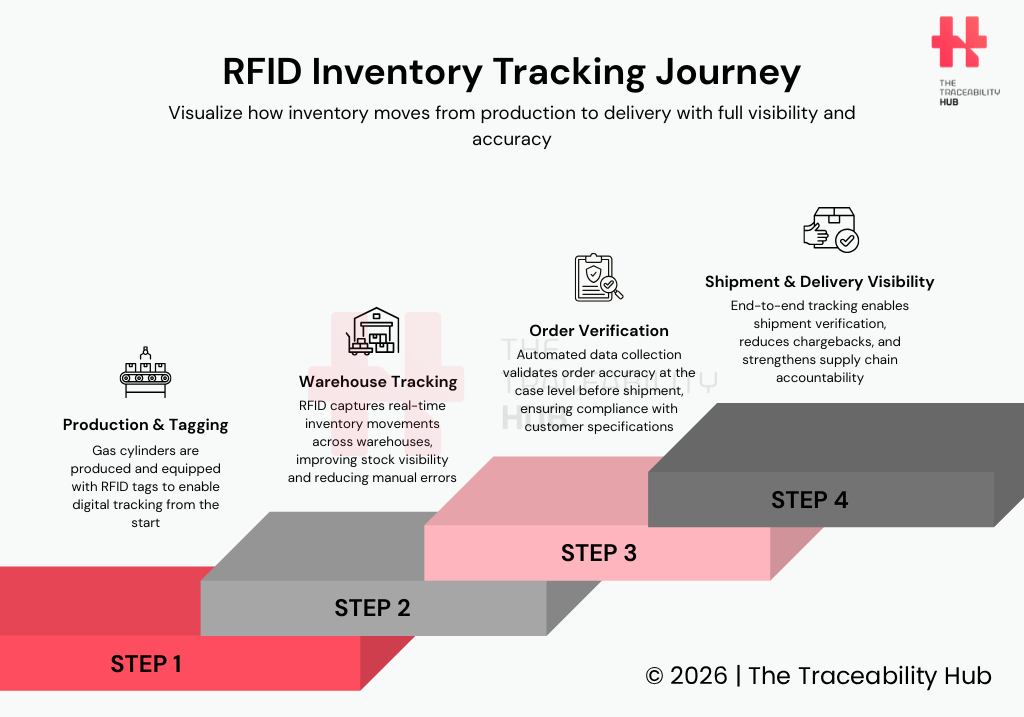
To address its inventory visibility and order verification challenges, the manufacturer implemented an RFID-enabled data collection, asset tracking, and digitalization system. RFID technology was used to automatically capture data on gas cylinder movements as products moved from production to the warehouse and between warehouse locations. This automated RFID inventory tracking provided end-to-end visibility into inventory movement across key stages of the shipping and receiving process.
The system also introduced automatic order verification and case-level inventory validation, reducing reliance on manual checks that were previously vulnerable to human error. By creating a verifiable digital system of record for inventory and shipment data, the solution allowed the company to confirm shipment details, monitor order fulfillment, and maintain the data needed to challenge customer chargebacks when required. Improved supply chain visibility and RFID asset tracking also helped the manufacturer identify inefficiencies and optimize its shipping processes over time.
RFID Inventory Tracking Journey
Results and Measurable Operational Improvements
The implementation of RFID-enabled data collection, automated inventory tracking, and digitalization provided the manufacturer with end-to-end visibility into inventory movement across production, warehouse operations, and distribution. Automated RFID tracking technology made it possible to follow gas cylinder shipments from production through the warehouse and between warehouse locations, giving the company greater control over shipping and receiving processes.
The system also enabled automatic verification of order accuracy at the case level, helping ensure that shipments matched customer specifications. With improved RFID-powered supply chain visibility and a verifiable system of record, the manufacturer was better equipped to manage and challenge customer chargebacks when necessary.
As a result, the company achieved more orders successfully fulfilled, fewer chargebacks, and higher levels of customer satisfaction. At the same time, increased automation improved operational efficiency, inventory tracking accuracy, and logistics performance, while providing the visibility needed to identify inefficiencies and continuously optimize the shipping process.
Customer Testimonial
A representative from the manufacturing company highlighted the impact of the RFID-enabled tracking system on shipment visibility and order verification. According to the customer, the solution now provides complete supply chain visibility from the moment an order leaves production, allowing the company to confirm order accuracy and follow the shipment’s journey until it arrives with the customer.
This improved transparency across the shipping process helps ensure that orders are delivered on time while providing the data-driven traceability required for shipment verification, inventory accountability, and supply chain transparency.
Key Takeaway: Improving Visibility and Accountability with RFID
This case highlights how data collection and digitalization supported by RFID-enabled tracking can help manufacturers strengthen visibility and control across complex logistics operations. By replacing manual verification processes with RFID asset tracking and automated order verification, the company gained a clearer view of inventory movement and warehouse stock positions from production through warehouse distribution.
The improved visibility created a reliable inventory tracking system of records that supports order accuracy, helps manage and challenge customer chargebacks, and ensures shipments meet customer specifications. At the same time, greater transparency across shipping processes allows organizations to identify inefficiencies and continuously improve logistics performance and operational efficiency. For manufacturers managing large volumes of physical assets, RFID-enabled traceability can play a key role in improving supply chain accountability, warehouse inventory visibility, and industrial asset tracking efficiency.
Read more: Steel Traceability Methods: Tracking Geographical Origin in Modern Supply Chains