

Supply Chain Analytics and Decision Intelligence
Supply chain analytics (including advanced analytics and AI-driven supply chain optimization) have evolved beyond simple calculations into sophisticated AI-powered insights. MATLAB dominated the global advanced analytics and data science industry with a 14.5 percent market share in 2022. This statistic shows how analytical capabilities have become essential in every industry. Companies now receive unprecedented amounts of data from digital technologies like mobile phones, social media, and cloud computing (key components of modern digital transformation).
Traditional data warehouse engines struggle to process these massive volumes of information. Modern organizations use advanced analytics platforms to make informed decisions and tackle these challenges effectively. Companies now use specialized business intelligence tools to direct their global supply chain operations smoothly.
AI in supply chain management (including machine learning forecasting and optimization algorithms) creates new possibilities for optimization and forecasting, while supporting quick decision-making as digital transformation speeds up.
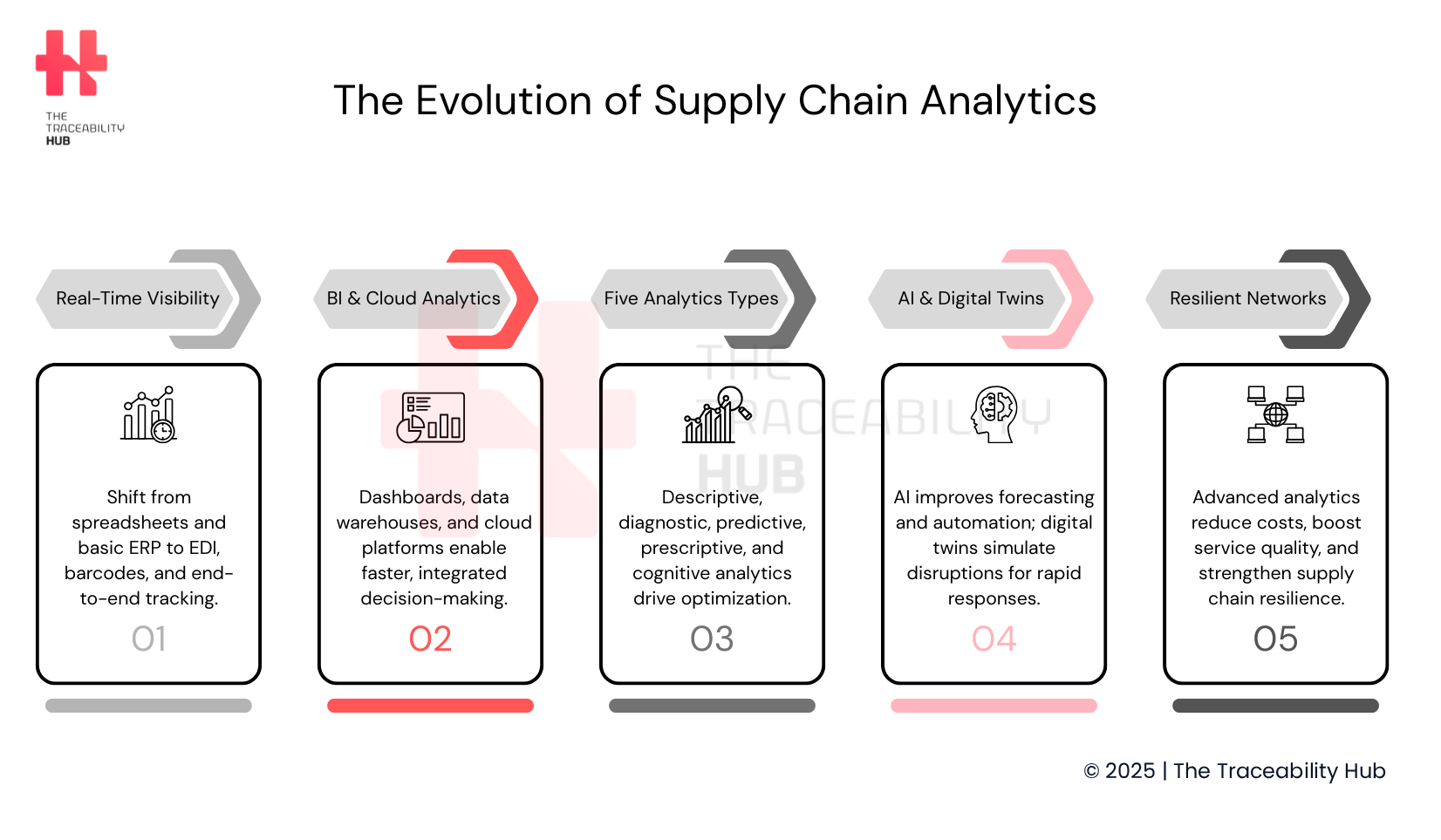
The Evolution of Supply Chain Analytics
From Manual Forecasting to Real-Time Visibility in Modern Supply Chains
The rise of supply chain visibility (real-time visibility and end-to-end tracking) marks a fundamental change in how businesses track, manage, and optimize their operations. Companies relied heavily on manual processes and limited technology to handle increasingly complex logistics networks before modern systems arrived.
Legacy Supply Chain Planning with Excel and ERP
Supply chains depended on manual processes with very limited visibility in the past. Recent surveys show that 42% of companies still use spreadsheets for data integration and preparation. A striking 73% of supply chain professionals rely on spreadsheets for planning. Manual approaches create major challenges: blind spots in operations, inefficiencies from duplicate work, and poor coordination between departments (all symptoms of low analytics maturity).
ERP systems came along to fix these limitations by working as central hubs for supply chain operations. Water treatment company ChemTreat switched from manual spreadsheet tracking to a modern ERP system. This gave them detailed end-to-end visibility across vendors, stock, and customers. They could now learn about spending patterns and customer demand relationships clearly. In spite of that, traditional ERP systems often lacked the integration, automation, and intelligence needed for quick, precise responses to supply chain disruptions (including risk management and compliance issues).
Emergence of EDI and Barcode Scanning Systems for Supply Chain Visibility
EDI and barcode scanning marked a turning point in supply chain visibility. Barcoding technology arrived in 1973 and changed how businesses track inventory and reduce processing errors. EDI made it possible to exchange standardized electronic data between businesses, which eliminated paper documentation and manual data entry: a major step toward digital supply chain ecosystems.
These technologies offer several key advantages:
- Improving operational efficiency: Reduced administrative costs through elimination of manual paperwork and data entry errors
- Enhancing supply chain visibility: Improved inventory tracking using barcodes to monitor stock throughout the entire supply chain
- Supporting customer experience optimization: Better customer service through improved communication and reduced stockouts
Studies show that retailers using EDI saw an average annual sales increase of 0.14%. Companies using these technologies report fewer mistakes, reduced returns, and smoother operations.
Impact of Globalization on Data Complexity and Multi-Tier Supply Chains
Data complexity grew exponentially as supply chains expanded globally, creating multi-tier supply networks and increased logistics complexity. As a result, 85% of supply chain professionals report increased complexity over a five-year period. They face challenges in coordinating operations across multiple countries while handling various regulations, cultural differences, and logistical complexities.
Data fragmentation has become a major problem that costs companies more than $600 billion annually. This issue stems from disconnected systems that can’t communicate well, including ERP software, inventory management systems, and CRMs (a common master-data management challenge). Managing relationships with multiple suppliers and logistics partners across global networks has made visibility harder. About 69% of companies report poor visibility across their supply chains.
Companies started looking for integrated solutions that could provide up-to-the-minute data on product movement from raw materials to final delivery (real-time supply chain visibility platforms). These solutions are the foundations of modern supply chain analytics platforms and business intelligence tools.
The Rise of Business Intelligence and Advanced Analytics in Supply Chains
Business intelligence (BI dashboards, KPIs, analytics reporting) has become the backbone of modern supply chain management. It gives companies the tools they need to guide complex operations. Supply chain executives report more frequent disruptions lately, with 76% facing challenges in recent years. This has led companies to make use of information-based solutions to build resilience and learn about their operations better: a key component of supply chain risk analytics.
Adoption of Business Intelligence Tools for Logistics
Supply chain business intelligence combines and analyzes data from multiple sources to get practical insights. The process covers data integration from different systems, advanced analytics, performance tracking, immediate visibility, and decision support (all part of unified supply chain data architecture). BI tools convert raw supply chain data into interactive visuals like dashboards, reports, and graphs. These help stakeholders understand complex logistics operations better. Companies can find inefficiencies, improve processes, reduce lead times, and cut unnecessary costs substantially with these tools.
Role of Data Warehousing and Data Governance in Supply Chain Reporting
Data warehousing works like a modern distribution hub as the main storage for all supply chain information. The system gathers and arranges data in well-laid-out tables that query tools can access. This central approach simplifies data collection and helps decision-makers use all relevant information.
Data warehouses also let companies mine data effectively to find patterns and trends that shape business strategies (supporting predictive analytics and demand planning). A strong data governance framework helps maintain accuracy, consistency, and security of data across departments.
Cloud-Based Analytics Platforms for Scalability
Cloud-based solutions have transformed supply chain analytics by removing traditional limits. These platforms are flexible and let organizations adjust their resources instantly based on what they need. They offer cost savings through pay-as-you-go pricing and immediate data processing for quick decisions. Companies stay nimble as market conditions change thanks to cloud computing’s adaptable nature. Cloud platforms work smoothly with IoT devices, AI, and machine learning tools. This enables advanced features like predictive analytics, route optimization, and continuous improvement of operations (core components of modern digital supply chains).
Types of Supply Chain Analytics and Their Use Cases Across Logistics and Operations
Modern supply chains depend on five distinct analytics categories (descriptive, diagnostic, predictive, prescriptive, and cognitive analytics). Each category serves unique functions in the operational ecosystem. These analytical approaches create a progressive framework that evolves from understanding history to automating future decisions.
Descriptive Analytics: Inventory, Order History and KPI Performance Tracking
Descriptive analytics look at historical data to measure past events and performance metrics. This fundamental type of analytics shows what happened in supply chains through KPIs and metrics in business reports and dashboards.
Companies use descriptive analytics to track sales per representative, product line performance, and overall revenue. A water bottle company might use descriptive analytics to track average production time for tailored bottles and on-time delivery rates (core supply chain performance metrics).
Diagnostic Analytics: Root Cause Analysis in Delays
Diagnostic analytics find out why specific events or trends occurred by revealing mechanisms behind performance variations. Data mining and correlation analysis connect outcomes with driving factors that explain why “X happened because of Y”. Diagnostic analytics might show that production delays came from a shortage of specific components. It can also help spot bottlenecks at a manufacturing assembly line’s final inspection station, supporting continuous improvement initiatives.
Predictive Analytics: Demand Forecasting Models
Predictive analytics looks into future scenarios using statistical models and machine learning algorithms. Walmart trained their ML algorithms 20X faster with RAPIDS open-source libraries. This helped them get the right products to the right stores quickly. Tesco used machine learning-based forecasting algorithms to manage over 30 million products across 3,000+ stores.
Companies can anticipate seasonal trends and prepare for market changes with accurate demand forecasting, which reduces both stockouts and overstock situations (a major benefit of advanced demand planning).
Prescriptive Analytics for Route Optimization, Scheduling, and Cost Efficiency
Prescriptive analytics gives applicable information based on insights from other analytics types. UPS uses prescriptive analytics to optimize routes. Their system determines the best paths for drivers to ensure safety, meet customer commitments, and optimize efficiency.
Organizations can find the quickest routes that minimize delivery times and costs through algorithms like linear programming and machine learning models. These capabilities go beyond transportation to inventory optimization, production scheduling, and pricing strategies: forming a complete optimization ecosystem.
Cognitive Analytics: AI in Supply Chain Chatbots
Cognitive analytics employs artificial intelligence and machine learning to process huge amounts of structured and unstructured data. This emerging technology works like human thinking—it learns from new data and keeps improving its insights and recommendations.
Digital assistants powered by cognitive analytics analyze historical data immediately to find critical insights. AI assistants can identify which suppliers cause most delays and spot disruption causes like weather, financial obstacles, or transportation bottlenecks (key elements of supply chain risk management).
Decision Intelligence and the Future of Supply Chain Optimization
Decision intelligence marks a new era in supply chain optimization (the convergence of AI, analytics, and automated decision-making). Companies now use AI and machine learning to transform their supply chain decisions with a complete understanding of their effects.
Integration of AI in Supply Chain Management in Supply Chain Management Systems
AI systems detect patterns in supply chain data that humans might miss. This helps companies predict disruptions instead of just responding to problems. Organizations can now make quick, smart decisions through predictive modeling, data analysis, optimization algorithms, and artificial intelligence.
The results speak for themselves. Companies using decision intelligence see their costs drop by 22% over three years. Their revenue grows by 11%, while overall costs decrease by 27%. AI-powered algorithms watch inventory levels, predict equipment failures, and optimize restocking schedules. This creates a fundamental change from reactive management to proactive control (a key goal of smart supply chain automation).
Real-Time Decision Making with Digital Twins and IoT-Enabled Supply Chains
Digital twins create virtual copies of physical supply chains. These copies run simulations of possible scenarios using real-time data.
Unlike old models that relied on static historical data, these dynamic simulations blend IoT sensors, ERP systems, and AI tools to provide quick insights (real-time supply chain decision-making). Companies use digital twins to:
- Test responses to disruptions like supplier delays or transportation bottlenecks
- Review trade-offs between cost, service levels, and lead times
- Find the best balance between competing priorities and complex constraints
McKinsey’s research shows that digital twin technologies can boost revenue by 10%. They can also cut time to market by 50% and improve product quality by 25%.
Data-Driven Decision Making in Procurement and Supplier Management
Procurement teams now deal with massive data flows from both internal and external sources. The best procurement departments create digital twins of their entire supply chains. These models track all points globally from raw materials to final delivery.
Teams can spot inefficiencies, negotiate better contracts, and forecast spending patterns by constantly checking supply risks, costs, and carbon impact at each point (part of advanced procurement analytics). This transforms procurement from a cost-saving function into a strategic asset through evidence-based decision intelligence.
Automation of Replenishment and Inventory Control
AI and machine learning help automated replenishment systems analyze big datasets to spot demand patterns. Sensors monitor stock levels and send data to inventory software, which orders supplies automatically when they run low.
This technology keeps stock at perfect levels by preventing excess inventory and shortages. Companies report less money tied up in extra stock, faster restocking, and less waste from unsold goods (key benefits of smart inventory management).
Challenges in Scaling Decision Intelligence Systems Across Complex Global Supply Chains
The path to decision intelligence in supply chains faces several obstacles. Poor data quality and inconsistent systems lead to wrong forecasts and unreliable tracking. Old systems struggle with real-time data flows, which require extensive engineering work and delay returns on investment.
Questions about responsibility, liability, and compliance come up often, especially in regulated industries. Success requires consistency, mature architecture, and long-term commitment. These challenges rank among the top three obstacles for 37% of operations and supply chain leaders (a common digital transformation barrier).
The Transformation Toward Intelligent, Automated, and Resilient Supply Chains
Supply chain analytics has transformed remarkably over the decades. Simple spreadsheet tracking has given way to sophisticated AI-powered systems (including predictive analytics, prescriptive analytics, and cognitive AI). Organizations have steadily moved away from manual processes that created blind spots and made operations inefficient. The introduction of technologies like EDI and barcode scanning marked the most important turning point that reduced errors and improved inventory tracking.
Business intelligence became the backbone of modern supply chain management as global complexity grew. Data warehouses now store critical information while cloud-based platforms provide scalability needed for growing operations. On top of that, these technological advances have helped companies progress through sophisticated analytics approaches.
The analytics spectrum now ranges from descriptive analytics that look at past performances to cognitive analytics that mirror human thinking. Predictive models can forecast future scenarios accurately while prescriptive analytics provide applicable recommendations to optimize operations. Root cause analysis tools help companies tackle problems at their source instead of just treating symptoms.
Decision intelligence stands as the next frontier in this development. Digital twins create virtual copies of physical supply chains and enable immediate decision making without ground consequences. Automated replenishment systems eliminate manual planning and maintain optimal inventory through continuous analysis. Procurement departments can transform cost-saving functions into strategic value-drivers through analytical insights.
These advances bring their share of challenges. Data quality issues and integration with older systems often delay implementation and ROI. Questions about responsibility and compliance emerge, especially when you have heavily regulated industries. The path ahead is clear – supply chains will become more intelligent, automated, and resilient through advanced analytics.
Organizations that can employ these technologies while addressing human and organizational challenges will own the future. Companies successfully implementing decision intelligence across their supply networks will gain competitive advantages through lower costs, higher revenue, and better customer service. This development in supply chain analytics represents more than just a transformation – it fundamentally changes how supply chains work in our complex global environment.
Read more: Smart Supply Chains: Why Italian Logistics Industry is Moving Beyond Traditional Models