

The Paradox of Italian Agrifood
The Italian agrifood sector is one of the strongest pillars of its economy. According to Coldiretti industry data, the broader food supply chain generates over €580 billion in value and employs approximately 4 million people.
Export competitiveness continues to grow, reaching record levels in recent years (source: ISMEA). Italian food products—from wine and pasta to dairy and processed goods—are consolidating their position in mature markets such as the United States and Germany, while gaining traction across Asia and the Middle East.
At a global level, this performance is supported by a strong and resilient demand for high-quality, traceable, and branded food products. According to the FAO, international food trade has become increasingly interconnected, with countries relying more than ever on cross-border flows of agricultural commodities and critical inputs.
And yet, beneath this strong performance lies a structural contradiction: a globally competitive output system built on fragile and external inputs.
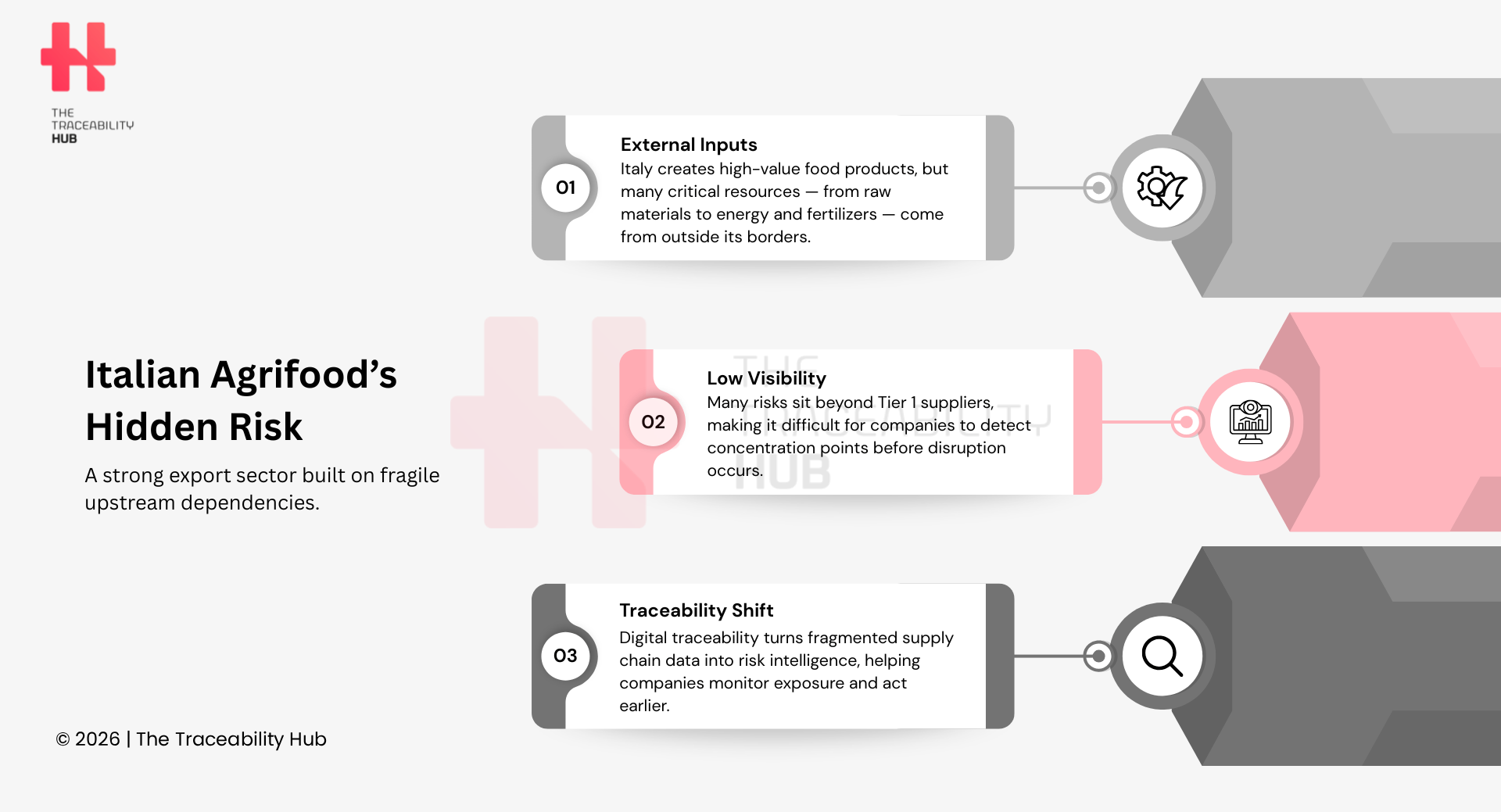
Italy excels in transforming and exporting value-added products, but key parts of its production model still depend on external sources, ranging from raw agricultural materials to energy and fertilizers.
This imbalance creates a hidden layer of vulnerability: one that does not immediately affect demand, but directly impacts cost stability, production continuity, and long-term export competitiveness.
Mapping the Hidden Dependencies
Italian agrifood supply chains do not operate in isolation. They are deeply embedded in global systems, reliant on flows of materials, energy, and technologies that originate far beyond national borders.
What makes this structure vulnerable is not dependency in itself, but the limited ability to see where those dependencies concentrate and how shocks may travel through the network.
These dependencies are often:
- multi-layered (extending far beyond direct Tier 1 suppliers)
- geographically dispersed (concentrated supply risk)
- indirect and poorly mapped (supply chain visibility blind spots)
In most cases, companies manage what they can see, while the most critical risks sit upstream, outside their operational visibility. The result is a structural asymmetry: high exposure, low awareness.
Understanding these hidden layers is the first step toward moving from reactive responses to proactive risk control.
Italian Agrifood’s Hidden Risk
Raw Materials: External Sourcing Dependency
At the core of the agrifood system lies a fundamental dependency: raw agricultural inputs.
Italy has built a globally competitive position in food transformation, creating high-value products that are exported worldwide. However, this strength is supported by a structural reliance on imported commodities, particularly cereals such as wheat and corn, animal feed, and oilseeds.
This dynamic creates a clear imbalance between where value is generated and where critical inputs originate. While production and branding are largely domestic, a significant share of the underlying resources is sourced internationally.
According to the FAO, global food systems have become increasingly interconnected, with countries depending on cross-border trade to secure essential agricultural inputs. As a result, national supply chains are no longer self-contained systems, but part of a broader and more complex global network.
For companies, this has direct strategic implications. Supply continuity can no longer be considered a domestic variable, influenced only by local production capacity or internal efficiencies. Instead, it is shaped by external factors such as global commodity market dynamics, climate risk events occurring in distant production regions, and shifts in trade policies and geopolitical conditions.
In this context, raw material sourcing is no longer just a procurement function. It becomes an exposure point that requires upstream intelligence, continuous monitoring, and strategic oversight.
Energy: System-Wide Cost Exposure
Energy represents one of the most critical, and often underestimated, inputs within agrifood supply chains. It underpins every stage of the value chain, from field operations and agricultural machinery to irrigation systems, industrial processing, and temperature-controlled logistics.
Despite its central role, energy is rarely treated as a core supply chain variable. In many organizations, it remains classified as a utility cost rather than as a dependency capable of influencing production continuity, pricing, and margins.
However, this perspective is increasingly outdated. The International Energy Agency highlights that agriculture is highly sensitive to energy price fluctuations, particularly in import-dependent regions such as Europe. As a result, cost volatility in energy markets does not remain confined to a single cost line, it propagates across the entire system.
For companies, this creates exposure across production costs, logistics expenses, final pricing, and margin stability. Because energy markets are global and only partially controllable at company level, businesses are exposed to fluctuations they may not be able to anticipate or absorb quickly.
In this context, energy should be understood not simply as an operational input, but as a systemic risk factor embedded across the entire agrifood value chain.
Fertilizers: Concentrated Supply Risk
If energy represents the backbone of agrifood production, fertilizers act as a multiplier. They play a direct role in determining agricultural yields, production volumes, and cost structures.
Yet, fertilizer supply chains are among the most concentrated and exposed globally. Production is geographically limited and heavily dependent on natural gas, making it particularly sensitive to both geopolitical tensions and energy market fluctuations.
According to the World Bank, fertilizer prices have experienced significant cost volatility in recent years, driven by a combination of geopolitical tensions and shifts in energy costs. The International Fertilizer Association further confirms that global supply is concentrated in a small number of regions, increasing systemic vulnerability.
This creates a tightly coupled dependency structure: energy influences fertilizer production, which in turn directly impacts agricultural output.
For companies, the implications are substantial. Input inflation and unpredictability become a structural condition rather than an exception. Margin compression becomes more frequent, and exposure to external shocks—often originating far upstream—becomes increasingly difficult to anticipate and manage.
Technology & Agritech Components
Agriculture is no longer solely a biological system; it is increasingly a technological one. Efficiency, productivity, and sustainability are now closely tied to the adoption of digital tools and advanced machinery.
Modern agrifood production relies on a growing ecosystem of technologies, including precision farming systems, IoT sensors, connected devices, and data-driven platforms that support operational decision-making.
Italy plays a leading role in the development and export of agritech solutions. However, this strength is embedded within global agri supply chains that provide critical components such as electronics, sensors, and software infrastructures.
As a result, a new layer of dependency is emerging, one that is less visible than raw materials or energy, but equally strategic. Disruptions in technology supply chains may not immediately halt production, but they can significantly impact efficiency, data availability, and the quality of decision-making processes.
Over time, these disruptions can translate into reduced export competitiveness, particularly in a context where digital capabilities are becoming a key differentiator.
Why These Dependencies Matter
These exposure points become critical when disruption turns an efficient global system into a transmission channel for cost, supply, and operational instability.
International organizations such as the OECD and UNCTAD have consistently highlighted how global value chains have become more complex, interdependent, and therefore more vulnerable to disruption.
Rather than isolated events, disruptions tend to propagate across sectors and geographies, amplifying their impact as they move through interconnected systems.
In practical terms, this means that an external shock affecting one layer of the supply chain, such as energy availability or fertilizer supply, does not remain contained. It rapidly translates into broader operational and economic consequences.
For agrifood companies, the effects are both immediate and systemic. Rising energy costs can increase production and logistics expenses; fertilizer shortages or price spikes can affect yields and output volumes; and together, these pressures can erode export competitiveness in increasingly price-sensitive international agrifood markets.
The pattern is clear: unmanaged dependencies become channels through which risk spreads across the entire value chain.
The Visibility Problem
The deeper challenge is visibility. As agrifood supply chains become more global, multi-tiered, and data-intensive, many companies still manage them through a relatively narrow field of view.
In practice, visibility often stops at Tier 1 suppliers, the companies with which a business has a direct contractual relationship. Beyond that point, transparency tends to weaken significantly, even though many of the most critical risks sit further upstream. A World Economic Forum report citing Bain survey data found that up to 60% of executives have no visibility beyond their first-tier suppliers, a gap that becomes especially problematic when disruptions originate in lower tiers of the network.
This is not just a governance issue; it is a structural weakness in how supply chains are understood and managed. The OECD has also noted that many companies are not fully aware of the details of their upstream supply chains, even as those networks become increasingly global and complex. In other words, exposure exists well beyond the areas companies can directly monitor.
The business implications are significant. When upstream dependencies remain opaque, companies tend to underestimate their actual risk concentration. This matters because vulnerability is not evenly distributed across all inputs. OECD product-level analysis shows that in OECD countries, about 8% of foreign-sourced intermediate products are vulnerable, with around 50 products identified as highly vulnerable due to limited supplier diversity and low substitutability.
That means a company may appear diversified at the supplier level while still being exposed to the component or input level. A business may buy from multiple direct Tier 1 suppliers, for example, but those suppliers may in turn depend on the same upstream producer, region, or logistics corridor. Without multi-tier visibility, this concentration risk often remains hidden until a disruption occurs.
Recent industry data reinforces the point. McKinsey’s supply chain risk survey found that while 58% of respondents say they have mapped their Tier 2 suppliers, fewer than half of those companies report having regular direct contact with them. This suggests that supplier mapping is improving, but actionable visibility into deeper tiers remains limited.
For managers, the consequence is clear: response capacity depends on information quality. When an issue emerges upstream—whether linked to raw materials, fertilizer production, component shortages, trade restrictions, or logistics bottlenecks—companies are often forced to act late, with partial information and reduced room for maneuver.
This is why visibility is no longer just an operational concern. It is becoming a strategic capability for risk management. In an environment defined by structural volatility, companies that cannot see beyond Tier 1 are not simply less informed, they are materially less prepared. At the same time, the World Economic Forum’s latest Global Value Chains Outlook argues that transparency, data integrity, and credibility are becoming strategic imperatives as supply chains are reshaped by geopolitical tension, energy constraints, and technological change.
For agrifood businesses, this shift is particularly important. The inputs that support production—raw materials, energy, fertilizers, and technology components—often sit deep upstream, outside immediate procurement visibility. As long as these layers remain fragmented, siloed, and only partially mapped, resilience will remain reactive rather than designed.
The Business Impact
Supply chain disruptions should no longer be viewed as exceptional events. For many industries, they have become a structural feature of the operating environment. McKinsey estimates that, over the course of a decade, companies can expect severe disruptions to erase roughly 45 days of EBITDA, a finding that reflects how recurrent and financially material supply chain shocks have become.
For agrifood businesses, the consequences are especially significant because disruption does not affect only one function at a time. It tends to move across the value chain, linking sourcing, production, logistics, pricing, and commercial performance. When a shock hits upstream inputs such as energy, fertilizers, or agricultural commodities, its effects are quickly transmitted into higher operating costs, margin compression, and reduced planning certainty.
UNCTAD has recently warned that disruptions tied to energy and fertilizer markets are driving up transport and trade costs, with tanker freight rates rising by more than 90% since late February, bunker fuel prices nearly doubling, and war-risk insurance premiums surging.
For companies operating in agrifood, this means that cost volatility becomes harder to absorb. Input inflation affects production economics, while higher transport and logistics costs place additional pressure on already narrow margins. At the same time, volatility in agricultural commodity markets continues to reshape procurement risk. The OECD-FAO Agricultural Outlook notes that agricultural and food markets remain exposed to uncertainty linked to macroeconomic conditions, geopolitics, and input costs, all of which influence price formation and business predictability.
The commercial impact is equally important. Delivery delays caused by logistics bottlenecks, input shortages, or transport disruptions can weaken service levels and customer reliability, particularly in mature markets and export zones where timing and continuity are critical. OECD work on resilient food systems emphasizes that food supply chains are increasingly affected by external shocks, including extreme weather events and market disruptions, with implications for both availability and affordability.
Over time, these pressures translate into a broader competitiveness issue. When companies face repeated volatility in sourcing, production, and logistics, they are less able to protect margins, plan investments, and maintain stable export performance. In this sense, disruption is not just an operational problem. It becomes a strategic one, because the ability to manage instability shapes export competitiveness in international agrifood markets.
From Hidden Dependencies to Managed Risk
The strategic question, then, is how companies can turn hidden exposure into managed risk.
In a globally interconnected system, external reliance is inevitable. What differentiates resilient organizations from exposed ones is the ability to make those links visible, measurable, and actionable across the supplier network.
This is where digital traceability moves beyond its traditional role and becomes a strategic risk intelligence capability.
Historically, traceability in agrifood has been associated with compliance, food safety, and product recall management. While these functions remain essential, they are no longer sufficient in a context defined by geopolitical volatility, input scarcity, and increasingly complex global sourcing.
Leading international organizations are pointing in the same direction. The World Economic Forum highlights how visibility and traceability are becoming foundational to building resilient and sustainable supply chains, enabling companies to better anticipate and respond to disruptions. Similarly, the OECD emphasizes that improved supply chain transparency is critical for identifying vulnerabilities and strengthening risk management frameworks.
Modern traceability systems extend far beyond product-level tracking. When properly implemented, they provide a structured, data-driven view of suppliers, inputs, locations, and risk signals across the network.
This enables companies to:
- map multi-tier supplier networks and expose concentration points
- trace the origin of essential production resources, including raw materials, energy sources, and key components
- identify geographic and geopolitical exposure across sourcing regions
- monitor risk indicators in real time, from supply disruptions to price and cost volatility
From a business perspective, this changes the timing of decision-making. Instead of waiting for disruptions to materialize, companies can detect weak signals earlier, evaluate alternative scenarios, and act with greater confidence.
In this sense, traceability becomes more than a transparency tool. It evolves into a risk intelligence layer, connecting fragmented data and turning it into operational and strategic insight.
Agritech as an Enabler of Traceability
Digital technologies play a central role in reshaping how agrifood supply chains are managed, monitored, and optimized. What was once a largely linear and opaque system is progressively becoming more data-driven, interconnected, and measurable.
This transformation is being accelerated by the rapid growth of Agritech. According to the Osservatorio Smart Agrifood industry data, the Italian market for digital technologies in agriculture has reached approximately €2.5 billion, with annual growth rates close to 20%. This reflects not only increased adoption, but also a structural shift toward more advanced, technology-enabled production models.
At the core of this evolution is the integration of operational technologies with traceability systems.
Solutions such as IoT sensors, precision agriculture tools, and data platforms are enabling the continuous collection of granular data across the production process. This includes information on input usage, environmental conditions, crop performance, and operational activities in the field.
When connected to digital traceability frameworks, this data becomes significantly more valuable. It allows companies not only to track products along the supply chain, but also to understand how those products were generated, linking origin, inputs, and processes into a coherent and verifiable dataset.
From a business perspective, this creates a dual benefit:
- On one side, it improves operational efficiency by enabling more precise use of resources such as water, fertilizers, and energy.
- On the other, it enhances upstream visibility across farming activities, reducing informational gaps that traditionally limited supply chain control.
More importantly, agritech enables a shift in the nature of traceability itself. From static, document-based tracking systems, agri-companies can move toward dynamic, data-driven traceability models, where information is continuously updated, validated, and integrated across different stages of the agrifood value chain.
What Companies Should Do Now
Addressing hidden dependencies requires more than incremental improvements. It calls for a structural shift, from fragmented supply chain management to a more integrated, visibility-driven approach.
For agrifood companies operating in increasingly volatile global markets, business resilience is no longer only a defensive capability. It is a strategic one. Building it starts with a clearer understanding of where risks originate, how they interact, and how they propagate across the value chain.
The following actions outline a practical pathway to move from exposure to proactive control.
Map Critical Inputs
The first step is to establish a clear and comprehensive view of the inputs that underpin production. This includes not only raw materials, but also energy sources, fertilizers, and key technological components.
In many organizations, this information is fragmented across functions, making it difficult to assess overall dependency. Consolidating it into a structured framework allows companies to identify which inputs are truly critical, where they originate, and how vulnerable they are to disruption.
This is not simply a procurement exercise. It is a strategic mapping of the elements that sustain operational continuity.
Assess Geographic Exposure
Once critical inputs are identified, the next step is to evaluate their geographic distribution.
Dependencies are often concentrated in specific regions, whether for agricultural commodities, energy supply, or industrial inputs. These concentrations can create hidden exposure to geopolitical tensions, climate risks, or regulatory changes.
As highlighted by the OECD, supply chain vulnerability is frequently linked not to the number of suppliers, but to their geographic concentration.
Mapping this exposure enables companies to identify potential chokepoints and assess the need for diversification or alternative sourcing strategies.
Extend Visibility Beyond Tier 1
Visibility limited to direct suppliers is no longer sufficient. Many of the most critical risks sit further upstream, beyond the scope of traditional supplier management.
Extending visibility means identifying key upstream actors, understanding shared dependencies, and detecting where apparently diversified suppliers may rely on the same regions, producers, or logistics corridors.
The World Economic Forum has emphasized that improving visibility beyond Tier 1 suppliers is essential for building resilient networks and supply chains.
Without this broader perspective, companies risk managing only the visible surface of their operations, while remaining exposed to disruptions originating deeper in the network.
Integrate Digital Traceability
Digital traceability provides the infrastructure needed to transform static supply chain maps into dynamic, real-time systems.
By integrating data across suppliers, logistics, and internal operations, companies can monitor the origin and movement of inputs, detect emerging disruptions, and respond more effectively to changing conditions.
This shift, from periodic mapping to continuous monitoring, enables faster decision-making and a more proactive approach to resilience planning.
As recognized by the World Economic Forum, traceability and transparency are becoming foundational elements of resilient and sustainable supply chains.
Combine Agritech and Traceability
The integration of agritech solutions with traceability systems represents a critical step forward.
Technologies such as IoT sensors, precision agriculture tools, and data platforms generate detailed, real-time information on production processes. When connected to traceability frameworks, this data extends upstream visibility, linking inputs, practices, and outputs in a coherent system.
According to the Osservatorio Smart Agrifood, the rapid growth of digital agriculture is enabling new levels of data integration across the agrifood sector.
For companies, this creates an opportunity to move beyond descriptive traceability toward a more analytical and predictive model, where decisions are informed not only by what has happened, but by what is likely to happen.
Rethinking Control in a Fragmented System
Italian agrifood does not face a demand problem; it faces a control problem within an increasingly fragmented supply system. The sector performs and exports on a scale, but it does so on top of external links that are often difficult to monitor and increasingly exposed to volatility.
The competitive gap is no longer defined by efficiency alone, but by the ability to identify exposure, interpret weak signals, and coordinate decisions across the network.
In this context, digital traceability evolves into something fundamentally different: not a record of the past, but an operating system for navigating structural volatility and uncertainty.
The companies that will lead are not those with fewer dependencies, but those that can convert external complexity into controlled, measurable, and strategic variables through digital traceability, agritech data, and integrated risk intelligence.
Read more: How Digital Traceability Is Transforming the Rice Supply Chain in Italy