


A Growth Target in an Unstable World
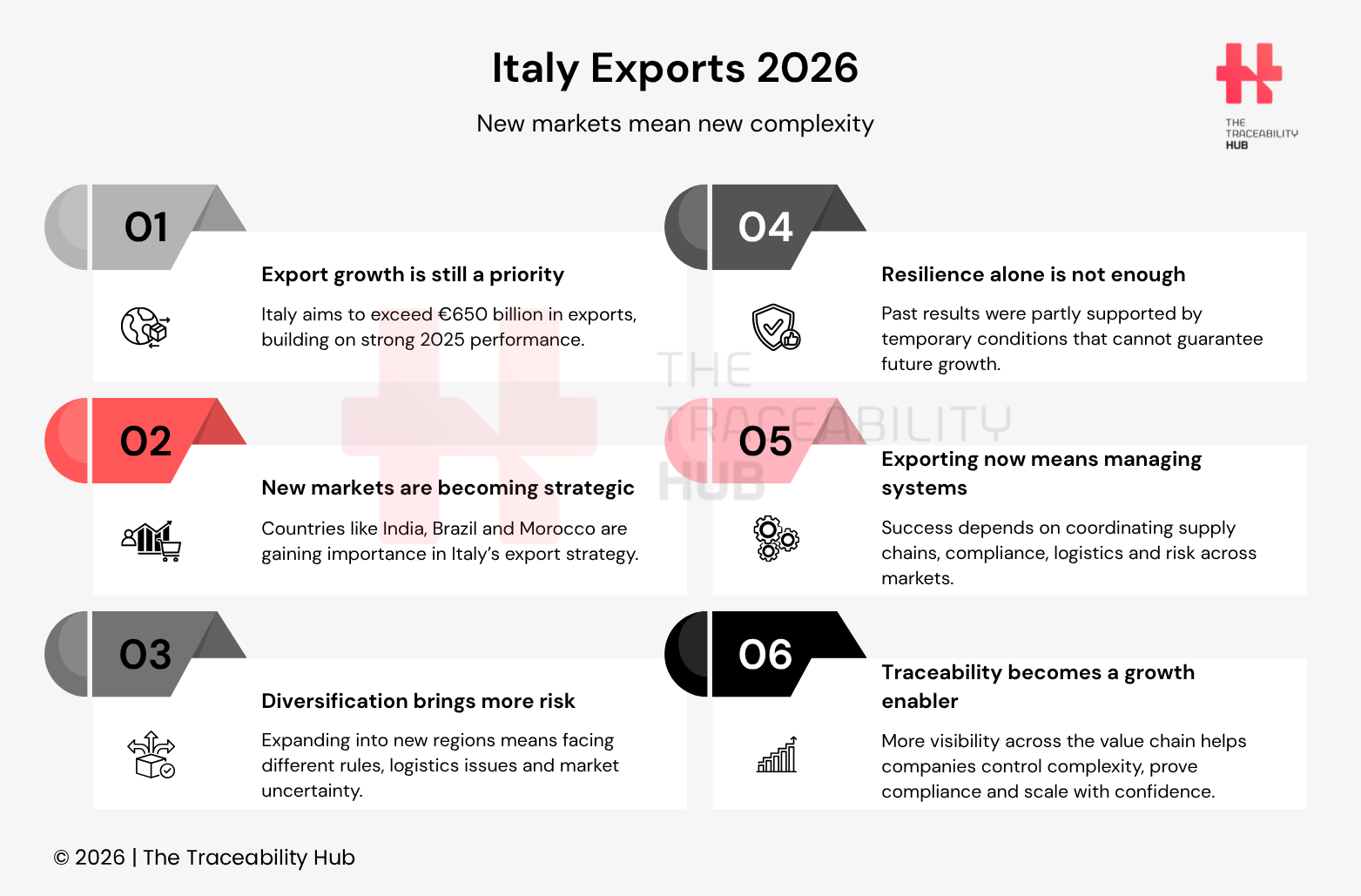
Italy approaches 2026 with a distinct and quantifiable objective: increasing national exports beyond €650 billion, following a robust performance of €643 billion in 2025. While this goal appears to be a logical progression from recent trends, it holds considerable strategic significance for Italy exports 2026 and the broader Made in Italy export strategy.
The importance of this target is underscored by the prevailing global context. In recent years, Italian exports and “Made in Italy” exports have shown consistent growth despite an increasingly challenging international trade environment characterized by tariffs, geopolitical uncertainty, energy market fluctuations, and ongoing disruptions throughout global supply chains. Under these circumstances, further export growth cannot be presumed; it requires deliberate and systematic effort supported by strong export risk management and supply chain resilience strategies.
This sustained growth is attributable not merely to recovery after economic setbacks but to the evolution of Italy’s production and export systems. These systems have been adapted through market diversification, supply chain restructuring, and the assimilation of regulatory compliance and operational changes that are now persistent features of the global landscape. Italian industry has successfully maintained its global competitive edge even as trade regulations, logistics networks, and risk parameters have transformed.
Nevertheless, adaptation alone will no longer suffice. The forthcoming stage of international expansion and export advancement will depend upon Italy’s ability to strategically organize its international outreach and global value chains. As businesses venture beyond traditional markets into increasingly complex regions, they encounter new risks alongside emerging opportunities. Effective management of commercial, regulatory, logistical, and reputational risks will be crucial for the sustainable realization of Italy’s export objectives for 2026.
The Shift Toward New Markets
The geography of Italian exports is undergoing a visible transformation. While traditional European and North American destinations remain essential, they are no longer sufficient to absorb Italy’s export growth ambitions on their own. As a result, a new group of emerging export markets is emerging as strategic priorities within national export strategies and internationalization plans.
Among them, India stands out for its sustained growth momentum and its increasing integration into European trade frameworks. Demographic scale, industrial expansion and a rapidly evolving regulatory environment are turning India into a key long-term partner, not only as a destination market, but also as a node within more complex, distributed supply chains and global value chains.
Brazil represents a different, yet equally strategic, case within Italy’s international market diversification strategy. It remains a structurally complex market, shaped by regulatory fragmentation, trade compliance requirements, and logistical challenges. At the same time, it is closely tied to future trade agreements that could significantly reshape access conditions for European exporters. For Italian companies, Brazil combines high potential with elevated entry, operational, and compliance risks.
Morocco, meanwhile, is consolidating its role as a regional manufacturing hub for investment and industrial development. Its proximity to Europe, expanding manufacturing base and growing integration into international value chains make it increasingly attractive, not just as an export destination, but as part of broader production, sourcing, and supply chain governance strategies.
These markets are not isolated opportunities. Together, they reflect a broader shift toward export diversification, which is now defining Italy’s export model and strategic internationalization approach. Rather than concentrating growth on a limited number of mature economies, Italian companies are expanding across multiple regions, sectors and demand profiles.
This diversification reduces dependency on any single market and increases strategic flexibility and operational resilience. However, it also introduces new layers of complexity—regulatory, operational and reputational—that must be actively managed as Italian exports move into a more fragmented and risk-intensive global trade landscape.
Opportunity Comes with Complexity
Diversification, however, comes at a price. As Italian exports expand across a wider and more fragmented set of international markets, a new layer of complexity becomes unavoidable.
Each geographic region presents unique operational challenges. Differences in regulatory environments significantly influence requirements for product certification, labelling, traceability, and trade practices. Risk exposure also varies considerably, encompassing factors such as creditworthiness, political stability, policy consistency, and geopolitical risk. The quality of infrastructure and logistics, including port operations, customs procedures, and last‑mile delivery, can have a substantial impact on delivery efficiency, costs, and overall supply chain robustness. Additionally, competitive landscapes are often opaque, particularly in markets where local businesses possess inherent structural or regulatory advantages.
Given these complexities, market entry necessitates more than strong product offerings or established brand value. It requires systematic decision‑making and strategic export management that evaluates how potential opportunities align with the company’s operational capabilities, supply chain visibility, risk appetite, and strategic long-term objectives.
Export, in other words, is no longer just a commercial function focused on sales volumes and market penetration. It is increasingly becoming a strategic capability tied to business resilience and global expansion strategy. Companies must evaluate growth potential alongside regulatory exposure, operational risk, timing and long-term positioning. Those that fail to integrate these dimensions risk turning diversification into fragmentation, adding complexity without building resilience or supply chain control.
As Italy’s export model evolves, the ability to govern complexity rather than simply absorb it will play a decisive role in determining which companies can convert new markets into sustainable export growth and long-term international competitiveness.
Italy Exports 2026
Resilience Has Limits
The strong export performance recorded in 2025 was supported, at least in part, by a set of favorable and partly exceptional conditions. Pre-emptive stockpiling ahead of anticipated trade barriers helped sustain volumes in several sectors. Certain industries, most notably pharmaceuticals, delivered outstanding results, benefiting from stable demand, resilient supply chains, and high value density. Large, one-off industrial deliveries, such as those in shipbuilding, also played a role in boosting aggregate figures.
These drivers are, by nature, transitory. They cannot be reproduced indefinitely and are unsuitable as a basis for sustained export growth in 2026 and subsequent years. Dependence on exceptional circumstances may obscure fundamental structural weaknesses rather than resolve them.
Meanwhile, global uncertainty continues to be pronounced. A significant factor for the coming year is geopolitical risk, especially along major trade corridors essential to international goods flows and global supply chains. Any disruption affecting these strategic routes, whether arising from conflict, sanctions, security concerns, or political instability, may cause widespread ramifications across supply chains, impacting costs, delivery reliability, operational resilience, and ultimately, market accessibility.
In such an environment, growth can no longer depend on favorable external conditions or temporary buffers. Resilience has limits when it is reactive. To remain competitive, Italian exporters must shift toward a more proactive export preparedness model: one in which growth is underpinned by internal capabilities, digital supply chain visibility, and strategic risk management rather than external circumstances.
The ability to anticipate risk, absorb disruption and maintain control over complex international operations will increasingly determine which companies can turn ambition into durable export performance.
From Exporting Products to Managing Systems
What is changing is not only where Italy exports, but how it does so. The traditional export model, built primarily around product excellence and market demand, is reaching its limits in an increasingly complex global environment shaped by operational risk and regulatory divergence.
To compete across multiple and heterogeneous markets, export strategies must evolve into a system-based approach. This means coordinating global supply chains that span several countries, each with its own regulatory and operational constraints. It requires compliance with a growing number of international trade regulations and regulatory regimes, often divergent and subject to rapid change. Logistics, production and distribution can no longer be managed as separate functions, but must be integrated into a single, coherent framework capable of responding to disruption and ensuring supply chain resilience.
At the same time, continuous risk monitoring and supply chain becomes essential, not as a defensive exercise, but as a strategic one. Visibility across suppliers, routes and partners, as well as the ability to identify vulnerabilities early, increasingly determines whether companies can maintain control as they scale internationally.
In this sense, Made in Italy is undergoing a structural shift. It is moving from exporting products to managing global value chains, interconnected networks that must function reliably across borders, regulations and risk environments. Success in this next phase will depend less on excellence in individual components, and more on the ability to govern the system as a whole through integrated supply chain governance and strategic internationalization.
The Role of Traceability in Global Expansion
This shift toward system-based exporting introduces a critical requirement: visibility. As global supply chains expand across multiple geographies and involve a growing number of actors, the ability to see, understand and govern what happens along the value chain becomes essential for sustainable international expansion and export risk management.
In complex international trade environments, companies need reliable digital traceability systems and supply chain visibility tools to track the origin of materials and production processes, ensure consistency across partners and suppliers, demonstrate compliance and authenticity to regulators and customers, and respond quickly when disruptions occur. Without this operational visibility and supply chain transparency, scale amplifies risk instead of mitigating it.
This is where traceability moves from a technical or trade compliance function to a strategic asset within global value chains. By connecting every stage of the value chain, from production and transformation to logistics and final market, traceability provides companies with structured, trustworthy supply chain data that can be shared internally and externally. It turns operational complexity into something manageable, and risk into something monitorable through real-time supply chain monitoring and data-driven decision-making.
In high-growth markets such as India or Brazil, where scale, fragmentation and regulatory heterogeneity are significant, traceability is not merely about meeting local requirements or export regulations. It becomes a way to build trust with partners, government and authorities, maintain control across extended supply networks, and protect the value embedded in products and brands. In these contexts, visibility is not optional, it is a prerequisite for sustainable expansion, business resilience, and long-term international competitiveness.
From Flexibility to Preparedness
Over the past few years, Italian companies have demonstrated a strong capacity for flexibility and operational resilience. Faced with overlapping shocks, from supply chain disruptions to regulatory shifts, they have adapted quickly, adjusted operations and kept exports moving despite uncertainty.
The next step, however, is fundamentally different.
It is no longer about reacting to change as it happens, but about anticipating it and structuring for it through proactive export preparedness and strategic risk management. In a more volatile and fragmented global environment, preparedness becomes the differentiating factor between short-term supply chain resilience and long-term global competitiveness.
This transition requires a deliberate strengthening of internal capabilities, including:
- Better market intelligence, to understand not only demand trends but also regulatory, political and operational geopolitical dynamics before entering or scaling into new export markets.
- Stronger supply chain governance, ensuring consistency, accountability and supply chain visibility across distributed networks of suppliers and logistics partners.
- Investment in digital supply chain, digital traceability systems, and data capabilities, enabling real-time monitoring, traceability and informed decision-making.
- A more integrated approach to internationalization, where commercial strategy, regulatory compliance, logistics and risk management are addressed together rather than in silos.
Growth will remain a critical factor for Italy exports 2026. However, from 2026 onward, successful companies will be those that effectively integrate growth with control and transparency, leveraging readiness as a strategic asset rather than merely a defensive measure.
A New Phase for Made in Italy
Reaching €650 billion in exports is within reach. Italy’s industrial base, manufacturing excellence, brand strength and international demand provide solid foundations for that ambitious export growth target.
Sustaining that trajectory in a volatile global environment, however, will require a deeper transformation of Italy’s export strategy and global value chain management. Expansion into new markets can no longer rely on momentum alone. It must be supported by stronger systems, clearer strategic choices, resilient supply chains, and more transparent supply chains, capable of operating across regulatory divergence, geopolitical risk and increasing operational complexity.
Made in Italy has already demonstrated its resilience under pressure. The next challenge is different: proving its ability to scale that resilience, turning it into a permanent feature of how Italian companies compete globally.
Because in 2026, success in international trade and global expansion is no longer defined only by what you sell, but by how effectively you can manage, monitor, demonstrate and protect value across the entire value chain through traceability, supply chain visibility, operational control, and strategic internationalization.
Read more: UDI Tracking for Medical Devices: A Smart Traceability Model for Manufacturers and Hospitals