



Why FSMA 204 Raises the Bar for Food Traceability Execution
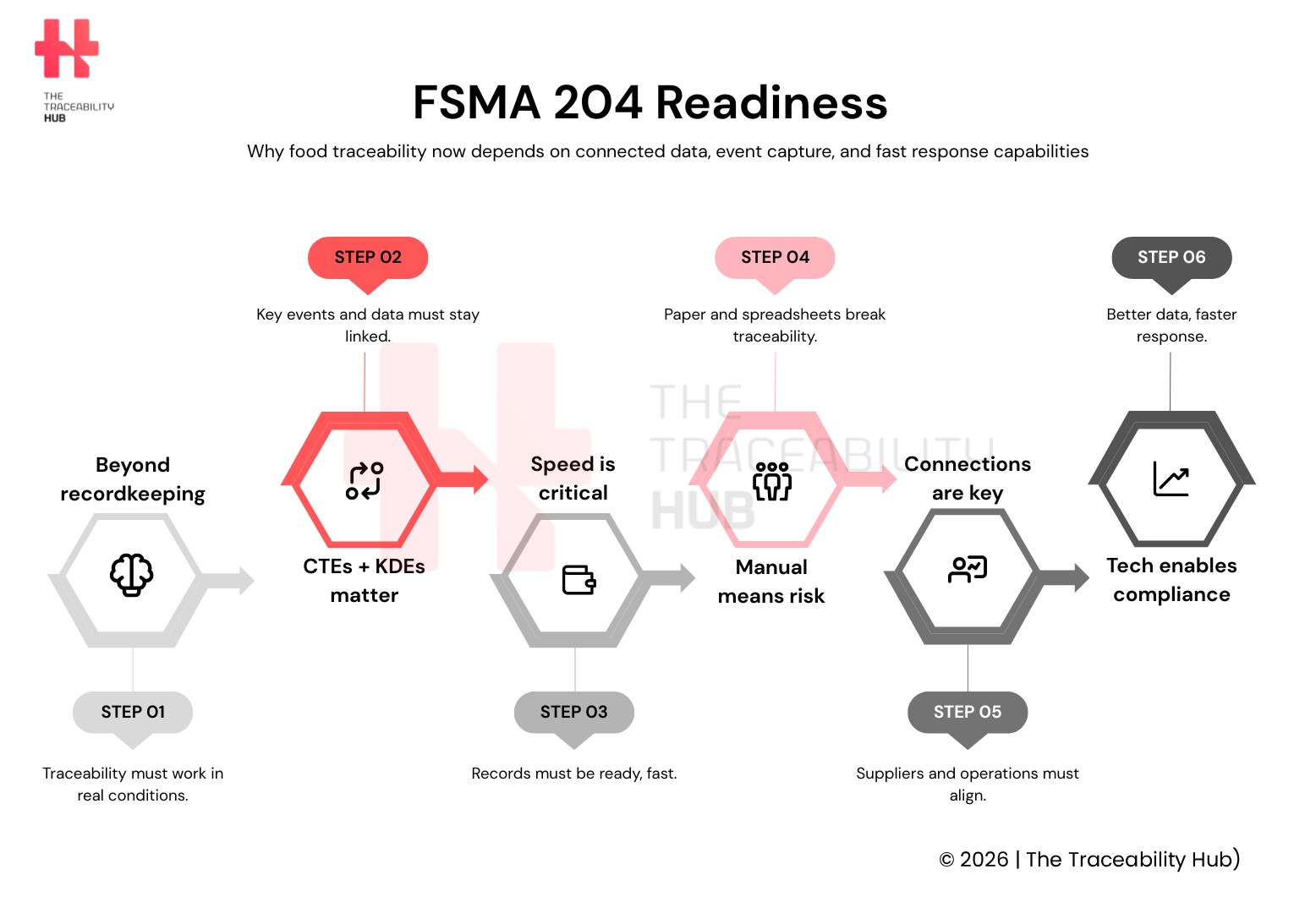
FSMA 204 changes the food-traceability conversation because it shifts attention from generic recordkeeping to structured, event-linked traceability systems that must be usable under regulatory pressure and FDA traceability compliance scenarios. For covered foods on the FDA’s Food Traceability List, the rule centers on Critical Tracking Events (CTEs) and Key Data Elements (KDEs) that need to move through the supply chain in a way the agency can request, validate, and review quickly.
In the U.S. market, that makes FSMA 204 readiness a systems and traceability technology question as much as a regulatory one, requiring digital food traceability solutions and supply chain visibility platforms.
The current federal enforcement timeline has also kept the issue very real. FDA has indicated that it does not intend to enforce the Food Traceability Rule before July 20, 2028, following congressional direction, but that extra time does not reduce the implementation challenge or food traceability systems. It simply clarifies that companies still need to build the capability.
Compliance will depend on whether traceability data, event-linked records, and food safety compliance information can actually be captured, linked, retrieved, and shared, not on whether policy documents exist.
The Data and Process Capabilities Companies Need to Support Compliance
At the center of FSMA 204 food traceability requirements is a straightforward but demanding requirement: companies subject to the rule must maintain the right information for the right events and make it available quickly when needed. That means product identity, traceability lot codes, event logic, traceability record linkage, and response workflows all have to work together. In many food organizations, the weak point is not awareness of FSMA 204 compliance requirements. It is the gap between what the rule requires and what current traceability systems, ERP systems, or warehouse management systems can produce reliably.
This is where food traceability technology solutions become important. Companies need tools that support lot-level record integrity, event capture across facilities and supply chain partners, and the ability to produce usable outputs without extensive manual traceability reconstruction. The same operational logic appears in more general discussions of food traceability, where visibility improves only when product identity and event data remain connected across the chain.
FDA has also emphasized that FSMA 204 rule does not prescribe one mandatory software platform or traceability application. That matters because FSMA 204 readiness is less about buying a branded tool and more about proving that records are legible, linked, retrievable, and shareable in a usable food compliance format when needed.
For many food businesses, the real evaluation question is whether current food traceability systems can support complete lot histories without depending on manual reconstruction or spreadsheet-based tracking.
Capturing Critical Tracking Events and Key Data Elements
A compliant FSMA 204 traceability process starts with clean event-based traceability design. Receiving, shipping, transformation, initial packing, and other relevant activities need to generate records that connect the required Key Data Elements to the appropriate product identity and traceability lot context. If teams rely on disconnected spreadsheets, handwritten logs, or inconsistent data entry rules, that food traceability linkage often breaks down before the record ever reaches an audit archive or reporting layer.
Food traceability Technology helps here not by replacing operational judgment, but by reducing traceability data loss and ambiguity. Systems that structure event capture at the point of activity (real-time traceability systems or digital food traceability platforms) make it easier to preserve traceability lot codes, source information, dates, locations, and transformation logic in a way that survives audits and investigations. The more manual the food traceability process, the more likely it is that response speed, traceability accuracy, and compliance readiness will collapse when the records are actually needed.
Linking Lot-Level Records Across Suppliers and Internal Operations
Lot-level traceability linkage is where many FSMA 204 readiness programs either strengthen or fail in achieving full food supply chain traceability.
A company may record information well inside one facility and still struggle to connect supplier traceability records, internal transformations, and outbound logistics data into one coherent traceability thread. FSMA 204 raises the stakes because covered foods products may pass through multiple entities before they reach retail, food service, or further manufacturing.
The best food traceability technology choices therefore support not only internal recordkeeping but also more disciplined partner coordination, traceability data exchange, and partner onboarding within a multi-enterprise food supply chain network.
Supplier onboarding, record mapping, data-standard alignment, and exception-handling processes all influence whether the chain holds together. Even consumer-facing technologies like QR codes on food labels only become meaningful when the upstream food traceability data architecture is solid enough to support trustworthy information.
FSMA 204 Readiness
Which Technology Solutions Help Close Readiness Gaps
No single traceability software tool guarantees FSMA 204 readiness. What helps most is a combination of:
- event-capture capability in food production systems,
- data-standardization logic for traceability data,
- integration support,
- rapid-response workflow design for recalls and audits.
ERP extensions, warehouse and manufacturing systems (WMS), dedicated traceability platforms, supplier portals, and analytics layers can all play a role, depending on where the current gaps sit.
For some companies, the priority is replacing paper-based or semi-manual food lot tracking systems. For others, it is integrating supplier traceability data or improving retrieval speed for traceability requests. Solutions that surface exceptions, validate missing fields, and make records easier to sort and export are especially valuable because they reduce the distance between daily operations and regulatory response.
Integration, Data Standardization, and Response Workflows
Integration matters because FSMA 204 is not just about collecting more food traceability data; it is about making distributed supply chain data behave like a usable traceability system. When purchasing, receiving, production, warehousing, and shipping all live in separate tools, the real implementation work lies in aligning identifiers, traceability record timing, and event ownership across those systems.
A useful FSMA 204 compliance benchmark is the ability to assemble a coherent traceability picture quickly when regulators ask for it. FDA states that, in certain circumstances, firms may need to provide the requested information in an electronic sortable spreadsheet, which is why integration and traceability data standardization deserve as much attention as label design or scanning accuracy. The same logic also appears in broader discussions of food traceability systems, where response speed depends on linked records rather than isolated documents.
Response workflows matter just as much. If an outbreak, recall event, or FDA request occurs, teams need to know who assembles the information, how it is validated, and how quickly it can be delivered in a sortable format. A company that can collect traceability data but not operationalize it under time pressure is not ready, even if its records look complete in routine conditions.
Why Implementation Planning Matters Before Enforcement Pressure Rises
The extra runway before FSMA 204 enforcement should not be treated as a reason to postpone. It should be used to test traceability record logic, clean up partner dependencies, and stress the response model before the stakes rise. Waiting until enforcement pressure becomes immediate usually means building around emergencies rather than building for resilient execution.
FSMA 204 is ultimately a food traceability readiness challenge. The companies that will handle it well are the ones that translate the rule into specific capabilities: event capture, lot-level traceability linkage, partner coordination, and rapid retrieval. Technology solutions matter because they make those capabilities repeatable. Without them, food regulatory compliance remains too dependent on manual reconstruction and tribal knowledge to be confident when the chain is under stress.
That preparation phase is also the best time to identify which records are still too dependent on tribal knowledge. If one experienced planner or quality lead is the only person who knows how to reconstruct a lot history, the process is not ready. Technology should reduce that dependency by making the traceability path visible, standardized, and repeatable for the broader organization.
For U.S. food businesses, the opportunity is bigger than avoiding a compliance scramble. Companies that use FSMA 204 preparation to improve lot-level traceability discipline, partner coordination, and retrieval speed can strengthen recall precision and supply chain confidence at the same time. The most effective FSMA 204 technology solutions will be the ones that turn regulatory requirements into durable food traceability operating capability.
Read more: Food Traceability: The Pillars of Safe Tracking Across the Agri-Food Supply Chain