



Why Food Traceability Is Foundational to Food Safety and Supply Chain Trust
Food traceability matters most when something goes wrong, but its value starts much earlier. A contaminated ingredient, an undocumented transformation step, or an unclear supplier handoff can turn a local issue into a costly multi-state disruption. In the United States, that reality has become even more visible as the FDA has pushed the Food Traceability Rule under FSMA Section 204 toward more structured, event-based traceability and recordkeeping. The message is clear: safe food tracking and food safety traceability are no longer just about keeping records, but about being able to use traceability data quickly and accurately.
Trust is part of the same equation. Buyers, regulators, and downstream partners need confidence that food can be traced with enough precision to support recall decisions, food recall management, root-cause analysis, and verification of sourcing claims. That is why food traceability now sits alongside broader conversations about production traceability, food supply chain visibility, and operational visibility. In agri-food systems, however, the challenge is sharper because supply chains are fragmented, highly seasonal, and often dependent on multiple transformations before a product reaches retail or food service. Effective agri-food traceability therefore depends on consistent traceability management across multiple stakeholders.
The Core Pillars That Make Food Traceability Reliable
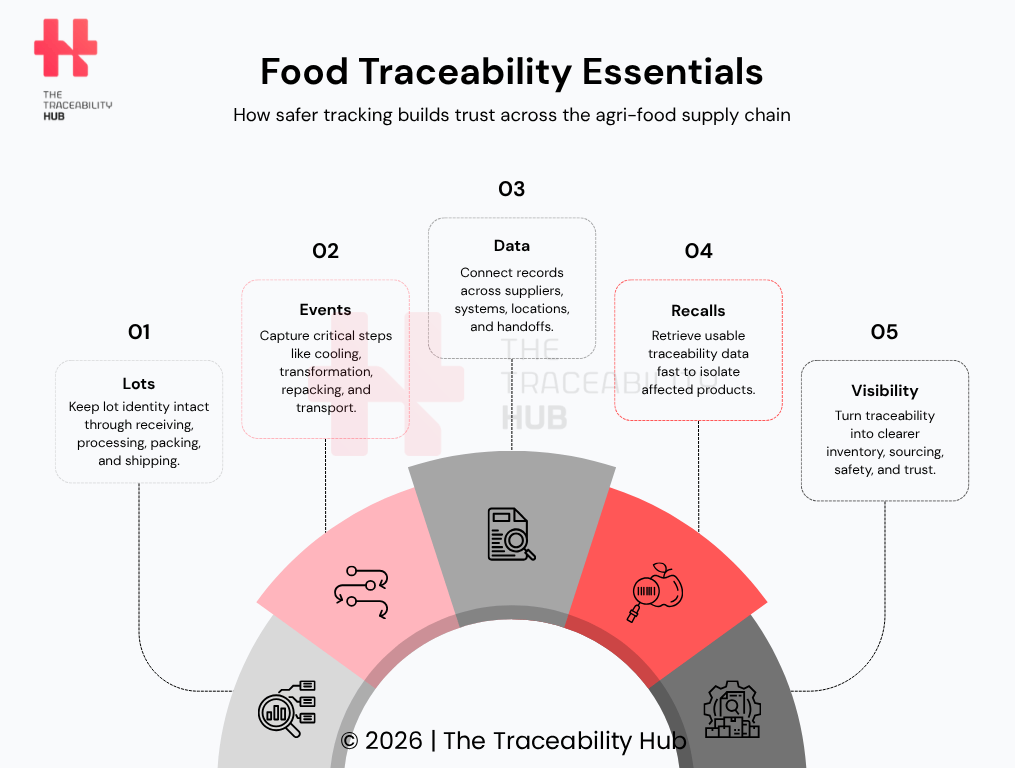
A reliable model starts with product identity, lot identification, and lot integrity. If a company cannot distinguish one lot from another or consistently carry that identity through receiving, transformation, packing, and shipping, the rest of the food traceability system is built on weak foundations. Lot design may sound basic, but it determines whether traceability is specific enough to isolate risk without over-expanding a recall and supports effective lot tracking throughout the supply chain.
The second pillar is event capture. Good food traceability records do not simply state where a product exists; they show what happened to it at critical points. Receiving, cooling, transformation, repacking, and shipping all matter because they explain how a product moved and changed. This is where the logic behind RFID technology, sensors, smart labels and other digital traceability and supply chain visibility tools become relevant: the safer the chain needs to be, the more important it becomes to reduce blind spots between handoffs, facilities, and transport steps while maintaining end-to-end traceability.
Product Identity, Lot Integrity, and Event Capture
Lot integrity is especially important in food because upstream materials often merge, split, or transform. A fresh product can become cut produce, an ingredient blend, a prepared meal, or a repacked retail format. Without disciplined identity rules and accurate product traceability, traceability either stops at the transformation point or becomes so broad that it is operationally useless. Precision depends on keeping the thread intact, even when the physical form changes.
Event capture works only when it is connected to that thread. For U.S. companies preparing for more rigorous traceability compliance, regulatory compliance, and customer expectations, the practical question is not whether data exists somewhere, but whether the right traceability records and traceability data can be retrieved quickly and in a usable format. That often means moving away from fragmented spreadsheets and relying on more structured traceability processes or food traceability software and platform that can connect lots, dates, locations, suppliers, and transformation steps without manual reconciliation every time an issue surfaces.
Supplier Coordination, Data Quality, and Response Readiness
The third pillar is partner coordination. Food traceability is rarely broken by one company acting alone; it is broken by mismatched data between companies. One supplier uses an internal naming convention, another sends partial shipping records, and a downstream packer captures events differently again. The result is traceability that appears completely inside each node but fails across the broader food supply chain traceability network.
This is why data quality and recall readiness belong together. It is not enough to collect traceability data if it cannot support rapid investigation. Records need common definitions, clear ownership, and processes for secure data sharing information under time pressure. Even seemingly simple consumer-facing tools such as QR codes on food labels only create real value when the underlying information architecture is reliable enough to support trust, transparency, and exception handling.
Food Traceability Essentials
Where Agri-Food Traceability Often Breaks Down in Practice
In practice, traceability problems usually come from handoffs, transformations, and inconsistent record discipline. Growers, processors, distributors, cold-chain providers, and retailers may each have functioning internal systems, yet still struggle to connect records when a lot moves across organizational boundaries. Paper-based processes, manual re-entry, and disconnected ERP, warehouse tools, or food traceability software amplify the risk and reduce overall supply chain transparency.
Another weak point is the gap between compliance records and operational records. Teams may hold enough information to satisfy a periodic review but still lack the speed needed during an active incident. When product histories have to be reconstructed from emails, Excel database, batch sheets, and separate logs, response time stretches exactly when clarity is most needed. Food traceability fails not only when data is missing, but when the path to the answer is too slow to support effective food recall management and regulatory response.
Fragmented Records, Handoffs, and Inconsistent Partner Data
Fragmentation becomes even more serious when products are perishable or multi-ingredient. A delay in matching incoming lots to outgoing shipments may not only affect compliance; it may leave exposed inventory in circulation while teams are still searching for the right records. For food businesses operating in the U.S., that creates a direct tension between safety, cost, continuity, and effective inventory traceability.
The solution is rarely one system alone. It is a combination of better identifiers, cleaner event design, agreed partner data, stronger traceability documentation, and more disciplined retention of records that can be sorted and shared under pressure. That combination is what makes a traceability system resilient enough to support investigations, regulatory requests, and customer expectations without turning every incident into a manual project.
Why Stronger Traceability Supports Safer Recalls and Better Visibility
When these pillars are in place, traceability does more than support compliance. It improves recall precision, inventory confidence, supply chain visibility, operational awareness and consumer engagement. Teams can isolate affected lots more accurately, reduce unnecessary product withdrawals, and move faster from suspicion to decision. That has obvious public-health value, but it also protects margin, reputation, and overall food safety performance.
The broader point is that food traceability is not a single technology choice. It is an operating model built on identity, event capture, partner coordination, reliable traceability data management, and response readiness. In the agri-food supply chain, safe tracking depends on how well those pillars work together. When they do, organizations achieve stronger food supply chain traceability, better supply chain transparency, and are better prepared not only for regulatory scrutiny, but for the everyday disruptions that make food supply chains difficult to manage in the first place.
A stronger traceability model also improves day-to-day planning. When lot identity, lot tracking and event records are dependable, teams can reconcile inventory faster, investigate supplier discrepancies earlier, and separate quality issues from logistics issues with less guesswork. That operational clarity is one reason food traceability is becoming a management capability, not just a compliance requirement.
It also supports more credible transparency. Retailers, food-service operators, and brand owners increasingly need to answer questions about origin, handling, sustainability and product movement with confidence. The same end-to-end traceability foundations used for recalls can support those answers, provided the records are built for consistency and speed rather than only for archival retention.
Read more: The Hidden Dependencies of Italian Agrifood Supply Chains