



From Ear Tags to End-to-End Traceability
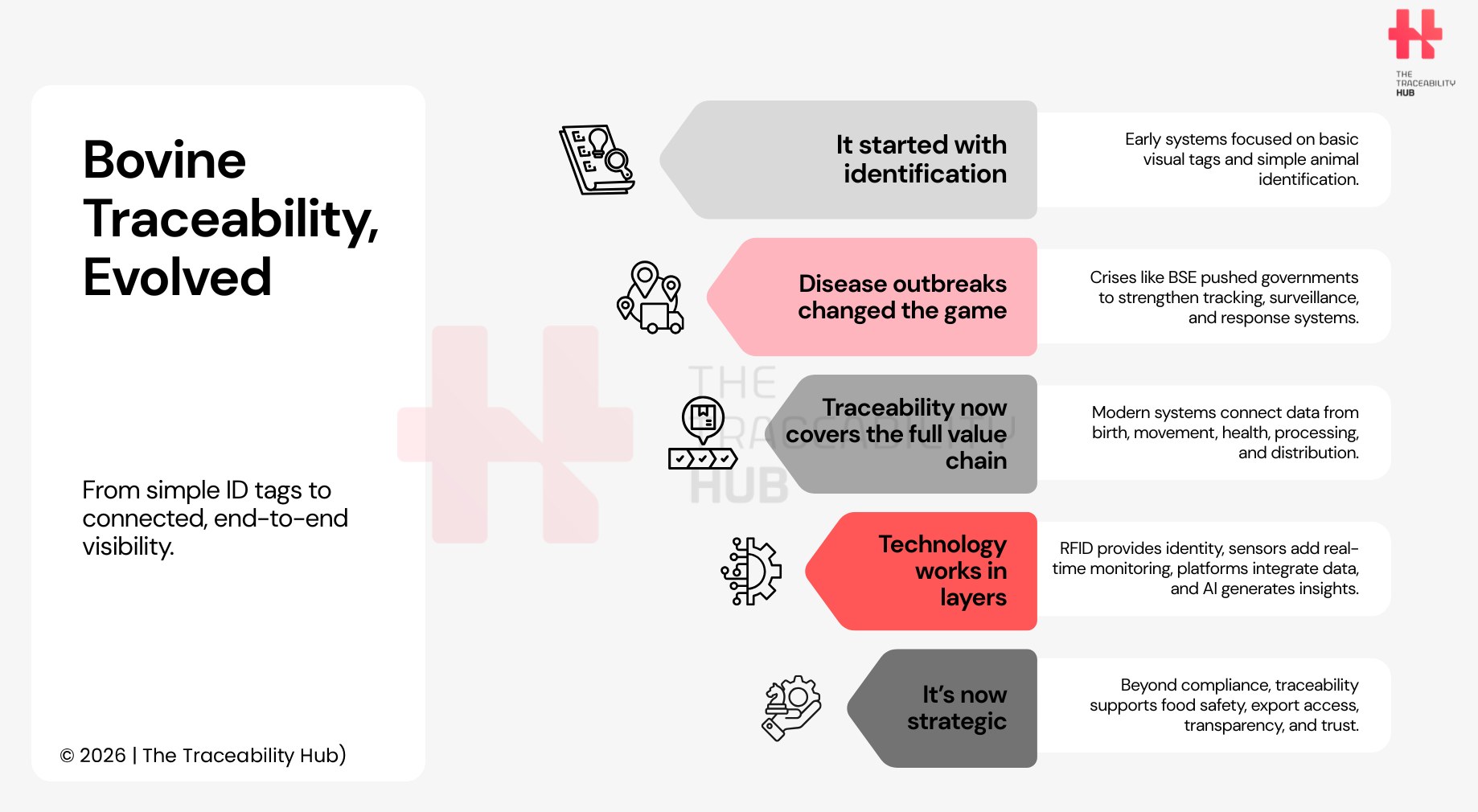
Bovine traceability has changed dramatically over time. What started with basic visual identification and livestock identification methods has become a far more connected end-to-end traceability system, linking each animal to data on movements, health status, processing, and distribution across the beef supply chain.
More than a technological upgrade, this shift reflects broader changes in regulation, international trade, and buyer expectations. Bovine traceability and cattle Traceability now plays a central role not only in compliance, but in food safety, biosecurity, market access, operational performance, supply chain transparency, and trust in the beef value chain.
Why Bovine Traceability Transformed
The initial drivers of cattle traceability and animal traceability systems were largely regulatory and risk based. Disease outbreaks—most notably bovine spongiform encephalopathy (BSE), or mad cow disease—exposed the limitations of basic identification systems and underscored the need for more robust livestock tracking and animal movement tracking frameworks. In response, governments and regulatory authorities strengthened traceability requirements to improve disease surveillance, containment, and response capabilities.
Over time, commercial and market forces accelerated this transformation. In many markets, stricter import protocols made traceability an increasingly important condition for international beef trade and export compliance, especially for export-oriented supply chains. At the same time, traceability began to serve a broader strategic purpose: helping companies differentiate products, substantiate origin claims, support food provenance initiatives, and reinforce confidence in the quality and integrity of beef products.
Today’s livestock traceability frameworks go far beyond simple identification. Modern systems increasingly connect individual animal identity with data on movement, health, processing, and distribution across the value chain. In doing so, they address regulatory obligations while also supporting commercial resilience, operational visibility, food supply chain transparency, and the growing demand for transparency in food systems.
Bovine Traceability, Evolved
The Multilayer Technology Architecture
Contemporary bovine traceability is enabled by multilayered technology architecture. Rather than relying on a single tool, advanced livestock traceability systems combine several technologies, each performing a distinct role across identification, monitoring, data integration, and verification. In practice, the most effective traceability models are built as connected layers rather than standalone solutions.
RFID: The Foundation of Identity
Radio-frequency identification (RFID) has become a widely adopted standard for electronic animal identification and plays a central role in many national cattle traceability frameworks. Its strength lies in scalability: RFID tags, RFID ear tags, and cattle RFID tags are relatively inexpensive, durable, and practical for deployment across large herds and complex supply chains.
However, RFID (RFID Food Traceability for Supply Chain Visibility) alone does not constitute full traceability. By itself, it provides a reliable identity layer for livestock identification, but not the broader context needed to understand where an animal has been, what has happened to it, or how its data connects to downstream processes.
Effective RFID cattle tracking therefore depends on integration with wider traceability systems and livestock data management platforms
IoT and Sensors: Adding Real-Time Visibility
Internet of Things (IoT) devices and sensor technologies extend traceability beyond static identification. Wearables and connected devices, including accelerometers, temperature sensors, and location-enabled tools such as GPS and LoRa-based systems, can generate continuous or near real-time data on animal activity, health indicators, and movement.
This added visibility enables more dynamic herd management, earlier detection of anomalies, and a more responsive approach to health and welfare monitoring. As a result, livestock monitoring technology and cattle monitoring systems are becoming increasingly important components of modern digital livestock traceability programs.
Data Platforms and Cloud Systems: Turning Data into Traceability
If RFID and sensors generate the raw inputs, data platforms make traceability operational. Centralized databases, cloud-based traceability infrastructures, and interoperable information systems act as the backbone of modern traceability frameworks by consolidating identification, movement, and monitoring data into usable records. These platforms support compliance workflows, livestock certification processes, chain-of-custody documentation, and broader visibility across the supply chain. Their real value lies in transforming fragmented data points into structured, actionable traceability intelligence that supports both operational decision-making and livestock compliance requirements.
AI and Advanced Analytics: Emerging Intelligence
Artificial intelligence (AI) and advanced analytics are increasingly being layered onto traceability infrastructures to enhance decision-making. Emerging applications include disease prediction, behavioral analysis, weight estimation, computer vision-based identification, fraud detection, and supply chain optimization.
While these capabilities are expanding rapidly, AI does not replace the underlying traceability architecture. Instead, it amplifies the value of existing RFID, sensor, and livestock platform data by generating insights that are more predictive, contextual, and scalable
Blockchain: An Optional Trust Layer
Blockchain is best understood as an additional trust mechanism rather than a core requirement of traceability. Its main value lies in immutability, auditability, and the ability to strengthen confidence in shared records, particularly in premium market programs, certification schemes, or export contexts where provenance claims and origin verification must be independently supported.
That said, large-scale adoption remains uneven, as blockchain traceability implementations can introduce additional cost, governance requirements, and complex integration. For many organizations, blockchain in agriculture remains a complementary rather than foundational technology.
Taken together, the most advanced bovine traceability systems combine these layers into a coherent architecture: RFID for identity, IoT sensors for monitoring, cloud platforms for integration, AI for insight, and blockchain—where relevant—as an optional layer for trust, auditability, and verification.
From Birth to Beef: Tracing the Entire Value Chain
Traditional traceability systems often stopped at slaughter, with limited continuity between upstream livestock records and downstream product information. By contrast, modern “birth-to-beef” traceability systems are designed to extend traceability across the full value chain, creating a more continuous and interoperable record of the animal and the product as they move through the system.
Primary Production: Birth Registration, Farm Management, and Health Records
Traceability begins at the point of origin. At the farm level, systems increasingly capture animal identification, birth registration, ownership data, health interventions, breeding history, and on-farm management records.
This early-stage data creates the foundation for all subsequent traceability events and is critical for both herd management and regulatory compliance. It also establishes the digital foundation required for end-to-end beef traceability and livestock supply chain traceability.
Logistics: Animal Movement, Feedlots, and Transport
As animals move across locations and operators, traceability depends on the accurate recording of transfers, transport events, and feedlot or backgrounding stages. This logistics layer is essential for monitoring exposure risks, maintaining continuity of custody, supporting animal movement tracking, and ensuring that movement data remains linked to the individual animal or group throughout the production cycle.
Processing: Slaughter, Carcass Segmentation, and Batch Tracking
Processing marks one of the most complex transitions in the traceability chain, because the traceability unit shifts from the live animal to carcasses, cuts, lots, and batches. Effective systems preserve this connection by mapping slaughter data, carcass segmentation, and production batch information back to upstream records.
This is what enables traceability to persist even after the physical animal has become multiple downstream product units, supporting comprehensive beef traceability and supply chain traceability throughout the processing environment.
Distribution and Retail: Packaging, Labelling, and Consumer Information
In downstream stages, traceability supports packaging records, labelling claims, origin verification, product traceability, and the communication of product information to buyers and consumers. At this point, traceability is no longer only about internal control; it also becomes a mechanism for market access, brand protection, food provenance verification, and transparency at the point of sale.
This end-to-end approach creates a continuous digital thread that extends traceability well beyond the farm gate and into the later stages of the beef supply chain. In strategic terms, that continuity is what turns identification into true value-chain traceability and farm-to-fork traceability.
The Supplier Spectrum
The bovine traceability ecosystem includes a diverse range of providers operating across identification hardware, digital livestock traceability platforms, supply chain integration tools, monitoring systems, and advanced analytics. What increasingly differentiates leading vendors is not just the ability to supply devices, but the ability to connect data, workflows, and intelligence across multiple stages of the livestock value chain and beef supply chain traceability ecosystem.
From Devices to Integrated Ecosystems
Some suppliers remain focused on core livestock identification infrastructure, such as RFID tags, readers, and basic data capture tools. Others have expanded into broader integrated livestock traceability ecosystems that combine identification, monitoring, cloud-based record management, and analytics. This distinction matters because the market is moving away from standalone components and tools toward integrated traceability environments that can support compliance, operational decision-making, and differentiated beef supply chain programs at the same time.
Allflex as a Leading Reference Point
Among the most prominent players, Allflex Livestock Intelligence is widely regarded as one of the leading global providers in livestock identification and monitoring technology. Its offering combines RFID and visual identification, tissue sampling, sensors-based monitoring, and data-driven monitoring capabilities, making it an important reference point in discussions about the evolution from identification to integrated livestock intelligence.
Capability Depth and Intelligence Level
Across the supplier landscape, livestock traceability providers can be understood through two broad dimensions: the depth of capability and the level of intelligence they enable. On one axis, capabilities range from basic hardware and animal identification tools to end-to-end traceability systems that connect multiple stages of the “birth-to-beef” chain. On the other hand, intelligence ranges from simple identification and record capture to predictive analytics, automation, and AI-supported decision-making for beef supply chain optimization.
What is increasingly clear is that no serious provider competes with a single technology alone. The direction of the market favors multilayered livestock traceability architectures in which hardware, software, livestock monitoring solutions, and analytics work together to deliver full traceability rather than isolated functionality.
Global Approaches to Bovine Traceability
Bovine Traceability programs vary significantly by region, shaped by regulatory priorities, livestock production structures, animal disease traceability requirements, public-health concerns, and exposure to export markets.
Some countries have built highly integrated systems that support lifetime animal tracking, while others remain more focused on disease response, movement controls, or export-specific compliance. Together, these models show that bovine traceability does not follow a single global template, even if the direction of travel is broadly toward greater digitalization and interoperability.
European Union: A Highly Structured Regulatory Model
The European Union operates one of the world’s most structured cattle traceability frameworks and livestock identification systems. Its model is based on individual identification, traditionally through double ear tags, supported by holding records and centralized national livestock databases.
In many member states, cattle passports have also played an important role in documenting animal identity and livestock movement tracking. The overall result is a system designed to maintain traceability from birth through movement and onward to slaughter, with strong emphasis on animal health, biosecurity systems, food safety, and regulatory control within the beef supply chain.
Australia: Lifetime Traceability at National Scale
Australia’s National Livestock Identification System (NLIS) is widely recognized as one of the most advanced national traceability models in the beef sector. It combines animal identification, property identification, and a central livestock database that records movements across the supply chain.
For cattle, electronic animal identification has become a core element of the system, enabling lifetime movement tracking and supporting both biosecurity management and export-market assurance. The Australian model is often cited as a benchmark for scalable digital livestock traceability and national traceability can operate at scale.
Brazil: Export-Focused and Selectively Applied
In Brazil, bovine traceability has historically been more selective, market driven, and focused on export compliance. SISBOV, the official livestock identification and certification system for cattle and buffaloes, has been especially important for export supply chains serving regulated markets such as the European Union.
Rather than covering the entire national herd uniformly, livestock traceability adoption has often been concentrated in certified export-oriented segments requiring beef certification and origin verification. This selective structure reflects both the scale of Brazil’s cattle sector and the operational complexity of implementing full individual traceability across highly diverse production systems.
United States and Canada: Two Different North American Models
The United States has traditionally prioritized animal disease traceability and livestock movement tracking over full lifecycle traceability, with federal rules focused mainly on interstate movement and rapid disease response rather than comprehensive birth-to-slaughter visibility for all cattle.
Canada, by contrast, has developed a more comprehensive RFID-based livestock traceability framework centered on mandatory identification and an expanding traceability infrastructure. While Canada’s movement-reporting requirements are still evolving, its overall system is generally regarded as more integrated and closer to end-to-end livestock traceability than the U.S. federal model.
Argentina and Uruguay: Export Logic with Different Levels of Maturity
Argentina and Uruguay both reflect the strong influence of export markets on traceability system design, but they differ in maturity, coverage, and livestock data integration. In Argentina, institutions such as SENASA have long played a central role in livestock identification and movement control, and the country is now moving further toward mandatory electronic individual identification.
Uruguay, meanwhile, is widely recognized for having one of the most comprehensive cattle traceability systems in the world, with near-universal individual animal traceability and integration between animal-level and meat-industry records. This has made Uruguay a particularly important reference point in global discussions about end-to-end beef traceability.
What these regional approaches make clear is that bovine traceability evolves in response to different pressures: disease risk, administrative capacity, export exposure, and the structure of national livestock sectors. Some systems are designed primarily for regulatory control, others for trade access, and others for full-chain transparency. Yet across these different models, the broader trend is consistent: traceability is becoming more digital, more connected, and more strategically important sustainable beef production and global food supply chain transparency.
Expansion Challenges
Despite its clear benefits, expanding bovine traceability and livestock traceability systems continue to present persistent challenges. Cost remains one of the most significant barriers, particularly for smallholders and fragmented livestock production systems that may struggle to absorb the expense of electronic RFID tags, livestock tracking devices, software, subscriptions, training, and ongoing compliance. As systems become more data-intensive, the gap between technologically advanced digital livestock operations and resource-constrained producers can widen rather than narrow.
Data fragmentation is another major obstacle. In many countries and beef supply chains, traceability information remains distributed across disconnected databases, proprietary platforms, processors, and regulatory jurisdictions. Where interoperability is weak, the result is not true end-to-end traceability but a series of partial records that are difficult to reconcile across the value chain. This limits the effectiveness of traceability precisely where continuity and speed matter most.
Governance adds further complexity. Effective livestock traceability systems require a workable balance between state oversight, industry participation, and commercial confidentiality, yet that balance is not easy to design or sustain. As systems become more digital, questions around data ownership, privacy, access rights, and control are becoming more prominent. These issues are often especially acute in developing economies, where digital infrastructure, institutional capacity, and enforcement mechanisms may be more limited, making large-scale implementation harder to achieve.
For the industry, the challenge is no longer whether bovine traceability matters, but how to expand it in ways that are economically viable, interoperable, and institutionally sustainable across the global beef supply chain.
What’s Next for Bovine Traceability
Several future directions are already shaping the next generation of digital livestock traceability systems. One of the most important is the convergence of traceability with sustainability metrics, including carbon footprint measurement, land-use monitoring, and, in some markets, deforestation-related reporting. This reflects a broader shift in the beef sector: traceability is no longer only about where an animal came from, but increasingly about how it was raised and what environmental claims can be substantiated across the beef supply chain. At the same time, AI and advanced analytics are expected to play a growing role in disease modelling, herd management, and predictive decision-making, making traceability systems more proactive, intelligent, as well as more transparent.
Another major direction is accessibility. There is strong interest in mobile-first and lower-cost digital tools that can make traceability tools more practical for small-scale farmers, especially in regions where infrastructure, connectivity, and institutional support remain limited. At the international level, greater interoperability between national and commercial systems will also become increasingly critical, as global beef trade depends more on the exchange of trusted data across borders. In that sense, the next phase of bovine traceability will be defined not just by better technology, but by broader inclusion and stronger data connectivity.
From compliance infrastructure to strategic value-chain intelligence and beef supply chain transparency, bovine traceability is becoming one of the defining systems shaping the future of beef.
Read more: FSMA 204: Technology Solutions for Food Regulatory Compliance