



The Tomato Industry at a Turning Point
In conjunction with the 2026 National Made in Italy Day, ANICAV, the National Association of Vegetable Preserves Industrialists, the association representing private companies operating in the sector of the processing and preservation of vegetable products, has released updated data offering a comprehensive overview of Italy’s processed tomato sector, a crucial component of the national food industry and broader Made in Italy supply chain ecosystem. Italy remains the foremost global exporter in this field, with exports valued at €2.8 billion and volumes surpassing 2.2 million tons. These statistics underscore the international significance and competitive stature of Italian tomato products within international food markets.
A notable shift occurred in 2025, representing the first decline in export performance in over ten years, an 8% decrease in value and a 2% reduction in volume. This trend indicates a profound structural change impacting the sector’s competitiveness and supply chain resilience rather than merely reflecting short-term volatility.
Industry experts attribute this slowdown not to diminished demand, but to a convergence of external systemic challenges affecting global supply chains and international trade competitiveness. Geopolitical tensions are altering trade dynamics, while protectionist measures and tariffs, particularly in the United States, are erecting additional trade barriers. Intensified competition from countries with less rigorous production standards is exerting downward pressure on prices, and escalating energy costs are putting further strain on producers as the next production cycle approaches.
As highlighted by ANICAV President Marco Serafini, these developments demonstrate that market competitiveness increasingly hinges on participants who do not comply with equivalent standards of quality, safety, sustainability, and transparent supply chain practices. This evolving landscape poses ongoing challenges for the global standing of Made in Italy products.
The Hidden Tension: Quality vs Price
Italian processed tomato products, particularly peeled tomatoes, pulp, and cherry tomatoes, which together account for over 64% of total exports, have long been positioned as high-value, premium-quality goods within the international food supply chain. This positioning is rooted in recognized quality, strict production standards, and strong brand equity associated with Made in Italy.
However, this premium positioning and value differentiation strategy are increasingly under pressure.
As Giovanni De Angelis, Director General of ANICAV, highlights, the strength of the made in Italy brand remains undeniable, but growing price-based competition is progressively eroding its ability to compete effectively in international markets increasingly driven by price sensitivity rather than verified transparency.
This dynamic reflects a broader structural tension that extends well beyond the tomato sector and affects global supply chains at large. Premium quality inherently comes with higher production costs, from compliance with stricter environmental and social standards to higher input and energy expenses. At the same time, markets are increasingly driven by price sensitivity, favoring lower-cost alternatives regardless of underlying differences in quality, traceability, sustainability, or responsible sourcing practices.
Compounding this issue is a critical information and transparency gap: consumers are rarely equipped with clear, accessible insights into what differentiates products at different price points. As a result, the perceived value of higher-quality and more sustainable goods is flattened, and price becomes the dominant, if not the only, decision-making factor within competitive food markets.
This dynamic is perhaps most visibly — and damagingly — embodied by the phenomenon of Italian sounding: the widespread global practice of using Italian names, colors, imagery, and geographical references on food products that have no authentic connection to Italy whatsoever. Products bearing names like “Bella Italia”, “Pomodoro di Roma”, or evoking Italian geographical heritage are manufactured in many countries, exploiting the reputational equity of Made in Italy without contributing to it. And without being subject to the quality, environmental, or social standards that Italian producers are required to meet.
The economic scale of the problem is staggering. According to Coldiretti which, with 1.6 million members, is the main organization of agricultural entrepreneurs in Italy, Italian sounding products generate an estimated €120 billion annually in global markets: more than double the value of Italy’s entire authentic agri-food export sector! In the tomato sector specifically, this means that for every genuine Italian product on an international shelf, multiple imitations compete alongside it, often at significantly lower prices, with no verifiable differentiation available to the consumer.
Italian sounding is, in effect, the ultimate expression of the transparency gap: it is not merely a case of quality being undervalued, it is a case of origin being systematically falsified, value being appropriated without accountability, and consumers being structurally prevented from making informed choices. No amount of brand investment or quality improvement by genuine Italian producers can compensate for this distortion if the information asymmetry is not addressed at its root through verifiable, traceable, and standardized origin data.
Why This Matters for Traceability
At this stage, the discussion extends beyond mere market dynamics and assumes direct relevance for supply chain traceability, verified transparency, and long-term competitiveness.
The competitive pressures identified by ANICAV are both economic and, crucially, informational in nature.
When products manufactured according to disparate production standards compete within the same marketplace, the lack of transparent and accessible product information results in distortions of value assessment, preventing true recognition of product merit.
When Transparency Is Missing, Price Wins
In environments characterized by low transparency and limited supply chain visibility, three key dynamics become evident. Firstly, limited visibility diminishes perceived value, causing high-quality and lower-quality products to appear indistinguishable. Secondly, price emerges as the primary, and frequently sole, criterion in decision-making processes, making the product a simple commodity. Thirdly, supply chains committed to quality, sustainability, and compliance gradually lose their capacity for effective differentiation.
This phenomenon reflects not the deficiency of the product itself, but rather the shortfall in the transparent, verifiable, and traceable information available about it.
Traceability as a Value Enabler
In this context, traceability is not only a tool for quality assurance: it is the most effective structural response to Italian sounding. A Digital Product Passport that verifiably links a product to its geographic origin, production process, and supply chain actors does what a brand name alone cannot: it makes authenticity demonstrable, not merely claimable.
Traceability and supply chain transparency offers an opportunity to restore visibility where it is currently lacking. By providing access to essential information, including the sources of raw materials, production methods, and adherence to environmental and social standards, traceability converts quality from an implied assurance into a clearly defined, verifiable characteristic.
This process enables quality and sustainability to become a quantifiable and communicable value rather than a concealed cost, fostering more informed decision-making throughout the market and supporting conditions for equitable competition, verified competitiveness, and stronger consumer trust.
Italian Tomatoes, Proven Better
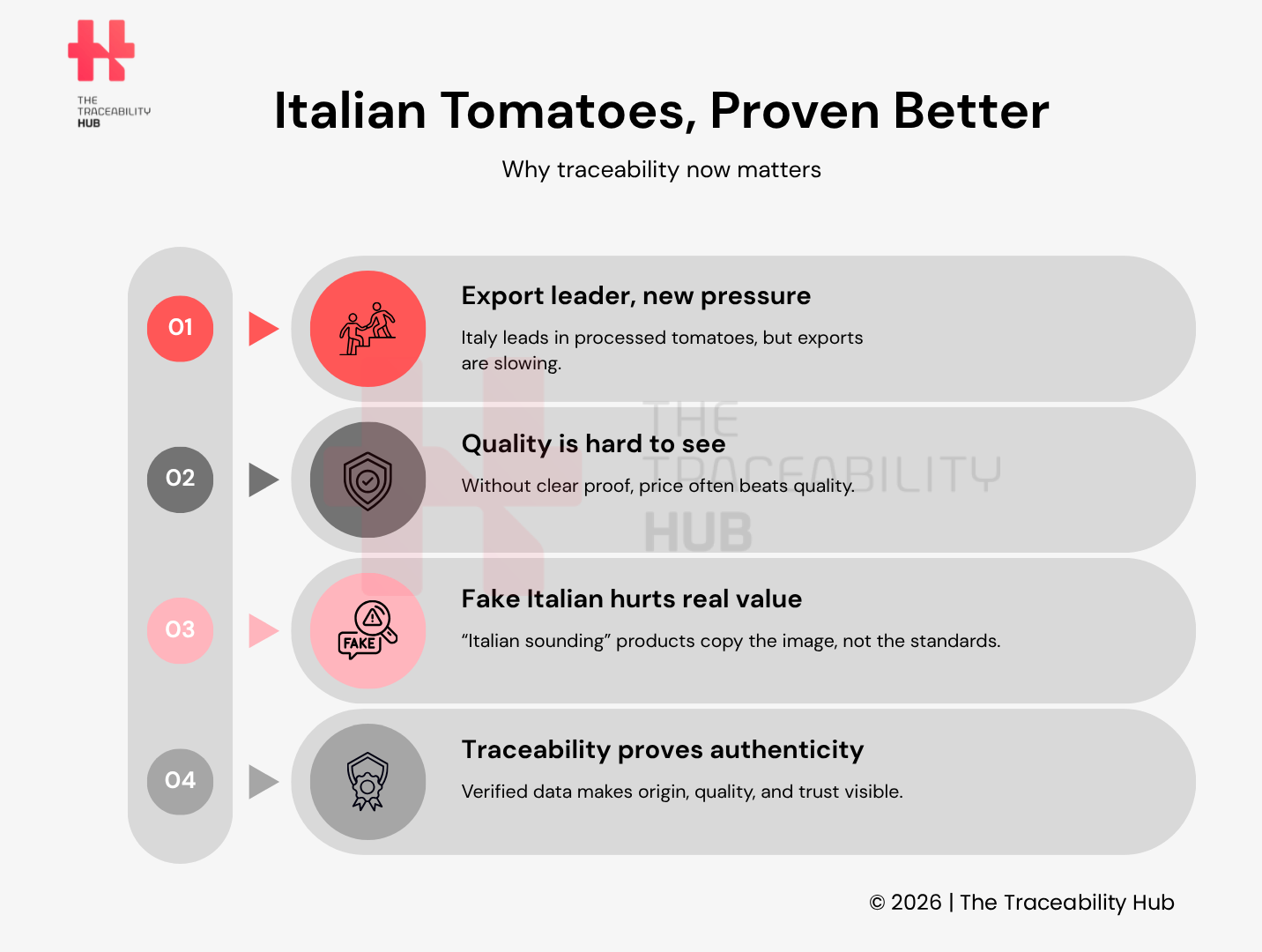
A Strategic Imperative: From Supply Chain to System
The call for a “more cohesive supply chain” should not be interpreted as a purely operational adjustment; rather, it is a call for system-level alignment, integrated traceability, and coordinated supply chain transparency that delivers practical benefits. By embracing system-level alignment, stakeholders can reduce inefficiencies, respond more quickly to market demands, and build stronger consumer trust through transparent practices.
In an increasingly complex and competitive global landscape, isolated improvements within individual actors are no longer sufficient. What is required is a coordinated approach that connects all stakeholders across the value chain through shared data, interoperable standards, traceability frameworks, and objectives.
To remain competitive, the Italian tomato industry, and, more broadly, made in Italy sectors, will need to evolve in this direction. This means strengthening data sharing across the value chain, enabling greater supply chain visibility and consistency from origin to final product. For instance, implementing Digital Product Passports (DPPs) allows producers to track each batch of tomatoes from farm to shelf, ensuring compliance with international standards and enabling targeted marketing based on verified origin.
It also requires the adoption of structured traceability frameworks and Digital Product Passport systems, which can support both compliance and differentiation in international markets.
Equally important is the need to align on common standards, sustainability narratives, and transparent communication strategies, ensuring that the value of quality, sustainability, and origin is communicated in a clear and consistent way.
Ultimately, this transition implies moving from a model based on implicit trust, historically associated with the strength of the Made in Italy brand, to one grounded in verified transparency and traceable supply chains, where value is not only claimed, but demonstrated.
From Reputation to Verified Competitiveness
The decline in exports projected for 2025 should be viewed not merely as an adverse indicator, but as a prompt for strategic reassessment. Italy maintains its prominent status in processed tomatoes, supported by longstanding quality, expertise, responsible production standards, and international acknowledgment. Nevertheless, current market dynamics suggest that reputation alone is insufficient to sustain competitive advantage.
As pricing pressures intensify and global competition becomes increasingly imbalanced, it is essential to provide tangible and verifiable evidence of value rather than relying solely on brand reputation or unverified assertions.
In this environment, traceability transcends its conventional function as a compliance measure. It evolves into a strategic asset for safeguarding value within food supply chains, helping to sustain market position, reinforce credibility, and facilitate competition based on verified quality rather than price differentiation.
Read more: Erreà’s Digital Product Passport: Advancing Traceability and Responsible Supply Chains