

The Shift: From Product Touchpoint to Relationship Channel
For decades, product packaging served a limited and mostly functional purpose: to inform, protect, and sell. It was designed as a one-way touchpoint, a static surface carrying instructions, branding, and essential product information. Its role ended more or less at the moment of purchase.
Today, that role is changing.
Packaging is no longer just a container or a communication layer. It is becoming something much more strategic: a digital entry point into an ongoing relationship between brand and consumer, transforming packaging into a true relationship channel and high-intent entry point within the omnichannel customer journey. This marks an important shift in how brands think about engagement. What was once a passive interaction is now turning into an active, dynamic moment that can continue well beyond the shelf.
At the center of this transformation is the rise of phygital experiences, frictionless forms of phygital engagement in which physical products connect seamlessly to digital environments. Through tools such as QR codes, smart labels, NFC tags, and connected packaging (or smart packaging and programmable media), brands can transform a simple product touchpoint into a gateway to digital content, services, and interactions.
What makes this especially relevant is that these tools are no longer experimental. They are becoming part of the mainstream customer journey. Consumers are increasingly comfortable using their phones through mobile-first interactions to engage with the physical world, and packaging is emerging as one of the most immediate and accessible points of connection.
The numbers make this shift clear.
In 2025, 59% of smartphone users scan QR codes daily, showing just how natural and habitual this behavior has become. At the same time, 68% of consumers scan product packaging to access information, verify authenticity, or unlock experiences. These figures highlight a fundamental evolution: consumers no longer see packaging as something to simply look at. They increasingly see it as something to interact with.
This changes the nature of the packaging-consumer relationship. The pack is no longer only there to communicate at a glance; it can now invite action, offer utility, and create relevance in real time. A scan can answer a question, verify authenticity, deliver product storytelling, provide reassurance, deliver additional value, or open the door to a broader brand experience (community, recipes, instructions, loyalty programs).
In this sense, packaging is shifting from a product touchpoint to a relationship channel.
That distinction matters. A touchpoint is momentary; a relationship channel is continuous. It creates the possibility of dialogue, repeat engagement, and deeper consumer connection. When physical packaging becomes digitally enabled, it no longer ends its function at the point of sale. Instead, it can become the starting point of an ongoing interaction shaped by curiosity, utility, and relevance.
For brands, this represents a major opportunity. For consumers, it reflects a new expectation: that the products they buy should not only meet a need but also connect them to useful and meaningful digital experiences.
The shift is already underway, and packaging is becoming one of its most visible expressions.
Why Packaging Is the Most Undervalued Digital Touchpoint
Unlike ads or emails, packaging occupies a uniquely privileged position in the customer journey. It is physically present, directly connected to the product, and encountered at a moment of high attention, whether during consideration, purchase, or use. That combination makes it one of the most underestimated digital access points available to brands today.
Packaging is always in the consumer’s hands. This simple fact matters more than it may seem. Most digital channels compete for fragmented attention across crowded environments, but packaging appears in a context where the consumer is already focused on the product itself. It is not an interruption; it is part of the experience.
It is also already tied to a purchase or consideration moment. That means the interaction begins with intent. Whether a consumer is evaluating a product on the shelf or engaging with it after purchase, the pack sits at the intersection of curiosity and decision-making. This gives it a very different role from media channels that must first capture attention before they can create engagement, positioning packaging as a high-intent entry point driven by active user intent.
A further advantage is trust. Packaging is generally perceived as an official and credible source of product information, supporting authenticity verification and strengthening consumer trust. In that sense, it is inherently trusted in a way that many digital touchpoints are not.
Taken together, these characteristics make packaging a high-intent entry point into digital engagement and the broader omnichannel customer journey.
This is not just a theoretical opportunity. Research shows that up to 60% of shoppers scan QR codes to access product information before purchase, particularly when looking for transparency and product details (ingredients, raw materials, certifications, origin, etc.). That behavior confirms that packaging is increasingly used not just as a surface to read, but as a channel to explore, validate, and decide.
From Static Label to Dynamic Media
What is changing most radically is the nature of packaging itself. It is no longer static; it is becoming programmable media and connected packaging capable of evolving over time.
This shift means that packaging can now do more than display fixed information. Through QR codes and connected features, it can deliver evolving content, respond to user needs, and support multiple brand objectives over time. The pack becomes a live interface rather than a printed endpoint.
Brands are already using QR codes on packaging to support product storytelling, ingredients or raw materials visibility, certification compliance and origin transparency, helping consumers understand where products come from and what stands behind them. They also use them to provide tutorials, recipes, or usage content, extending the product experience beyond the label and into practical value.
At the same time, packaging can support conversion and retention by offering loyalty rewards, sweepstakes and promotions, turning a simple scan into the start of an ongoing brand interaction. And perhaps most importantly, it allows brands to collect first-party data directly from consumers, strengthen owned audiences, and develop richer data ecosystems.
This is a major strategic advantage. In fact, 95% of businesses report that QR codes help collect valuable first-party data, making packaging an increasingly important part of owned audience strategy in an increasingly cookie-less retail and marketing landscape.
Seen in this light, packaging is no longer just a physical wrapper or informational layer: it is becoming a digital media channel embedded directly into the product experience, one that combines trust, intent, and interaction in a way few other touchpoints can.
The Phygital Layer: Connecting Physical Products to Digital Value
Phygital experiences create value because they turn a very simple gesture, a scan or a tap, into something immediate and useful. That is what makes them effective. The interaction itself is minimal, but the outcome can be highly relevant: access to information, exclusive services, content, or personalized incentives that enrich the product experience.
What matters is not the technology alone, but the ability to connect the physical product to a layer of digital value that feels seamless and worthwhile. When that happens, packaging stops being just a carrier of information and becomes an access point to a broader brand ecosystem and omnichannel customer journey.
Reducing Friction Is Everything
One of the main reasons some phygital experiences work better than others is accessibility and frictionless interaction. Consumers are much more likely to engage when the experience feels immediate, intuitive, and easy to access.
In practical terms, engagement increases when:
- no app download is required (app-free access)
- the experience loads instantly through browser-based WebApps
- the interaction is perceived as useful, not intrusive
This is why browser-based experiences, such as WebApps, are gaining traction as frictionless interaction models. They remove one of the main barriers to engagement, the need to install an app, and significantly reduce the drop-off that often happens when users face too many steps before reaching value. In a phygital journey, reducing friction is not a secondary design choice; it is a core success factor.
From Curiosity to Action
Every scan signal intent represents a measurable high-intent entry point. It reflects a consumer who has decided to take action, however small, in order to learn more, access something, or continue the interaction. This makes phygital engagement especially valuable from a business perspective, because it captures interest at the moment it becomes measurable.
The performance data confirms the conversion and retention potential of phygital engagement:
- QR-powered campaigns can achieve around 37% click-through rates, significantly higher than traditional digital channels
- 30% of users who scan go on to purchase within 24 hours
These numbers show that phygital interactions are not simply engaging in theory. They are closely connected to concrete business outcomes. When well designed, they can move consumers from curiosity to action quickly, making packaging not just a communication medium, but a performance channel capable of driving conversion and retention.
From Packaging to Relationship Channel
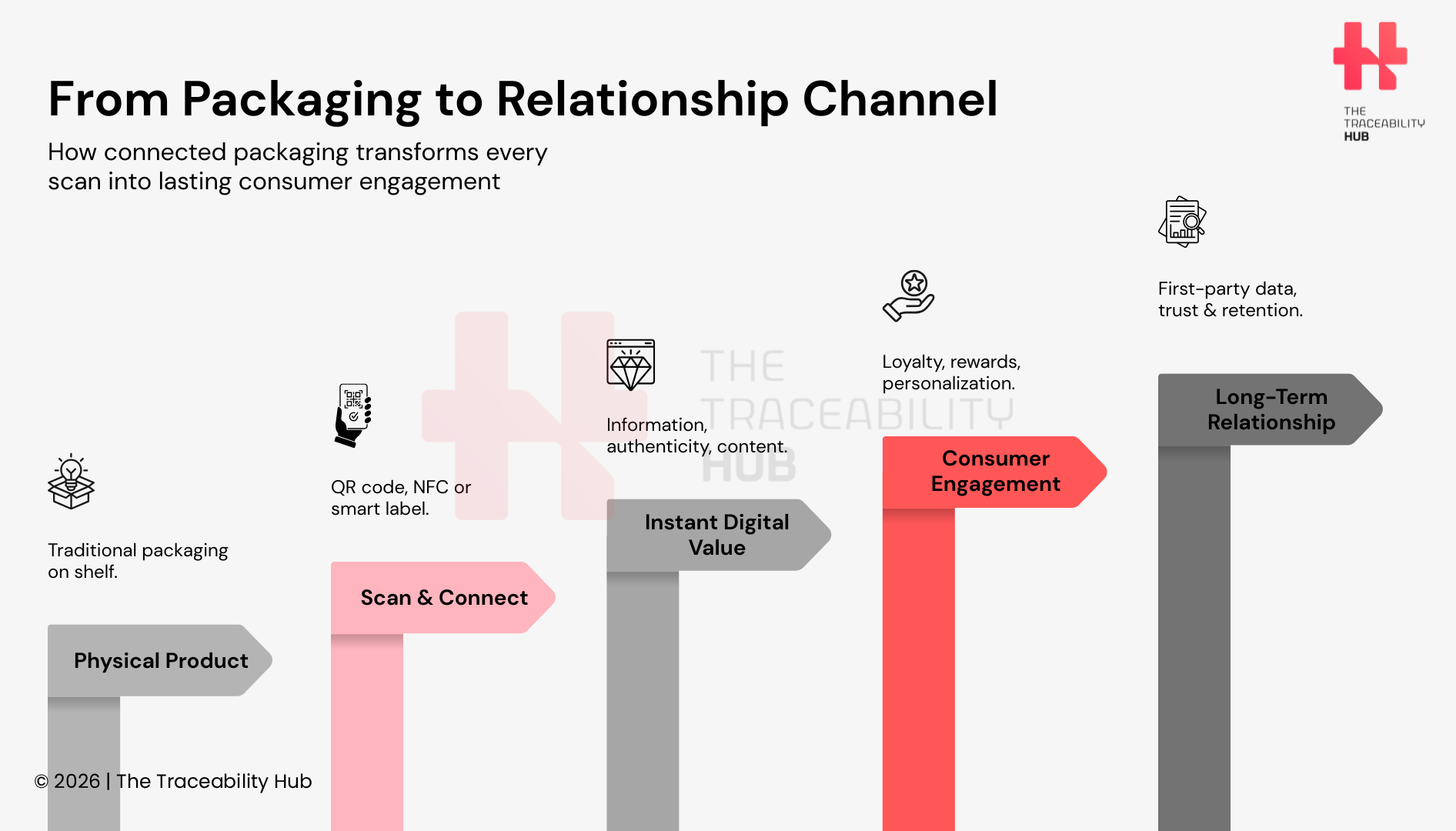
From Engagement to Relationship: The Real Value of Phygital
The most important transformation does not happen at the moment of the first scan. It happens afterwards.
The real value of phygital lies in its ability to extend a one-time interaction into an ongoing relationship channel built around recognition, continuity, and repeat engagement. A scan may begin with curiosity, utility, or a need for information, but its strategic value emerges when that moment becomes the starting point for recognition, continuity, and repeat engagement.
Turning Anonymous Consumers into Known Users
Connected packaging gives brands the opportunity to move beyond anonymous interactions and build a more direct understanding of who is engaging with their products.
Through phygital experiences, brands can:
- capture first-party data through consent-based interactions
- build proprietary audiences and strengthen owned audiences
- track interactions across touchpoints
This is becoming increasingly important in a context where third-party cookies are declining and brands need more reliable, consent-based ways to understand and activate their audiences. In this scenario, packaging is no longer just a communication tool. It becomes a gateway to owned data ecosystems that support long-term customer intelligence, creating a direct connection between product interaction and audience intelligence.
Building Loyalty Beyond the Shelf
The value of connected packaging also extends well beyond the point of purchase. Once the physical product becomes a digital access point, it can support a much broader relationship strategy built around continuity and relevance.
Phygital experiences can enable:
- QR-powered loyalty programs, reward programs, sweepstakes and gamification
- personalized offers and individualized experiences
- ongoing communication through digital channels
This changes the role of packaging in a meaningful way. Instead of ending its function once the product is sold, it can continue to generate value over time, bringing consumers back into the brand ecosystem through useful interactions, incentives, and tailored experiences.
The impact is already visible in the data:
- 61% of consumers engage with QR-powered loyalty programs, demonstrating their effectiveness in supporting retention
- Brands using dynamic QR content see significantly higher repeat engagement and improved retention
This is where phygital delivers its real strategic value. The product is no longer the end of the journey; it becomes the beginning of a relationship.
Trust, Transparency, and the Role of Digital Product Passports
Phygital is not only about engagement. It is also about trust.
As consumers become more attentive to what they buy, packaging is increasingly expected to do more than attract attention or provide basic instructions. It must also give access to credible, relevant, and structured information. In this sense, connected packaging is not only a channel for interaction, but also a tool for transparency, authenticity verification, and trust building.
Transparency as a Consumer Expectation
Consumers increasingly expect access to information that helps them better understand the products they are considering or using. This includes:
- product origin
- ingredients and raw materials
- certifications
- environmental impact
- authenticity verification
This growing demand for visibility is one of the reasons why Digital Product Passports (DPPs) through the Ecodesign Regulation (ESPR) are becoming so important.
The European Union is introducing DPPs as part of the Ecodesign regulation, requiring products to include structured information about lifecycles, materials, and sustainability.
This marks an important shift. Product information is no longer limited to what can fit on a label. It is becoming part of a broader digital layer that can support both regulatory requirements and consumer expectations for transparency, utility, and product traceability.
From Compliance to Customer Experience
Although DPPs emerge as regulatory tools, they increasingly support a transition from compliance to customer experience.
They can also represent:
- a digital identity of the product
- a direct communication channel with consumers
- a new touchpoint for engagement and storytelling
This is what makes them strategically relevant as both regulatory assets and relationship channels. A Digital Product Passport is not only a repository of required information; it can also become an interface through which brands connect data, product context, and customer experience.
According to Deloitte research, DPPs act as a digital bridge between product, brand, and customer, enabling new customer experiences and long-term engagement opportunities.
This is where the phygital dimension becomes especially interesting. What begins as a compliance requirement can also become a competitive asset, turning transparency into a source of value, trust, and differentiation.
In this sense, DPPs do not just help products meet regulatory standards. They help brands transform compliance into a competitive advantage rooted in trust, transparency, and differentiation.
Designing Phygital Experiences That People Actually Use
Not all phygital experiences succeed. The difference rarely lies in technology itself; it lies in relevance and design.
A connected experience may be technically functional, but if it does not feel useful, clear, and easy to access, consumers will not engage with it. In phygital, adoption depends on whether the interaction delivers real value aligned with evolving consumer expectations.
Deliver Value, Not Just Interaction
Consumers are willing to engage when they receive something meaningful in return. That value can take different forms, including:
- useful content
- exclusive benefits
- personalized experiences
What matters is that the interaction feels justified. If a scan simply leads to a generic landing page or appears to exist only for data collection, users disengage quickly. The experience must offer a clear reason to continue, otherwise technology becomes visible in the wrong way, as friction rather than value.
Make It Seamless
The best-performing phygital experiences tend to share a common set of characteristics. They are designed to minimize effort and maximize clarity from the very first interaction.
In most cases, that means:
- instant access through QR codes or NFC tags
- frictionless interaction, with no download required
- mobile-first design optimized for smartphone use
- a clear value proposition
These elements are not secondary. They define whether the experience feels natural or burdensome. When the path from physical product to digital layer is immediate and intuitive, consumers are far more likely to complete the interaction and return to it again.
Think Omnichannel: Integrate the Entire Customer Journey
Phygital should not be designed as an isolated activation. Its full value emerges when it connects with a wider ecosystem of brand touchpoints.
That means linking packaging to:
- the retail environment (usually hidden to brands)
- digital channels
- loyalty ecosystems
In this model, packaging becomes one node within a broader omnichannel customer journey spanning retail, CRM, loyalty, and digital environments. Brands that integrate these touchpoints can aggregate audiences across channels and build more consistent, measurable relationships over time.
This is where phygital becomes strategically powerful: not when it adds a digital layer for its own sake, but when it connects the physical product to a coherent and continuous customer journey.
Packaging as the New Starting Point of Experience
The role of packaging is evolving rapidly.
What was once a static label is becoming something much more strategic. Today, packaging can function simultaneously as:
- a first-party data collection tool
- a product storytelling platform
- a QR-powered loyalty driver
- a Digital Product Passport and compliance interface
- a direct channel to the consumer
This evolution changes the place packaging occupies in the customer journey. It is no longer limited to informing or supporting the point of sale. It is becoming an active layer of experience, one that connects product, data, content, and relationship in a single touchpoint.
In a phygital world, every product becomes a gateway to digital value, owned audiences, and relationship channels.
This is why the real opportunity does not lie in simply adding QR codes or connected features to packaging. It lies in designing experiences that people actually want to use: experiences that are meaningful, immediate, mobile-first, and frictionless.
The brands that will succeed are not those that treat packaging as a technical add-on, but those that understand its new strategic role. They will be the ones able to turn product interactions into something more lasting, relationships built through relevance, value, and continuity.
A Case Study: Genuine Way
Genuine Way is a technology provider specializing in digital product identity and blockchain-based supply chain traceability for FMCG (Fast Moving Consumer Goods) brands. Its core proposition is to bridge the gap between physical products on shelves and digital information accessible to consumers via QR codes, smart tags, or NFC, helping to get:
- Compliance: Meeting regulatory requirements including the EU Digital Product Passport (DPP) and Ecodesign for Sustainable Products Regulation (ESPR)
- Transparency: Supply chain notarization on blockchain, anti-counterfeiting, sustainability storytelling
- Consumer Engagement: Interactive WebApps accessible by scanning a QR code, requiring no app download, with loyalty programs, recipes, content, and coupons
La Molisana
La Molisana is one of Italy’s historic pasta producers, founded in 1911 in Campobasso (Molise region) and rescued by the Ferro family in 2011 after the third bankruptcy. The company is led by CEO Giuseppe Ferro and has a 100% Italian integrated supply chain with proprietary milling.
The Genuine Way Project
Every La Molisana pasta packet now carries a QR code which, when scanned without any need to download an app, opens a WebApp curated by Chef in Camicia (one of Italy’s most followed cooking content creators on social media). The content includes:
- One-minute video recipes customized for each pasta format and seasonal cycle
- Scientific content from agronomists, nutritionists, and researchers — infographics and video-interviews that change monthly and follow the wheat cycle from sowing to harvest
- Thematic editorials on pasta traditions, contaminations, and trends
La Molisana is one of the most-cited examples in Italian retail of how QR codes can transform a low-margin commodity (pasta) into a digital touchpoint for content marketing, brand loyalty, and shopper engagement at the point of sale. According to a sample analysis by GS1 Italy and Nielsen, QR codes appear today on approximately 9% of Italian mass-market consumer goods — with pasta, coffee, sweet snacks, wine, and olive oil being the most represented categories.
Pasta Felicia (Andriani Group)
Pasta Felicia is a brand of Andriani S.p.A. Società Benefit, headquartered in Gravina in Puglia (Apulia region). The company holds B Corp certification and is recognized as the only Italian pasta producer that is fully allergen-free, with an integrated multigrain mill. It is led by brothers Michele and Francesco Andriani, who inherited over 40 years of milling expertise from their father Felice.
The Felicia brand specializes in organic, naturally gluten-free pasta made from raw materials including buckwheat, brown rice, oats, chickpeas, lentils, peas, and beans. Its claim “Alimentiamo l’ottimismo” (We feed optimism) positions the product as the largest assortment of gluten-free organic pasta available on the Italian market.
The Genuine Way Project
The Felicia QR code on packaging gives access to personalized recipes and nutritional content tailored to each pasta format (oats, lentils, chickpeas, etc.). The functional logic is similar to La Molisana but with a heavier emphasis on nutritional education and the science of alternative-ingredient pasta, given the brand’s positioning toward conscious consumers and people with intolerances.
Aceto Ponti (Ponti S.p.A.)
Ponti S.p.A. is a historic Italian vinegar and pickled vegetable producer, headquartered in Ghemme (Piedmont), with multiple production plants across Italy including the Vignola facility (Modena) dedicated to the Aceto Balsamico di Modena IGP, where output can reach 4.5 million liters per year. The company is led by Giacomo and Lara Ponti as CEOs. Ponti holds three major certifications: FSSC 22000, ISO 22000, and ISO 22005, with independent quality control laboratories at every production site including isotopic analysis for wines.
The Genuine Way Project
This project goes beyond consumer-facing content into actual blockchain-notarized supply chain traceability. Every bottle of 100% Italian Apple Vinegar Ponti carries a QR code that, when scanned, reveals in real time:
- The variety of apples used
- The date of harvest
- The municipality (Comune) where the apples were harvested
- The journey of the apples from orchard to processing (apples are 100% Italian and processed within 24 hours of arrival at the facility)
All product data is certified by SGS (the global testing and certification body) and notarized on blockchain by Genuine Way to guarantee transparency and reliability that cannot be tampered with retroactively.
According to Giacomo and Lara Ponti: “The QR code represents for us a further step in the direction of transparency toward consumers; we believe that the security of a traceable and sustainable supply chain is a priority to deliver a product of value to the customer”.
Strategic Significance
The Ponti case demonstrates the full Genuine Way technology stack in operation: physical product → QR code → cloud platform → blockchain notarization → real-time consumer accessibility. It also shows the convergence of certified third-party data (SGS), immutable record (blockchain), and consumer storytelling (WebApp) into a single integrated experience.
The cases progress along a sophistication ladder: La Molisana and Felicia sit at the most accessible end: the QR code is a content delivery channel (recipes, nutritional information). Ponti sits at the more sophisticated end: the QR code is a blockchain-notarized traceability proof with third-party certification.
The strategic positioning anticipates the EU Digital Product Passport mandated by the Ecodesign for Sustainable Products Regulation (ESPR). This is the regulatory tailwind that will turn what is today a voluntary brand differentiator (QR codes with traceability) into a structural compliance requirement for most physical goods entering the EU market over the next 3-5 years.
Read more: UWB vs RFID: Rethinking Real-Time Traceability Beyond Readers