



Why RFID Adoption Still Stalls in Some Use Cases
Over the past decade, RFID has become one of the most established enabling technologies for traceability. Standards bodies such as GS1 have helped define how RFID supports identification and event capture across supply chains, while RAIN RFID has proven its value in applications that require fast, non-line-of-sight reading and high-throughput data collection.
And yet, in some environments, adoption has advanced more slowly than expected.
This is especially true in use cases such as returnable asset management, Reusable Transport Items (RTIs), work-in-progress tracking, and track-and-trace across operational spaces where assets move through yards, warehouses, plants, or mixed indoor-outdoor environments without following rigid, repeatable paths. In these contexts, the issue is rarely the value of traceability itself. The challenge is often the way traceability must be physically implemented.
The constraint, in other words, is not conceptual. It is architectural.
Passive RFID systems are highly effective when items move through defined read zones. Their performance is strongest when organizations can design around fixed readers, antenna infrastructure, and controlled chokepoints such as dock doors, portals, conveyors, or transition gates. This model works well in structured flows because the system is built to answer a precise question: did a tagged object pass a known point? GS1 Standards, particularly EPCIS (Electronic Product Code Information Services), highlights these strengths clearly, especially in high-speed identification and automated inventory capture, and event-driven supply chain visibility scenarios.
But many industrial and logistics environments do not operate that way.
When visibility must extend across wide areas, when layouts change frequently, or when tagged assets do not naturally pass through controlled checkpoints, RFID infrastructure can become more difficult to justify. Portals, dock door readers, antennas, network integration, site tuning, and physical installation all add complexity and cost. In practice, that means the business case is no longer determined by tag cost alone, but by the total architecture required to make the system reliable. Sources describing RFID portal and chokepoint deployments consistently show how dependent these systems are on engineered read zones, physical flow discipline, and the resulting infrastructure overhead or architectural friction.
This is one reason why adoption can stall.
The problem is not that RFID fails to deliver value. On the contrary, it remains a highly effective technology for identification, automation, and event capture. The issue is that in some cases, the infrastructure model required by passive RFID creates a barrier between technical feasibility and scalable deployment. Even recent industry and academic analysis on passive RFID-based RTLS (Real-Time Location Systems) points out that performance depends heavily on context, configuration, and the fit between technology model and operational reality. The 2024 review in the journal Sensors underscores exactly this point: passive RFID can be highly valuable, but not universally optimal for every real-time visibility requirement.
That distinction matters strategically.
Because once adoption stalls, organizations often interpret the signal incorrectly. They conclude that the use case is not mature, that traceability is too expensive, or that ROI is too uncertain. In many cases, however, what is really breaking down is not the business need, but the architecture model being applied to it, and the associated infrastructure overhead required to sustain checkpoint-based visibility.
This opens a more important question for decision-makers:
What if the limitation is not RFID itself, but the assumption that visibility must always be built around readers, gates, and predefined checkpoints?
Enter UWB: A Different Paradigm for Real-Time Location
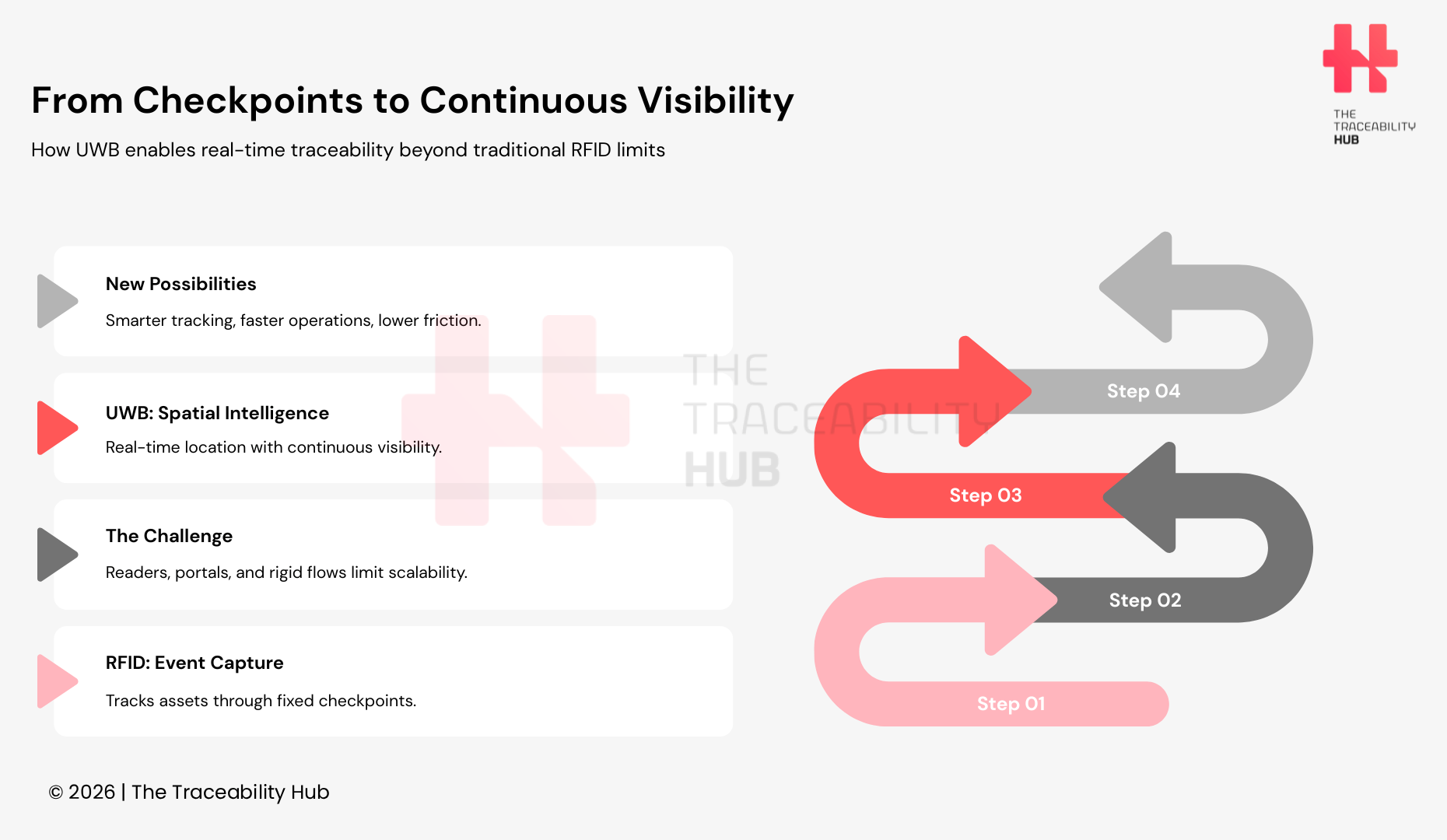
Ultra-Wideband (UWB) introduces a fundamentally different logic for traceability and Real-Time Location System (RTLS) design. Where RFID is primarily designed to capture the passage of an object through a defined point, UWB is designed to determine the position of that object in space, continuously, precisely, and in real time.
This is not just a technical distinction. It is a shift in architecture.re
UWB systems work by measuring the travel time of radio signals between tags and infrastructure nodes, using ranging techniques based on time of flight (ToF). This allows the system to calculate position with a level of precision that is typically measured in centimeters rather than meters. Industry sources and technology bodies such as the FiRa Consortium describe UWB as a technology built specifically for precise location awareness, with real-world deployments supporting high-density, large-scale positioning environments.
In practical terms, that means UWB is not asking whether an asset crossed a gate. It is asking where that asset is now.
That difference changes the design assumptions behind the entire traceability system.
While RFID is optimized for event capture, UWB is optimized for continuous spatial intelligence and the creation of a live spatial layer. Instead of relying on readers placed at chokepoints, UWB builds a positioning layer through anchors and active tags that exchange signals and calculate distance with very high temporal resolution. According to NXP, UWB enables “secure fine ranging” and precise positioning for industrial and IoT applications; Qorvo similarly describes UWB as a real-time location technology capable of centimeter-level precision using methods such as Two-Way Ranging (TWR) and Time Difference of Arrival (TDoA).
This is why UWB is increasingly relevant in environments where the question is no longer Did it pass here? but rather Where is it right now, and how is it moving?
The performance characteristics reinforce this shift. Across industrial UWB ecosystems, positioning accuracy is commonly described in the 10–30 cm range, depending on deployment conditions, anchor geometry, and environmental complexity. Vendor and ecosystem documentation also shows that active UWB tags can operate for multiple years on battery, often in the 2-to-5-year range, especially when transmission rates are tuned to use case requirements and motion-based power management is applied.
That makes UWB materially different from passive identification technologies. It is not simply a better way to register a movement event. It is a way to create a live spatial layer and enable continuous spatial intelligence across operations.
And that has profound implications for traceability design.
Because once position becomes continuously available, traceability is no longer limited to discrete checkpoints. It can extend into dwell-time analysis, zone-based process monitoring, asset search, operator safety and geofencing, workflow orchestration, and real-time exception management. In other words, UWB transforms traceability from a sequence of recorded transitions into a dynamic understanding of presence, location, and movement.
The Cost Equation: Why UWB Changes the Game
One of the most overlooked advantages of UWB is not just its accuracy, but the way it can reshape the economics of deployment.
In many real-world scenarios, the cost barrier in traceability projects does not come from the identifier itself. It comes from the infrastructure required to make visibility reliable. This is where UWB changes the conversation.
Unlike RFID architectures that often depend on multiple portals, gate readers, antenna arrays, and tightly controlled read zones, UWB infrastructures are typically designed around a more distributed positioning layer. Anchors are installed to create coverage across an area rather than to monitor only predefined transition points. In practice, this often means a lower dependence on dense checkpoint infrastructure and a much weaker reliance on forcing assets through controlled flows. UWB systems scale by extending positioning coverage, not by multiplying read portals.
That difference matters financially.
In environments where RFID initiatives stalled because of high reader costs, installation complexity, or uncertain ROI, UWB can rebalance the business case by reducing the architectural friction and infrastructure overhead between the use case and the infrastructure. The value does not come from replacing one tag with another. It comes from reducing the amount of engineered control the environment needs in order to become traceable. Recent positioning and vendor ecosystem materials increasingly frame UWB in these terms: not simply as a precision technology, but as a way to lower deployment complexity for continuous visibility use cases.
This is especially relevant in facilities where asset flows are irregular, spaces are open or mixed-use, and operational layouts evolve over time. In those environments, the need to install and maintain a dense network of gate-based reading points can undermine ROI before the system has even scaled. UWB does not eliminate infrastructure, but it often allows organizations to design for coverage, continuous spatial intelligence, and location intelligence rather than for forced passage and event capture.
That shift is what changes economics.
It is true that UWB tags are active devices, and therefore more expensive than passive RFID tags. But that comparison can be misleading if taken in isolation. The more relevant question is whether the total system cost delivers usable, continuous visibility in the target environment. Public market and vendor references show that UWB tag pricing now spans a much broader and more accessible range than in the past, with costs varying significantly depending on form factors, ruggedization, sensors, battery configuration, and certification requirements. At the same time, some vendors highlight multi-year battery life, while broader market evidence points to a continuing decline in the cost of UWB-enabled hardware as industrial adoption grows.
This is what makes UWB increasingly viable for assets that are not disposable, low-value, or single-use, but operationally important and repeatedly circulating through the system.
That includes:
- Returnable transport items (RTIs)
- Pallets and totes
- High-value mobile assets
- Reusable containers and handling equipment
For these asset classes, the economic logic is often different from product-level tagging. The objective is not ultra-low-cost identification at massive unit scale; it is reliable, real-time visibility over reusable assets whose loss, delay, underutilization, or misplacement creates measurable operational cost. In that context, the higher cost of an active tag can be justified by the broader reduction in search time, process friction, asset shrinkage, and idle inventory.
In other words, UWB does not necessarily win the cost argument because each component is cheaper. It wins because, in the right use cases, the overall architecture is better aligned with the economics of visibility.
Beyond Visibility: New Use Cases Enabled by UWB
The move from event-based identification to continuous location awareness does more than improve visibility. It expands the very scope of what traceability can do.
Once location is continuously available through a Real-Time Location System (RTLS), organizations are no longer limited to reconstructing what happened after the fact. They can begin to monitor movement, detect delay, enforce logic, and trigger action in real time. This is where Ultra-Wideband UWB moves from being a tracking technology to becoming an operational layer built on continuous spatial intelligence.
Several use cases illustrate this shift particularly well.
Yard and Facility Management
Large yards, plants, and mixed indoor-outdoor facilities are among the most difficult environments to make traceable with traditional checkpoint-based architecture. Assets may move irregularly, remain parked in open areas, or be repositioned without passing through any controlled read point. In these contexts, UWB enables real-time localization across unstructured space, making it possible to find trailers, containers, pallets, vehicles, tools, or work-in-progress assets without manual search.
This makes UWB particularly valuable for yard and facility management, where continuous location awareness is more useful than periodic event capture.
This is not just a convenience gain. It directly reduces wasted labor, dispatch delays, and operational uncertainty. Some suppliers, for example, describe yard visibility to eliminate time lost searching across large industrial sites, while others explicitly position precise outdoor and depot tracking as critical for transit and heavy manufacturing operations.
Dwell-Time Analytics
When every movement and every position update become available as data, time itself becomes measurable in a new way.
UWB allows organizations to determine not only where an asset is, but how long it remains in a given zone, how often it stops, and where delays accumulate. This enables precise dwell-time analytics, which are especially valuable in manufacturing, warehousing, and intralogistics environments where idle time often signals hidden process inefficiency.
Providers explicitly frame “time” as one of the core industrial challenges solved by UWB-based location intelligence, while others highlight dwell-time monitoring as a way to optimize lead times, track production sequence, and improve operational efficiency. In other words, UWB turns location data into process intelligence, enabling organizations to move from historical reporting toward real-time operational optimization.
Operator Safety and Geofencing
One of the most compelling extensions of continuous positioning is safety.
Because UWB can locate people, vehicles, and equipment with high precision—typically 10-30 cm accuracy— and low latency, it enables dynamic safety zones that are far more responsive than static barriers or signage. Workers entering hazardous areas can trigger alerts. Forklifts approaching pedestrians can activate proximity warnings. High-risk zones can be monitored in real time rather than enforced only procedurally.
These capabilities make operator safety and geofencing among the fastest-growing industrial applications of modern RTLS platforms.
This is increasingly recognized as a major industrial application of UWB. One may highlight worker localization and industrial process automation as core UWB use cases, while another industrial UWB portfolio explicitly includes geofencing for safety and security. What matters here is not just awareness, but intervention. Continuous location enables systems to react before an incident, not only to document it afterward.
Automated Proof-of-Location
A further step beyond tracking is verification.
In many processes, the critical requirement is not simply to know that an asset exists in the network, but to prove that it was in a specific place at a specific time. This is particularly relevant for compliance-sensitive workflows, service-level agreements, controlled process steps, and handoff validation.
UWB enables this by making location verifiable at zone level, with a degree of spatial confidence that is difficult to achieve with broader, lower-resolution technologies. Some suppliers position UWB RTLS as a foundation for automated alerts, workflow enforcement, and zone-based logic, while others recent RTLS release further emphasizes differentiated levels of positioning accuracy and presence detection depending on the area and use case.
This creates the basis for automated proof-of-location: a machine-verifiable record that an asset or operator was present where the process required them to be.
That capability matters not only for operational control, but increasingly for accountability and regulatory compliance.
Taken together, these use cases show why UWB should not be understood merely as a better locating technology. It is a different traceability model, one that extends visibility into search, timing, safety, verification, and continuous spatial intelligence.
These are precisely the scenarios in which traditional Passive RFID, RAIN RFID, or checkpoint-based architecture often struggle or require extensive customization to approximate the same outcome. With UWB, they become native capabilities of the system design.
From Checkpoints to Continuous Visibility
UWB in Practice: A Growing Industrial Ecosystem
UWB is no longer an experimental technology confined to innovation labs or isolated proofs of concept. It has evolved into a credible industrial Real-Time Location System (RTLS) stack, supported by a growing ecosystem of semiconductor players, infrastructure providers, software platforms, and integration partners.
At the silicon level, the market has already consolidated around recognizable names. This matters because it signals that UWB is no longer dependent on niche component innovation. It now sits within the product strategies of major semiconductor vendors with the scale, ecosystem reach, and roadmap continuity required for industrial adoption.
At the systems level, the market has matured as well. Providers offer end-to-end RTLS solutions that combine UWB hardware, location engines, analytics layers, and enterprise integration capabilities. These are not generic positioning tools; they are increasingly specialized operational platforms for manufacturing, logistics, warehouse optimization, intralogistics, industrial safety, and returnable asset management.
The strategic signal here is just as important as technology itself. When a company. UWB is moving beyond early-stage experimentation and into broader operational portfolios, around industrial-scale visibility, automation, safety, and workflow intelligence.
What this shows is that the UWB market is entering a different phase of maturity.
The technology is now supported by:
- established silicon roadmaps
- a visible layer of industrial RTLS solution providers
- growing alignment with enterprise integration standards
- increasing adoption of FiRa Consortium interoperability standards
- increasingly deployment-ready hardware and software stacks
This does not mean UWB is already a universal standard. But it does mean the conversation has changed. The relevant question is no longer whether UWB is technically viable. In many sectors, that point has already been answered. The new question is where it can create the most value as part of a scalable traceability, continuous spatial intelligence, and operational intelligence architecture.
In that sense, the industry is moving from pilot-phase curiosity to operational readiness. And that transition is often the clearest sign that technology is approaching standardization, not everywhere, and not all at once, but in the environments where its architectural advantages are strongest.
Not a Replacement, but an Extension of Traceability
One critical point for decision-makers is this: UWB does not replace existing traceability systems. It complements them.
That distinction is essential, because the value of UWB does not lie in displacing serialization, barcode, or RFID infrastructures that already support product identification and event capture. It lies in extending those systems with a new layer of real-time spatial intelligence, or a live spatial layer, built on continuous positioning.
The underlying traceability stack remains intact. Serialization still provides unique products or asset identity. Standards such as GS1 EPCIS still provide the event model needed to capture what happened, when, where, and why across supply chain and operational processes. Barcode, Passive RFID, and RAIN RFID technologies continue to play a central role in registering business events, handovers, aggregation, and movement across defined points.
What UWB adds is something different: a continuous, real-time location layer powered by Real-Time Location System (RTLS) infrastructure.
Seen this way, the architecture becomes more complete:
- What is it? Serialization
- What happened? Track-and-trace events using GS1 EPCIS
- Where is it now? UWB real-time positioning and continuous spatial intelligence
This layered logic is increasingly relevant because traceability is evolving beyond static compliance and retrospective visibility. Organizations are being pushed toward models that combine product identity, event history, and dynamic operational state into a single, more connected information architecture.
This is one reason why UWB aligns so strongly with the broader direction of the market.
The emergence of the Digital Product Passport (DPP) under the EU’s Ecodesign for Sustainable Products Regulation reflects exactly this evolution: a move toward richer, more structured, and more interoperable product information systems that support transparency, sustainability, and lifecycle intelligence. GS1 has explicitly positioned its standards, including identifiers, data carriers, and EPCIS event-sharing frameworks, as foundational building blocks for this next generation of product data exchange.
In that context, UWB should be understood not as an alternative to traceability, but as an enabler of real-time operational intelligence within it.
That makes the strategic question far more nuanced than a simple technology comparison. The issue is no longer whether an organization should choose between barcode, RFID, and UWB as mutually exclusive options. The real question is how these layers can work together to create a more complete picture of product identity, process events, live asset status, and continuous spatial intelligence.
When Should You Consider UWB?
UWB becomes particularly relevant when the limits of event-based architectures start to constrain operational performance.
That is often the case when:
- RFID infrastructure costs and infrastructure overhead become a barrier to scale
- Asset flows are irregular, non-linear, or difficult to control
- Continuous visibility through a Real-Time Location System (RTLS) is more valuable than point-in-time reads
- Operational efficiency depends on knowing precise location, not just last recorded event
- Safety, operator safety and geofencing, workflow enforcement, or compliance require real-time awareness
- Automated proof-of-location is needed for process validation or service verification
In these situations, the added value of UWB does not come from replacing existing traceability systems, but from filling a visibility gap they were not designed to solve.
This is especially true in environments where the last confirmed scan is not enough to support decision-making. If a pallet, tote, tool, vehicle, or reusable container has already been identified and logged into the process, but still cannot be located with certainty in real time, the traceability stack remains incomplete from an operational standpoint.
That is where UWB becomes strategically relevant.
Strategic Takeaway
RFID remains one of the most important and proven technologies in traceability. It is efficient, standardized, and highly effective in scenarios built around discrete events and controlled read points.
But it is not automatically the optimal solution in every context.
Ultra-Wideband UWB introduces a complementary paradigm—one that shifts traceability from events to presence, from checkpoints to continuous awareness, from Passive RFID event capture to continuous spatial intelligence, and from retrospective reconstruction to live operational context.
For organizations designing next-generation traceability architectures, the question is therefore no longer simply: “Should we use RFID?”
A more strategic question is: “Where does real-time location create additional value on top of the traceability systems we already have?”
Read more: Blockchain Traceability: What It Solves and Where It Adds Real Value