


Export Performance in a Volatile World
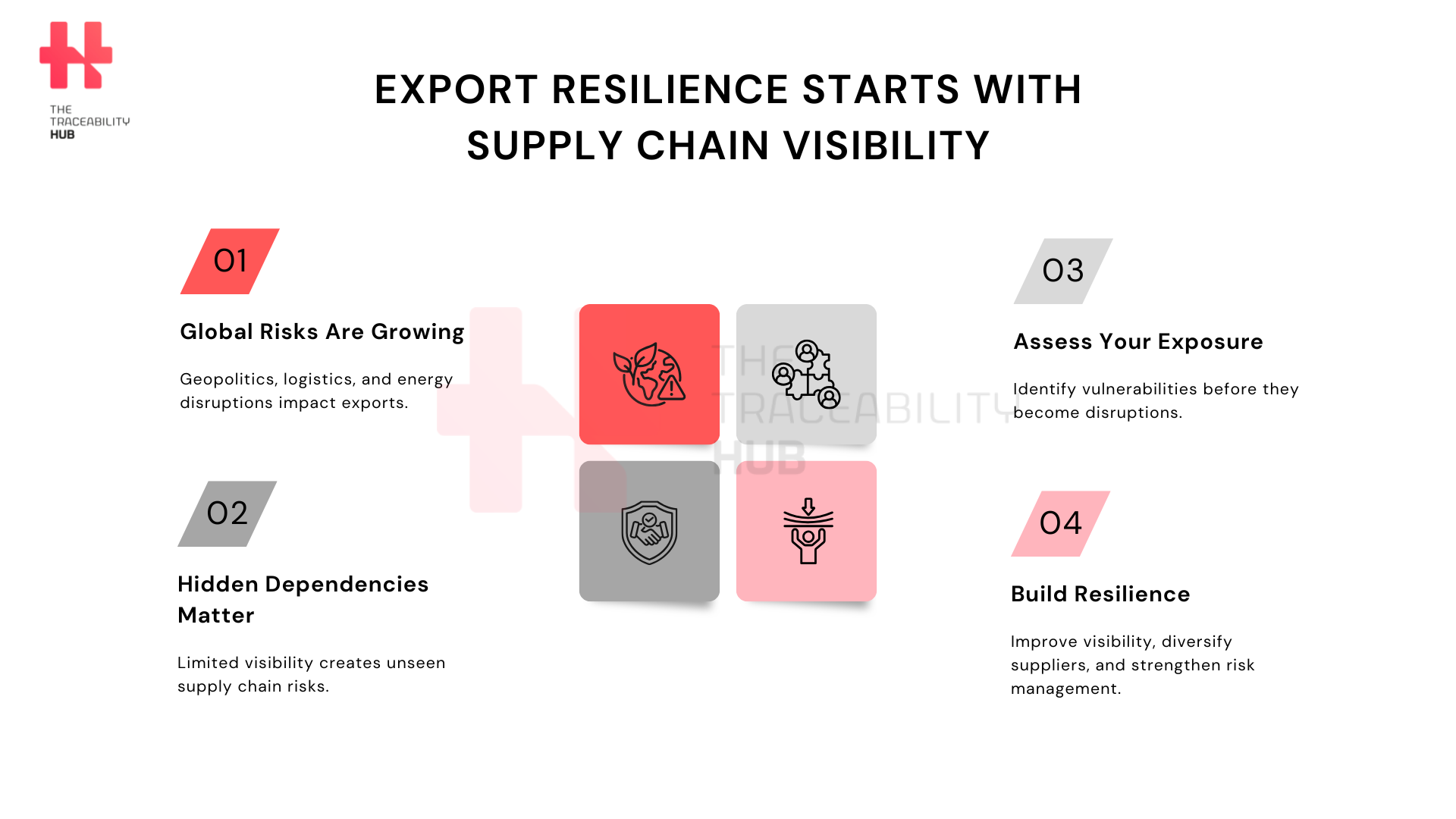
From geopolitical tensions and logistics bottlenecks to energy shocks and currency volatility, export-driven companies are operating in an increasingly unstable environment characterized by growing global supply chain disruptions and heightened export risks.
According to organizations such as the World Economic Forum and UNCTAD, global supply chains are becoming more exposed to systemic risks, with disruptions originating not only from logistics but also from upstream dependencies, energy markets, and geopolitical dynamics.
These evolving conditions underscore the importance of supply chain resilience, supply chain risk management, and proactive export resilience strategies.
At the same time, research from McKinsey & Company shows that companies can expect significant operational disruptions over time, often driven by factors outside their direct control, from supplier instability to sudden cost spikes and broader supply chain vulnerabilities.
In this context, export performance is no longer determined solely by market demand or product quality. It increasingly depends on a company’s ability to anticipate, absorb, and adapt to disruption through effective supply chain resilience practices, structured risk mitigation strategies, and stronger operational resilience capabilities.
This supply chain resilience checklist is designed to help you:
- Assess your current level of exposure to global risks
- Identify critical vulnerabilities in your supply chain and potential hidden dependencies
- Understand where greater supply chain visibility and control are needed
- Evaluate your current level of supply chain risk management maturity
And most importantly, it provides a structured starting point to move from reactive risk management to proactive resilience.
Why Export Resilience Matters
Global trade today is deeply shaped by global value chains (GVCs), and interconnected global supply chains and cross-border production networks in which goods, services, and intermediate inputs move across multiple countries before reaching final consumers. The OECD estimates that GVCs account for around 70% of international trade.
This interdependence creates both opportunities and vulnerabilities. The OECD notes that supply chains face mounting pressures from shocks such as geopolitical tensions, natural disasters, and economic volatility, and that disruptions in one location can propagate through interconnected production networks. These realities reinforce the growing need for export resilience, business continuity planning, and structured supply chain risk management.
World Bank research similarly finds that GVCs have transformed world trade, accounting for nearly half of global trade flows, and can support growth and development, while also increasing exposure to external shocks, especially where supplier networks are complex, concentrated, or lack sufficient supplier diversification strategies.
A further challenge is limited visibility beyond tier-1 suppliers. OECD work on supply-chain interdependencies and value-added trade highlights that risks can be embedded in indirect (“look-through” or “hidden”) exposures that are not immediately apparent from direct import or supplier relationships.
Taken together, these dynamics suggest that export performance increasingly depends not only on demand and competitiveness, but also on the ability to understand, monitor, and manage interconnected supply networks under uncertainty through stronger supply chain resilience, enhanced supply chain transparency, and improved operational resilience.
Export Resilience Starts with Supply Chain Visibility
How to Use This Checklist
This supply chain resilience self-assessment is designed to provide a structured and practical evaluation of your supply chain’s exposure to global risks and potential supply chain disruptions.
- Answer each question based on your current operating model, not on planned improvements or future initiatives.
- Score each item from 0 to 2, using the following criteria:
- 0 = No visibility / no control
- 1 = Partial / inconsistent
- 2 = Fully managed / structured
- Be as objective as possible. The value of this exercise lies in identifying real gaps, not perceived strengths.
- At the end of the checklist, calculate your total score to determine your overall level of export resilience, assess your organization’s supply chain resilience maturity, and identify priority areas for improvement.
Section 1: Supply Chain Visibility
Do you know what your supply chain really looks like?
In increasingly complex global value chains, limited supply chain visibility remains one of the main barriers to effective supply chain risk management. According to the OECD, many companies operate within multi-tier supply networks where critical dependencies often exist beyond direct suppliers and are not always immediately visible.
This lack of supply chain transparency and end-to-end visibility can delay response times and amplify the impact of disruptions. Strengthening visibility is therefore the first step toward building a more resilient supply chain, improving operational control, and enhancing business continuity.
Assessment questions:
- Do you have visibility beyond Tier 1 suppliers?
- Can you trace the origin of critical raw materials?
- Do you maintain an updated supplier map?
- Do you monitor supplier risk (geographic, financial, operational) through structured supplier risk management processes?
What this section reveals: Your ability to detect risks before they impact operations, strengthen supply chain visibility, support early disruption detection, and improve proactive supply chain risk management.
Section 2: Dependency Risk
How dependent are you on fragile inputs or regions?
Global value chains have increased efficiency, but they have also created concentrated dependencies, on specific suppliers, regions, and critical inputs. According to the OECD, these dependencies are not always direct or visible and can expose companies to significant disruption when key nodes in the supply chain are affected.
For export-driven companies, this means that risk is often embedded in the structure of sourcing itself. Reliance on a single country, supplier, or input can quickly become a critical vulnerability when faced with geopolitical tensions, trade restrictions, supply shortages, or broader global supply chain disruptions.
These forms of concentration risk highlight the importance of supplier diversification strategies, dependency mapping, and proactive supplier risk management.
Understanding and actively managing these dependencies is essential to reduce exposure, strengthen supply chain resilience, improve operational resilience and ensure continuity.
Assessment questions:
- Have you identified your critical inputs?
- Do you rely on single-country or single-supplier sourcing?
- Do you have qualified alternative suppliers?
- Do you assess geopolitical exposure of sourcing regions?
What this section reveals: Your structural vulnerability to disruption, exposure to hidden dependencies, and readiness to implement effective supplier diversification strategies as part of broader supply chain risk management efforts.
Section 3: Logistics Exposure
How exposed are your flows to global bottlenecks?
Global trade relies on a limited number of strategic routes and transit points. According to the OECD, the increasing concentration of trade flows through specific corridors and hubs creates structural vulnerabilities, as disruptions in these nodes can have disproportionate impacts across supply chains.
Events affecting major chokepoints, such as maritime straits or key canals, can lead to delays, increased transportation costs, reduced delivery reliability, and wider logistics bottlenecks throughout global trade networks. For export-driven companies, this translates into operational uncertainty and potential service disruptions.
In this context, supply chain resilience depends not only on efficient logistics, but on the ability to monitor, anticipate, and adapt to disruptions in real time, ensuring continuity even when standard routes are compromised.
Organizations focused on how to prepare for global supply chain disruptions should prioritize logistics flexibility, shipment visibility, and scenario planning.
Assessment questions:
- Are your logistics routes dependent on critical chokepoints (e.g. Hormuz, Suez)?
- Do you monitor delays and disruptions in real time?
- Do you have contingency logistics plans and documented response procedures?
- Can you quickly reroute shipments if needed?
What this section reveals: Your ability to maintain delivery continuity, minimize the impact of global supply chain disruptions, strengthen operational resilience, and support long-term export resilience through effective logistics risk management.
Section 4: Energy & Input Risk
How sensitive is your supply chain to cost shocks?
Energy and raw materials are among the most critical, and volatile, components of modern supply chains. According to the World Bank, commodity prices, including energy and key agricultural inputs, have experienced significant fluctuations in recent years, creating ongoing uncertainty for production and sourcing strategies.
These trends reinforce the importance of monitoring energy price volatility, commodity price volatility, and broader input cost volatility as part of effective supply chain risk management.
For many industries, energy is not only a direct cost factor but also an indirect driver of input prices, logistics expenses, and overall supply chain performance. At the same time, limited visibility into the origin and availability of key inputs, such as fertilizers, processed materials, or intermediate goods, can amplify exposure to sudden shortages, supply disruptions, or price spikes.
Without a clear understanding of these dependencies, companies risk facing unexpected cost increases that directly impact margins and pricing stability in export markets. These forms of exposure frequently contribute to margin erosion and weaken overall export resilience.
Building resilience in this area requires the ability to track inputs, assess cost sensitivity, and implement mitigation strategies that reduce exposure to volatility and improve operational resilience.
Assessment questions:
- Are you exposed to volatile energy prices?
- Do you track the origin and availability of key inputs (e.g. fertilizers, materials)?
- Do you measure cost sensitivity to energy or raw materials?
- Do you have mitigation strategies for cost spikes?
What this section reveals: Your exposure to margin erosion, sensitivity to energy price volatility, and readiness to implement mitigation measures that strengthen supply chain resilience.
Section 5: Financial & Currency Risk
Are you managing hidden financial volatility?
In global trade, financial risk is often less visible than operational risk, but equally impactful. Exchange rate fluctuations can directly affect pricing, margins, and competitiveness, particularly for companies operating across multiple currencies.
According to the European Central Bank, exchange rate movements play a significant role in shaping export performance, influencing both cost structures and revenue stability. For companies exposed to currencies such as the US dollar, widely used in global trade, even moderate volatility can translate into meaningful financial impact.
Without a structured approach to managing currency exposure, companies risk margin erosion, pricing inconsistencies, and reduced predictability in international operations, and weakened financial resilience.
Building resilience requires moving beyond passive exposure to actively managing financial risk through scenario analysis, pricing strategies, and risk mitigation tools.
Integrating financial risk into broader supply chain risk management efforts supports stronger export resilience and improved decision-making.
Assessment questions:
- Are your transactions exposed to USD or other volatile currencies?
- Do you actively manage FX risk (hedging, pricing strategies)?
- Do you simulate margin impact under different currency scenarios?
- Do you adjust pricing dynamically based on FX changes?
What this section reveals: Your financial resilience in global markets, effectiveness of FX risk management, and ability to protect margins from currency volatility.
Section 6: Digital & Traceability Capabilities
Do you have the tools to manage complexity?
As supply chains become more interconnected and dynamic, managing them effectively requires more than static processes or fragmented data. Digital capabilities, particularly in traceability, supply chain analytics, and data integration, are increasingly essential to ensure visibility, coordination, and responsiveness across the entire value chain.
According to the OECD, the growing complexity of global value chains makes it more difficult for companies to identify dependencies and respond to disruptions without structured access to data. Limited transparency and delayed information flows can significantly reduce a company’s ability to act on time.
Digital traceability systems address this gap by enabling end-to-end visibility, improving data consistency across stakeholders, and supporting more informed data-driven decision-making. When integrated with supply chain risk management processes, these supply chain traceability tools allow companies to move from reactive responses to proactive monitoring and early detection of disruptions.
Organizations investing in digital traceability for supply chains often improve coordination, reduce response times, and strengthen both operational resilience and business continuity.
In a volatile environment, the ability to access and act on reliable data in real time is no longer a competitive advantage, it is a prerequisite for operational continuity.
Assessment questions:
- Do you use digital systems to track your supply chain end-to-end?
- Can you access real-time data across suppliers and flows?
- Do you integrate traceability with risk management?
- Can you identify disruptions early through data signals?
What this section reveals: Your readiness to operate in a volatile environment through stronger digital traceability, end-to-end visibility, and enhanced early disruption detection capabilities.
Beyond Visibility — The Architecture of Digital Traceability
The six sections of this checklist describe the what of supply chain resilience, where exposure exists, how dependencies manifest, what signals matter. The harder question, for most export-driven companies, is the how: what does it actually take to build digital traceability across a multi-tier, multi-country supply chain?
The answer is rarely a single tool. It is an architecture, a set of interoperable layers that together turn raw operational data into decision-grade intelligence.
Three layers matter most:
- Layer 1 — The product-level identity
Every unit produced, packaged, or shipped becomes traceable through a unique digital identity: serialization, aggregation logic, machine-readable codes (linear, 2D, RFID, NFC). This is the foundation. Without product-level identity, no supply chain data can be reliably reconstructed downstream, and no Digital Product Passport, regulatory or commercial, can be issued.
Companies operating in regulated industries (pharma, food, beverage, cosmetics, medical devices) have already built this layer to satisfy compliance frameworks such as EU FMD, DSCSA, EUDAMED, and similar national regulations. Companies in less regulated industries are now building it to satisfy market and reputational demands, sustainability claims, anti-counterfeiting, brand integrity, ESG reporting.
- Layer 2 — The supply chain orchestration
Product identities, on their own, generate data. The orchestration layer transforms data into visibility: it captures events along the chain (production, packaging, shipment, customs, distribution, delivery), reconciles them across systems and trading partners, and exposes them to the decision-makers who need them.
This is where most companies stop. They have data; they don’t have visibility. The orchestration layer is what bridges the gap.
- Layer 3 — The intelligence and response layer
Visibility, on its own, generates dashboards. The intelligence layer transforms visibility into action: it identifies anomalies, flags emerging disruptions, simulates impact scenarios, and recommends mitigations. It connects supply chain data to financial, regulatory, and operational decisions in real time.
This is the layer where AI plays the most meaningful role today, not as a generic capability, but as embedded intelligence trained on regulated-industry data, validated against compliance requirements, and integrated into the operational workflows where decisions are made.
Why Architecture Matters More Than Tools
Many companies invest in individual tools for traceability, a vision system here, a serialization database there, a logistics tracking platform elsewhere, and end up with fragmented visibility: every supplier on a different standard, every plant on a different system, every region on a different protocol.
Architecture is what prevents this fragmentation. A unified architecture means one data model, one set of standards, one operating system for traceability, deployable across continents, configurable to local regulations, scalable from a single line to a multi-plant global rollout.
The companies that have built this architecture early, typically those in regulated industries that had no choice but to invest, are now discovering an unexpected benefit: their compliance infrastructure has become their resilience infrastructure. The data they were forced to collect for regulatory purposes is exactly the data they now need to manage geopolitical risk, energy volatility, supplier diversification, and logistics disruptions.
Companies in less regulated sectors who haven’t yet built this architecture face a choice: build it deliberately now or build it under pressure later. The first costs less. The second, in a volatile decade, may not arrive on time.
Scoring & Interpretation
Once you have completed all sections of the checklist, calculate your total score to assess your overall level of export resilience, determine your organization’s supply chain resilience maturity, and identify key opportunities for improvement.
Total Score: ___ / 48
36-48: Resilient
You demonstrate a high level of control and preparedness across your supply chain.
You have established strong visibility, diversified sourcing strategies, and structured risk management processes.
Your organization is well-positioned to absorb disruptions, strengthen business continuity, and maintain operational continuity in volatile environments.
Focus next:
- Strengthen predictive capabilities
- Leverage advanced analytics and supply chain analytics for decision-making
- Develop scenario simulation models to anticipate future risks
20-35: Exposed
You have partial control over your supply chain, but critical gaps remain.
Limited visibility, insufficient supplier diversification, and structural dependencies may expose your operations to disruption, affecting both performance and margins.
Improving resilience at this stage requires targeted actions to increase transparency and reduce reliance on vulnerable nodes.
Focus next:
- Extend supplier visibility beyond Tier 1
- Map and assess critical dependencies
- Accelerate the adoption of digital traceability tools and end-to-end monitoring capabilities
0-19: High Risk
Your supply chain is highly exposed to external shocks and lacks the necessary visibility and control to respond effectively.
In this scenario, disruptions can quickly translate into operational delays, cost increases, and reduced competitiveness in export markets.
Immediate action is required to establish a basic level of supply chain resilience and regain control over your supply chain.
Immediate priorities:
- Map your supply chain structure
- Identify critical inputs and high-risk dependencies
- Implement foundational traceability and monitoring systems
From Assessment to Action
Completing the assessment is only the first step. The real value lies in translating insights into concrete actions that strengthen your supply chain resilience and export resilience over time.
Companies that successfully improve their export resilience typically adopt a structured approach, focusing on visibility, risk identification, supplier risk management, and the gradual integration of digital and operational capabilities.
Where to start:
- Map your supply chain beyond Tier 1: Develop a clear understanding of your supplier network, including indirect dependencies that may not be immediately visible, as part of recognized supply chain visibility best practices.
- Identify critical inputs and high-risk regions: Assess which materials, components, or geographies represent potential points of vulnerability and concentration risk.
- Assess your exposure to energy and FX volatility: Evaluate how fluctuations in energy costs and exchange rates impact your cost structure and margins.
- Introduce digital traceability tools: Implement systems that enable end-to-end visibility and support data-driven decision-making and improve responsiveness.
- Build contingency plans for logistics and sourcing: Define alternative routes, suppliers, and operational responses to ensure continuity in case of disruption.
Building Resilience as a Strategic Capability
Export resilience is no longer a secondary consideration. It is a core capability that determines how effectively a company can operate in an increasingly volatile and interconnected global environment.
As global value chains continue to evolve, complexity and uncertainty are becoming structural features rather than temporary disruptions. In this context, companies that rely solely on efficiency or cost optimization are more exposed to risk. Those that invest in supply chain visibility, supplier diversification, and structured risk management are better positioned to maintain continuity and protect their margins.
The shift required is both operational and strategic. It involves moving from fragmented information to integrated visibility, from reactive responses to proactive risk management, and from isolated decisions to coordinated, data-driven processes across the supply chain.
Ultimately, export resilience is not about eliminating disruption. It is about building the capability to anticipate, absorb, and adapt to it, consistently and at scale.
Organizations that embrace this mindset will be better equipped to navigate global supply chain disruptions, strengthen business continuity, and compete successfully in an increasingly uncertain world.
Read more: Resale Platforms as Enablers of Circular Fashion: The Role of Vinted and Vestiaire Collective