



How Resale Platforms Are Driving Circular Fashion
The rise of resale platforms is reshaping how value is created, retained, and recirculated in the fashion industry. In a sector increasingly challenged to reduce waste and extend product longevity, pioneering platforms such as Vinted and Vestiaire Collective offer a tangible example of how circular fashion models can move from concept to practice.
By enabling garments to remain in active use beyond their first owner, these marketplaces platforms help extend product lifecycles while preserving part of their retained value over time. They also reflect a broader structural shift in consumer behavior: from the traditional logic of ownership and disposal to an emerging paradigm of access, clothing reuse, and circulation.
This article examines how resale platforms contribute to the operationalization of the circular fashion economy, and what their commercial growth reveals about product durability, retained value preservation, and the evolving relationship between consumers and clothing.
Market Context: The Rapid Growth of Fashion Resale
The second-hand apparel market has gained significant momentum in recent years, driven by a combination of affordability, digital accessibility, and growing attention to environmental sustainability. Research cited in the thredUP 2024 Resale Report and developed with GlobalData suggests that fashion resale has outpaced broader apparel retail growth, pointing to a permanent structural shift rather than a short-lived macro trend.
This trend is unfolding against a wider environmental backdrop. The European Environment Agency has highlighted the high environmental pressures and high carbon footprints associated with textile consumption in Europe, while the Ellen MacArthur Foundation frames the second-hand apparel market as one of the mechanisms that can help keep fashion products in use for longer and support the transition to an authentic circular economy.
Digital platforms have made resale experience more accessible, searchable, and easier to integrate into everyday shopping habits. Their growth suggests that second-hand fashion is increasingly being recognized not only as a cost-conscious option for consumers, but also as a more structured, data-driven channel for extending product life and retaining value over time.
Beyond the Platform: The Technology Behind Modern Resale
The rise of resale platforms is, on the surface, a story about consumer behavior. Below the surface, however, it is a story about technology. The very possibility of operating a marketplace of millions of pre-owned items, and of doing so with credibility, speed, and trust at scale, depends on a set of digital capabilities that have matured rapidly over the past decade.
In the broader fashion-luxury sector, digital transformation is reshaping the very concept of a product. Shoes, handbags, accessories, and premium clothing are no longer merely physical goods intended for sale; they are becoming smart, connected, and traceable throughout their entire lifecycle. Each product can now be associated with a digital identity, a dynamic ID capable of recording information about materials, production processes, logistics movements, repairs, changes in ownership, and even final recycling pathways.
This connected supply chain logic is changing the way fashion products generate value. The traditional linear flow of production distribution sale end of life is giving way to an interconnected system in which every stage of a product’s lifecycle produces data, and that data becomes a strategic asset. In premium footwear, for example, a digital identity can contain detailed information on material composition, the origin of components, production runs, and international distribution. Through dynamic QR codes, smart tags, and cloud platforms, this information becomes accessible to manufacturers, service centers, retailers, and the end consumer.
What emerges is a new operational layer beneath the resale platform itself: circular logistics, in which the product continues to generate value, data, and relationships well beyond the initial purchase.
Vinted: Scaling Peer-to-Peer Circularity
Vinted represents one of the clearest examples of how digital platforms can scale circularity through low-friction, peer-to-peer exchange. Its operational model is designed to make daily second-hand transactions simple, fast, and universally accessible: users can list unwanted items, sell directly to other users, and purchase pre-owned clothing through an interface built around ease of use, prepaid shipping options, and integrated in-platform buyer protection. On its official “How it works” pages, Vinted emphasizes zero selling fees, streamlined listing tools, and integrated logistics infrastructure and shipping support, features that reduce friction for both buyers and sellers.
From a circular fashion perspective, the platform’s strategic value lies in accessibility and immense market scale. By lowering barriers to entry, Vinted makes resale and garment recirculation available to a broad user base, not only to niche or premium segments. Its positioning affordability supports high transaction frequency, particularly in mid- to low-price apparel categories, where traditional resale models have often struggled to operate efficiently. In this sense, Vinted does not scale circularity primarily through high-value inventory, but through sheer transaction volume: large numbers of relatively low-friction exchanges that keep mass-market garments in circulation longer.
This has direct implications for long-term product longevity. Apparel items that might otherwise remain unused or be discarded can re-enter circulation and reach new users, often across different regions through the platform’s logistics infrastructure. Vinted explicitly frames this model around keeping items in use for longer and making second-hand an easy first choice. The broader significance is that circularity, in this case, is operationalized not through supply chain complexity, but through digital simplicity: ease of listing tools, price accessibility, and an open marketplace structure that supports repeated reuse at scale.
At the same time, the high-volume model has limits. Compared with more curated or premium resale platforms, Vinted has historically placed less emphasis on product traceability and comprehensive product authentication across all listings, although third-party verification services are available for select high-value items and categories. Garment quality can also vary significantly between listings, and lower average item values may reduce the economic incentive for repair, garment refurbishment, or deeper product care. As a result, Vinted is highly effective at enabling mass recirculation, but less structurally equipped to guarantee product traceability or consistent quality across the full marketplace.
Vestiaire Collective: Premium Resale and Value Preservation
Vestiaire Collective illustrates a different but equally relevant strategic pathway to circular fashion: one built not on mass peer-to-peer volume, but on trust, rigorous curation, and retained value preservation. Positioned in the premium and luxury resale segment, Vestiaire Collective has developed an online marketplace model centered on designer and high-end fashion, where product authentication, strict condition assessments, and brand desirability play a central role in enabling resale at higher price points.
A key differentiator of this luxury platform is its emphasis on trust infrastructure. According to Vestiaire Collective’s official authentication and quality control materials, the company combines seasoned human expertise, advanced digital tools, and automated AI-supported verification processes to assess the accuracy of listed items. Its own trust documentation also highlights the role of specialized authentication teams and strategically located international hubs in supporting quality control and expert counterfeit detection. In the luxury apparel segment, where transaction values are higher and reputational risk is significant, this protective trust layer is not just operational, it is a core strategic asset.
From a circularity standpoint, Vestiaire Collective shows that resale models become more structurally viable when products retain substantial value over time. Luxury and premium garments, designer bags, and high-end accessories are more likely to justify care, maintenance, and, where needed, repair, because their resale potential remains economically meaningful. In this context, product longevity is structurally reinforced not only by reuse, but also by the persistence of brand equity, superior material quality, and desirability across ownership cycles. As a result, luxury resale is not simply a way to clear out excess closet inventory; it becomes part of a broader value-preservation mechanism.
This economic foundation is also what gives the platform broader strategic relevance within the circular economy. By framing pre-owned fashion as curated, expertly authenticated, and investment-aware, Vestiaire Collective contributes to repositioning second-hand market and resale from a secondary or informal market into a more established part of the luxury fashion ecosystem. Its market narrative increasingly presents pre-owned items not as a substitute of lower status, but as a legitimate sustainable alternative to new, particularly for modern consumers seeking access to desirable brands, archival pieces, or better value retention over time.
However, this luxury model is inherently more selective by design. It depends on categories and brands that can sustain an elevated resale value, and it is therefore less representative of the broader apparel market than mass-market platforms. However, precisely because it links circularity to trust, long-term desirability, and retained economic value, Vestiaire Collective demonstrates how fashion resale can become embedded not only in consumer behavior, but also in the strategic logic of premium fashion.
The Authentication Challenge: Where Resale Meets Technology
The growth of premium resale has brought one structural problem to the foreground: counterfeiting. As high-end products increasingly enter secondary marketplaces, the question of authenticity becomes existential, not only for individual transactions, but for the credibility of the entire resale ecosystem.
In sectors such as luxury watches, handbags, and premium accessories, increasingly sophisticated counterfeits are emerging, often nearly indistinguishable from the originals, even to seasoned experts. The watch industry is currently undergoing one of its most profound transformations precisely to combat the phenomenon of so-called “Frankensteins”: products assembled with partially original components and parts replaced over time, which are particularly difficult to identify through traditional inspection alone.
This is where traceability technology becomes a structural enabler, not merely a service layer. A product’s digital identity makes it possible to certify authenticity, provenance, and history throughout the entire lifecycle, transforming each item into a verifiable and uniquely identifiable asset. New technological approaches aim to make every component traceable, creating a detailed digital map of the entire product and giving brand control over certification, authentication, and downstream verification.
An advanced traceability system can record changes in ownership, periodic authentication checks, maintenance history, and condition assessments, creating a continuous verifiable digital history that follows the product across ownership cycles. Anyone purchasing a luxury watch, designer handbag, or premium sneaker on the secondary market can access real-time information about that specific item, dramatically increasing the transparency and security of the transaction.
For brands, this evolution opens strategic opportunities that go well beyond defensive anti-counterfeiting measures. The pre-owned product no longer escapes the brand’s control but remains part of a monitorable and manageable ecosystem. Buyback programs, proprietary resale platforms, and premium rental services become operationally feasible, turning the secondhand market from a parallel economy into an integrated component of the brand’s own business model
From Niche to Infrastructure: Official Signals of Resale Growth
Official company disclosures and public platform statements reinforce the idea that fashion resale is rapidly evolving from a niche consumer behavior into a more structured layer of global market infrastructure. Both Vinted and Vestiaire Collective now operate at a commercial scale that goes beyond simple second-hand exchange, combining active marketplace activity with complex logistics, trust services, and broader ecosystem development.
For Vinted, recent official financial results point to substantial commercial growth and geographic expansion. In its 2024 financial results, Vinted reported €813.4 million in consolidated revenue, up 36% growth year on year, alongside continued expansion into new countries and household categories. The company also highlighted ongoing investment in shipping and payments infrastructure through its proprietary Vinted Go and Vinted Pay divisions, indicating that resale is no longer limited to a simple marketplace interface alone, but increasingly supported by vertically integrated logistics and banking services. Its monetization model also reflects this structure: according to Vinted and its official price lists, a mandatory buyer protection fee is applied at checkout, typically combining a fixed base amount with a percentage of the total transaction value to fund its platform safety operations.
For Vestiaire Collective, official trust and company materials emphasize global reach market and authentication capability as core growth indicators. The platform states that it operates in over 70 countries, with more than 150 experts in quality control and authentication, and authentication hubs in the US, UK, France, Hong Kong, and Singapore.
On its company profile, Vestiaire Collective also refers to an active, curated inventory of around 5 million items, with more than 30,000 new pieces added daily, underlining the scale at which curated premium resale is now functioning. These operational signals suggest that even in a higher-trust, higher-value segment, resale has become operationally sophisticated rather than marginal.
Additional industry signals emerge from Vestiaire Collective’s market-facing research and its collaboration with the Boston Consulting Group (BCG). Their 2025 report presents resale not as an auxiliary market, but as an increasingly embedded component of mainstream fashion and luxury consumption, with survey data showing that second-hand already represents a meaningful share of users’ wardrobes.
While platform-specific metrics should always be read in the context of company positioning, the broader pattern is clear: resale is becoming a strategic channel supported by data systems, platform services, verification processes, and increasingly professionalized operating models.
Taken together, these robust metrics show that resale is no longer simply a passing consumer trend. It is becoming part of the commercial and operational infrastructure through which fashion products are circulated, valued, verified, and redistributed over multiple lifecycles.
How Resale Platforms Power Circular Fashion
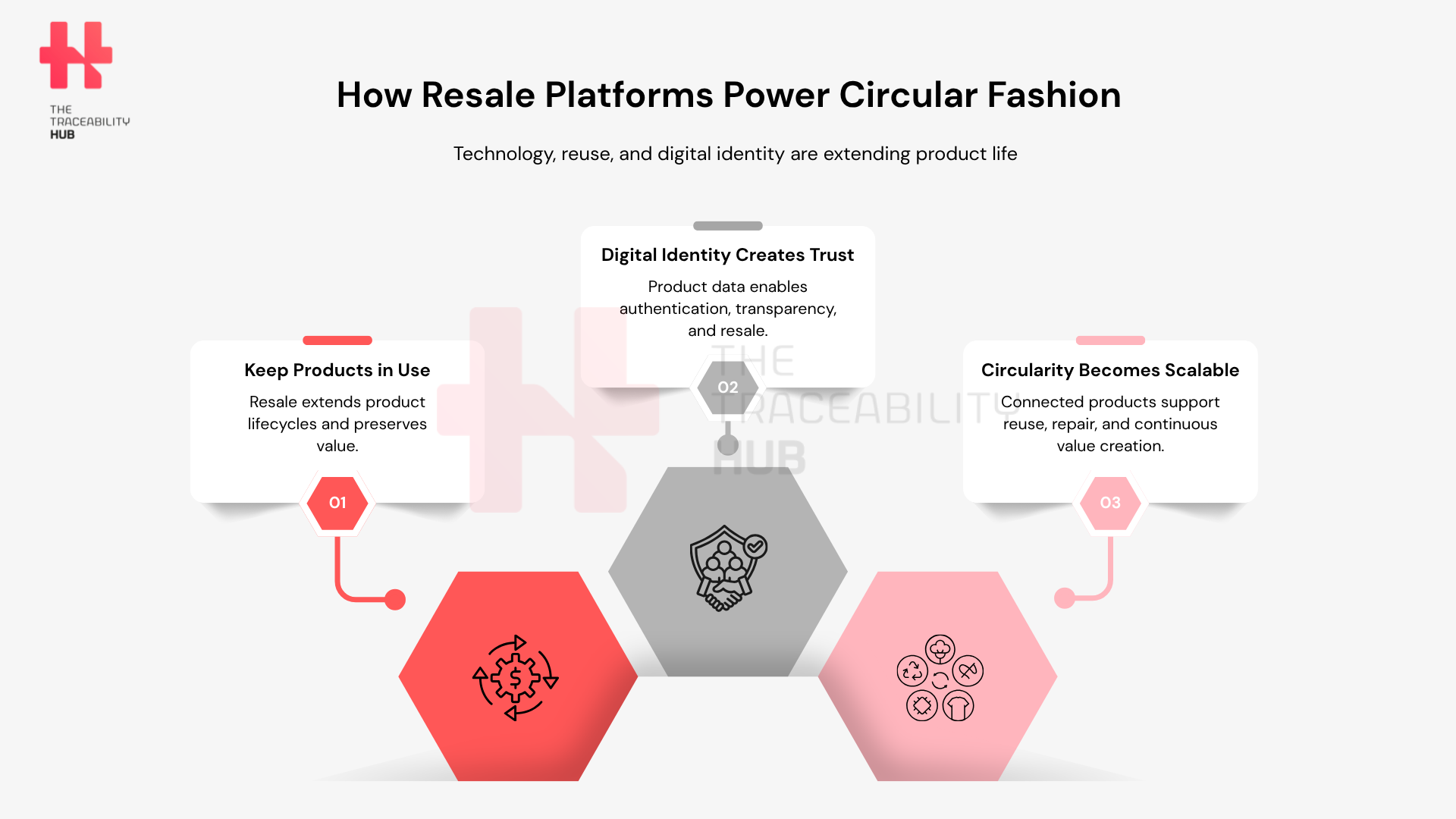
Value Shapes Circular Potential
The strategic comparison between Vinted and Vestiaire Collective points to a central insight for circular fashion: products do not become circular simply because digital resale exists. Their ability to remain in circulation depends, to a significant extent, on the value they retain over time.
For lower-value mass-market garments, circularity within a circular economy tends to be driven by volume and accessibility. Resale works when platforms make exchange fast, simple, and affordable enough to support frequent low-stakes recirculation. For higher-value luxury garments, circularity is more closely tied to preservation and trust. Resale becomes commercially viable because initial quality of the product continues to justify authentication, structural maintenance, repair, and re-commercialization.
In both market models, value is the enabling condition, although it operates differently. At one end, value is generated through ease of exchange; at the other, through durability, brand desirability, and retained worth. This suggests that circular fashion is not only a matter of systems or platforms, but also of how economic, emotional, and perceived physical value are embedded into apparel products from the outset.
The Missing Layer: Repair, Design, and Product Intelligence
Despite their undeniable commercial success, digital resale platforms also expose some of the structural gaps that still limit the full development of circular fashion. Extending product life through resale is important, but it does not automatically solve the broader system-level challenges related to product repairability, material traceability, and product design.
One of the clearest gaps concerns the limited integration between modern resale platforms and regional repair ecosystems. Not all garments are economically worth repairing before resale, especially in lower-value segments where the retail cost of intervention may exceed the item’s market value. At the same time, product condition has a direct impact on resale attractiveness and final pricing, which means that garments often need to be maintained to remain commercially viable in secondary markets.
A second issue is the systemic lack of standardized product information. In many cases, digital platforms offer only partial visibility into material composition, structural durability, care requirements, or recyclability. This lack of data creates friction not only for buyers, but also for the broader circular system, because pre-owned products are harder to assess, maintain, and eventually process responsibly at end of life.
Finally, limited upstream traceability constrains trust on a scale. While this is especially relevant in premium and luxury resale regarding counterfeiting, it also affects the broader second-hand market. Without clearer information on raw material origin, condition history, repairs, or material quality, digital platforms can facilitate recirculation, but they cannot fully optimize long-term product stewardship.
Repair as a Customer Relationship: The Strategic Role of Digital Identity
Among the structural gaps highlighted above, the limited integration between resale and repair ecosystems deserves particular attention. Repair is not merely a maintenance function, in mature circular models, it becomes a strategic dimension of the brand-consumer relationship.
In the luxury sector, the ability to repair a product while maintaining its quality, authenticity, and value is becoming an increasingly important factor for both consumers and brands. However, ensuring that repairs are consistent with original quality standards requires access to accurate and up-to-date information. This is precisely where digital identity systems play a transformative role.
Modern platforms make it possible to record a product’s complete history, including the original materials used, replaced components, and previous interventions. A premium sneaker, for example, can have a detailed traceable history specifying the type of sole originally installed, the upper materials, any replacements made, the authorized service center that performed the repair, and the date of each intervention. When a customer requests after-sales service, the certified center can immediately access this information and respond more quickly, more accurately, and in line with the brand’s quality standards.
The strategic implication is significant. Repair ceases to be a passive after-sales service and becomes an active touchpoint in the ongoing customer relationship. The product maintains a living connection with the brand even years after purchase, opening pathways for personalized service offerings, scheduled maintenance plans, and entirely new forms of customer loyalty.
For resale platforms, this is the missing connective tissue. A pre-owned garment or accessory that arrives at a secondary marketplace with a verified repair and maintenance history is fundamentally a different commercial proposition than one without, easier to authenticate, easier to price accurately, and more attractive to discerning buyers. The combination of resale infrastructure and brand-controlled repair ecosystems is one of the most promising paths toward circular models that are not only environmentally meaningful, but commercially sustainable at scale.
The Role of Traceability and Digital Product Passports
Beyond authentication and resale efficiency, digital identity is also playing an increasingly important role in the final phase of a product’s lifecycle. One of the historical limitations of the fashion industry has been the difficulty of effectively managing disposal and recycling, especially for products composed of multiple materials that are complex to separate. New digital platforms now make it possible to link detailed information about a product’s material composition, treatment history, and proper recycling pathways directly to the product itself.
Through a QR code or smart tag, consumers can access recycling instructions, information on the materials used, return programs offered by the brand, and details regarding the product’s environmental impact. In more advanced implementations, these systems also allow monitoring of metrics such as overall carbon footprint, tracking impact generated during production, transportation, use, and end-of-life. This enables companies to obtain measurable and verifiable sustainability data, moving beyond purely declarative environmental claims, strengthening transparency, and meeting growing regulatory and consumer expectations.
Sustainability, in this model, becomes an operational process supported by technology rather than a communication strategy. The same digital identity that ensures authentication at the point of resale becomes the data anchor that enables responsible disposal at end of life, a continuous chain of information that follows the product from origin to recycling and back into new material streams
If resale platforms have demonstrated how garments can remain in circulation longer, the next step is making that resource circulation more informed, trusted, and operationally efficient. This is where upstream traceability becomes a critical strategic capability. The ability to verify product identity, access reliable lifecycle information, and understand how an item has been used, cared for, or repaired could significantly strengthen the resale ecosystem.
Today, many resale transactions still rely on limited and uneven product data. This information gap creates friction across the entire supply chain: manual authentication can be difficult, pricing can become inconsistent, and repair or care decisions often depend on incomplete information. The problem is not only commercial, but structural. Without verified visibility into what a product is, what it is made of, and how it has moved through different ownership cycles, circularity remains only partially scalable.
Digital Product Passports (DPPs) could help address this critical infrastructure gap. By linking physical products to verified and cloud-accessible data, DPPs could support easier authentication, more accurate resale pricing, and stronger integration with repair and care services. Furthermore, DPPs could also improve marketplace transparency around material composition, geographic product origin, and maintenance history, helping platforms and consumers make better decisions over the lifetime of a garment.
In this sense, the combination of online resale and traceability points toward a more mature form of circular infrastructure. High-volume resale enables recirculation; traceability makes that recirculation more reliable, valuable, and globally scalable. Together, they could move circular fashion beyond marketplace efficiency alone and toward a system in which garments carry the information needed to remain usable, trusted, and economically relevant across multiple life cycles.
From Resale Platforms to Circular Systems
Vinted and Vestiaire Collective show that resale is no longer a marginal phenomenon within the fashion industry. It is becoming part of the infrastructure through which garments retain value, recirculate across users, and remain economically relevant beyond first ownership. In that sense, these digital marketplaces are not simply facilitating transactions; they are helping define how circular fashion works in practice.
Yet they also reveal the limits of platform-led circularity when it is not supported by the wider system. Resale can extend product life, but full circularity requires garments to be designed for durability, supported by repair ecosystems, and connected to digital traceability tools that preserve information as products move across multiple life cycles.
The real opportunity, then, lies in linking these layers together. When resale is combined with better product design, maintenance, and product intelligence, it can evolve from a transactional model into a more resilient circular fashion system.
Ultimately, a garment’s second life is never determined by the mechanics of resale alone. It depends on how well that garment was designed, maintained, and valued from the beginning.
Read more: When Recycling Becomes the Only Option: Why Sorting Needs Better Data