



The Hidden Challenge Behind Fashion’s Global Success
On April 15th, Italy observed its National Made in Italy Day, an institutional milestone dedicated to recognizing the nation’s industrial, cultural, and creative achievements. The selection of this date shows particular significance. Among the many sectors that represent the global reputation of Made in Italy fashion and Italian manufacturing excellence, fashion stands out as an industry that has profoundly influenced Italy’s international image over decades and remains a vital economic driver within the global fashion industry.
With a turnover surpassing €90 billion, contributing approximately 5% of national GDP and employing nearly 500,000 individuals, the Italy fashion industry is not only one of Italy’s most prominent exports, but also a core element of its industrial landscape and fashion supply chain ecosystem. Italian brands, manufacturers, and supply chains are consistently linked to craftsmanship, quality, innovation, and technical expertise.
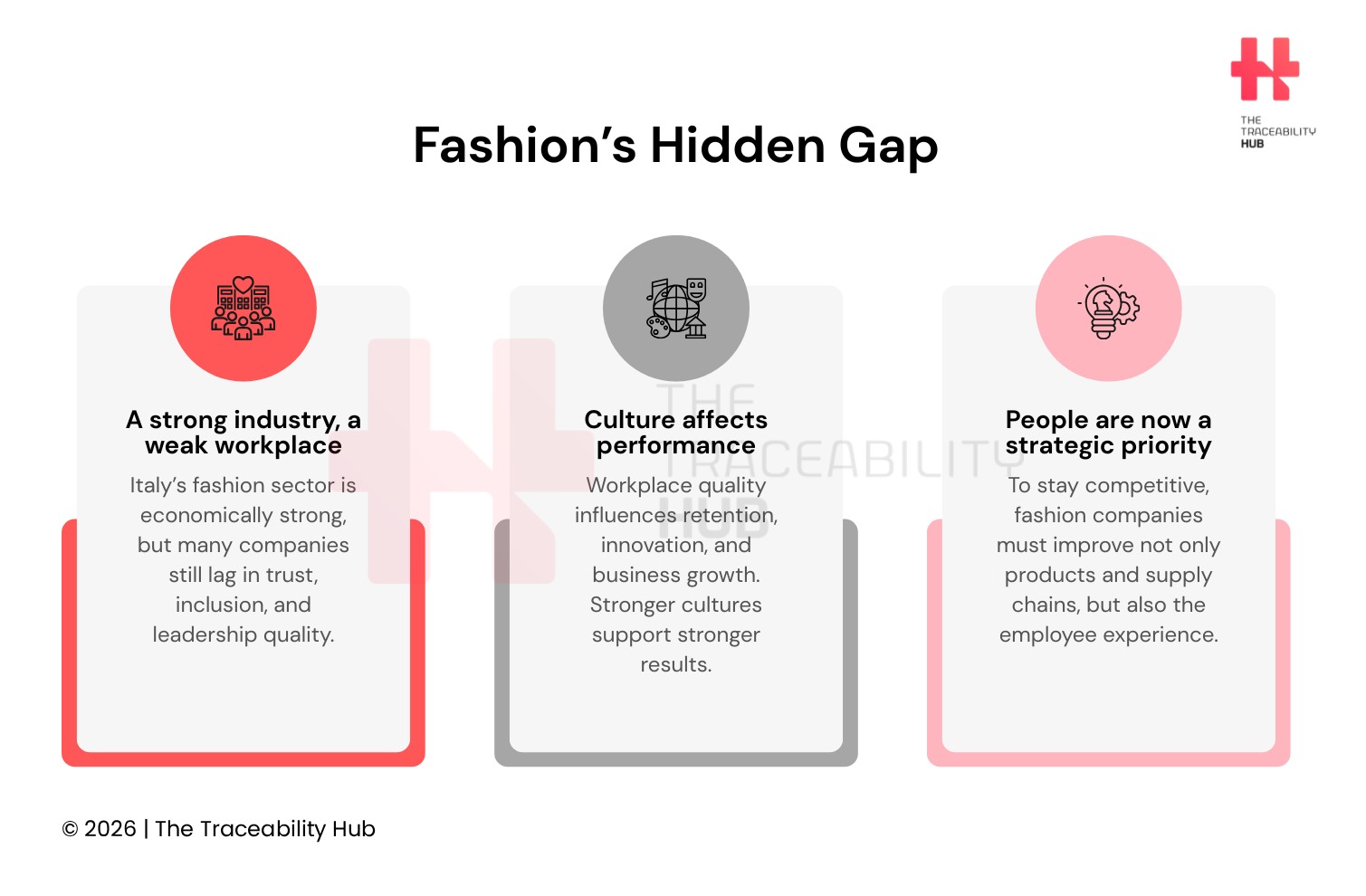
Despite these outward achievements, there exists a less visible yet increasingly prominent challenge. Beneath the prestige associated with runways, designer labels, and export figures lies a structural vulnerability: a continued lag in developing high-quality, trust-based workplace environments. While investments have traditionally been concentrated on product excellence, branding, and production, the evolution of organizational culture, particularly in areas such as management practices, employee engagement, and valuing personnel, has not kept pace.
As labor markets grow more competitive and expectations regarding workplace culture, leadership, employee well-being, and psychological safety rise across Europe, addressing this disparity is becoming imperative. In a sector reliant on skilled artistry, creativity, and accumulated expertise, workplace quality is emerging as a crucial determinant for long-term resilience, business competitiveness, and competitiveness.
The juxtaposition of global accomplishment and internal fragility signals a pivotal moment for Italy’s fashion sector, prompting critical reflection on how excellence, organizational transparency, and sustainable business growth should be defined and maintained in the future.
Fashion’s Hidden Gap
A Structural Weakness Behind a Global Success Story
Despite its economic weight and international visibility, Italy’s fashion industry struggles to translate production excellence into organizational excellence and effective workplace culture in the fashion industry. This gap is clearly reflected in the Best Workplaces Italia 2026 ranking published by Great Place to Work Italy, which is based on direct feedback from more than 210,000 employees across 415 organizations operating in the country.
Within this broad sample, the fashion sector stands out for the wrong reasons. Only one fashion company appears among the top 75 workplaces in Italy, a result that highlights a systemic underperformance in areas such as workplace trust, leadership credibility, inclusion, and overall employee experience. In a country where manufacturing excellence and creativity often go hand in hand, this absence is difficult to dismiss as coincidental.
Rather than a statistical anomaly, the data points to a deeper structural issue. While sectors such as information technology, biotechnology, and financial services have made organizational culture a strategic priority, investing in employee wellbeing initiative, transparent governance models, and participatory leadership, fashion has largely remained anchored to more traditional, hierarchical management approaches. These models, once considered adequate, are increasingly misaligned with today’s workforce expectations, workplace sustainability standards, and labor market dynamics.
According to Alessandro Zollo, CEO of Great Place to Work Italy, the problem is not a lack of talent or commitment, but the way the employee experience is understood and managed within many fashion organizations.
“In fashion companies, there is still a fragmented and impersonal perception of the employee experience.”
This fragmentation often reflects complex, multi-tier fashion supply chains, seasonal employment patterns, and strong divisions between creative, industrial, and operational roles. Without a consistent cultural framework that connects people across functions and levels, efforts to build employee trust and engagement remain isolated, and ultimately ineffective.
As competition for skilled labor intensifies and generational expectations evolve, this organizational lag risks becoming a tangible constraint on growth. For an industry built on long-term expertise, craftsmanship, and identity, the inability to create cohesive and credible workplace cultures is no longer just an internal concern, it is emerging as a factor that can directly influence business performance, resilience, and corporate reputation.
The Business Cost of Cultural Delay
The consequences of this cultural gap extend far beyond conventional human resources metrics. Research demonstrates that organizational culture and workplace wellbeing exerts a direct and quantifiable influence on business outcomes, particularly in industries where skills, innovation, and expertise are essential assets.
Findings from Great Place to Work Italy consistently reveal that organizations prioritizing employee trust and workplace wellbeing achieve superior performance across various key areas. Certified organizations exhibit employee retention rates exceeding 86%, compared to approximately 66% for non-certified counterparts. Additionally, they possess a heightened ability to attract and retain talent amid increasingly complex and competitive labor environments.
Furthermore, Great Place to Work data identifies a strong correlation between internal trust levels, evaluated through the Trust Index, and revenue expansion. This connection is reflected at the national level: companies listed among Italy’s Best Workplaces enjoy average revenue growth of +20%, whereas those in traditional industry and service sectors report growth of around +1%, as indicated by ISTAT statistics.
In summary, workplace culture can no longer be regarded as merely a “soft” or intangible element. It now represents a fundamental driver of competitiveness, shaping productivity, workplace resilience, operational excellence, and sustained value creation.
A Paradox at the Heart of Italian Fashion
The disconnect is particularly pronounced within Italy’s fashion industry. This sector excels in creativity, craftsmanship, emotional storytelling, and fashion brand identity, establishing globally recognized brands that effectively engage consumers. However, numerous fashion organizations face challenges in aligning these core values with their internal management practices and workplace culture strategies.
This situation creates a structural paradox: while the industry is characterized by aesthetic excellence, originality, and a strong emotional connection to its audience, it frequently operates within organizational environments distinguished by limited cohesion, low inclusion, insufficient employee engagement, and weak organizational transparency.
As a result, there is a consistent underutilization of human capital, which poses a significant challenge in an industry where innovation, design acumen, creativity, and artisanal skill set are essential differentiators. When organizational culture does not foster trust, workplace collaboration, psychological safety, or professional growth, the creative potential of employees may be restricted instead of enhanced.
A Case in Point: The Exception That Proves the Rule
There are, however, noteworthy exceptions that illustrate alternative approaches. Kiabi, ranked 7th among companies with 500–999 employees in the 2026 Best Workplaces Italia list, serves as a distinguished example in the fashion sector.
Kiabi’s standing reflects a carefully considered and systematic approach to organizational culture, emphasizing active listening, tangible inclusion and employee wellbeing initiatives, and a strong alignment between stated company values and daily operations. The organization integrates workplace culture directly into its management practices and decision-making, rather than regarding it as a purely theoretical concept.
This case demonstrates that even amid the inherent complexities of the fashion industry -including seasonal fluctuations, varied professional roles, and dispersed fashion value chains – it is feasible to establish a cohesive, trust-driven organizational model. Such a model supports both personnel and business performance, positioning workplace quality and employee satisfaction as a strategic advantage rather than a liability.
Kiabi’s example highlights a broader insight: the cultural divide prevalent across much of the Italian fashion sector is not inevitable. Where leadership proactively addresses these challenges, workplace excellence can complement and amplify fashion’s creative identity, transforming it into a key competitive advantage.
From Reputation Lever to Structural Strategy
The transformation required within Italy’s fashion industry is both profound and comprehensive: it is systemic. Enhancing workplace wellbeing, employee engagement, and fostering trust-based workplace cultures must be considered integral to business strategy, rather than peripheral activities associated with employer branding or corporate social responsibility. These factors are increasingly recognized as structural components of business operations, exerting direct and measurable impact on how fashion companies function, innovate and compete within the global fashion industry.
This influence extends across several strategic areas. The quality of the work environment significantly affects an organization’s capacity to attract and retain talent, especially for positions requiring specialized expertise, creativity, craftsmanship, and technical know-how developed over extended periods. It shapes productivity, organizational resilience, and innovation potential, determining how effectively teams collaborate, share knowledge, and engage in experimentation. Moreover, it has implications for brand credibility, workplace transparency, and external perception, as internal practices are subject to greater scrutiny from consumers, partners, investors, and ESG-focused stakeholders. Ultimately, organizational culture contributes to financial performance, either supporting or limiting sustained business growth and long-term value creation.
Within this framework, workplace excellence should be viewed not merely as a reputational asset, but as a foundational element of business strategy and sustainable competitiveness.
Why This Matters Now: A Strategic Inflection Point
The urgency of this transition is underscored by significant changes within the labor market. Emerging generations are redefining expectations regarding work, leadership, organizational transparency, and organizational purpose. Conventional incentives, such as competitive salaries, job stability, or brand reputation, are increasingly insufficient for fostering loyalty and engagement, particularly among younger professionals.
Employees now prioritize considerations such as purpose and shared values, equity and inclusion, work–life balance, workplace wellbeing, and psychological safety, factors that have become pivotal in evaluating employers and making informed career decisions. These preferences directly impact daily choices about where individuals seek employment, their tenure within organizations, and the extent to which they contribute their skills, innovation potential, and creativity.
For fashion companies, failing to respond to these evolving expectations can result in measurable disadvantages. As competition for talented professionals intensifies and shortages of specialized skills become more prevalent, neglecting to modernize workplace practices may lead to cultural shortcomings that impede organizational performance, employee retention, and business resilience. In an industry subject to global competition, evolving sustainability standards, and fluctuating demand, such challenges have the potential to significantly weaken competitive positioning and employer attractiveness.
The ROI of Trust: Five Strategic Benefits
Organizational research and industry benchmarks confirm that investing in workplace culture, employee wellbeing, and workplace trust generates tangible returns. For fashion companies navigating a rapidly evolving landscape, these advantages directly address several persistent sector challenges tied to talent retention, organizational excellence, and innovation.
Reduced turnover costs emerge as an immediate benefit. Strong employee retention minimizes expenses linked to recruitment, onboarding, and training, particularly in positions requiring specialized technical, operational, or creative expertise.
A constructive workplace environment transforms employees into authentic brand ambassadors. When individuals are valued, included, and engaged, they tend to speak positively about their employer, enhancing reputation and organizational authenticity. In the image-focused fashion sector, internal credibility significantly shapes external narratives and consumer trust.
Workplace quality also elevates talent attraction. As prospective employees become increasingly discerning, organizational culture and employee experience serves as a differentiator alongside brand visibility and product offerings. Organizations recognized for fairness, inclusion, workplace transparency, and respect attract wider and more diverse talent pools.
A key advantage for the fashion industry is enhanced creativity and innovation. Trust-oriented environments foster experimentation, collaboration, and cross-functional idea exchange, and creative problem-solving. Creativity thrives when individuals feel secure in contributing, challenging assumptions, and taking calculated risks.
Finally, investments in organizational culture yield measurable financial benefits. Enhanced employee engagement and workplace wellbeing correlate with greater productivity, operational stability, and sustained revenue growth, directly linking human capital to business outcomes and competitive advantage.
Collectively, these elements highlight a definitive conclusion for Italy’s fashion sector: bridging the cultural gap is not simply about trend adoption or ESG compliance. It requires aligning organizational practices with the same core values, creativity, excellence, craftsmanship, and authenticity, that drive Made in Italy fashion’s global leadership.
From Traceability to “Human Transparency”
For The Traceability Hub, this discussion opens up a broader and increasingly relevant line of reflection. As the fashion industry accelerates its journey toward greater transparency in fashion supply chains, driven by initiatives such as Digital Product Passports (DPP) and ESG reporting frameworks, and sustainable fashion traceability, it is also being called to address a parallel challenge: internal transparency and organizational accountability.
Traceability, in this evolving context, is no longer limited to products, raw materials, or production processes. It increasingly extends to dimensions that were once considered internal or intangible, including working conditions, organizational culture, and employee experience. Stakeholders, from regulators to consumers and investors, are paying closer attention to how companies operate not only across their value chains, but also within their organizations.
Seen through this lens, internal trust becomes part of a wider “human transparency” or “human traceability” narrative. One that links sustainability commitments with ethical governance and long-term business value. Just as supply chain traceability aims to make processes verifiable, accountable, transparent, and resilient, human transparency brings visibility and consistency to how organizations treat, support, and engage their people. For an industry where reputation is tightly intertwined with credibility, this alignment is becoming increasingly difficult to separate from broader traceability strategies.
A Strategic Choice for Italian Fashion
Italian fashion stands at a crossroads.
The sector can continue to rely on its heritage, creative legacy, craftsmanship, and global reputation, or it can evolve by aligning its internal organizational culture with the same standards of excellence it promotes externally. The evidence outlined throughout this analysis points in a clear direction: companies that invest in trust, employee wellbeing, and inclusive workplace models are not only more attractive employees, but also more resilient and competitive businesses.
As pressures on talent, innovation, and sustainability intensify, workplace culture is no longer a secondary concern or a discretionary investment. It is a strategic lever with measurable impact on organizational performance, business resilience, and long-term value creation.
The real question facing the fashion industry is therefore no longer whether it can afford to invest in workplace excellence and organizational culture.
It is whether it can afford not to.