



Why Blockchain Traceability Is Often Misunderstood
Enterprise-grade blockchain traceability is often described in marketing material as if the ledger itself creates end-to-end transparency. It does not. A cryptographic blockchain can make timestamped records harder to alter without leaving traces, but it cannot fix bad source data, fill missing events, or compensate for weak operating processes. That is the first point to get clear. In most U.S. supply chains traceability networks, the real question is not whether blockchain-based ledger sounds more trustworthy. It is whether a shared, time-ordered record actually solves a coordination problem that existing systems are struggling to handle.
This is where many high-profile deployment projects go off track. Teams start with a broad promise, more trust, more transparency, better traceability, and only later discover that the real bottleneck sits elsewhere. Sometimes the issue is poor event capture. Sometimes it is inconsistent identifiers. Sometimes partners do not even agree on what should be recorded.
In those cases, adding a blockchain layer is not the fix. The practical business-first way to evaluate this technology is much simpler: which events need to be shared, who needs to rely on the same version of history, and where are disputes or delays expensive enough to justify a heavier architecture?
The Supply Chain Problems Blockchain Can Help Address
A decentralized blockchain starts to make sense when several independent parties need the same shared event history and no one party should fully control it. That can happen in provenance tracking, multi-tier chain-of-custody workflows, complex multi-party compliance processes, or any environment where physical custody handoffs create friction and evidence is scattered across different IT systems. In those cases, a blockchain can reduce legal arguments about who changed what, when it changed, and whether the electronic record can be trusted by auditors.
This is why the strongest, highest-ROI use cases are usually narrow and specific. They are not built around the idea that every traceability problem needs a distributed ledger. They are built around a concrete pain point: disputed provenance, slow administrative reconciliation, weak auditability, or low trust across organizational boundaries. When blockchain works, it usually works because it supports one clearly defined multi-stakeholder process well, not because it has been positioned as a universal layer for systemic transparency.
Shared Visibility Across Multiple Stakeholders
Real-time Shared visibility matters because global supply chains rarely break inside one company’s internal ERP system. They break between companies. A manufacturer records one event, a logistics provider records another, and then a distributor, retailer, or regulator needs to compare the two. Once the flow crosses distinct company boundaries, especially across outsourced operations or multiple jurisdictions, historical visibility gets messy and fragmented fast.
A secure blockchain network can help when the main issue is that multiple parties need to reference the same cryptographic evidence without depending entirely on one participant’s private database. That does not mean the model is simple. Project Governance still matters. Strict Permission rules still matter. Core underlying Data structures still matter. But when the real systemic bottleneck is shared evidence across a distributed network, blockchain can solve a synchronization problem that a standard private system may not solve as cleanly.
Data Integrity, Provenance, and Auditable Event Histories
One of blockchain’s real architectural strengths is auditable continuity. If a product, batch, or sustainability claim needs a history that different parties can inspect and rely on, blockchain can make silent changes much harder. That unique feature can strengthen origin claims, custody tracking, and event-based regulatory compliance records, especially when the market value of the physical product or the risk of dispute is high.
But this is exactly where the industry hype needs to stop. The ledger only protects what gets written to it. If low-quality or the wrong data goes in, the system preserves the wrong data. If a transformation event is skipped, the missing step does not magically reappear because the record sits on chain. A blockchain can flawlessly preserve digital evidence. It cannot create evidence that operations were never captured in the first place.
Blockchain From Hype to Real Traceability Value
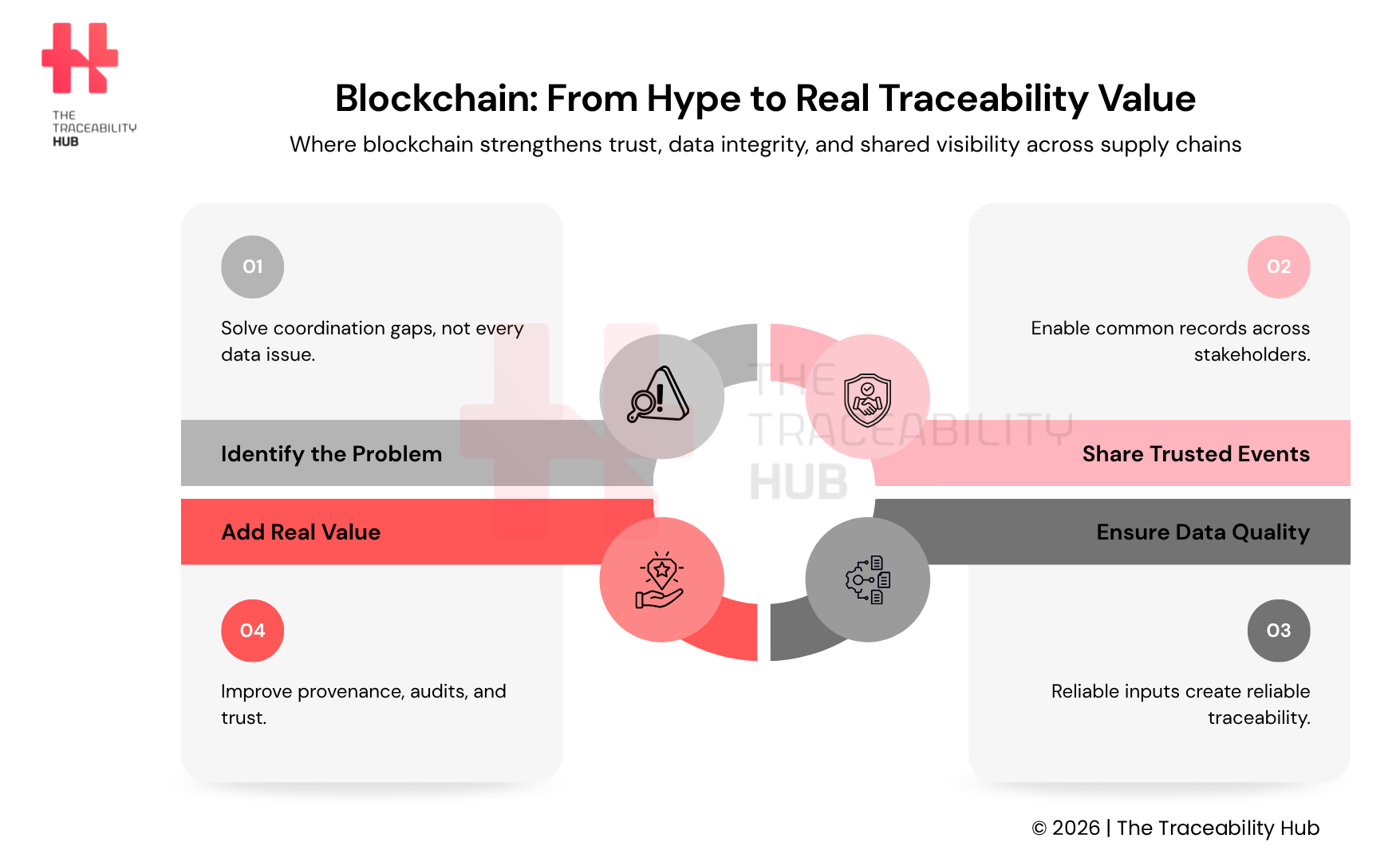
Where Blockchain Adds Little Value Without Stronger Foundations
A Blockchain layer adds very little when the underlying problem is basic data immaturity. If product identifiers are inconsistent, partner data arrives late, or event definitions vary from one system to another, the main need is not a distributed ledger. It is better master data, better integration, and cleaner event capture. Until those basic operational foundations work flawlessly, adding a blockchain platform usually means adding complexity on top of confusion.
The same applies when one organization already controls the process effectively. If a centralized or federated database system can handle the workflow with clear access rules and a reliable audit trail, blockchain may not improve much at all. In those cases, it often adds cost, governance overhead, and technical friction without creating proportional operational value for the business.
Poor Data Capture, Weak Governance, and Integration Gaps
This exact foundational gap is where many blockchain traceability projects stall. The hard operational questions are not technical side notes. They are the project. Who is allowed to write to the ledger? Who validates a disputed event? What happens when a participant submits incomplete or wrong data? How do you separate confidential business data from shared proof? If those questions are unresolved, the blockchain layer does not remove the conflict. It simply sits on top of it.
System Integration gaps are another reality check. A blockchain network that depends on manual uploads, delayed file exchanges, or patchy batch reconciliations is not improving traceability in any meaningful way. The more practical architectural model is to capture events where operations are already happening, then expose or anchor the relevant proof to a shared ledger when that shared proof is genuinely useful. In other words, blockchain should always be evaluated as one specific layer in a broader traceability architecture, not as the architecture by itself.
How to Evaluate Blockchain Traceability with a Business-First Lens
A more grounded evaluation of this technology starts with four simple questions.
- What specific decision gets better if multiple parties trust the same shared event history?
- Where are administrative reconciliation disputes costly today?
- Which source data is reliable enough to safely share?
- Can the participants sustain the governance model over time?
If the answers are vague, blockchain is probably being asked to play the wrong technological role.
If the answers are strong, blockchain can create real value. It can support high-margin provenance claims, reduce friction in multi-party workflows, and strengthen auditability when central control is not practical or not acceptable to the network. But it earns that role only when it is attached to a specific coordination problem. That is the line between a blockchain traceability concept that sounds impressive in a slide deck and a blockchain traceability program that actually works.
That is why the most credible blockchain traceability programs usually look less ambitious from the outside. They are narrower. They focus on one specific claim type, one network, one evidence flow, or one recurring reconciliation issue. They are designed around measurable friction, not around the promise that putting data on chains will somehow improve every traceability challenge at once.
For U.S. organizations looking at the technology today, the practical mindset is selective adoption. Use blockchain where shared evidence is the real bottleneck and where the network can support the governance that comes with it. In many other cases, the better strategic move is still the less glamorous one: stronger identifiers, cleaner event capture, tighter partner alignment, and interoperable systems that already do the job faster and with less friction.