


AI, Resilience, and the New Operating Model of Supply Chains
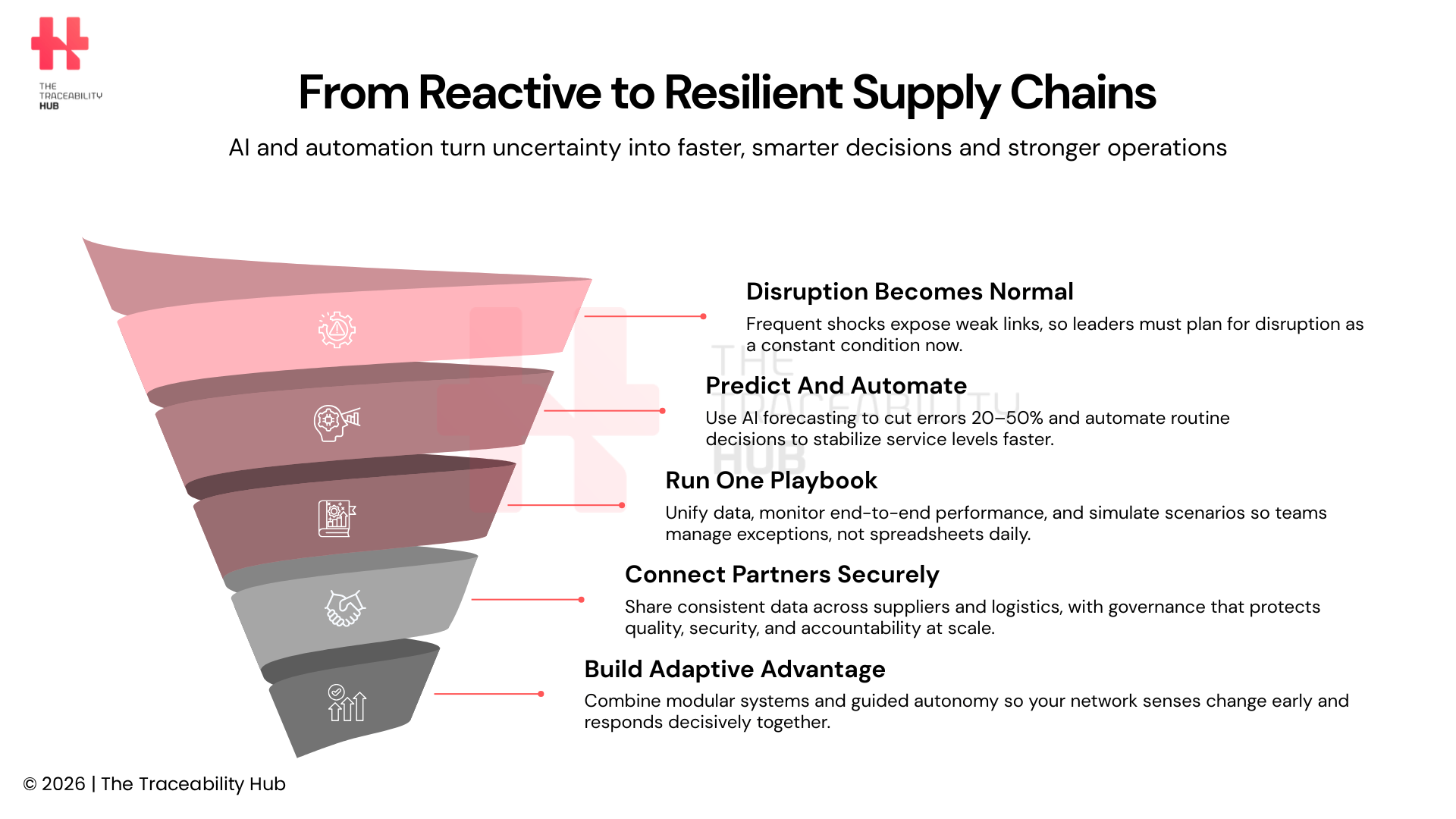
Disruption is no longer an exception in supply chain management, but a persistent structural condition that defines operational performance in modern digital supply chains. Events such as the COVID-19 pandemic, combined with geopolitical tensions, tariffs policy and climate-related shocks, have exposed systemic vulnerabilities across global value chains and interconnected supply chain networks. According to McKinsey & Company, companies can expect significant supply chain disruptions lasting one month or more every 3.7 years, reinforcing the need for a shift in mindset toward resilient and adaptive supply chain strategies. In this context, resilience is no longer about avoiding disruption, but about the ability to anticipate, absorb, and rapidly adapt to it within a data-driven supply chain environment.
This shift is being enabled by the increasing adoption of advanced analytics and artificial intelligence. AI-driven forecasting (a core application of AI in supply chain management), for instance, has been shown to reduce errors by 20–50% while significantly lowering lost sales and product unavailability, allowing organizations to better manage demand volatility and supply constraints. At the same time, automation is transforming execution: as highlighted by the consultancy company Gartner, supply chains are moving toward hyper automation (or end-to-end supply chain automation), where AI, machine learning, and robotic process automation are combined to streamline decisions and reduce manual intervention.
Emerging paradigms such as agentic AI, systems capable of making autonomous decisions within defined parameters, are beginning to further enhance adaptability in intelligent supply networks, while “ambient intelligence”, enabled by IoT and embedded analytics, is improving real-time visibility across operations. These developments align with the broader vision outlined by the World Economic Forum of intelligent, responsive supply networks that continuously learn and optimize. In parallel, the role of the workforce is evolving toward augmented decision-making (or human-AI collaboration in supply chains), where human expertise is enhanced, not replaced, by AI systems. Together, these trends mark a transition from reactive supply chains to predictive, adaptive ecosystems capable of turning uncertainty into strategic foresight and competitive supply chain advantage.
How AI And Automation Are Transforming Supply Chains Today
AI-Powered Demand Forecasting and Inventory Optimization
AI is improving supply chain planning by processing far more variables than traditional forecasting tools can typically manage, including historical sales, promotions, pricing, external market signals, and in some cases weather or logistics data, key inputs in AI-driven demand forecasting systems.
McKinsey reports that AI-driven forecasting can reduce errors by 20% to 50% and lower lost sales and product unavailability by as much as 65%, making it one of the most measurable applications of artificial intelligence in supply chain management.
In practice, these systems combine historical data with statistical methods and machine learning models to detect patterns, update forecasts more dynamically, and better capture non-linear drivers of demand such as seasonality, volatility, and changing customer behavior within predictive supply chain models. IBM notes that AI-based demand forecasting is increasingly used to optimize inventory, production, pricing, and broader supply chain decisions by improving the speed and quality of planning and data-driven decision-making.
The impact extends directly to inventory optimization. AI-enabled planning tools, or AI-powered inventory optimization systems, can help companies reduce inventory levels by 20% to 30% while maintaining or improving service performance, according to McKinsey.
IBM also describes automated replenishment systems that monitor stock positions in real time (supporting real-time supply chain visibility) and trigger orders when inventory falls below predefined thresholds, helping reduce both understocking and overstocking improving inventory management efficiency.
Documented case studies support these gains. IBM reports that Novolex, a leading manufacturer of food, beverage, and specialty packaging servicing customers across a wide range of industries, used AI-powered forecasting to reduce excess inventory by 16% and shorten planning cycles from weeks to days, showing how better forecasting can translate into faster, leaner, and more agile supply chain operations.
Automated Warehouse Operations and Robotics
Warehouse automation is increasingly driven by robotics systems designed to operate in dynamic environments alongside human workers, forming a key pillar of supply chain automation and logistics optimization. Autonomous mobile robots (AMRs), unlike traditional automated guided vehicles (AGVs), are equipped with sensors, cameras, and mapping technologies (such as LiDAR and SLAM) that allow them to navigate flexibly, avoid obstacles, and adapt routes in real time.
This enables safer human-robot collaboration and more adaptable smart warehouse operations.
The adoption of robotics is accelerating globally. According to the International Federation of Robotics, the number of service robots used in logistics, including warehouse robots, has grown rapidly in recent years, reflecting strong demand for automation in fulfillment, distribution, and e-commerce supply chains. Industry analyses from McKinsey & Company indicate that warehouse automation can deliver significant improvements in productivity, throughput, and space utilization, although results vary by implementation and operating model within different supply chain ecosystems.
Technologies such as automated storage and retrieval systems (AS/RS) further enhance efficiency by optimizing vertical space and reducing picking times in automated warehouse systems. Robotics systems are typically deployed to handle repetitive or physically demanding tasks, such as picking, sorting, and transport, allowing human workers to focus on exception handling, supervision, and higher-value decision-making activities in supply chain management.
Real-Time Decision Making and Predictive Analytics
The effectiveness of AI in supply chains depends fundamentally on data integration and supply chain data interoperability. As emphasized by Gartner, fragmented or poor-quality data remains one of the main barriers to scaling AI initiatives and achieving full digital supply chain transformation. Organizations that establish unified and reliable data foundations are better positioned to deploy advanced use cases such as demand sensing and predictive maintenance within data-driven supply chain systems.
Real-time data streams from IoT devices, sensors, and cloud-based platforms are enabling greater operational visibility across supply chains. This allows companies to detect disruptions earlier and respond more quickly, improving supply chain resilience and responsiveness. For example, predictive maintenance models, widely documented by McKinsey & Company, can reduce machine downtime by 30–50% and lower maintenance costs by 10–40% by identifying potential failures before they occur, supporting proactive supply chain operations.
Similarly, enhanced visibility supports faster decision-making in logistics and distribution. While fully autonomous rerouting remains context-dependent, real-time analytics (a key capability in predictive analytics supply chain solutions) can significantly shorten response times to disruptions such as port congestion or transport delays. This shift enables supply chain metrics, such as service levels and inventory performance, to be monitored and adjusted continuously, rather than relying on static or lagging reports, reinforcing the move toward real-time, adaptive supply chain management.
From Reactive to Resilient Supply Chains
Key Trends in Supply Chain Management Driven by Innovation
From Reactive to Predictive Supply Chain Models
Supply chains are shifting from reactive models, based on descriptive analytics and historical reporting, to more predictive and adaptive approaches within AI-driven supply chain ecosystems. Traditionally, planning focused on understanding disruptions after they occurred, often relying on periodic data updates and siloed decision-making. Today, organizations are increasingly investing in advanced analytics and AI to anticipate risks and respond more dynamically, enabling the transition toward predictive supply chain models and intelligent supply networks.
A central enabler of this transition is the adoption of “control tower” architectures (or supply chain control tower platforms), which integrate data across procurement, manufacturing, and logistics to provide end-to-end visibility. According to Gartner, supply chain control towers are evolving from passive monitoring tools into platforms that support real-time decision-making and scenario analysis within data-driven supply chain environments. These systems can incorporate both internal and external data, such as demand signals, supplier performance, and logistics constraints, to improve responsiveness and supply chain agility. While the use of external data (e.g. weather or port congestion) is well established, the systematic use of less structured inputs like social media remains more limited and context dependent.
In parallel, simulation capabilities are advancing using digital twins, virtual representations of supply chain networks (or digital twin supply chain models) that allow companies to model different scenarios and test decisions before implementation. McKinsey & Company highlights that digital twins can support risk analysis, capacity planning, and inventory optimization by enabling more frequent and granular scenario testing compared to traditional planning cycles. The role of generative AI in this space is emerging, particularly in enhancing scenario generation and AI-powered decision support, but its adoption is still at an early stage.
Across these developments, a consistent pattern is the move toward “human-in-the-loop” decision models (a core concept in augmented intelligence supply chain strategies). As emphasized by the World Economic Forum, AI is most effective when augmenting human expertise rather than replacing it. Supply chain professionals are increasingly shifting from manual, execution-focused roles to more strategic functions, overseeing automated processes, managing exceptions, and applying judgments to complex trade-offs in AI-enabled supply chain management.
Modular and Composable Technology Architectures
Composable business architectures are gaining traction as organizations move away from rigid, monolithic systems toward more flexible, modular approaches (or composable supply chain architectures). In this model, capabilities such as demand forecasting, inventory management, and procurement are designed as interoperable services, often connected through APIs, allowing companies to adapt individual components without overhauling entire systems within a modular supply chain technology stack. According to Gartner, composability enables greater business agility by allowing organizations to reconfigure processes and technologies more rapidly in response to changing conditions and supply chain disruption.
While some industry narratives claim dramatic performance gaps, more conservative and validated estimates suggest that organizations adopting composable approaches can improve speed to market and innovation capacity significantly, though results vary widely depending on implementation maturity in digital supply chain transformation initiatives. Deloitte highlights that modular architecture can reduce transformation risk and support incremental upgrades, helping organizations balance innovation with operational continuity in complex supply chain systems.
Connected Execution Across Order, Warehouse, and Transportation Systems
As supply chains become more complex, the need for coordination across execution systems is increasing within connected supply chain ecosystems. Traditionally, Order Management Systems (OMS), Warehouse Management Systems (WMS), and Transportation Management Systems (TMS) have operated in silos, each optimizing its own performance metrics. However, disruptions often require coordinated, cross-functional decisions across the end-to-end supply chain.
Connected execution models aim to address this by enabling real-time data exchange and workflow synchronization across systems (a key feature of integrated supply chain platforms). A collaborative multi-enterprise platform should be designed to manage end-to-end digital supply chain visibility and execution. It should enable real-time information exchange by centralizing data from various stakeholders into a common hub.
Technologies such as event-driven architecture and API-based integrations allow updates in one system to be reflected across others more quickly, improving responsiveness to changes in demand, inventory, or logistics conditions and enabling real-time supply chain orchestration. McKinsey & Company notes that end-to-end visibility and integrated planning can significantly improve service levels and reduce inefficiencies, although full real-time orchestration remains an evolving capability rather than a universal standard.
The Shift from Efficiency to Adaptability
Supply chain strategy is evolving from a primary focus on efficiency toward a broader emphasis on resilience and adaptability within adaptive supply chain models. Cloud adoption is a key enabler of this shift: Gartner consistently identifies cloud platforms as a top investment priority for supply chain organizations due to their scalability and support for advanced analytics and AI-driven supply chain applications.
At the same time, the adoption of AI remains uneven. While many organizations are investing in AI capabilities, only a smaller share has successfully scaled these solutions across their operations. McKinsey & Company reports that a limited percentage of companies achieve enterprise-wide AI deployment, highlighting a gap between experimentation and full integration in enterprise AI supply chain systems.
As a result, competitive advantage is increasingly tied not just to operational efficiency, but to the ability to respond quickly to continuous volatility. Rather than optimizing for stable conditions, organizations are designing supply chains that can adapt dynamically, leveraging modular technologies, real-time data, and integrated decision-making to respond to ongoing disruption in agile and resilient supply chain networks.
Building Resilient and Intelligent Supply Chain Networks
Digital Supply Networks Replacing Linear Chains
Traditional supply chains have historically operated as linear sequences of handoffs between relatively isolated actors. Today, this model is evolving toward digital supply networks, interconnected ecosystems (or digital supply chain networks) in which suppliers, manufacturers, logistics providers, and distributors collaborate through shared data and digital platforms. Deloitte describes this shift as a move from static, sequential chains to dynamic, multi-directional networks that enable greater visibility, coordination, and responsiveness in modern supply chain ecosystems.
In digital supply networks, companies increasingly diversify sourcing strategies and reduce reliance on single suppliers by building more flexible, digitally connected supplier ecosystems within resilient supply chain strategies. While automated sourcing and dynamic supplier selection are emerging capabilities, most organizations are still progressing toward this level of orchestration, with many processes remaining partially manual or semi-automated.
The concept of the “digital thread” is central to these networks. It refers to the continuous flow of data connecting physical assets and operations with digital systems across the value chain: a key pillar of data-driven supply chains. Technologies such as IoT sensors, cloud platforms, and advanced analytics enable real-time data capture and analysis, improving visibility into inventory, production, and logistics conditions. According to McKinsey & Company, enhanced end-to-end visibility can significantly improve service performance and reduce disruptions, although implementation maturity varies widely across global supply chain operations.
These capabilities support a transition from simple tracking to more advanced operational intelligence. As highlighted by the World Economic Forum, digitally enabled supply networks can improve resilience by allowing organizations to detect risks earlier, coordinate responses across partners, and adapt more quickly to changing conditions in intelligent supply chain systems.
Scenario Planning and Rapid Supplier Onboarding
Scenario planning is becoming a core capability in modern supply chains, enabling organizations to model potential disruptions, such as supplier outages, demand spikes, or logistics constraints, before they occur using predictive supply chain analytics. Digital twin supply chain technologies allow companies to simulate supply chain operations in virtual environments and test alternative strategies without operational risk. These tools support more informed decision-making around capacity, sourcing, and inventory under different scenarios.
Cloud-based collaboration platforms further enhance coordination by enabling shared data access between internal teams and external partners within connected supply chain platforms. This reduces fragmentation and supports faster, more aligned responses, although full real-time collaboration across all partners remains an evolving capability.
Supplier onboarding is also being streamlined through digitalization. While timelines vary significantly by industry and regulatory context, organizations are increasingly using centralized platforms, standardized data models, and automation to accelerate onboarding processes in digital supplier management systems. Risk-based approaches, where higher-risk suppliers undergo more extensive due diligence, are widely adopted to balance speed with compliance in supply chain risk management.
Sustainability Through Automation and Tracking
Sustainability is becoming a central dimension of supply chain strategy within sustainable supply chain management frameworks. According to the World Economic Forum, a significant majority of companies’ environmental impact, often over 80%, originates in their value chains (Scope 3 emissions), reinforcing the importance of supply chain emissions tracking and ESG reporting. This makes supply chain visibility and tracking critical for decarbonization efforts.
Technologies such as IoT sensors and digital platforms enable more granular monitoring of inventory, transport conditions, and asset utilization within green supply chain operations. These capabilities can help reduce waste, improve efficiency, and support more accurate emissions tracking, although precise outcomes depend on implementation.
In terms of global context, the International Energy Agency reports that the transport sector accounts for roughly 20–25% of global CO₂ emissions, underscoring the importance of logistics optimization. Advanced analytics and AI can support emissions reduction indirectly, for example through route optimization, load consolidation, and demand forecasting, but widely cited fixed reduction ranges (e.g. 5–10%) are highly context-dependent and not universally applicable.
Customer-Centric Supply Chains Powered by AI
Customer expectations are increasingly shaping supply chain design, with service levels, speed, and transparency becoming critical performance metrics in customer-centric supply chains. AI and advanced analytics are enabling more proactive management of customer outcomes by improving demand forecasting, identifying potential delays, and supporting more accurate delivery commitments within AI-driven supply chain systems.
For example, predictive analytics can help detect risks to lead times, such as supply shortages or logistics disruptions, and support earlier mitigation actions in real-time supply chain decision-making. AI is also widely used in areas such as dynamic inventory allocation, order promising, and personalized product recommendations, particularly in retail and e-commerce contexts within intelligent supply chain platforms.
The Future Landscape: What’s Coming Next in Supply Chain Innovation
Agentic AI and Autonomous Decision Making
Artificial intelligence in supply chains is evolving beyond traditional rule-based automation toward more adaptive and semi-autonomous systems within next-generation supply chain technologies. What is often described as “agentic AI” refers to AI-driven components that can process real-time data, evaluate multiple scenarios, and support decision-making across functions such as inventory management, procurement, and maintenance in autonomous supply chain systems.
Unlike static automation, these systems operate in iterative feedback loops, continuously improving performance based on new data. However, fully autonomous decision-making remains at an early stage. According to Gartner and McKinsey & Company, most organizations are currently adopting hybrid models where AI augments human decision-making rather than replacing it, reinforcing the importance of human-AI collaboration in supply chains. Early implementations of multi-agent systems are emerging in controlled use cases, but widespread deployment is still developing. As also highlighted by the World Economic Forum, the near-term impact of AI in supply chains lies in enhancing speed, accuracy, and responsiveness, enabling organizations to anticipate and manage disruptions more effectively while maintaining human oversight.
Human-AI Collaboration and Augmented Intelligence
The role of AI in supply chains is increasingly framed as augmentation rather than replacement. Often referred to as “augmented intelligence,” this approach combines human expertise with machine-driven insights to improve decision-making quality and speed within AI-augmented supply chain operations. While market forecasts for this segment vary depending on definitions and scope, there is broad consensus that investment in AI-enabled decision support is growing rapidly across industries.
In practice, human-AI collaboration typically evolves across different levels of maturity. At the foundational level, AI supports decision-making by providing insights and recommendations based on large datasets. As capabilities advance, systems can suggest optimized actions or scenarios, while humans retain control over final decisions in human-in-the-loop supply chain models. In more advanced use cases, certain operational decisions, such as routine replenishment or scheduling, may be automated within predefined rules and governance frameworks. This hybrid “human-in-the-loop” model remains the dominant and most effective approach for enterprise AI adoption.
Data Interoperability and Trust Frameworks
Data interoperability is a critical enabler of modern supply chains, allowing information to be exchanged across systems, partners, and platforms in a consistent and secure way within interconnected supply chain ecosystems. As supply chains become more interconnected, the ability to integrate data from multiple sources, such as logistics providers, suppliers, and internal systems, supports greater visibility, coordination, and resilience in data-driven supply chain networks.
At the same time, trust and governance frameworks are becoming increasingly important to ensure data quality, security, and compliance. Organizations are adopting structured approaches to supplier risk assessment, data validation, and information sharing, particularly in regulated environments and ESG reporting contexts within trusted data ecosystems. While specific proprietary frameworks and metrics vary, the broader trend is toward standardized, trusted data ecosystems that enable collaboration while maintaining control and accountability.
Building the Adaptive Supply Chain
Supply chains are undergoing a structural transformation, moving from linear, efficiency-driven models to interconnected, data-driven networks built for resilience and adaptability (or adaptive and intelligent supply chains). Disruption is no longer a temporary shock but a constant condition, requiring organizations to rethink how they plan, execute, and collaborate across the value chain within modern supply chain innovation strategies. Technologies such as AI, advanced analytics, automation, and cloud-based platforms are enabling this shift, improving forecasting accuracy, enhancing visibility, and supporting faster, more informed decision-making in AI-powered supply chain systems.
Looking ahead, competitive advantage will depend less on optimizing isolated functions and more on orchestrating end-to-end networks that can sense, adapt, and respond in real time within predictive and autonomous supply chain ecosystems. Organizations that invest in predictive capabilities, modular architectures, and trusted data exchange will be better positioned to navigate ongoing volatility and turn uncertainty into a source of strategic advantage in the future of supply chain innovation.
Read more: How Customer Data Platforms Turn Raw Data into Business Results