


The Evolution of Smart Pharmacy Care
Smart pharmacy technology, encompassing digital health solutions and pharmacy automation systems, is revolutionizing the way patients access and manage their medications. This addresses a key healthcare challenge: medication adherence. Studies reflect an increasing demand for more flexible and convenient medicine access options. Research suggests that approximately 40% of patients are open to using smart locker systems for prescription collection at their convenience, while home delivery and pharmacy-based vaccination services are also highly valued by a considerable segment of the patient population.
As a result, the smart pharmacy model is evolving beyond traditional dispensing. These systems integrate intelligent lockers (including refrigerated units), digital monitoring tools, and patient support applications (such as medication management apps and adherence tracking systems) to improve both access to medicines and adherence to therapy. This piece explores how these technologies work and their real-life impact on patient care and treatment effectiveness improvement.
The Medication Management Challenge Patients Face Today
Medication adherence remains one of the main challenges affecting the effectiveness of therapies and overall patient outcomes in healthcare systems. Patients may forget doses, take incorrect quantities, or discontinue treatment due to side effects or logistical barriers. This results in negative outcomes both for patients and for healthcare systems, including wasted medicines and reduced treatment effectiveness and increased healthcare costs due to poor adherence.
Access-related barriers further exacerbate the problem. For many patients, particularly those with chronic conditions, access to medication is limited by rigid schedules, distance from healthcare facilities, and logistical constraints: highlighting the need for remote healthcare access and decentralized pharmacy solutions. These challenges contribute to lower adherence and increased pressure on healthcare systems.
Addressing this issue requires integrated solutions that combine improved access with adherence support, through digital medication management and remote patient monitoring tools. Emerging models, such as smart pharmacy systems, aim to tackle both dimensions simultaneously by integrating digital tools, remote monitoring, and innovative distribution solutions.
Smart Pharmacy Technology
How Smart Pharmacy System Technology Works
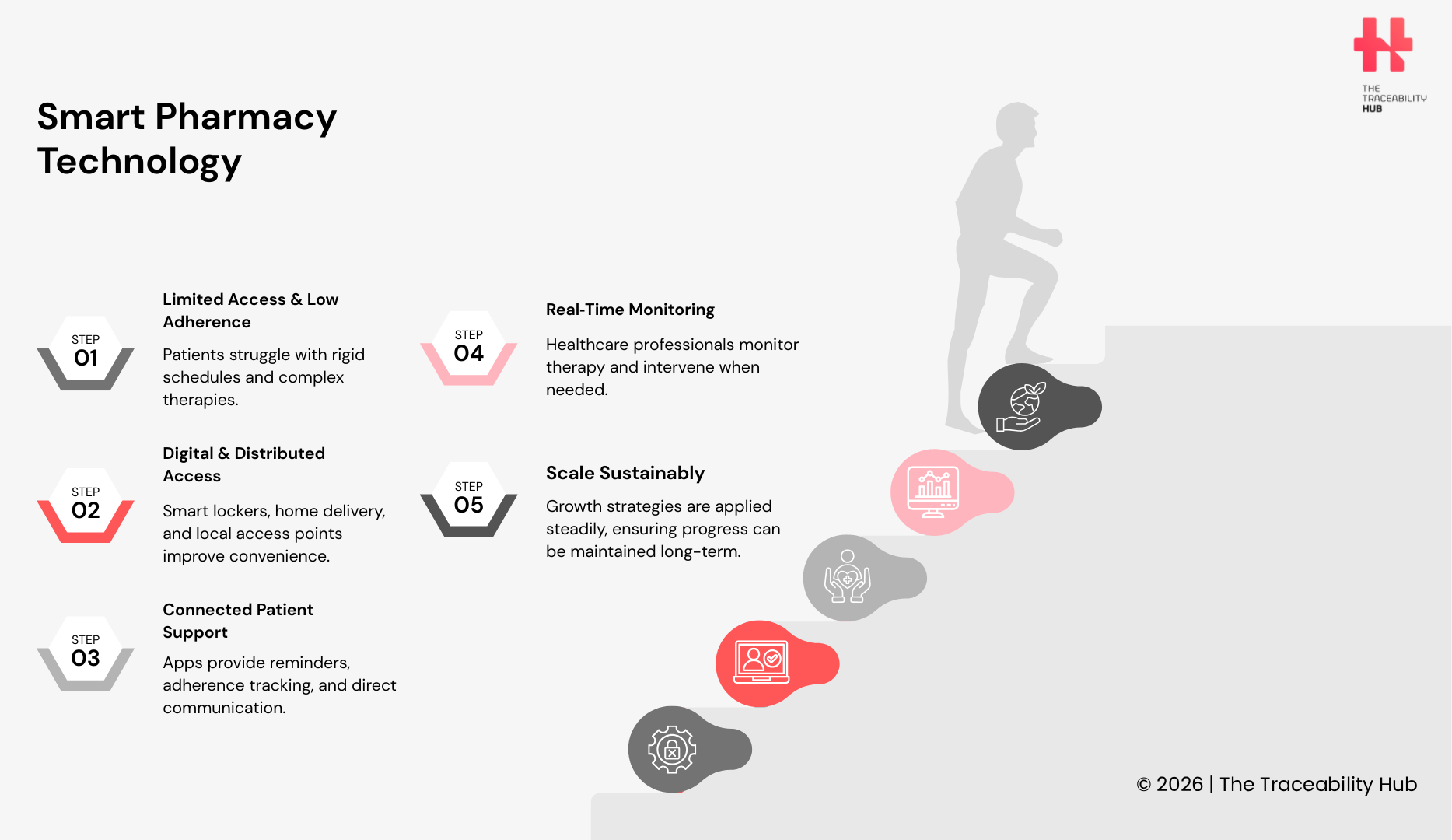
Smart pharmacy systems operate through the integration of digital tools and physical distribution infrastructure, a connected healthcare ecosystem, to support patients throughout their therapeutic journey, with a particular focus on improving access to medicines and medication adherence.
In the proposed model, developed within the context of telemedicine and territorial healthcare innovation, intelligent lockers, also equipped with refrigerated units, are installed in proximity-based facilities such as “Case della Comunità”, a preliminary medication step, because most of the times there is no need to go directly to the hospital or to the first aid ward. These intermediate health houses are connected to a centralized logistics system (pharmaceutical logistics optimization platform) that ensures efficient and timely distribution of medicines, overcoming common barriers such as rigid pharmacy schedules, geographical distance, and hospital congestion.
At the same time, a dedicated digital application (a healthcare mobile app for medication management), supports patients in managing their therapy. The app provides personalized reminders, collects data on medication adherence through adherence monitoring systems, and enables direct communication with healthcare professionals. This information is made available through a monitoring dashboard, allowing operators to track the patient’s therapeutic pathway and intervene when necessary. The system also leverages artificial intelligence, AI in healthcare logistics and communication optimization – to optimize distribution processes and improve communication efficiency.
In parallel, innovations in pharmaceutical packaging, such as smart blister packs and connected bottles, enable the collection of data on medication usage, offering additional insights into adherence patterns and supporting more informed clinical decisions.
By combining smart packaging, digital platforms, and distributed access points, this integrated system addresses both adherence and access challenges. It reinforces the central role of the pharmacist, even in remote dispensing scenarios, and supports a more coordinated, patient-centered model of care within a digital pharmacy ecosystem. Designed to be modular and scalable, the solution aligns with broader healthcare transformation initiatives, including those promoted by the PNRR and the organizational framework defined by DM 77.
In Italy, a good tool to provide concrete assistance comes from the Mario Negri Institute, a Pharmacological Research Institute, with offices in Bergamo and Milan, which has created “INTERCheck”: a prescription support system that evaluates the complex therapies of elderly people on multiple medications and the various aspects of pharmacology, with the aim of balancing the risks and benefits of each treatment. The service is free and reserved for doctors, pharmacists, and nurses involved in medication management. It implements the Institute’s own database of interactions, as well as the recommendations and best clinical and healthcare practices of “Choosing Wisely-Italy”: an American-inspired project, supported by various national health federations, for more informed and shared choices, and to foster dialogue with patients and citizens regarding diagnostic tests, treatments, and procedures at risk of inappropriateness.
The Real-World Impact on Patient Care
Smart pharmacy systems are reshaping patient care by addressing two of the most critical challenges in healthcare delivery: access to medicines and medication adherence (key drivers of healthcare system efficiency and patient outcomes). By integrating physical infrastructure with digital tools, these systems enable a more continuous and patient-centered approach to therapy management and digital medication adherence support.
In the proposed model, intelligent lockers, also equipped with refrigerated units (advanced automated medication dispensing systems), are combined with centralized logistics and digital platforms to ensure that patients can access their medications more easily, regardless of time or location. This is particularly relevant for chronic patients, whose access to therapy is often limited by rigid schedules, distance from healthcare facilities, and logistical constraints within hospitals.
At the same time, digital applications play a key role in supporting adherence through patient adherence support tools and remote monitoring systems. Personalized reminders, data collection on medication intake, and direct communication channels with healthcare professionals allow for continuous monitoring of the therapeutic pathway. Dedicated dashboards further enable healthcare operators to track patient progress and identify potential adherence issues early using data-driven healthcare insights.
The expected impact of this integrated approach is significant. Improved adherence can lead to a reduction in avoidable hospitalizations, while better access to medicines helps ensure continuity of care, especially for vulnerable populations such as elderly and chronic patients. In addition, the system contributes to reducing waste and unused stock, optimizing healthcare resources, and alleviating pressure on overburdened healthcare structures through healthcare resource optimization strategies.
Beyond operational efficiency, these solutions also reinforce the role of pharmacists, positioning them as key actors in a more distributed and collaborative healthcare model. Overall, smart pharmacy systems represent a scalable and sustainable innovation, aligned with current healthcare transformation efforts and capable of delivering tangible benefits across the entire care continuum.
Advancing Patient-Centered Care Through Smart Pharmacy Systems
Smart pharmacy technologies represent a promising approach to addressing the persistent challenge of medication adherence while improving access to care through digital health solutions and connected pharmacy systems. By integrating digital tools, intelligent distribution systems, and patient support platforms, these solutions enable more continuous monitoring of therapy, via remote patient monitoring and adherence tracking technologies, and facilitate timely interventions by healthcare professionals.
The expected impact includes improved adherence, reduced avoidable hospitalizations, better use of healthcare resources, and greater accessibility to medicines, particularly for chronic and vulnerable patients. At the same time, these systems support a more patient-centered model of care and reinforce the role of pharmacists within an increasingly distributed healthcare ecosystem (digital healthcare infrastructure and smart pharmacy networks).
As healthcare systems continue to evolve, smart pharmacy solutions offer a scalable and sustainable pathway to enhance both clinical outcomes and operational efficiency positioning smart pharmacy technology as a key driver of healthcare digital transformation.
Read more: Key Considerations for Government Officials Regarding Unproven Traceability Providers