


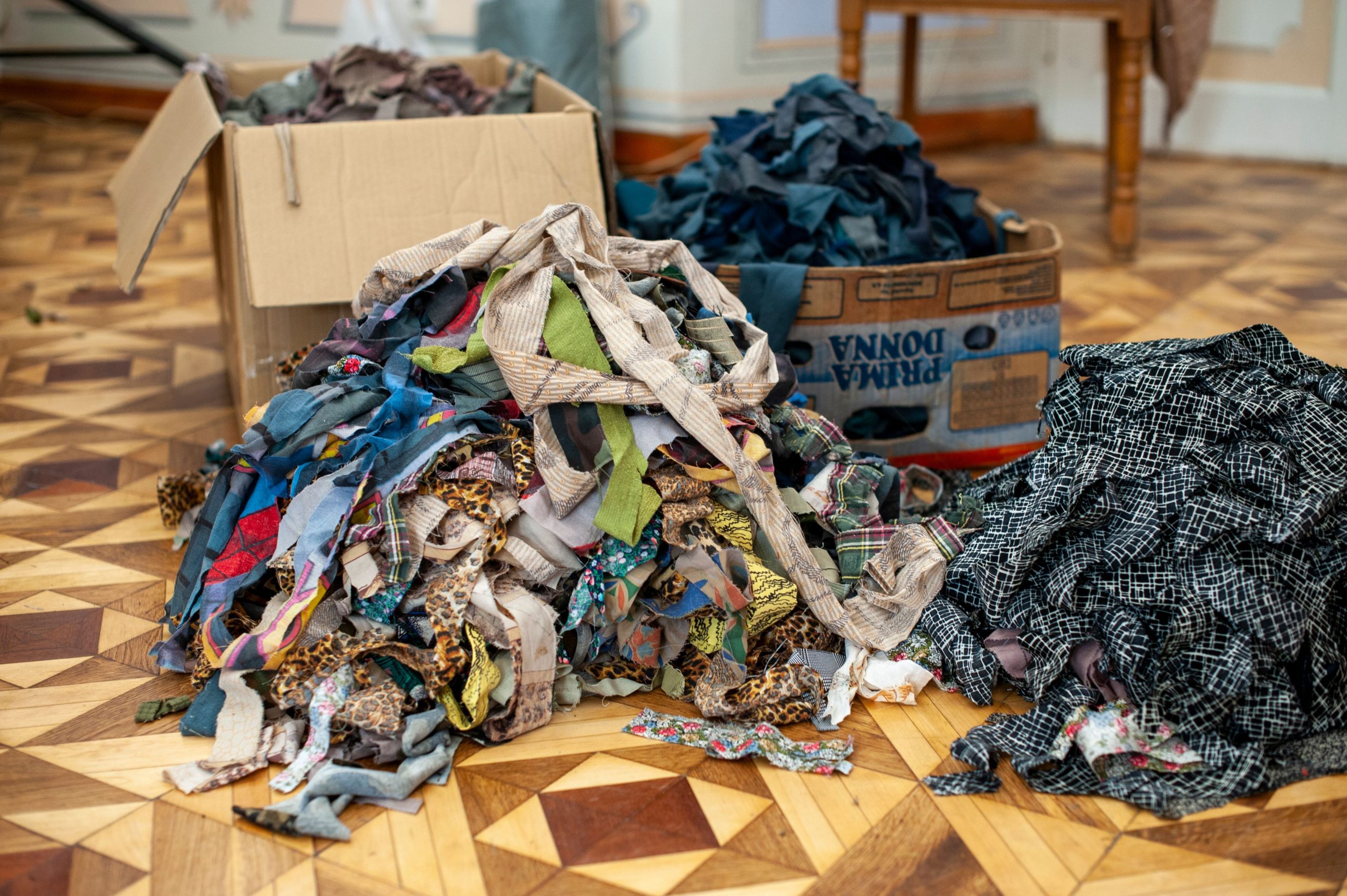
Textile Sorting Is the Missing Link in Recycling
In circular fashion, garment recycling is often treated as the system’s ultimate fallback, the solution that absorbs everything that can no longer be actively reused, repaired, or resold. But in real-world industrial practice, successful textile recycling is not guaranteed.
It only works when products can be accurately identified, correctly sorted, and systematically routed toward the right processing pathway. At end of life, a discarded garment’s fate depends not only on what raw fibers it is made of, but on what is known about it.
That distinction matters more than ever. As textile waste volumes grow and mandatory separate collection expands across Europe, the fashion industry is under increasing pressure to turn discarded garments into high-quality usable feedstock rather than low-value downcycled output or waste. Yet textile sorting remains one of the most fragile points in the entire value chain. If a garment’s exact fiber composition is unclear, trims are not documented, physical labels are missing or inaccurate, or product data is unavailable in a usable format, even technically recyclable garments can be downgraded, misdirected, or excluded from recycling altogether.
In other words, textile recycling fails long before the physical recycling process itself. It fails when data is incomplete, inaccessible, or unreliable at the moment decisions need to be made.
The Critical Moment: Sorting at End of Life
Before any discarded garment can be recycled, it must first pass through manual or AI-enabled textile sorting. This is the stage where operators determine whether an item is recyclable, which recycling stream it belongs to, and whether it contains hidden elements that could disrupt advanced recovery processing.
These decisions are highly consequential for the value chain, yet they are often made under pressure. In many cases, sorting happens quickly, with limited data tools, and on the basis of incomplete or unreliable information. Human operators may have to rely on care labels, basic visual inspection, or partial product knowledge to assess fiber composition, identify non-textile components, and detect potential hazardous contaminants.
That creates a structural weakness across the circular economy system. If key product information is missing, inaccurate, or digitally inaccessible, garments that might otherwise be suitable for high-grade textile recycling can be routed to the wrong stream, downgraded to lower value uses, or removed from the recycling flow altogether. What looks like a recycling problem downstream often begins as an information problem upstream, at the exact point where sorting decisions are made. The European Environment Agency (EEA) notes that, as separate textile collection legally expands across the EU, insufficient sorting infrastructure and recycling capacity risks pushing collected material toward incineration, landfill, or export instead of sustainable circular recovery.
Recent industry and research work point in the same direction: better textile sorting depends not only on better infrastructure, but on better product data. Technical guidance from the T-REX Project emphasizes that recyclability is shaped by factors such as fiber composition, trims, prints, and garment construction, while recent reviews of AI-enabled textile sorting highlight the ongoing difficulty of reliably detecting complex blended fibers and working with incomplete material data when relying on near-infrared optical sorting tools alone.
The Information Gap: What Sorters Don’t Know
Today, most garments arrive at commercial sorting facilities with surprisingly little usable information attached to them. Labels may be incomplete, missing, or too generic to support a reliable decision. In most cases, there is no accessible digital product data, and virtually no visibility into chemical treatments, performance coatings, finishes, or other processing details that can directly alter chemical recyclability.
This stark lack of transparency creates a major bottleneck at precisely the point where accuracy matters most. Sorters are often forced to rely on superficial visual inspection, experience-based assumptions, and standard labeling that was never designed to support industrial end-of-life decisions. A care label may show the main fiber category, but it rarely reflects the full material complexity of a modern garment, particularly when blends, bonded layers, hidden components, or chemical treatments are involved.
The core problem is not only that lifecycle information is missing. It is that the information available is often not usable in an industrial sorting context. It may be too vague, too inconsistent, too difficult to verify, or simply unavailable in a format that can support fast, repeatable decisions on a scale. The European Parliamentary Research Service (EPRS) identifies exactly these kinds of structural gaps across the textile value chain, including missing product data, poor accessibility, reliability issues, and the cost and difficulty of sharing data between disconnected market actors.
As a result, modern textile sorting becomes a form of informed guesswork. And even when that guesswork is based on deep human expertise, it still introduces uncertainty into the system. High-quality Items that could potentially be recycled may be rejected, downgraded, or sent to less suitable streams simply because the underlying data is not available when the decision is made. Studies on the upcoming Digital Product Passport (DPP) for textiles explicitly recognize that actors such as sorters and recyclers need better access to product-level information, while recent reviews of AI-enabled textile sorting show that better automation still depends on better underlying data, especially for blended fibers and complex post-consumer inputs.
Without reliable open data infrastructure, textile waste is not just the outcome of poor recycling technology. It is often the outcome of poor information.
Beyond Materials: The Hidden Risk of Chemicals
Material fiber composition alone is not enough to determine whether a garment can move safely and effectively into a clean recycling stream. An apparel product may appear recyclable on paper because its fibers are technically recoverable, yet still contain hidden chemical substances that complicate, limit, or even prevent recycling in practice.
That chemical risk is often invisible. Advanced chemical finishes, coatings, water-repellent treatments, toxic dyes, plasticizers, flame retardants, and other substances used during production may not be visible to sorting operators, but they can have significant consequences downstream. Some chemical additives may interfere with recycling processes, reduce the quality of recovered output, or create contamination risks for other material flows. Other hazardous substances may raise health and safety concerns for workers handling post-consumer textiles or for facilities processing them on a scale. Recent technical reviews show that residual finishes and chemical additives can interfere with both mechanical and chemical recycling pathways, making pre-treatment, contamination control, and better chemical transparency increasingly important.
This is why recyclability cannot be assessed through fibers identification alone. It must also comprehensively account for chemical safety. The European Environment Agency has explicitly warned that substances such as PFAS (per- and polyfluoroalkyl substances) in textiles can act as a barrier to circularity by undermining longer use, garment reuse, and safe material recycling and by increasing the risk of contamination and release across the value chain.
Recent independent investigations into ultra-fast fashion products have made this systemic chemical issue impossible for regulators to ignore. Testing on garments sold through platforms such as Shein and referenced alongside Temu has raised concerns around restricted substances, unsafe chemical levels, and persistent gaps in supply chain transparency. A 2025 Greenpeace investigation found hazardous chemicals above EU legal limits in a significant share of tested Shein products, including PFAS, endocrine-disrupting phthalates, and heavy metals, while CHEM Trust reported similar concerns in coverage of those findings and highlighted broader risks linked to rapid-consumption platforms such as Temu.
The broader implication is clear: a garment is not automatically circular or recyclable simply because its label says polyester or cotton. If its underlying chemical profile is unknown, or worse, incompatible with safe circular use, then the system is operating with blind spots. In that context, better sorting data is not just about identifying materials. It is about knowing enough to avoid contamination, protect workers, and prevent hazardous substances from being carried further into circular systems.
The Consumer Blind Spot
The information gap blocking circular fashion does not begin at the end of life. In many cases, it begins at the point of purchase.
Consumers, especially in digital online retail environments, often have remarkably limited visibility into the full lifecycle footprint of what they are buying. Fast-fashion Product pages may provide only basic composition details, if any, while meaningful information about chemical treatments, hidden substances of concern, durability, repairability, or end-of-life options is rarely available in a usable form. Even when certain sustainability metrics are voluntarily disclosed by brands, it is not typically structured to help consumers understand whether a garment is likely to be recyclable, how it should be handled at end of life, or what risks it may carry further down the value chain. The Digital Product Passport for textiles study by the European Parliamentary Research Service explicitly frames this transparency gap as a system-wide issue affecting not only brands and regulators, but also downstream sorters, recyclers, and consumers.
Closing this consumer blind spot is now technically possible, and increasingly, commercially expected. Smart packaging and labelling solutions that link physical garments to digital product records through standardized, scannable identifiers (QR codes, 2D codes, NFC tags) are emerging across multiple consumer sectors as the practical interface between the product and the end user. A single scan, from a smartphone, can give consumer access to verified information about composition, country of origin, chemical treatments, sustainability certifications, and end-of-life instructions, all the data that today is fragmented, hidden, or absent from physical labels.
The strategic value of this approach extends beyond consumer transparency. The same digital identity that engages the consumer at the point of purchase becomes the operational reference at the point of disposal. A QR code on a garment label is, simultaneously, a marketing channel for brand storytelling, a regulatory compliance vehicle for the Digital Product Passport, and an operational anchor for sorting and recycling decisions years later. One identifier, multiple use cases, across the full product lifecycle.
Antares Vision Group’s Genuine Way platform, for example, has been designed exactly around this convergence: a single product identity that connects consumer engagement, brand protection, supply chain traceability, and end-of-life data accessibility through one standardized digital touchpoint. The implication for textiles is significant, it means that the same labelling and tagging infrastructure that helps a fashion brand differentiate itself in a saturated market can also provide the data continuity that recyclers and sorters need decades later, without retrofitting or duplication.
For consumers, this turns a generic label into a meaningful informational interface, supporting more deliberate purchasing decisions and stronger circular behavior. For brands, it transforms a packaging compliance requirement into a customer engagement opportunity. For the broader circular system, it ensures that the information embedded in a garment at the moment of production remains accessible, verifiable, and operationally usable throughout its entire lifecycle, including the moment when sorting decisions determine whether the garment becomes high-value feedstock or waste
This total data lack creates a structural blind spot in the market. Low-quality apparel products can enter global circulation without a clear lifecycle pathway, and consumers have little basis for distinguishing between garments that are designed for circular systems and those that are likely to become problematic once discarded. In effect, the current fashion market continues to reward availability, price, and speed, while the information needed for responsible end-of-life management remains largely invisible.
The data.europa.eu overview of the EU’s Digital Product Passport highlights this exact transparency gap, noting that the initiative is meant to provide clearer and standardized information on composition, substances of concern, and disposal guidance in order to improve open transparency across the value chain.
The downstream consequence of this consumer blind spot is incredibly severe. When apparel products are placed on the market without sufficient visibility into composition, chemistry, or recyclability, non-recyclable or unsafe items do not simply disappear. They accumulate in waste streams, complicated sorting, increase contamination risks, and reduce the efficiency of recycling systems already operating under pressure. From that perspective, the consumer blind spot is not just a corporate transparency issue. It is an infrastructure issue, because every information gap at the front end of the fashion lifecycle eventually reappears at the back end of the system.
Textile Recycling Starts with Better Data
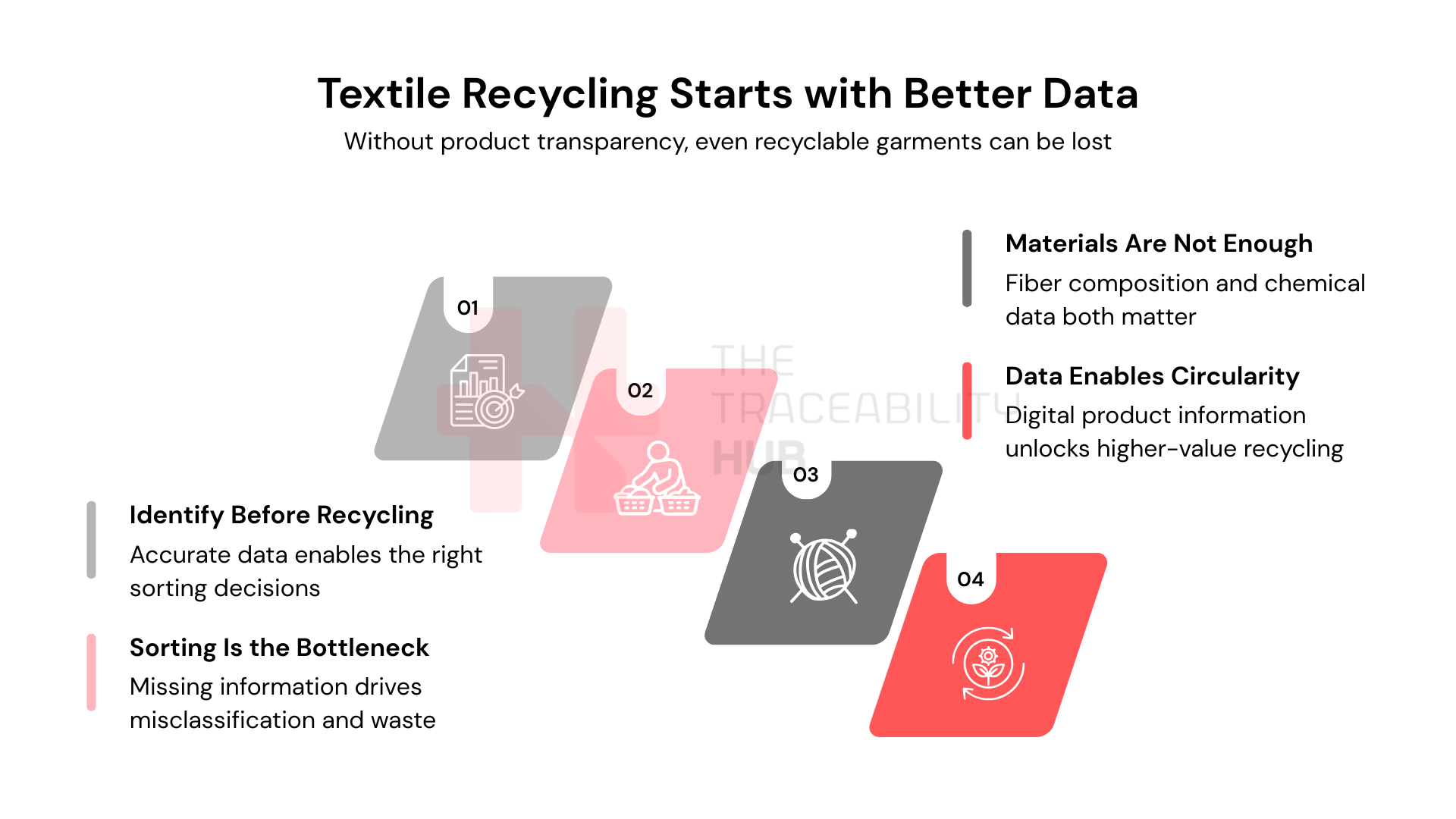
The Role of the EU Digital Product Passport (DPP)
Against this backdrop, the EU Digital Product Passport (DPP), introduced under the Ecodesign for Sustainable Products Regulation (ESPR), stands out as one of the most promising, legally binding structural responses to the information gap. Rather than leaving critical product knowledge fragmented across physical labels, supplier files, and disconnected systems, the textile DPP is designed to make relevant information more accessible, more standardized, and more usable across the value chain.
If implemented well, textile DPPs could significantly improve decision-making at end of life. For industrial sorters and recyclers, that could mean access to more accurate and standardized material composition data, better visibility into substances of concern and chemical treatments, clearer indicators of recycling compatibility, and more actionable machine-readable guidance on how a product should be sorted, disassembled, or chemically treated. The 2024 European Parliamentary Research Service study on textile DPPs explicitly recognizes that actors such as sorters, mechanical recyclers, regulators, and consumers could all benefit from better product-level information.
This structural transition matters because the DPP has the potential to shift product data from a passive compliance asset to an operational infrastructure layer. In other words, it could help transform information raw data from something brands hold into something circular systems can use.
Recent official ESPR updates also confirm that textiles are among the priority product groups in the EU’s 2025–2030 work plan, reinforcing the strategic role of DPPs in improving traceability, transparency, and structural circularity across the sector. Textiles are specifically identified among the first implementation priorities, with DPPs explicitly positioned as a core mechanism for lifecycle data sharing and sustainability requirements.
That said, the real-world value of the DPP will depend entirely on its technical execution. A digital passport that contains incomplete, inconsistent, or inaccessible data will not solve the industrial textile sorting challenge. For the system to work, information must be accurate, interoperable, relevant to end-of-life operations, and available in a format that can support fast, repeatable decisions in real-world sorting environments. The opportunity to transform the industry is real, but so is the risk of reducing the DPP to a compliance exercise rather than building it as a practical tool for circular infrastructure.
Why Sorting Guidance Must Be a Priority
For the Digital Product Passport to deliver real value, it cannot be designed only for corporate regulators, financial auditors, or brand compliance teams. It must also work for the actors making rapid operational decisions at end of life, especially sorting operators and textile recyclers.
That means the information within the DPP must go beyond static transparency. It needs to be highly operational and actionable. In practice, this includes machine-readable data that can be integrated into sorting workflows, clear standardized classification of material recyclability, visibility into substances of concern, and practical instructions for separation, disassembly, and chemical treatment. General product marketing information may support traceability, but it is not enough to support high-quality textile sorting on a scale. The 2024 European Parliamentary Research Service study on textile DPPs explicitly notes that a DPP should create value for actors across the textile chain, including sorters and recyclers, not only upstream stakeholders.
The challenge of operationalizing this data should not be underestimated. Making product information genuinely usable in industrial sorting environments requires more than a regulatory mandate, it requires an integrated data platform capable of doing three things at once: aggregating heterogeneous data from across the textile value chain (brands, suppliers, chemical compliance databases, certification bodies), normalizing it against shared standards and ontologies, and exposing it in real time to the operational systems where sorting decisions are actually made.
This is the architectural challenge that industrial traceability platforms are now being designed to address. Systems that integrate product identity, supply chain data, and substance-level transparency in a single unified data layer are emerging as the practical infrastructure behind the Digital Product Passport, turning what would otherwise be a fragmented set of compliance documents into a query able, machine-readable knowledge base that sorting operators, AI-enabled classification systems, and chemical recycling facilities can actually consume in real time.
Industry players that have spent the past decade building digital traceability infrastructure for highly regulated sectors, pharmaceutical, food and beverage, cosmetics, are now applying that experience to textiles. Antares Vision Group, for example, has developed an integrated data platform approach (DIAMIND) that combines product-level identity, end-to-end serialization, supply chain visibility, and AI-enabled analytics within a single architecture, the kind of foundational layer that the DPP needs in order to function as an operational tool rather than a compliance artefact.
Without this kind of unified data infrastructure, even a well-designed DPP risks becoming a passive repository: standardized in format but disconnected from the systems that need it most at the moment of decision. With it, the same data that satisfies regulatory transparency can directly drive sorting workflows, alert operators to substances of concern, and route garments toward the highest-value recovery pathway available.
This is where specific technical implementation choices become decisive. If the DPP data structure is readable only at a compliance level, but not usable in real-world sorting environments, the information gap will persist. By contrast, structured and machine-readable product data can help reduce sorting ambiguity, support faster triage, and improve the quality and consistency of end-of-life decisions. Broader DPP guidance under the ESPR framework also reinforces this logic by defining the passport as a structured, machine-readable set of product data intended to travel with the product across its entire multi-stage lifecycle.
Without that operational data layer, even well-designed, sustainable products remain at risk. If a garment’s true recyclability cannot be clearly identified, if hazardous substances are not flagged, or if handling instructions are missing, garments may still be downcycled, incinerated, or landfilled simply because the system cannot process them with confidence. The European Environment Agency has already warned that, unless sorting and specialized recycling capacity improves, large volumes of separately collected textiles may still end up in incineration, landfill, or global export.
In that sense, providing granular sorting guidance is not a technical detail. It is the point at which corporate transparency becomes operational or fails to.
From Product Design to End-of-Life Execution
Designing for recyclability is necessary, but it is not sufficient. A garment may be conceived with better eco-friendly mono-materials, fewer blends, or safer chemical choices, yet still fails to enter the right recovery pathway if the system cannot identify it correctly at end of life.
That is why authentic circular performance must be understood as a chain of connected decisions rather than a single design attribute. For textile recyclability to work in practice, products must remain identifiable once they become waste, relevant manufacturing information must travel with them beyond the point of sale, and sorting decisions must be based on data rather than assumption. If any of these structural conditions are missing, the ecological value created at the design stage can be lost at the operational stage.
This is where three critical layers come together into one system. The first is product design: the material mix, physical construction choices, and chemical profile that shape whether a product can theoretically be recycled. The second is data infrastructure: the systems, standards, and tools, including the DPP and broader traceability frameworks, that make this information accessible across the value chain. The third is operational execution: the real-world sorting, separation, and recycling processes that determine what happens to the product once it reaches end of life.
Too often in fashion, these layers are treated separately. But a circular economy only works when they function as a connected system. A recyclable product without usable data can still be misclassified. A strong digital data framework without operational uptake can still fail in practice. An efficient sorting infrastructure cannot compensate for low-quality products whose composition or chemical profile remains unknown. The real challenge, therefore, is not only designing for recyclability, but ensuring that design intent can be translated into end-of-life execution.
Key Insight: Recycling Depends on Information
Across the entire product lifecycle, one factor repeatedly determines whether circularity works in practice: the immediate availability of reliable information at the moment a decision needs to be made.
That principle applies at every stage of the value chain. It affects how products are designed, how they are digitally purchased, how they are sorted, and whether they can ultimately be recycled safely and effectively into new fibers. When the right product information is available at the right time, actors across the value chain can make better decisions. When it is missing, fragmented, or unusable, circular systems begin to break down.
The consequences of these data gaps are cumulative. Without reliable information, products are harder to identify, recycling pathways become less certain, and commercial waste volumes increase. Materials that might otherwise be recovered are downgraded, discarded, or misdirected. At the same time, the absence of visibility on substances of concern, chemical treatments, or construction complexity can escalate both environmental and human risks, from contamination of recycling streams to health and safety concerns for workers handling post-consumer textiles.
In that sense, information is not a supporting layer of circularity. It is a precondition for it. Textile Recycling depends not only on physical materials, technologies, or sorting infrastructure, but on whether the system can access and act on the right product data when it matters most.
No Data, No Recycling
Recycling is often framed as a purely mechanical or technical challenge, a question of infrastructure, processing capacity, or discovering material innovation. But in reality, it is just as much an information challenge.
If textile recycling is to become commercially viable at scale, the system needs more than recyclable materials and better technologies. It needs clear, reliable, and accessible data at the points where decisions are made. Textile Sorters need usable product information. Chemical transparency must be built into the system, not treated as an afterthought. Consumers need better visibility into what they are buying and what happens to it at the end of life. And Digital Product Passport systems must be aggressively designed not only for regulatory compliance, but for real operational use across sorting and recycling environments.
Because ultimately, recyclability is not an abstract product feature. It is a practical physical outcome that depends on whether someone, somewhere in the chain, knows how to handle a product safely and correctly. If that knowledge is missing, even recyclable products can become waste.
In that sense, the future of textile recycling will depend not only on what raw materials our products are made of, but on whether the right information can move with them, from design to disposal, and from ambition to operational execution.
Read more: How Phygital Experiences Turn Packaging into Consumer Engagement