



Geopolitics Meets Supply Chains
Global supply chains are entering a phase of structural instability where geopolitical tensions, energy dependencies, and financial volatility are no longer external shocks but persistent operating conditions. From disruptions in critical maritime corridors to fluctuations in commodity prices and currencies, companies, particularly in export-driven sectors such as agrifood and industrial manufacturing, are facing a growing mismatch between sustained global demand and the fragility of the systems that support it. This shift is forcing organizations to rethink not only how goods move, but how geopolitical supply chain risk is monitored, anticipated, and managed across increasingly complex and opaque value chains.
In this context, digital traceability is emerging as more than a compliance or transparency tool, it is becoming a foundational capability for supply chain intelligence.
Tier 1 supplier visibility beyond immediate partners remains a critical gap, particularly as disruptions frequently originate upstream where data is fragmented or unavailable.
As operating conditions become less predictable, the ability to generate end-to-end visibility and translate it into actionable insight is becoming central to building true supply chain resilience.
This article explores how geopolitical dynamics are reshaping supply chain risk, why traditional visibility models are no longer sufficient, and how digital traceability, integrated with broader data ecosystems, enables more adaptive and informed decision-making.
The Shift: From Stable Trade to Volatile Systems
For decades, supply chains were built on the assumption that global trade would remain relatively stable, transport routes reliable, and cost efficiency the primary objective. Under these conditions, organizations optimize speed, scale, and lean inventory, managing global networks as linear systems that could be planned and controlled with reasonable confidence. That model has weakened under the weight of supply chain volatility.
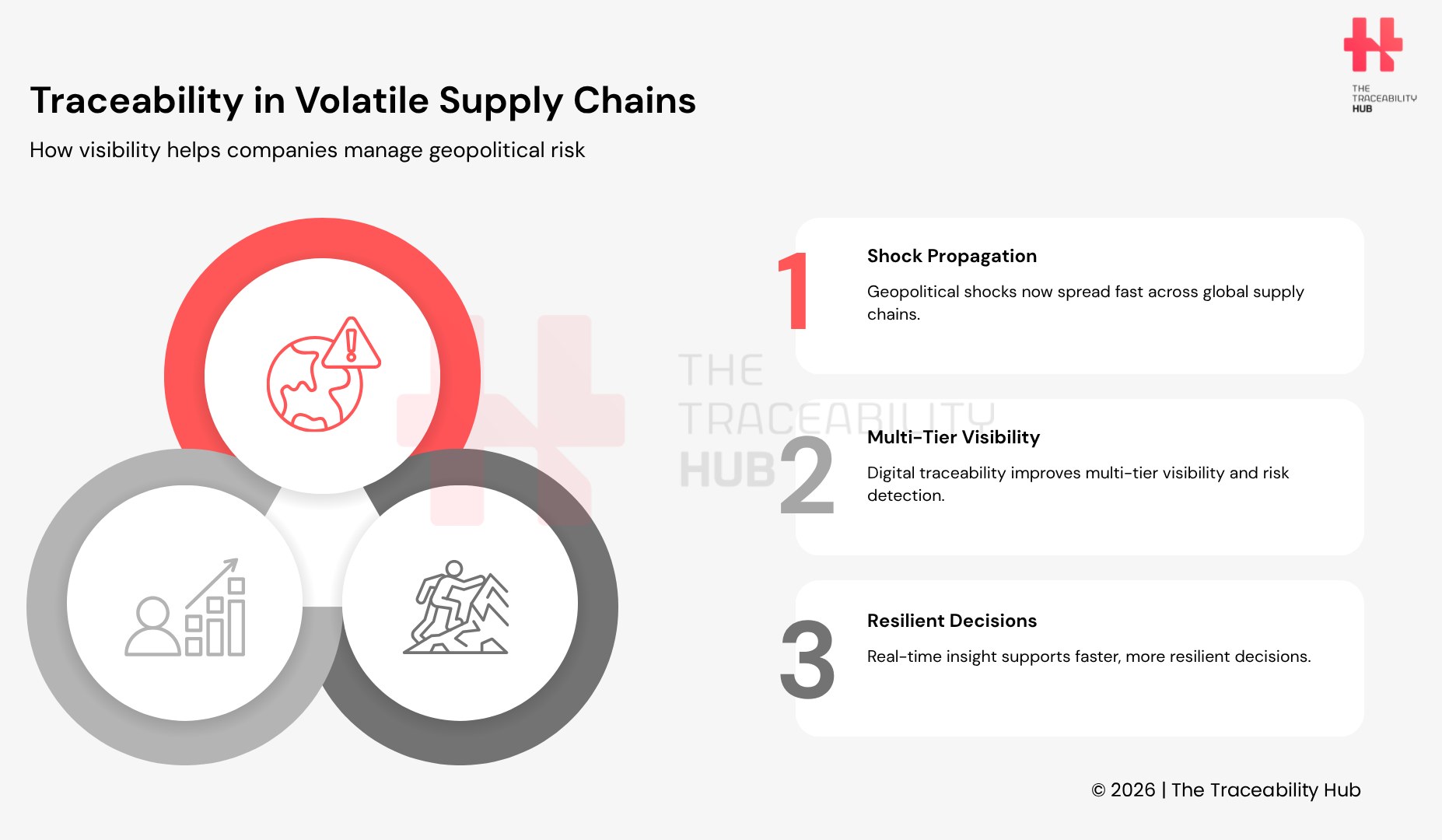
Today, supply chains operate as interconnected systems where disruption in one node can rapidly propagate across production, logistics, pricing, and financing. Events that once appeared localized now generate cascading effects, amplified by interdependence and limited multi-tier visibility across upstream tiers. Volatility is no longer episodic; it is embedded in how the system behaves.
Strategic chokepoints such as the Strait of Hormuz illustrate how geographically concentrated risks can disrupt global flows simultaneously across energy, transport, and industrial inputs. Energy dependency has become a system-wide vulnerability, as fuel, power, and petrochemical inputs underpin virtually every stage of production and distribution amidst ongoing trade fragmentation. At the same time, geopolitical instability, manifesting through sanctions, trade restrictions, and regional conflicts, act as continuous pressure points rather than isolated events.
The result is a structural transformation: supply chains are no longer optimized networks, but exposure networks. In this environment, supply chain resilience depends on visibility, adaptability, and the ability to detect risk before it propagates, capabilities that are increasingly enabled through digital traceability.
Implications for Decision-Making, Data, and Technology
As volatility becomes structural, decision-making models are being redefined. Traditional approaches, based on long planning cycles, stable assumptions, and efficiency-driven optimization, are increasingly misaligned with conditions shaped by geopolitical instability, energy cost variability, and fragmented trade environments. Organizations are moving toward shorter planning horizons, scenario-based modeling frameworks, and iterative processes that can be adjusted as conditions evolve.
This shift reflects a broader reality: decisions that were once periodic are now continuous. Supplier configurations, sourcing reconfigurations, pricing strategies, and market priorities must be revisited more frequently as external conditions change. Energy disruptions, trade restrictions, and regulatory divergence introduce variability that cannot be fully predicted, only managed.
In this context, precision forecasting becomes less valuable than real-time responsiveness. Speed of execution, operational resilience, and the ability to reverse or adapt decisions are becoming critical. Organizations that can dynamically reconfigure sourcing, logistics, or pricing, supported by real-time visibility into supply networks, are better positioned than those relying on fixed, efficiency-based models.
Data: From Historical Reporting to Real-Time Signal Interpretation
This shift in decision-making is closely tied to the evolution of data. Historically, organizations relied on internal, structured datasets, sales, inventory, supplier records, analyzed through periodic reporting. While still relevant, these backward-looking views are insufficient in environments where disruption originates externally and evolves rapidly.
A significant share of supply chain risk emerges beyond Tier 1 suppliers, where traditional visibility is limited. As a result, organizations are increasingly integrating external signals, geopolitical developments, energy markets, logistics flows, and supplier disruptions, into their data ecosystems. The goal is to detect early indicators of change before they translate into operational impact.
However, many data infrastructures remain constrained by data silos and fragmentation alongside operational latency. Static dashboards and periodic reports struggle to capture fast-moving dynamics, while siloed architectures limit the ability to build a coherent view of risk. Digital traceability plays a critical role in addressing this gap by enabling continuous visibility across multi-tier supply chains and connecting previously disconnected data sources.
The challenge is no longer access to data, but the capability for real-time signal interpretation in context, identifying patterns, assessing implications, and translating insight into timely decisions. This represents a shift from reporting performance to sensing change.
Technology as Strategic Decision Infrastructure
Technology is evolving accordingly, moving from an efficiency layer to a core component of decision-making. Advanced analytics and AI-driven systems are increasingly used to model scenarios, assess trade-offs, and evaluate outcomes under different conditions. These capabilities allow organizations to simulate disruptions, test alternative strategies, and identify vulnerabilities across their operations.
In volatile environments, where variables are numerous and interdependent, manual analysis is insufficient. Technology enables faster interpretation of complex data and supports rapid response through automation and predefined actions. Digital traceability enhances these capabilities by providing the underlying visibility required to make scenario-based modeling analysis meaningful and actionable.
At the same time, technology does not replace human judgment. Strategic decisions, especially those involving uncertainty and trade-offs, continue to require human oversight and accountability. The role of technology is to augment decision-makers with better information and faster analysis, enabling more informed and timely action.
Organizations that treat technology as a strategic decision infrastructure—integrated with multi-tier traceability and aligned with strategic objectives—are better equipped to navigate complex and rapidly changing supply chain environments.
Traceability in Volatile Supply Chains
Impacts on Marketing, Customer Intelligence, and First-Party Data
The same instability affecting supply chains is reshaping commercial marketing strategy. In more predictable environments, marketing could rely on long planning cycles, stable pricing structures, and segmentation models based on gradual change. Today, context-dependent demand is increasingly influenced by external factors such as inflation, energy costs, supply constraints, and regional economic divergence.
Customer behavior has become more context-dependent, with confidence and purchasing decisions shifting in response to changing conditions. In many sectors, supply chain performance, availability, customer experience reliability, and price stability, directly influences how customers perceive value. This creates a tighter link between operational performance and marketing effectiveness.
As a result, marketing is moving toward continuous, adaptive marketing strategy built on continuous, flexible models. Rather than executing fixed campaigns, organizations are adjusting messaging, pricing, and channel strategies in response to current conditions. Static dynamic customer segmentation and annual planning cycles are giving way to more agile approaches that can incorporate new signals as they emerge.
Performance is no longer defined solely by efficiency against plan, but by the ability to remain aligned with a moving market.
Customer Intelligence Under Uncertainty
Customer intelligence is evolving in parallel. Traditional approaches, based on historical analysis and periodic surveys, provide useful context but are less effective when behavior is influenced by rapidly changing external factors.
In uncertain conditions, purchasing cycles become less predictable. Customers delay decisions, reassess priorities, and switch more readily when price, availability, or perceived risk changes. Brand loyalty becomes more conditional, influenced not only by brand preference but by reliability and supply chain transparency. This is particularly evident in sectors where supply chain disruptions directly affect the end-user customer experience.
Organizations therefore need a more dynamic understanding of customer behavior. By combining transactional data, interaction signals, and contextual indicators, such as market conditions or supply constraints, they can build a more current view of intent. The focus shifts from understanding past behavior to interpreting present signals and anticipating near-term actions through continuous interpretation.
Customer intelligence becomes less about static segmentation and more about continuous interpretation.
First-Party Data as Strategic Foundation
These changes are elevating the role of first-party data strategy. As third-party signals become less reliable due to privacy regulations and ecosystem changes, organizations are placing greater emphasis on data they can directly collect, own, and control.
First-party data provides a more stable foundation for understanding customer behavior, particularly when external signals are fragmented. It is also more aligned with regulatory requirements, allowing organizations to manage data in a transparent and compliant way across different markets.
Beyond compliance, first-party data enables more resilient engagement. When integrated across channels, commerce, CRM, digital platforms, and service interactions, it allows organizations to detect shifts in costumers behavior earlier and respond more effectively. This supports not only personalization, but also broader decision-making around pricing, retention, and market prioritization.
In this context, first-party data becomes part of the infrastructure that enables organizations to maintain continuity in customer understanding despite external volatility.
Organizational Capabilities and the Execution Gap
While organizations increasingly recognize the need for resilience and adaptability, an operational execution gap often lags behind strategy. Persistent disruption, driven by geopolitical instability, energy volatility, and trade fragmentation, has made many decisions continuous rather than episodic. However, the operational capabilities required to support this shift are not always in place.
A significant share of disruptions still originates beyond direct supplier visibility, highlighting the limitations of current supply chain models. Without sufficient traceability across multi-tier networks, organizations struggle to detect risk early and respond effectively. As a result, strategic intent advances faster than the operational capabilities needed to deliver it.
Operating Models Designed for Stability
Many organizations continue to operate with structures designed for stability. These models assume predictable demand, linear planning, and clearly separate functional responsibilities. In volatile environments, however, decision-making becomes inherently cross-functional, requiring deep cross-functional coordination across marketing, supply chain, procurement, finance, and technology.
Yet these functions often remain only partially integrated. Data flows are fragmented, planning cycles misaligned, and decision-making distributed across functional silos. This limits responsiveness and increases the risk of misalignment between commercial and operational priorities.
The absence of end-to-end visibility and multi-tier traceability further exacerbates this issue, forcing decisions to be made on incomplete information.
Skills, Governance, and Decision Bottlenecks
Capability gaps in skills and governance also constrain execution. While access to data has increased, the ability to interpret complex signals and act on them remains uneven. Many organizations lack sufficient expertise in scenario-based modeling and real-time decision-making.
Governance structures often prioritize control over speed, leading to unclear decision ownership and delays when conditions fall outside predefined processes. In volatile environments, this increases decision latency and internal friction.
Even where data and traceability systems are in place, their impact is limited if they are not integrated into decision workflows. The primary bottleneck is therefore not technological, but organizational.
From Capability Building to Organizational Readiness
Addressing these challenges requires more than incremental capability building; it requires organizational readiness: aligned incentives, clear accountability, and decision processes designed for speed and coordination.
Digital traceability must be embedded into core operations, ensuring that multi-tier visibility across supply chains is not only available, but actionable. Organizations that can effectively connect traceability, data, and decision-making are better positioned to anticipate disruption and adapt to changing conditions.
Ultimately, supply chain resilience is not a static capability but an operational outcome. In systems defined by interdependence and continuous change, competitive advantage depends on the ability to make the invisible visible, and to act on that visibility faster than the environment evolves.
Real-World Disruption: When Systemic Risk Becomes Visible
Recent developments in the Strait of Hormuz illustrate how quickly localized geopolitical tensions can escalate into systemic risk amplification. Temporary restrictions on maritime transit and security concerns have triggered immediate reactions in energy markets, with oil prices showing sharp short-term swings, rising by several percentage points in response to perceived supply risks, and liquefied natural gas markets experiencing extreme volatility, with price increases reaching up to 80% during peak uncertainty.
At the same time, the impact on global logistics has extended well beyond the region. Even as transit conditions begin to stabilize, recovery across shipping networks is expected to take months rather than weeks, as vessel backlogs, sourcing reconfigurations, rerouting decisions, and congestion continue to disrupt delivery schedules and increase operational costs. Hundreds of vessels have been delayed or repositioned, creating ripple effects across trade routes connecting Europe, Asia, and the Middle East.
These disruptions are not confined to energy flows. Their effects propagate across entire value chains, directly influencing the availability and cost of critical inputs such as fertilizers, fuel, and industrial materials. In downstream sectors, including food production and healthcare supply, this translates into tangible risks around product availability, pricing, and delivery reliability. Even short-term disruptions in key transit corridors and strategic chokepoints have been shown to affect access to essential goods, highlighting how tightly interconnected global supply systems have become.
What makes these events clear is not simply the existence of disruption, but the multi-tiered amplification. A constraint in a single strategic corridor can simultaneously impact energy markets, logistics capacity, and the availability of essential goods across multiple regions. In highly interconnected systems, disruption is no longer contained, it cascades.
In this context, the ability to trace dependencies, monitor exposure, and anticipate cascading effects becomes critical. Visibility is no longer a reporting function; it is a prerequisite for operating in global supply chains.
From Visibility to Action in Volatile Systems
The conditions shaping global supply chains today are not temporary disruptions, but structural characteristics of how the system now operates. Geopolitical instability, energy dependencies, and fragmented trade environments have transformed supply chains into interconnected networks where risk propagates quickly and unpredictably. In this context, the ability to operate effectively depends less on eliminating uncertainty and more on managing it.
Across decision-making, data, marketing, and organizational design, a common requirement emerges: the need for continuous end-to-end visibility and the capability to act on it. Digital traceability plays a central role in enabling this shift. By making dependencies, exposures, and upstream risks visible, it allows organizations to move from reactive responses to more anticipatory and coordinated actions.
However, visibility alone is not sufficient. Competitive advantage increasingly depends on how effectively organizations translate insight into execution—how quickly they can interpret signals, make decisions, and align actions across functions. This requires not only investment in data and technology, but also changes in operating models, governance, and accountability.
In systems defined by interdependence and continuous change, supply chain resilience is no longer a static capability or a one-time investment. It is an operational outcome, shaped by the ability to connect traceability, data, and decision-making into a coherent and responsive global system. Organizations that can make the invisible visible, and act on it faster than conditions evolve, will be better positioned to navigate volatility and sustain performance in an increasingly uncertain world.