



EU Tobacco Policy at a Crossroads: Evidence vs Agenda
For many years, the European Union has approached tobacco control and EU tobacco regulation with a dual mandate: protecting public health and maintaining the cohesion of the internal market. This evidence-based tobacco policy stance has contributed to making EU regulations, particularly the Tobacco Products Directive and the Tobacco Advertising Directive, global benchmarks for European tobacco regulation and tobacco-control governance beyond Europe.
The recent Commission evaluation of the EU’s tobacco-control framework raises a critical issue for the upcoming EU tobacco policy cycle: are regulatory decisions being guided by the most reliable evidence, or is evidence increasingly being adapted to fit pre-established policy objectives and precautionary regulatory agendas? The Commission’s Staff Working Document, released on 2 April 2026, underscores that thorough evaluation is fundamental to legitimate reform, rather than merely a rhetorical commitment within EU public health policy.
This issue has practical implications for the future of the EU tobacco framework and nicotine market governance. The EU’s political commitment, articulated in Europe’s Beating Cancer Plan, aims to achieve a “tobacco-free generation” (defined as less than 5% tobacco use) by 2040, significantly elevating the importance of regulatory credibility and evidence-based tobacco regulation. If progress toward this goal appears driven by predetermined agendas instead of empirical evidence, two immediate risks arise: first, policies may not generate proportional health benefits in an evolving nicotine market; second, confidence in EU governance and Better Regulation principles could decline among Member States, stakeholders, and citizens. Ultimately, the discussion now centers not only around the extent of regulation, but also on whether the EU can effectively demonstrate, through clear, transparent, and reproducible means, how scientific evidence informs policy decisions, consistent with its Better Regulation principles.
A Framework Under Pressure
The Commission’s recent assessment demonstrates that the EU’s core tobacco-control legislation, primarily embodied in the Tobacco Products Directive (TPD) and the Tobacco Advertising Directive (TAD), has delivered measurable public health and tobacco-control benefits. The findings attribute declines in smoking rates and tobacco-related harm, enhanced consumer information via improved health warnings, and increased alignment with international commitments such as the WHO Framework Convention on Tobacco Control (WHO FCTC) to this European tobacco regulatory framework.
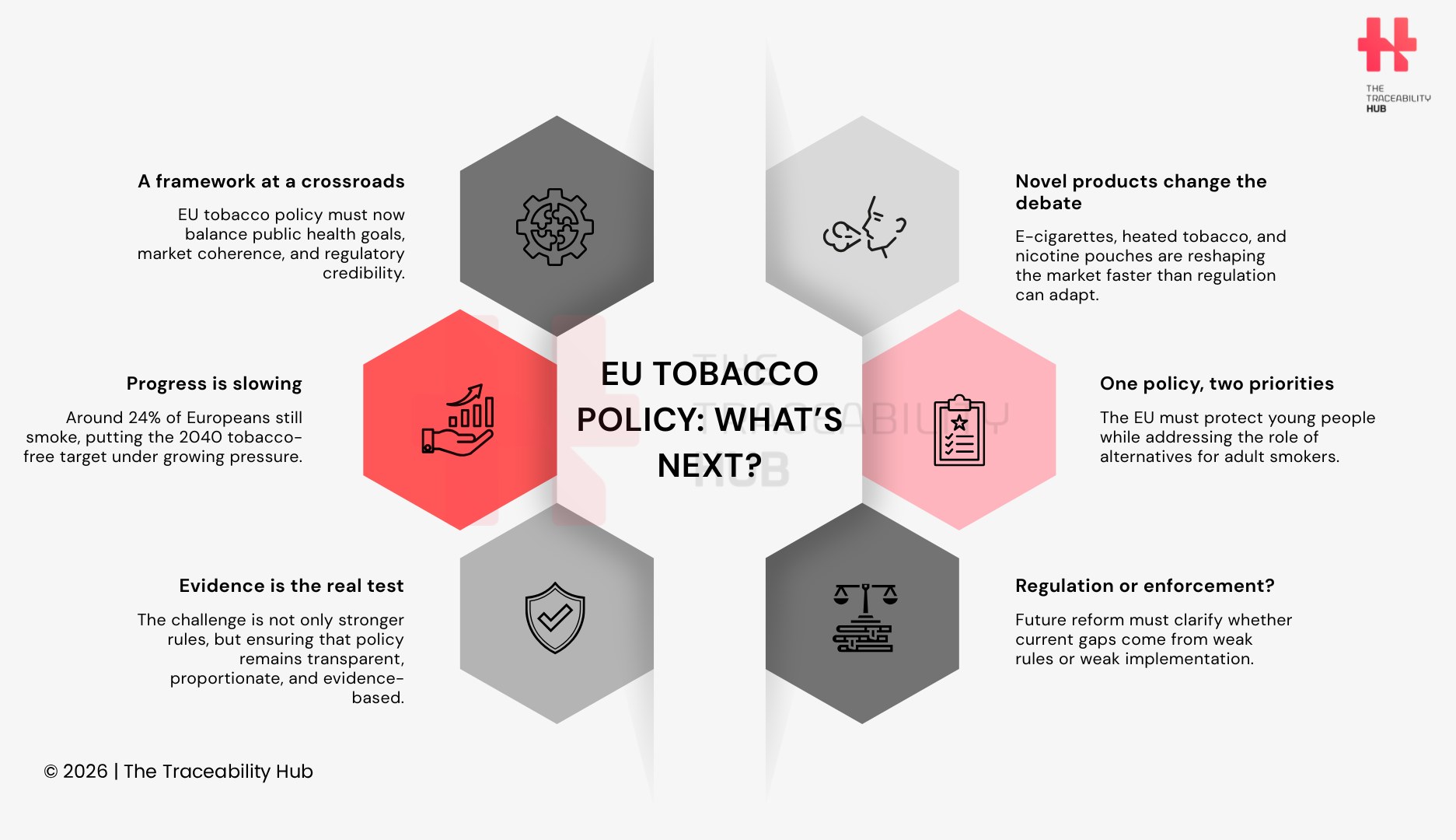
Nonetheless, the evaluation indicates that progress toward the EU’s tobacco-free objectives is decelerating, with smoking prevalence rates remaining persistently high across the European nicotine market. Data from the European Commission’s Special Eurobarometer SP539 “Attitudes of Europeans towards tobacco and related products” shows that approximately 24% of Europeans continue to smoke (either daily or occasionally), presenting a significant challenge to achieving the “tobacco-free generation” target (less than 5% usage) by 2040 as articulated in Europe’s Beating Cancer Plan and broader EU public health strategy.
Moreover, nicotine market dynamics and consumer behavior trends have evolved more rapidly than the regulatory landscape. The proliferation of novel products, including e-cigarettes, heated tobacco products, and nicotine pouches and alternative nicotine formats, has altered nicotine consumption patterns and challenged uniform assumptions about “tobacco use”. Additionally, tobacco marketing and nicotine-product promotion activities have increasingly migrated to digital platforms and social media ecosystems. The WHO European Region cautions that children and adolescents are frequently exposed to online promotion of unhealthy commodities, including traditional tobacco and emerging nicotine-delivery products, within environments characterized by targeted advertisements and influencer-driven campaigns.
EU Tobacco Policy What’s Next
The Core Issue: Evidence vs Interpretation
One of the most frequently noted critiques from stakeholders does not pertain to the existence of EU tobacco regulation itself, but rather to the way scientific evidence is interpreted and incorporated into policy decisions. The Commission’s own assessment of the EU tobacco framework openly recognizes the methodological challenges involved in isolating the impact of individual regulatory measures within a complex and dynamic nicotine market environment.
Shifts in smoking prevalence, nicotine consumption patterns or consumption patterns cannot be directly ascribed to specific elements of the Tobacco Products Directive or the Tobacco Advertising Directive alone, due to the influence of numerous overlapping factors. These factors include wider societal trends, economic circumstances, digital market evolution, and changes in consumer behavior that occur independently of tobacco regulatory interventions.
Blind Spots in Market and Consumer Dynamics
The evaluation also acknowledges that certain external factors have not been systematically incorporated into the analytical framework. For example, limited consideration is given to adult consumer preferences and to the increased availability of non-combustible alternatives, such as e-cigarettes, nicotine pouches and heated tobacco products. These dynamics are becoming increasingly important in shaping patterns of nicotine consumption across Europe. By not thoroughly accounting for substitution effects, risk differentials, or behavioral responses among adult users, the evidence base may present an incomplete view of causality, potentially overstating the impact of regulation while underestimating market-driven changes and consumer-led transitions away from combustible tobacco.
From Evidence Generation to Evidence Selection
In addition to methodological limitations, concerns have been raised regarding the selection and prioritization of evidence within the EU policymaking process. Stakeholders have noted an excessive dependence on consultation inputs and qualitative perceptions, potentially at the expense of thorough empirical analysis and quantitative evidence. Although public consultations represent a legitimate and essential aspect of EU governance and Better Regulation principles, they are not intended to replace quantitative evidence or causal evaluation.
If consultation feedback is treated as proof rather than contextual input, distinctions between evidence generation and policy interpretation may become unclear. This has contributed to critiques concerning selective data usage, evidence selection bias and inadequate transparency in evaluating contradictory findings within EU tobacco policy debates.
Tension with Better Regulation Principles
These issues present a structural challenge to the EU’s Better Regulation framework and evidence-based governance model. The Commission’s Better Regulation Guidelines stipulate that policy decisions should be based on robust scientific evidence, that analytical assumptions must be clearly disclosed, and that conclusions remain reproducible and subject to review. If the connection between evidence, analysis, and regulatory outcomes is not explicitly communicated, it risks undermining the integrity and credibility of the EU policymaking process.
When addressing highly politicized objectives, such as the 2040 “tobacco‑free generation” target and long-term smoking reduction strategies, this challenge becomes particularly prominent. The credibility of future EU tobacco regulatory initiatives will depend not only on their ambition but also on the transparent and demonstrable quality of the supporting evidence base.
The “Novel Products” Dilemma
The evaluation identifies the regulation of novel nicotine products, such as e‑cigarettes, heated tobacco products, and nicotine pouches and electronic nicotine delivery systems (ENNDS), as the most complex challenge facing the current EU tobacco framework. The report underscores the swift increase in usage, particularly among younger individuals, and notes that while evidence regarding potential health risks is emerging, it remains inconclusive.
The Commission highlights ongoing concerns related to initiation effects and the potential for non‑combustible nicotine products to serve as a gateway to cigarette smoking, particularly in light of limited long‑term epidemiological data. These issues are also recognized in assessments by WHO and at the EU level, both of which stress prevailing uncertainties and advocate for precautionary measures, especially concerning youth exposure.
Signals of Substitution Among Adult Smokers
Simultaneously, the same body of evidence points to a distinct pattern among adult smokers. Evaluative data, including results from the European Commission’s Special Eurobarometer SP539, show an increasing proportion of smokers transitioning from combustible cigarettes to alternative nicotine products and non-combustible tobacco alternatives. This smoking transition trend is most evident in Member States that have adopted more nuanced tobacco regulatory frameworks.
In particular:
- Sweden, frequently referenced in EU and international tobacco-control assessments, has reduced smoking prevalence to below 5%.
- Czech Republic and Greece also display steeper declines in cigarette smoking compared with the EU average.
Although direct causality remains contested within evidence-based tobacco policy discussions, these country-level experiences suggest that product differentiation, when combined with robust youth protection strategies and tobacco-control measures, may contribute to more significant and sustained reductions in smoking prevalence.
A structural policy gap
This coexistence of risks and opportunities exposes a central policy gap within the current EU tobacco framework. Regulatory architecture struggles to simultaneously accommodate the potential tobacco harm-reduction role of novel products for adult smokers and the imperative to prevent youth uptake and renormalization of nicotine use.
The evaluation itself stops short of resolving this tension, but it makes clear that treating all novel products as functionally equivalent to combustible tobacco may oversimplify a far more nuanced nicotine-market reality. As a result, the debate over novel products has become a test for whether EU tobacco policy can evolve in a way that remains both evidence-based and proportionate.
Structural Gaps in the Current Framework
The evaluation identifies a series of systemic weaknesses that reflect a growing mismatch between the scope of EU tobacco legislation and the realities of today’s nicotine market. While the regulatory framework was originally designed around conventional tobacco products, several emerging nicotine categories now sit at its margins or outside its reach altogether. Products such as nicotine pouches and certain electronic nicotine delivery systems (ENNDS) are not fully or consistently covered, creating regulatory blind spots that complicate enforcement and risk uneven consumer protection across the Union.
Fragmentation and Internal Market Tensions
These regulatory gaps are compounded by increasing regulatory fragmentation at national level. In the absence of fully harmonized EU tobacco rules, Member States have adopted divergent approaches to novel nicotine products, resulting in internal market inconsistencies that run counter to the original objectives of the Tobacco Products Directive and EU internal market governance. Differences in product authorization, flavor restrictions, and marketing rules have led to legal uncertainty for operators and uneven conditions of competition, while also challenging cross-border enforcement and regulatory coordination.
Tools Struggling to Keep Pace
The evaluation further points to limitations in the EU’s ability to effectively regulate specific dimensions of the evolving nicotine market, notably:
- Flavors, where diverging national bans coexist with incomplete EU-level regulatory mechanisms
- Digital marketing, which increasingly escapes traditional tobacco advertising controls
- Emerging nicotine product categories, which evolve faster than legislative update cycles and regulatory modernization efforts
As a result, tobacco regulatory responses often appear reactive rather than anticipatory, struggling to keep pace with innovation, digital distribution channels, and evolving consumer behavior.
Operational Complexity and Compliance Burdens
Beyond structural design, operational challenges persist. Stakeholders highlight the growing complexity of compliance tools, particularly the EU Common Entry Gate (EU-CEG) system, which is widely seen as resource-intensive for both authorities and manufacturers operating within the European nicotine market.
Ambiguities in nicotine product classification further exacerbate this burden, creating uncertainty over applicable requirements and increasing the risk of inconsistent implementation across Member States. Together, these issues reinforce the perception of a tobacco regulatory framework that is increasingly difficult to operate, even as EU regulatory expectations continue to expand.
Enforcement vs Regulation: The Unanswered Question
One of the most consequential issues left unresolved by the evaluation is whether the current shortcomings of the EU tobacco framework originate primarily from regulatory design or from uneven enforcement at Member State level. The distinction is critical for evidence-based tobacco policymaking. Without a clear diagnosis, future policy interventions risk targeting the wrong problem, tightening rules where implementation is weak or adding regulatory complexity where enforcement capacity is already stretched.
This ambiguity is particularly evident in areas where outcomes depend less on legislative wording than on day-to-day tobacco enforcement and regulatory oversight. Illicit trade remains a persistent challenge, despite an extensive tobacco regulatory architecture, suggesting that gaps may lie in controls, coordination, and resources rather than in the absence of rules. Similarly, age-control requirements and youth-protection measures are well established in law, yet their effectiveness varies significantly across Member States, reflecting differences in inspection regimes, sanctions, and enforcement priorities, and compliance monitoring systems. Cross-border sales—especially in digital environments—further illustrate this tension, as existing provisions struggle to deliver consistent oversight in practice.
By not clearly disentangling regulatory insufficiency from enforcement failure, the current EU tobacco policy debate risks conflating two distinct policy responses. Strengthening legislation without addressing enforcement deficits may yield limited gains, while improving enforcement without regulatory clarity may prove equally ineffective. As the EU considers the next phase of its tobacco strategy and tobacco-control framework, the ability to answer this question will be central to ensuring that policy action is proportionate, targeted, and evidence-based.
A Turning Point for EU Policy
The EU tobacco framework remains one of the most comprehensive tobacco regulatory systems in the world, reflecting decades of policy development at the intersection of public health protection and internal market governance. Yet its future effectiveness now hinges on a single, decisive factor: the ability to realign regulatory action with a genuinely evidence-based tobacco policy approach, while adapting to a nicotine market that is evolving faster than the legislative cycle designed to govern it.
Without such recalibration, several risks become increasingly difficult to ignore:
- Public health objectives may stall, as existing tobacco-control measures deliver diminishing returns in a more complex nicotine consumption landscape.
- Regulatory credibility may erode, particularly if policy choices appear driven by interpretation or precaution rather than demonstrable outcomes.
- Market distortions may intensify, including the growth of illicit trade and regulatory arbitrage between Member States.
The path toward a smoke-free Europe and a “tobacco-free generation”, therefore, is not defined solely by stronger rules, broader prohibitions, or more restrictive tobacco legislation. It depends on smarter governance, one that distinguishes regulation from enforcement, integrates emerging scientific evidence without selective bias, and remains transparent about uncertainty and tradeoffs. At this turning point, the credibility of EU tobacco policy will be measured less by ambition alone, and more by its capacity to let evidence genuinely lead.
Read more: From Cigarettes to Alternatives: What the EU Tobacco Debate Reveals About Consumer Behavior