



Europe’s Nicotine Shift Is Redefining Regulation and Traceability
The European tobacco debate is no longer just about regulation; it is about behavioral transformation and evolving nicotine consumer behavior. Across the EU, cigarette smoking is slowly trending downward, yet the broader nicotine landscape and EU nicotine market are becoming more complex, more diversified, and harder to govern through traditional tobacco control systems.
Across the EU, 24% of citizens still smoke (daily or occasionally), a figure that has only marginally declined since 2020. At the same time, nicotine consumption is not vanishing, it is diversifying: 3% of people report using e-cigarettes, 2% use heated tobacco products, and around 4% have tried nicotine pouches. These alternatives are no longer niche. They are part of a rapidly shifting nicotine consumption ecosystem shaped by innovation, changing risk perceptions, digital nicotine distribution, and new access channels that increasingly challenge traditional European tobacco regulation and nicotine product compliance models.
The trend becomes even more strategically relevant when viewed through a youth lens. The World Health Organization (WHO) warns that the European Region remains the world’s highest-prevalence area for tobacco use, with 24.1% of adults using tobacco in 2024, and an “alarming rise” in youth vaping: 14.3% of adolescents aged 13–15 report using e-cigarettes. This matters because nicotine markets today are increasingly built around product variety, portability, flavors, and online nicotine sales channels, which can outpace traditional enforcement models and tobacco governance frameworks.
Understanding this shift is essential not only for public health policy, but also for traceability and regulatory control. As product categories fragment and sales channels expand (including cross-border e-commerce and informal networks), tobacco supply chains become harder to monitor end-to-end. In this evolving environment, the ability to trace products, verify compliance, and maintain transparency across the nicotine value chain becomes a core pillar of effective governance and supply chain accountability.
Declining Smoking, Rising Alternatives
Long-term trends indicate a consistent decline in daily smoking rates, with the lowest prevalence observed among younger adults aged 16 to 29. This generational transition represents a significant indicator of the decreasing popularity of traditional cigarette use across Europe and broader changes in smoking consumer behavior. However, this progress should not be interpreted as a straightforward reduction in overall nicotine demand.
Currently, there is a notable shift in nicotine consumption methods and nicotine market diversification. As traditional cigarettes decline, alternative products such as e-cigarettes, nicotine pouches, heated tobacco products, and oral items like snus are increasingly being integrated into mainstream usage. The market is not contracting but rather evolving into a diverse nicotine ecosystem comprising multiple categories, each presenting distinct regulatory challenges and distribution channels.
Sweden provides a concrete example of how this transition can look in practice. Daily smoking levels are among the lowest in Europe, while alternative nicotine products are widely used and socially normalized. The Swedish case highlights a key point for policymakers, tobacco compliance leaders, and supply-chain stakeholders: even where smoking falls sharply, nicotine consumption can remain substantial, making product classification, nicotine product monitoring, and end-to-end visibility increasingly critical for regulatory control and traceability.
Youth Behavior: The Critical Variable
The most dynamic – and most sensitive – shift is happening among younger populations. While overall smoking prevalence is slowly trending downward, nicotine uptake is increasingly shaped by experimentation, social influence, vaping trends in Europe, and product formats designed for convenience and discretion. For regulators, this is the critical variable: youth behavior can accelerate adoption curves far faster than traditional policy cycles can respond.
Several patterns stand out. Global evidence suggests that e-cigarette experimentation is relatively widespread among younger individuals: 16.8% report ever use (95% CI: 10.6–25.6), while 4.8% report current use (95% CI: 3.0–7.6). The same findings show a clear gender gap, with e-cigarette use more common among boys than girls in both modes: among boys, prevalence reaches 18.8% ever (95% CI: 8.4–36.8) and 4.9% current (95% CI: 3–8); among girls, it is 9.9% ever (95% CI: 5–18.6) and 1.6% current (95% CI: 1–3.1). Importantly, the distance between “ever” and “current” tobacco use reinforces a recurring signal in youth nicotine behavior and vaping consumer behavior: occasional experimentation tends to be far more common than sustained consumption, which makes early access pathways especially consequential.
This matters because the drivers are structural. Social and digital exposure increasingly acts as the entry point: young audiences are more likely to encounter nicotine products through peer content, short-form video platforms, vape influencer culture, and lifestyle-oriented messaging than through traditional retail visibility alone. Accessibility also plays a role, not just physical availability, but the sense that these products are easier to obtain, easier to hide, and easier to integrate into daily routines. Finally, nicotine risk perception has shifted: many young users frame alternatives as “less harmful”, sometimes without distinguishing between relative risk for adult smokers and absolute risk for non-users, a gap that digital nicotine marketing narratives and influencer ecosystems can amplify.
From a system perspective, youth-driven uptake creates a traceability challenge: products move faster, channels are more fragmented, and informal distribution becomes harder to map. The more nicotine demand is shaped by digital and social dynamics, the more enforcement requires visibility across product categories, sales channels, and cross-border flows, not just traditional tobacco controls designed around cigarettes.
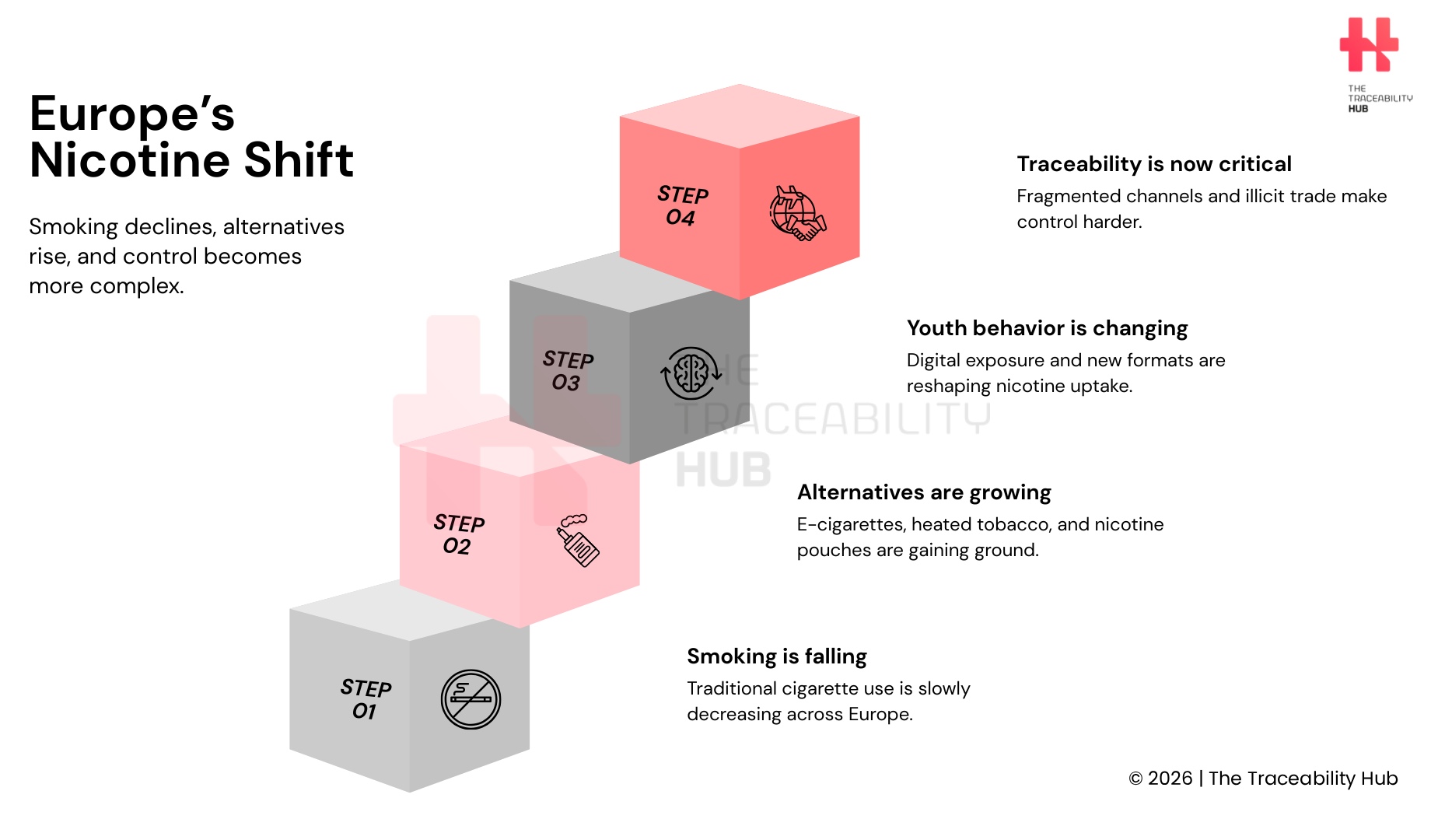
Europe’s Nicotine Shift
The Illicit Tobacco Market Effect
A significant concern highlighted by stakeholders is the rapid expansion of illicit tobacco trade and irregular markets for emerging nicotine products. As European tobacco regulation and nicotine product restrictions become more stringent in varying degrees across Europe, consumer demand persists and often shifts toward channels with limited nicotine compliance, inconsistent enforcement, and less transparent supply chains.
Evidence from policy evaluations suggests that restrictions on product features, such as bans on certain flavors, may not eliminate consumption as intended. Rather, they can trigger substitution effects (users switching to other product types) and channel effects (purchases moving across borders or into informal supply routes), especially when legal access becomes more constrained, but consumer interest remains stable. This is particularly visible in categories such as vaping and heated tobacco products, where product innovation and distribution have outpaced the speed of harmonized enforcement system.
Recent quantification efforts suggest that the scale of the issue may be considerable. According to a 2025 study of the European e-cigarette supply chain, approximately 48% of the e-cigarette market in Europe operates within an “irregular” zone, ranging from non-compliant personal imports to fully illegal vaping products and commercial trade. This finding substantiates claims that up to half of the nicotine market circumvents conventional compliance mechanisms and regulatory oversight.
The consequences are considerable and affect the entire nicotine system. Illicit channels generally do not offer reliable age verification, assured product safety standards, or collection of excise and VAT revenues. Most importantly for regulators and authorized operators, they also diminish tobacco supply chain transparency and traceability. When products move outside official reporting and notification frameworks, transparency across the supply chain is compromised: it becomes more difficult to identify manufacturers, verify batch integrity, and monitor cross-border movements. Thus, the illicit nicotine market presents not only public health risks but also constitutes a significant gap in system control, undermining enforcement efforts, fiscal strategies, and the effectiveness of traceability systems.
The Excise Tax Dimension: A Growing Fiscal Crisis
Beyond public health, the expansion of illicit and irregular nicotine markets represents a structural and growing threat to government revenues across the EU. Tobacco and nicotine products are among the most heavily excise-taxed categories in Europe: excise duties on cigarettes alone are required under EU law to represent at least 60% of the weighted average retail selling price, and many member states apply rates substantially above this floor. For governments, this fiscal architecture depends entirely on products moving through traceable, compliant supply chains where tax collection is enforceable.
When products migrate to illicit channels, that architecture breaks down. Illicit tobacco and nicotine products, whether counterfeit cigarettes, unregistered e-liquids, or non-compliant nicotine pouches, move outside the fiscal perimeter entirely, generating no excise duty, no VAT, and no contribution to the public health funding that tobacco taxation is partly designed to support. The European Commission and individual member state tax authorities have consistently identified illicit tobacco trade as one of the most significant sources of excise revenue loss in Europe, with estimates of foregone receipts running into billions of euros annually.
The structural shift toward nicotine alternatives complicates this picture further. Many alternative products – particularly nicotine pouches, certain e-liquids, and cross-border personal imports – occupy regulatory grey zones where excise classification is inconsistent across member states, tax rates are applied unevenly, and collection mechanisms are underdeveloped relative to the growth of the category. As these products scale, the fiscal gap between the volume of nicotine consumed and the excise revenue collected widens – a dynamic that creates pressure on national budgets while simultaneously undermining the cost-of-access lever that taxation is intended to provide as a public health tool.
For policymakers, this creates a dual imperative: not only to contain illicit markets on health grounds, but to close the fiscal gap through more consistent excise classification, cross-border enforcement cooperation, and – critically – robust traceability infrastructure that makes tax-unpaid product movement detectable and actionable.
Illicit channels generally do not offer reliable age verification, assured product safety standards, or collection of excise and VAT revenues. Most importantly for regulators and authorized operators, they also diminish tobacco supply chain transparency and traceability. When products move outside official reporting and notification frameworks, transparency across the supply chain is compromised: it becomes more difficult to identify manufacturers, verify batch integrity, and monitor cross-border movements. Thus, the illicit nicotine market presents not only public health risks but also constitutes a significant gap in system control, undermining enforcement efforts, fiscal strategies, and the effectiveness of traceability systems.
Traceability & System Control Challenges
From a tobacco traceability perspective, the shift toward novel nicotine products introduces new layers of complexity that traditional tobacco control systems were not designed to handle. The challenge is no longer simply tracking “tobacco products” as a single regulated category, it is maintaining oversight across a fast-expanding nicotine ecosystem of formats, components, and distribution models that behave very differently across borders.
The first source of friction is fragmented product categorization. Regulatory obligations and traceability expectations can vary significantly depending on whether a product contains tobacco or only nicotine, whether it is a device or a consumable, and whether it flows through legal retail networks or sits in the grey zone of irregular imports and semi-compliant trade. Each of these distinctions affect what can be verified (origin, composition, labeling, tax status, and product authentication), and how consistently it can be enforced across the nicotine supply chain.
A second pressure point is the growth of digital sales channels and nicotine e-commerce. Cross-border e-commerce, social media–driven distribution, and informal peer-to-peer supply routes can bypass the physical touchpoints where compliance checks typically happen. In practice, this means that a nicotine product can move from manufacturer to consumer with fewer verifiable controls, especially when transactions are mediated by platforms, online communities, or small-scale resellers operating across multiple jurisdictions.
Ultimately, regulatory misalignment exacerbates the issue. Variations in national regulations concerning flavors, packaging, nicotine formats, and product classifications result in a fragmented landscape where identical products may be permissible in one jurisdiction and restricted in another. These discrepancies create gaps in EU-level oversight and tobacco enforcement, diminishing comprehensive visibility and complicating monitoring efforts. Consequently, as product categories expand and distribution channels diversify, traceability requires not only tracking individual product types but also ensuring effective system management across a complex, cross-border nicotine market.
The Strategic Trade-Off
At the heart of the EU tobacco debate lies a fundamental strategic trade-off. Policymakers want to reduce smoking prevalence, yet when cigarette use declines, consumers often shift toward alternative nicotine formats and reduced-risk nicotine products. At the same time, tightening rules on those alternatives can unintentionally expand illicit nicotine markets, pushing demand into channels where core safeguards break down, including:
- Age verification
- Product safety and quality standards
- Tax collection and fiscal oversight
- End-to-end traceability
- Tobacco compliance and product monitoring
The excise dimension adds a further layer of complexity to this trade-off. Governments face the paradox of needing to regulate alternative nicotine products firmly enough to protect public health – particularly youth – while avoiding regulatory designs so restrictive that they accelerate the shift of consumption into non-taxed, non-traceable channels. An overly blunt ban on flavors, for instance, may reduce legal sales while leaving excise revenues unchanged or worsening them, if displaced demand moves to untaxed informal sources. Conversely, a more permissive approach that keeps alternatives within the formal, taxed market preserves fiscal yield but may conflict with harm-reduction objectives in specific population segments. Navigating this tension requires regulatory precision: differentiated rules that can be applied by product category, age group, and sales channel, supported by the kind of end-to-end traceability infrastructure that makes the distinction between compliant and non-compliant product movement enforceable in practice.
And while protecting youth must remain non-negotiable, overly blunt restrictions can also limit tobacco harm-reduction pathways for adults who would otherwise transition away from combustible tobacco products. The real challenge, therefore, is not choosing one objective over another, but designing a tobacco governance system capable of balancing all three, aligning regulation, enforcement, and traceability so that public health goals are met without creating new control gaps.
A System in Transition
The EU tobacco ecosystem is entering a new phase of structural change: from combustion to nicotine market diversification, from tightly regulated products to hybrid nicotine markets, and from linear supply chains to fragmented, multi-channel nicotine distribution ecosystems.
For policymakers, businesses, and traceability leaders, the defining question is no longer whether the nicotine market will evolve – but how can governance keep pace with that evolution: how do you regulate a category that is moving faster than the rules designed to control it? And how do you maintain excise revenue integrity across a market that is simultaneously diversifying, digitalizing, and partially migrating to channels where traditional fiscal enforcement has limited reach?
The answer will shape not only the effectiveness of public health strategies, but also the future of tobacco compliance, supply chain transparency, and end-to-end control across an increasingly complex nicotine value chain — where visibility, classification, and accountability will determine whether regulation remains enforceable in practice.
Read more: Geopolitics Meets Supply Chains: The New Role of Digital Traceability