



Why EU-FMD Matters and Why Italy Is Different
The Falsified Medicines Directive (EU‑FMD) was established to enhance patient safety and fortify the integrity of the legal pharmaceutical supply chain throughout the European Union. Its principal aim is to prevent falsified medicines from infiltrating the legitimate distribution network by facilitating comprehensive verification of prescription pharmaceuticals through a unified pharmaceutical traceability and medicine verification system. By implementing a standardized system of unique identifiers, pharmaceutical serialization, and point-of-dispense verification, the EU‑FMD provides a unified framework designed to guarantee that medicines delivered to patients are authentic, traceable, legally sourced. and compliant with EU pharmaceutical regulation requirements.
Italy, however, has historically constituted an exception to this framework among EU Member States. For many years, the Italian pharmaceutical market has utilized the Bollino farmaceutico, a government-issued pharmaceutical anti-counterfeiting security label affixed to medicinal packaging, which enabled strong national traceability and reimbursement control. As a result, Italy operated under a temporary EU-FMD derogation and did not immediately adopt the EU-wide verification model.
This context explains why Italy initially remained outside the EU-wide pharmaceutical serialization infrastructure adopted by other Member States. Over time, however, cross-border manufacturing, pharmaceutical supply chain integration, parallel distribution, and centralized EU regulatory mechanisms increased the need for harmonization and interoperability, making continued divergence increasingly difficult to sustain.
The current transition thus constitutes a fundamental structural transformation, rather than a routine regulatory adjustment. For Marketing Authorization Holders (MAHs), Contract Manufacturing Organizations (CMOs), pharmaceutical manufacturers, and packagers, alignment with the EU‑FMD necessitates a shift from exclusively national traceability processes to an integrated European system. This change has significant repercussions for pharmaceutical packaging requirements, data governance, systems integration, and supply-chain coordination, all of which demand strategic foresight and effective cross-functional collaboration.
Background: EU-FMD and the Italian Exception
Directive 2011/62/EU, referred to as the Falsified Medicines Directive (EU‑FMD), was enacted to mitigate the increasing risks associated with falsified medicines infiltrating the legitimate pharmaceutical supply chain within the European Union. For the first time at the EU level, this Directive formally defines a falsified medicinal product as any medicine that intentionally provides incorrect information concerning its identity, origin, or history. This definition encompasses falsification of pharmaceutical packaging, labeling, product name, and composition, as well as misrepresentation regarding the manufacturer, country of origin, marketing authorization holder, or pharmaceutical distribution records.
The EU‑FMD primarily applies to prescription‑only medicines, which are recognized as being at greater risk for falsification and pharmaceutical counterfeiting. In order to safeguard patients and reinforce the integrity of the legal supply chain, the Directive requires the implementation of specific safety features on each individual pack. These features include a unique identifier encoded in a 2D DataMatrix and an anti‑tampering device. Collectively, these pharmaceutical serialization measures facilitate the verification of product authenticity and package integrity throughout the pharmaceutical supply chain and at the point of dispensing, thereby establishing a unified European framework for serialization and verification.
Why Italy Had a Six-Year Exemption
When EU-FMD entered into force, Italy was granted a six-year exemption based on the existence of a robust national pharmaceutical traceability system that already ensured a high level of protection against falsified medicines. At the core of this system was the Bollino farmaceutico, a state-issued security sticker applied to medicinal product packs. The Bollino farmaceutico played a central role in national medicine traceability, authentication of legitimate medicines, and reimbursement control, particularly for products funded by the Italian National Health Service.
Due to its central management and consistent implementation, the Bollino system was deemed sufficient to achieve the public health objectives targeted by the EU-FMD. Consequently, Italy received formal recognition of compliance through alternative national measures, allowing for a temporary postponement of the adoption of EU-wide serialization requirements.
This exemption was not designed to be permanent. As the EU‑FMD became fully operational throughout the Union, maintaining a national system separate from the European Medicines Verification System (EMVS) increasingly constrained harmonization and pharmaceutical interoperability. This regulatory context clarifies both the distinctive nature of the Italian situation and the rationale behind the ongoing transition to EU‑wide serialization compliance.
Italy’s Transition to EU-FMD Compliance
Italy’s compliance with EU-FMD mandates integration into the European Medicines Verification System (EMVS), a unified EU-wide pharmaceutical serialization platform that facilitates the serialization and verification of prescription medicinal products. Consistent with procedures in other Member States, this process is coordinated nationally by a dedicated National Medicines Verification Organization (NMVO), which serves as the liaison between pharmaceutical stakeholders and the broader European pharmaceutical verification system.
The establishment of the Italian NMVO represents a foundational step in the transition. Its role is to govern the national medicine verification system, coordinate pharmaceutical serialization onboarding activities, and ensure connectivity with the EU Hub, the central repository operated by the European Medicines Verification Organization (EMVO). Through this connection, pharmaceutical manufacturers upload serialization data to the EMVS (via the EU Hub), which then makes the relevant records available to the concerned National Medicines Verification Systems (NMVS) so that wholesalers, pharmacies, hospitals, and other authorized parties can consult and verify pack authenticity prior to dispensing.
Italy’s Roadmap for EU-FMD Compliance: Key Dates and Transition Phases
Italy’s transition to EU-FMD compliance is being implemented through a phased pharmaceutical strategy, intended to systematically shift from the national Bollino model to complete integration within the European verification system. The process encompasses a two-phase pilot project, with phase 2 functioning as the stabilization period, and an established official go live date:
- Pilot phase 1: Now nearing conclusion, this initial stage aims to validate system connectivity, data exchange, and operational feasibility in a controlled environment. Participation has been restricted to selected pharmaceutical stakeholders, and testing activities have not impacted products designated for commercial distribution.
- Pilot phase 2: Commencing in May, this phase functions as a pharmaceutical serialization stabilization period, broadening testing to medicines intended for commercial distribution and to a context that reflects the real distribution chain (i.e., no longer a protected environment), while engaging a wider range of pharmaceutical companies. A parallel run will be conducted, enabling the traditional Bollino system and the National Medicines Verification System (NMVS) to operate concurrently, thereby maintaining pharmaceutical business continuity throughout the transition.
The process will culminate with the official go‑live in February 2027, at which point full EU‑FMD serialization and medicine verification compliance will become mandatory for all prescription medicines entering the Italian pharmaceutical market.
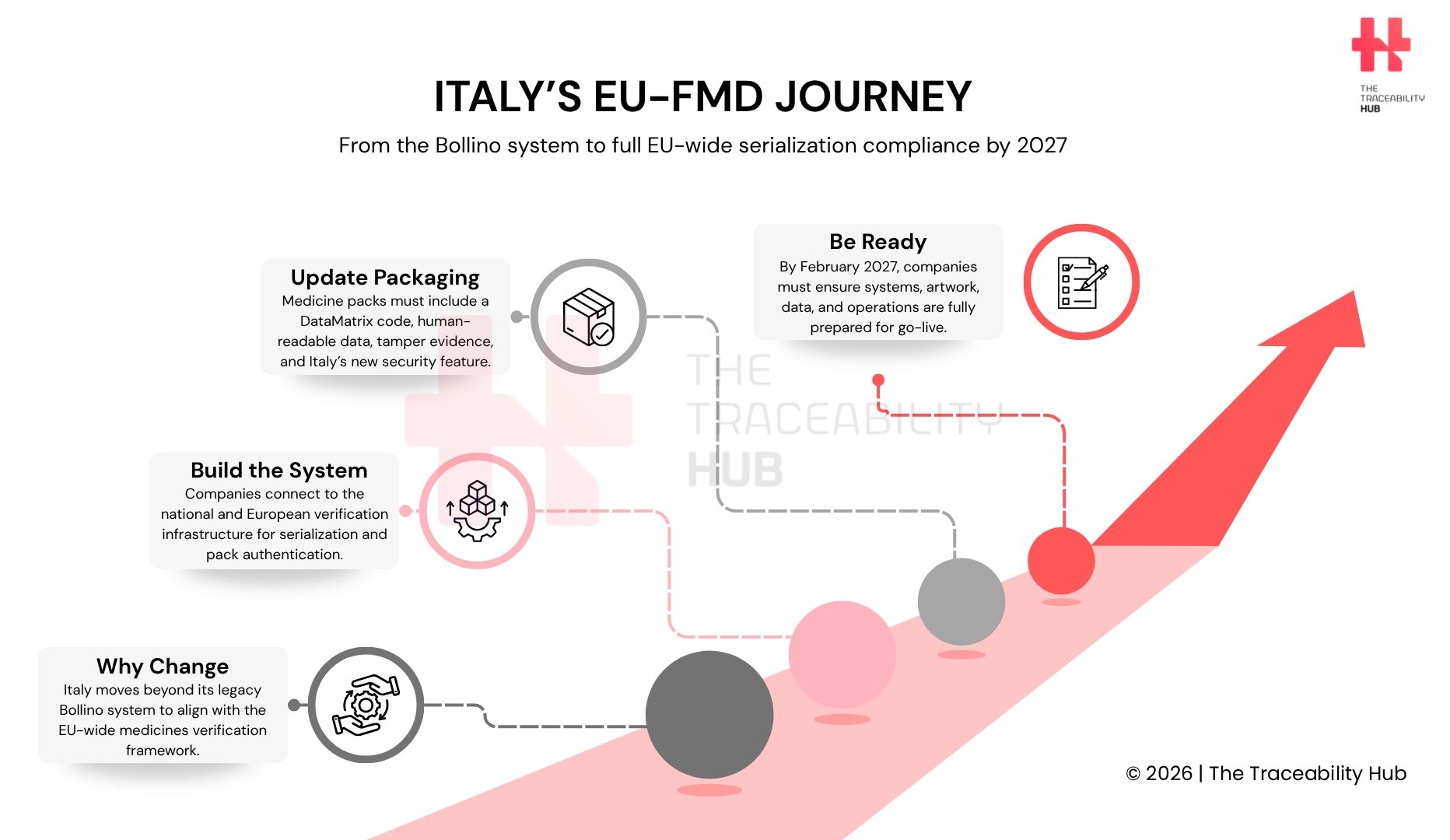
Italy’s EU-FMD Journey
Packaging and Serialization Changes
The transition from the national Bollino-based system to EU-FMD compliance introduces significant modifications to the packaging of prescription medicines in Italy. These pharmaceutical packaging changes impact not only the information displayed on packaging, but also the identification and verification of pharmaceutical products.
Prior to the adoption of EU-FMD standards, prescription medicines were identified using the Bollino farmaceutico, facilitating national pharmaceutical traceability and reimbursement management. However, these packs lacked an EU-FMD-compliant DataMatrix and were not integrated with the European Medicines Verification System (EMVS) infrastructure.
Following the implementation of EU-FMD requirements, pharmaceutical packaging must now include safety features such as a unique identifier encoded within a 2D DataMatrix barcode. Additionally, the Italian pharmaceutical system retains a national anti-counterfeiting feature, “elemento carta valori” (commonly known as Bollino 2.0), which operates alongside, rather than replaces, EU-mandated pharmaceutical safety measures. The inclusion of an anti-tampering device remains compulsory to maintain the integrity of the packaging and pharmaceutical authentication standards.
“Carta valori”, or security papers, due to their intended purpose are resistant to counterfeiting and falsification because they are produced using security printing techniques and/or watermarked paper with special pastes, or by using plastic or aluminum substrates (such as license plates) or other materials. They may contain magnetic strips or optical memory, microprocessors (chips), holograms, or other security systems.
Furthermore, EU-FMD stipulates that certain human-readable pharmaceutical data elements must be printed on each pack, including GTIN, serial number, AIC code, expiry date, and batch number. Ensuring consistency between machine-readable serialization data and visible pharmaceutical packaging information marks a significant advancement over the pre-EU-FMD model.
Key Insights from Italy’s EU-FMD Serialization Pilot Project
Italy’s transition was facilitated by an organized pharmaceutical serialization pilot initiative, established to verify the national medicine verification framework prior to comprehensive regulatory implementation and EU-wide pharmaceutical serialization compliance.
Phase 1: System Validation and Pilot Testing
Pilot phase 1 focused on validating pharmaceutical system connectivity and data exchange in a controlled setup and with packs not intended for commercial distribution (as summarized above). The main takeaway for pharmaceutical companies is the need to confirm end-to-end readiness across serialization, pharmaceutical verification workflows, data management, and exception handling before expanding scope.
Phase 2: Why It Is Operationally Critical
Pilot phase 2 is the operational stress test for Italy’s pharmaceutical serialization ecosystem: activities are executed in conditions that mirror the real pharmaceutical distribution chain and require true end-to-end validation with the NMVS. This is also the stage in which dual-system governance (parallel run with Bollino) and day-to-day pharmaceutical execution controls become critical for preventing errors and ensuring business continuity.
Machinability tests have also been broadened to include all companies that requested the IPZS test version of the dispositivo carta valori (a self-adhesive label made of watermarked paper, free of optical brighteners and equipped with fluorescent fibrils invisible to UV rays, security inks, and identification codes that can be read both plainly and through optical scanning), within the specified timeframe, thereby allowing for a more extensive and representative pharmaceutical packaging validation sample.
Technical and Artwork Implications
The EU‑FMD imposes stringent standards regarding the application, serialization print quality, and readability of DataMatrix codes on pharmaceutical packaging. High levels of print quality, contrast, and symbol integrity are essential to facilitate consistent scanning and verification throughout the supply chain.
Human-Readable Information
Human-readable pharmaceutical information must correspond precisely to the content of the 2D DataMatrix. Careful attention should be paid to both formatting and sequencing, ensuring that the GTIN is consistently presented first.
This alignment between machine-readable pharmaceutical serialization data and visible packaging information is essential for EU-FMD compliance, pharmaceutical traceability, and effective medicine verification across pharmacies, hospitals, wholesalers, and dispensers.
Artwork Updates and AIFA Approval
The implementation of EU‑FMD pharmaceutical safety features necessitates updates to carton artwork, which may impact layout, dimensions, and materials, and pharmaceutical labeling workflows. These pharmaceutical artwork modifications are contingent upon AIFA approval, underscoring the importance of proactive planning and effective coordination in artwork management as a key EU-FMD project activity.
For companies with extensive SKU portfolios, pharmaceutical artwork updates and serialization-related packaging redesigns may become one of the most resource-intensive aspects of the transition.
Operational Impact on Pharmaceutical Companies
Organizations are required to verify that pharmaceutical production lines are equipped to handle serialization processes, including DataMatrix printing, vision inspection, pharmaceutical code verification, and the application of both the “elemento carta valori” and anti-tampering devices. Although aggregation is not compulsory under EU-FMD requirements, some pharmaceutical companies may implement aggregation solutions to improve pharmaceutical logistics, warehouse efficiency, and supply-chain traceability.
Systems and Data
The EUFMD mandates comprehensive pharmaceutical serialization repositories and dependable connectivity with the national verification framework (via the NMVO/NMVS) and with the EMVS through the EU Hub, which is operated by EMVO. Maintaining accurate pharmaceutical master data—including GTIN and AIC codes—is critical to prevent verification errors, serialization mismatches, and EMVS alert generation.
For pharmaceutical manufacturers, MAHs, and CMOs, pharmaceutical systems integration and serialization data governance become central operational priorities, particularly during the transition to EU-wide serialization and medicine verification.
Top EU-FMD Compliance Risks and How to Mitigate Them
Italy’s transition to EU‑FMD compliance presents a suite of complex, interrelated pharmaceutical serialization risks that pharmaceutical companies must proactively address to mitigate the potential for delays, inefficiencies, or lapses in pharmaceutical compliance. These challenges stem not from the regulatory framework itself, but rather from the intricacies of coordinating regulatory, technical, and operational adjustments within constrained timelines.
A primary concern is regulatory timing misalignment. Although EU‑FMD deadlines and pharmaceutical serialization milestones are clearly defined, national implementation schedule, artwork approvals, and operational readiness may advance at varying rates across different products and manufacturing sites. Discrepancies among regulatory filings, system integration, and pharmaceutical production scheduling can result in bottlenecks, particularly as the official launch date nears. Therefore, early and robust cross-functional collaboration is essential to ensure alignment between regulatory, packaging, IT, and operational schedules.
Additionally, the risk of pharmaceutical artwork approval bottlenecks must be closely monitored. The need to update a broad array of SKUs in response to EU‑FMD serialization requirements has the potential to strain AIFA’s approval processes, especially if pharmaceutical artwork submissions are delayed or inadequately prioritized. Since approved packaging artwork is prerequisite for both pharmaceutical production and serialization line validation, any setbacks here can have widespread repercussions throughout the transition timeline.
Another significant challenge involves pre‑printed material pharmaceutical packaging obsolescence. Existing stocks of cartons or packaging components incompatible with new pharmaceutical serialization and anti-counterfeiting requirements may become unusable without careful management. A strategic approach to phasing out or adapting pre‑printed packaging materials is vital to prevent financial losses and pharmaceutical supply interruptions during the switchover.
In the stabilization phase, the complexity of managing dual pharmaceutical systems must also be addressed. The simultaneous operation of the traditional Bollino system alongside the National Medicines Verification System (NMVS) demands meticulous oversight of processes, data flows, and packaging configurations, verification data flows, and pharmaceutical execution controls. Insufficient segregation or lack of clear procedures during this stage heightens the risk of operational errors and serialization inconsistencies across the pharmaceutical supply chain.
Finally, supplier bottlenecks pose an external risk. As the deadline for comprehensive EU‑FMD serialization compliance approaches, concurrent industry-wide demand for equipment upgrades, pharmaceutical packaging upgrades, serialization software, and pharmaceutical data management solutions could exceed supplier capacity. Pharmaceutical companies that postpone procurement may experience extended lead times and diminished flexibility. Accordingly, engaging technology and packaging suppliers early is critical to successful mitigation.
Key Insights for Successful EU–FMD Compliance in Italy
Italy is entering the final stretch of its EU-FMD implementation, with pharmaceutical companies moving from planning and controlled testing to execution under operational conditions and fixed national serialization milestones.
A key Italy-specific point is coexistence: EU-FMD requirements for prescription medicines will be implemented alongside national pharmaceutical anti-counterfeiting measures. The Bollino farmaceutico remains in use for over-the-counter (OTC) products, while prescription medicine packs will also include the Italian elemento carta valori (often referred to as Bollino 2.0).
Compliance with EU-FMD has a cross-functional impact, affecting packaging pharmaceutical formats, artwork layouts, and IT infrastructure, serialization repositories, and operational workflows. It necessitates coordinated efforts across regulatory, quality, operations, and supply chain teams. Therefore, EU-FMD compliance should be viewed as an organizational transformation initiative, extending far beyond packaging requirements.
Pilot phase 2 should be treated as the final pharmaceutical serialization readiness gate: use it to confirm governance for the parallel run, define execution controls (roles, SOPs, escalation paths), and validate that pharmaceutical data quality and exception handling are stable enough to scale ahead of go-live.
Ultimately, a successful pharmaceutical serialization transition relies on early and sustained collaboration throughout the supply chain. Manufacturers, contract manufacturing organizations (CMOs), distributors, and dispensers must work closely together to efficiently manage dual systems, uphold data integrity, and maintain continuous medicine supply. Active and ongoing partnership is essential for ensuring Italy’s complete alignment with EU-FMD compliance standards and European pharmaceutical traceability requirements.
Essential Steps for Operational Success in Italy
- Confirm product scope and timelines: Determine which pharmaceutical products are within the EU‑FMD scope and synchronize internal schedules with national milestones, pilot phases, and the February 2027 go‑live date to mitigate last‑minute changes.
- Validate GTIN–AIC mapping: Ensure precise and consistent mapping of GTINs and AIC codes across regulatory submissions, pharmaceutical packaging artwork, and serialization systems to prevent medicine verification data discrepancies.
- Update artwork layouts: Review and update pharmaceutical carton designs to incorporate 2D DataMatrix codes, human‑readable data, elemento carta valori, and anti‑tampering devices, considering spatial limitations and print quality standards.
- Engage AIFA proactively: Coordinate pharmaceutical artwork submissions in advance and establish early engagement with AIFA to manage approval timelines and dependencies, particularly for pharmaceutical portfolios with numerous SKUs.
- Assess line print quality capability: Confirm that current printing and vision systems can reliably generate compliant and legible DataMatrix codes on designated packaging materials during normal production.
- Prepare EMVO connectivity: Verify the readiness of serialization systems for seamless integration with the NMVO/NMVS and for connection to the EMVS via the EU Hub (operated by EMVO), to ensure reliable data upload and synchronization.
- Plan for parallel operations: Develop clear serialization procedures to address the simultaneous operation of the Bollino system and the NMVS during the stabilization phase, minimizing operational complexity and error risk.
- Manage pre‑printed inventory: Evaluate current stocks of pre‑printed pharmaceutical packaging materials and implement a transition strategy to minimize packaging obsolescence and avoid unnecessary write‑offs.
- Train operations and QA teams: Provide comprehensive training to operations and quality personnel on new serialization processes, controls, and obligations arising from EU‑FMD compliance.
- Map the entire pharmaceutical supply chain, including external warehouses: Examine all supply chain elements, including third‑party logistics providers and external warehouses, to ensure conformity with verification and decommissioning processes.
- Review SOPs: update standard operating procedures to accommodate new packaging, data management, and verification workflows mandated by EU‑FMD.
- Evaluate the need to enhance the Quality Team: Assess the necessity for additional pharmaceutical quality resources or expertise to address heightened regulatory and operational demands.
- Be ready for EU alerts management: Establish processes and assign responsibilities for managing EU‑wide pharmaceutical verification alerts and exceptions issued by the European Medicines Verification System.
What Companies Should Prioritize Now
As Italy transitions into the final stage of EU-FMD alignment, pharmaceutical organizations are advised to prioritize EU-FMD compliance by recognizing pharmaceutical artwork management and human readable data as key components.
It is imperative to closely monitor communications from the Ministry of Health, NMVO, and IPZS to ensure adherence to the latest Italian pharmaceutical serialization guidelines, verification requirements, and regulatory updates related to EU-FMD implementation.
Read more: How Italy’s CN3 Is Redefining Precision Medicine Through RNA, Data, and Traceability