


Why TOR Management Matters More Than Ever
The growing reliance on temperature-sensitive therapies (including biologics, mRNA vaccines, and RNA-based therapies) is fundamentally reshaping the risk profile of the pharmaceutical supply chain and cold chain logistics ecosystem. As highlighted in the introduction, nearly 43% of newly approved drugs require cold chain conditions and temperature-controlled supply chain environments, a proportion driven largely by the rapid expansion of biologics and RNA-based technologies.
Unlike traditional small-molecule drugs, these advanced therapies are structurally complex and inherently unstable. Their efficacy depends on maintaining tightly controlled environmental conditions throughout the entire life cycle, from manufacturing to administration within a temperature-controlled pharmaceutical supply chain. Even minimal deviations outside specified temperature ranges can initiate irreversible degradation processes, directly impacting clinical performance and product integrity.
This vulnerability is particularly critical for RNA-based products, where molecular integrity is highly sensitive to thermal stress and temperature fluctuations. According to data from the World Health Organization (WHO), failures in temperature control contribute significantly to global inefficiencies, with up to 50% of vaccines wasted each year, largely due to cold chain disruptions and inadequate temperature monitoring.
The implications extend across three key dimensions:
- Therapeutic efficacy: Temperature excursions can lead to denaturation or degradation of active components (including protein denaturation and RNA degradation), reducing or nullifying treatment effectiveness.
- Patient safety: Chemical and structural instability may result in the formation of harmful degradation by products, increasing the risk of adverse effects and patient safety risks.
- Economic sustainability: High-value biologics and advanced therapies amplify the financial impact of product loss, making temperature excursions a major cost driver in pharmaceutical logistics and supply chain risk management.
In this context, Time Out of Refrigeration (TOR) is no longer a marginal operational variable. It has become a critical control parameter within cold chain management and pharmaceutical traceability systems, requiring precise measurement, continuous monitoring, and integration into broader traceability and quality systems.
As the pharmaceutical landscape continues to evolve, effective TOR management is emerging as a key differentiator, linking scientific integrity, regulatory compliance, and supply chain resilience.
TOR in Pharma
Why TOR Management Matters More Than Ever
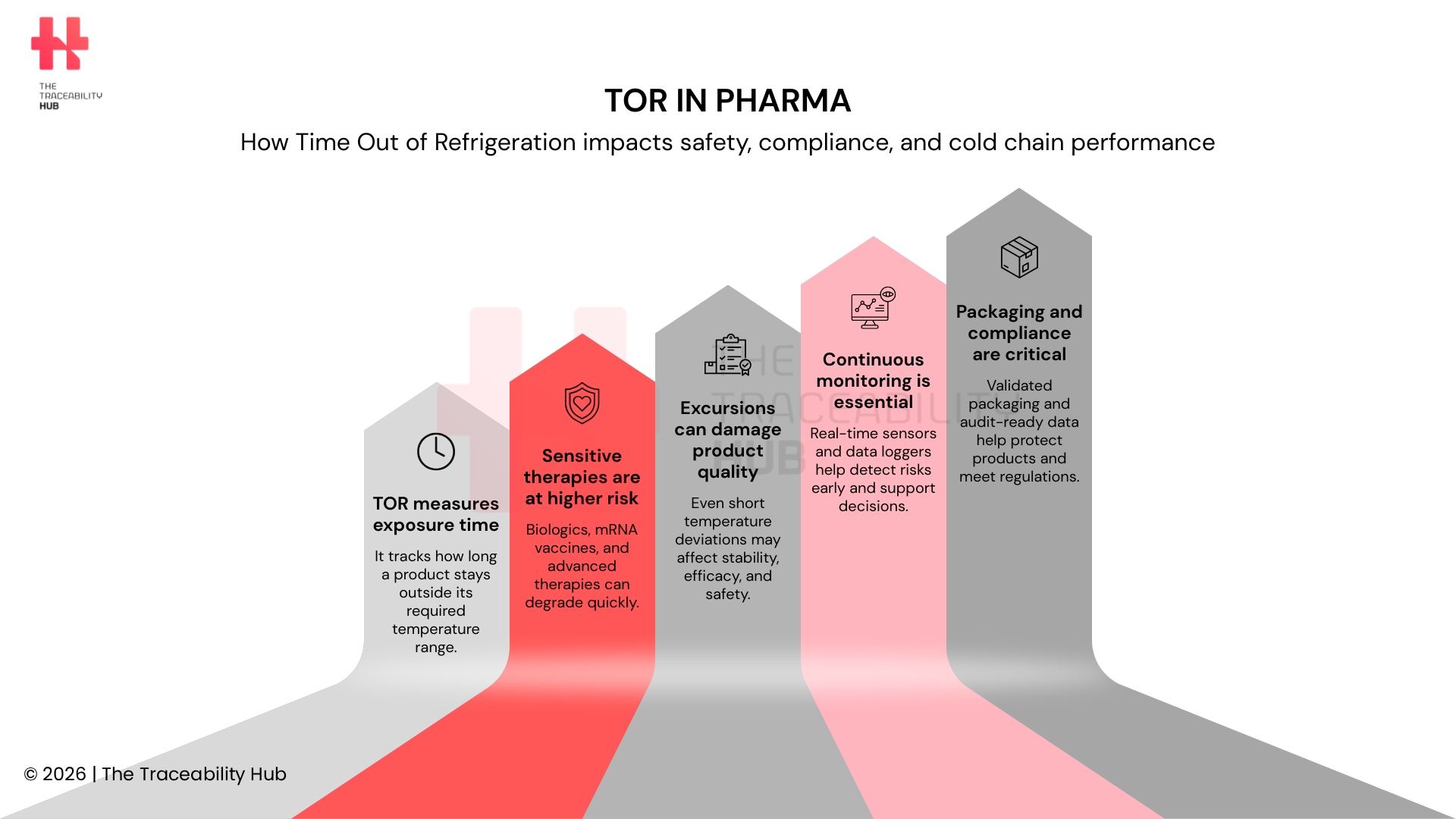
The shift toward biologics and RNA-based therapies is redefining the criticality of temperature control and cold chain compliance across the pharmaceutical lifecycle. Unlike traditional small-molecule drugs, these advanced therapies are structurally complex and inherently unstable, making them highly sensitive to environmental conditions, particularly temperature fluctuations and thermal stress.
Even brief excursions outside prescribed storage ranges can trigger irreversible molecular changes, directly compromising product integrity and stability. This is especially relevant for mRNA-based treatments, where stability is tightly linked to maintaining precise thermal conditions throughout storage and temperature-controlled transport and distribution.
As the industry transitions toward higher-value, more sensitive therapies, the margin for error is rapidly shrinking. Temperature deviations are no longer isolated quality events; they represent systemic risks that can affect the entire pharmaceutical value chain and cold chain logistics network.
In this evolving context, Time Out of Refrigeration (TOR) emerges as a critical parameter, one that directly impacts on therapeutic performance, regulatory compliance, and economic outcomes.
Key Risks Associated with Poor TOR Management
Temperature deviations can lead to molecular degradation, including protein denaturation or RNA breakdown, which significantly diminishes therapeutic effectiveness. In severe cases, this can result in the complete loss of functionality, rendering treatments unusable and contributing to pharmaceutical waste and product loss.
These molecular changes not only compromise patient safety by increasing the risk of adverse reactions, but also threaten regulatory compliance, as products may fail to meet the stringent standards set by agencies like the U.S. Food and Drug Administration (FDA) and EMA.
Thermal stress further amplifies these risks by inducing a range of physicochemical alterations, such as:
- Structural dislocation at the molecular level
- Phase separation in liquid formulations
- Formation of degradation by-products through oxidation or hydrolysis
These changes may alter the safety of the product, raising the likelihood of harmful side effects and leading to non-compliance with regulatory standards and pharmaceutical quality systems. As a result, compromised products not only endanger patient health but also expose manufacturers to regulatory penalties and recalls.
The economic consequences of inadequate TOR management are substantial. When a product fails due to temperature excursions, it triggers financial losses from wasted inventory, regulatory actions, and potential harm to brand reputation. In this context, even a single compromised shipment can translate into high economic loss, reinforcing the need for robust TOR monitoring, risk mitigation strategies, and end-to-end traceability systems.
Ultimately, poor TOR management interlinks patient safety risks, regulatory non-compliance, and significant economic loss, demonstrating that each risk amplifies the others, making comprehensive TOR control essential for safeguarding both public health and business sustainability in pharmaceutical supply chains.
Understanding Temperature Sensitivity: Standard Ranges
Effective TOR management requires a thorough understanding of temperature classifications established by regulatory bodies such as the United States Pharmacopeia (USP) and the World Health Organization (WHO).
These standardized ranges are grounded in stability data that delineate the environmental parameters necessary for pharmaceutical products to retain their safety, efficacy, and quality throughout their designated shelf life within a temperature-controlled supply chain.
As therapies increasingly exhibit sensitivity to temperature, especially with advancements in biologics and RNA-based treatments, maintaining strict compliance with these guidelines is critical to preventing product degradation, temperature excursions, and cold chain failures, and meeting regulatory requirements.
Regulatory Temperature Ranges and Their Applications
Pharmaceutical products are typically categorized into four main temperature ranges:
- Ultra-Cold (-80°C to -60°C): Primarily used for highly sensitive products such as mRNA vaccines and certain gene therapies, where molecular stability requires extremely low temperatures to prevent rapid degradation and ensure RNA stability.
- Freezer (-25°C to -10°C): Applicable to specific biologics and specialty pharmaceuticals that require frozen storage but are less sensitive than ultra-cold products.
- Refrigerated / Cold (2°C to 8°C): The most common range in pharmaceutical cold chain logistics, covering vaccines, insulin, and a large proportion of biologics. This range is strictly regulated due to its widespread use and sensitivity to excursions.
- Controlled Room Temperature (20°C to 25°C): Defined by USP standards, this range allows for limited, controlled excursions (typically between 15°C and 30°C) while maintaining product stability and quality assurance compliance.
Each category denotes a validated stability boundary. Exceeding these limits, even briefly, can lead to cumulative thermal stress, causing gradual degradation of the product and compromising product integrity.
Accordingly, TOR is evaluated within the context of a comprehensive exposure profile, in which duration, frequency, and magnitude of deviations collectively determine overall product stability risk.
Accurate interpretation and application of these classifications are essential steps for ensuring robust TOR monitoring, regulatory adherence, and efficient pharmaceutical traceability system.
From Static Control to Dynamic Monitoring
Traditional cold chain management has historically relied on maintaining temperature within predefined ranges, with limited visibility between checkpoints. This static approach, often based on periodic measurements, is no longer sufficient in a landscape dominated by highly sensitive biologics and RNA-based therapies.
Today, the focus is shifting toward continuous, data-driven cold chain monitoring, where temperature is tracked in real time across the entire supply chain. This evolution is driven by both technological advancements and increasing regulatory expectations for traceability, data integrity, and audit-ready documentation.
Continuous Monitoring
The adoption of advanced technologies, such as IoT sensors, RFID temperature tracking systems, and real-time data loggers, is transforming cold chain visibility and pharmaceutical logistics monitoring.
These tools enable:
- Real-time detection of temperature excursions, reducing response times
- Immediate intervention, helping prevent product loss or degradation
- End-to-end traceability, supporting compliance with regulatory requirements such as FDA 21 CFR Part 11 and EU GDP guidelines
Continuous monitoring also facilitates the creation of tamper-proof data records, which are increasingly required for audits, quality assurance processes, and regulatory inspections.
Mean Kinetic Temperature (MKT)
While real-time data is essential, evaluating temperature exposure requires more than isolated readings.
Mean Kinetic Temperature (MKT) provides a scientifically grounded method to assess the cumulative impact of temperature variations over time within cold chain monitoring systems.
According to USP <1079.2> guidelines:
- Controlled Room Temperature assessments typically consider a 30-day evaluation period
- Controlled Cold conditions may require analysis over shorter timeframes, such as 24 hours, depending on product sensitivity
MKT integrates both the duration and intensity of temperature excursions, offering a more accurate representation of product stability risk and thermal exposure.
As a result, MKT is increasingly used not only for reporting but as a decision-making tool, supporting critical actions such as product release, quarantine, or rejection within pharmaceutical quality systems.
Together, continuous monitoring and MKT analysis mark the transition from reactive cold chain management to a predictive, data-driven TOR strategy, aligned with the broader goals of pharmaceutical traceability, supply chain transparency, and quality assurance.
Packaging as a Performance Lever
Effective temperature management in the pharmaceutical supply chain extends beyond monitoring, it requires protection by design. As therapies become more sensitive to thermal variations, cold chain packaging solutions are evolving into a critical control point for mitigating Time Out of Refrigeration (TOR) risks and minimizing temperature excursions.
Validated temperature-controlled packaging systems are engineered to maintain temperature stability under real-world conditions, accounting for external variables such as ambient temperature fluctuations, handling delays, and transport disruptions within pharmaceutical logistics networks. According to guidelines from organizations such as the World Health Organization (WHO) and EU Good Distribution Practice (GDP), packaging systems must be qualified and tested to ensure they can consistently maintain required temperature ranges throughout distribution and cold chain transport.
In this context, packaging is no longer a passive container, it is an active performance enabler, directly influencing product integrity, regulatory compliance, and supply chain reliability.
Packaging Solutions and Selection Criteria
Different temperature requirements demand tailored pharmaceutical packaging solutions and cold chain packaging configurations:
- Gel packs: Commonly used for refrigerated shipments (2°C to 8°C), gel packs provide a cost-effective solution for short-duration transport, particularly in last-mile pharmaceutical delivery scenarios.
- Dry ice: Essential for ultra-cold logistics (-80°C to -60°C), especially for mRNA vaccines and advanced therapies. Its sublimation properties allow for consistent low temperatures but require careful handling and regulatory compliance (e.g., IATA Dangerous Goods Regulations).
- Phase Change Materials (PCMs): Designed to maintain highly specific temperature ranges, PCMs offer greater precision and longer thermal stability compared to traditional refrigerants. They are increasingly used for high-value biologics and extended transit times in temperature-sensitive supply chains.
However, selecting the appropriate packaging solution requires alignment with several critical factors:
- Product-specific stability data, defining allowable temperature ranges and temperature excursion limits
- Transit duration and variability, including potential delays or multi-leg shipments in global pharmaceutical logistics
- Environmental conditions, such as seasonal variations and geographic route complexity
Additionally, regulatory frameworks emphasize the need for lane qualification and packaging validation studies, ensuring that chosen solutions perform reliably under expected distribution conditions and maintain cold chain compliance.
In this sense, packaging becomes a strategic lever within TOR management, integrating with real-time monitoring technologies and traceability systems to deliver end-to-end temperature assurance and cold chain integrity.
Regulatory Pressure and Compliance Readiness
Time Out of Refrigeration (TOR) management is no longer limited to operational excellence: it is a regulatory compliance imperative. As pharmaceutical supply chains become more complex and globally interconnected, authorities are strengthening requirements around temperature control, pharmaceutical traceability, and data integrity.
Regulatory bodies increasingly expect companies to demonstrate not only that products were stored within defined conditions, but also that any temperature excursions are properly monitored, assessed, and documented. This shift reflects a broader move toward risk-based quality management and end-to-end supply chain visibility.
Key Regulatory Frameworks and Compliance Requirements
Several global frameworks are shaping the expectations around TOR management and cold chain compliance:
- Drug Supply Chain Security Act (DSCSA): Enforces end-to-end traceability of pharmaceutical products, requiring interoperable systems to track and verify drug movements across the supply chain. Temperature data is increasingly integrated into these pharmaceutical traceability frameworks to ensure product integrity.
- IATA Temperature Control Regulations (TCR): Establishes standardized procedures for handling temperature-sensitive healthcare products during air freight, including packaging, labeling, and temperature monitoring requirements.
- EU Good Distribution Practice (GDP): Mandate that medicinal products are consistently stored, transported, and handled under suitable conditions, with documented evidence of temperature control and excursion management.
- FDA 21 CFR Part 11: Defines requirements for electronic records and signatures, ensuring that temperature monitoring data is secure, traceable, and audit ready.
Across these frameworks, a common expectation emerges: companies must ensure data integrity, real-time visibility, and documented proof of compliance within their temperature-controlled supply chain operations.
This means:
- Continuous and reliable real-time temperature monitoring
- Immediate investigation and risk assessment of temperature excursions
- Complete and auditable records of storage and transport conditions
As a result, TOR management becomes a cross-functional responsibility, involving quality, regulatory, logistics, and IT teams within a fully integrated pharmaceutical quality system.
Toward a More Resilient Pharmaceutical Supply Chain
As pharmaceutical therapies become increasingly complex, the industry must refine temperature management strategies to safeguard product integrity and patient safety. A key principle in this context is Time Out of Refrigeration (TOR), denoting the period during which temperature-sensitive products are exposed to conditions outside controlled refrigeration.
TOR management acts as an essential control mechanism, linking product quality, digital traceability, supply chain efficiency, and patient outcomes throughout the pharmaceutical value chain.
Regulatory bodies such as the World Health Organization (WHO), U.S. Food and Drug Administration (FDA), and European Medicines Agency (EMA) endorse risk-based, data-driven quality systems that incorporate TOR controls. These agencies highlight the necessity of integrating real-time, documented evidence of temperature monitoring and excursion management within supply chain operations to ensure compliance and uphold rigorous safety standards.
The adoption of Industry 4.0 technologies in pharmaceutical supply chains is revolutionizing pharmaceutical supply chains, shifting from reactive practices to predictive management. For example, Internet of Things (IoT) sensors provide continuous monitoring of temperature variations during storage and transport, enabling logistics teams to respond promptly when products encounter deviations from their specified range.
Advanced analytics platforms analyze real-time data to detect emerging risks, initiate corrective measures, and compile robust documentation for regulatory review. Digital traceability systems facilitate seamless information exchange across quality, regulatory, and IT departments, establishing a transparent and auditable chain of custody tracking systems.
Through investment in validated cold chain logistics solutions and integrated traceability infrastructures, organizations can significantly reduce temperature excursions, minimize product loss, meet evolving regulatory compliance requirements, and enhance competitiveness in the high-value, high-risk therapy market.
Read more: Designing Garments That Last: From Longevity to Resale and Circular Design